- 344 pages
- English
- ePUB (mobile friendly)
- Available on iOS & Android
eBook - ePub
Cultural Tourism and Sustainable Local Development
About this book
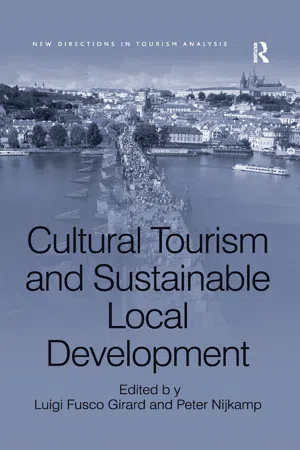
With the exponential rise in leisure mobility, tourism has increasingly become of great economic significance. Cultural heritage, such as museums, churches, historical landscapes, urban parks, and exhibitions attract many visitors and countries, regions and cities which house such historic-cultural amenities have seen increasingly large waves of tourists. While an avalanche of tourists has a positive impact on the local economy, such modern mass tourism also brings about negative externalities such as congestion, decline in quality of life, low access to cultural amenities and loss of local identity; to the extent that the sustainability conditions of a locality might be endangered. This tourism dilemma is particularly pronounced in cities with a rich cultural past, such as Venice, Naples and Amsterdam. Bringing together an interdisciplinary team of leading scholars from North America and Europe, this book examines the interface of local cultural resources and modern mass tourism from a sustainability perspective. It puts forward innovative methodologies and best case practice for future cultural conservation policies.
Information
Chapter 1
Narrow Escapes: Pathways to Sustainable Local Cultural Tourism
Luigi Fusco Girard and Peter Nijkamp
1. Aims and Scope
Our modern world is moving towards a leisure economy, where an increasing amount of everyone’s discretionary income is spent on culture, recreation and tourism. As retired people make up more and more of the population, a new leisure class – often rather wealthy and healthy – is emerging. Consequently, the economic significance of the leisure industry is gaining in importance, with tourism as one of the most popular and visible phenomena. Mass tourism – which started essentially after the Second World War when Pan American World Airways introduced tourist class on its flights – is the most pronounced exponent of the modern leisure economy, where culture, nature, shopping, or sheer entertainment form the main motives for spatial mobility to foreign destinations.
Tourism has become a global economic sector with a wide and significant impact on the socio-economic and ecological development of regions and nations. Its importance has increased over the past decades, as a consequence of the rise in spending power of increasingly mobile consumers and households, the increasing accessibility of tourist regions or cities all over the world, the emergence of relatively cheap transport modes (such as low-cost carriers), the changes in lifestyles (with more journeys over longer distances) and the trend towards internationalisation in modern societies.
Tourism is on the rise and will likely become one of the largest economic sectors in our modern open global economy. In the EU, tourism has become a key sector expanding the economic base of destination areas, stimulating foreign trade and exchange, and favouring employment in many branches of the economy. In line with the trend of an increasingly important tourist sector, cultural tourism is on the rise as well. However, to achieve a truly sustainable improvement of the opportunities offered by tourism for higher competitiveness and growth, many tourism initiatives must be fine-tuned in order to guarantee an ecologically efficient development in an age with increasing volumes of tourists.
The figures produced by the WTO (World Trade Organization) suggest a steady increase in tourist numbers all over the world. Of course, we have sometimes witnessed a temporary dip (for example, after the SARS epidemics or after September 11, 2001), but the structural trend is one of a permanent rise in tourist volumes over the past decades. Tourism has even become a source of strong competition among destination regions and has prompted many new (public and private) initiatives in order to make these regions attractive to an increasing number of visitors. In fact, tourism has become a ‘normal’ industrial sector that is critical for the economy of destination areas in order to maximise their expected revenues. As a result, modern tourist policy is based on a strategic blend of demand-side and supply-side initiatives for the development of these regions. The provision of appropriate tourist facilities (for example, clean beaches, places of historical interest, attractive museums, cultural heritage, and so on) is, of course, a major challenge to policy-making bodies, especially in the context of sustainable local development.
It is noteworthy that tourists form a rather heterogeneous class. Some want to enjoy a given city or a cultural atmosphere, others are oriented towards specific goods or cultural amenities, such as a lake, a mountain, a museum, or a historical district. Many tourist destinations offer a broad package of facilities to be visited, so that they can attract a maximum number of potential visitors from different places of origin. Other tourist destination have only one unique sales label, such as Agra with its Taj Mahal or Pisa with its leaning tower. Tourism indeed offers a challenging research domain. Tourism research is certainly proliferating, from the perspectives of both regional and sectoral research and cultural-geographical research.
This book focuses attention in particular on tourism that is (mainly) related to or attracted by the presence of cultural heritage in a tourist destination. Cultural heritage refers to historico-cultural capital regarded as an important, and visibly recognised landmark from the past and that is one of the identity factors of a tourist place. Historico-cultural capital has a few distinct characteristics which distinguish this form of capital from other types of capital, in particular, the exclusive linkage to the ‘sense of place’, the absence of a proper price formation system, the high degree of inconsistency of the capital good provided, and the occurrence of (spatial-)economic externalities in the supply of this capital good. Managing historico-cultural capital has also a clear interface with local planning, urban architecture, environmental management and transportation policy. Thus, the modern tourist sector – in relation to cultural heritage planning – offers a very interesting but complex scene where socio-cultural forces (for example, changing tastes and lifestyles) and geographical factors (for example, spatial images and perceptions, including marketing strategies) are all important components of tourism policy.
Cultural heritage – a broad container concept – has a hate-love relationship with modern tourism. It acts as an attraction force for people from different places of origin, while it stimulates local socio-economic development and reinforces a sense of local identity and pride. On the other hand, vast volumes of tourist flows may be at odds with the ecologically benign development of localities and may negatively affect social cohesion at a local level. Consequently, the issue of local sustainable development is at stake here.
This volume offers different perspectives on the role of cultural heritage as both a catalyst for and a threat to regional development. The complex relationship between sustainable development and the tourist industry calls for a thorough investigation. In this book, various conceptualisations of cultural values in local sustainable development or of different niches in the tourist sector are presented and interpreted, by considering cultural tourism as a critical success factor for local strategic planning. To this end, it is necessary to have a proper understanding of the potential of tangible and intangible cultural assets, by assessing amongst others the ecological carrying capacity or the socio-cultural attractiveness of tourist sites.
It is often – and sometimes uncritically – taken for granted that cultural tourism (that is, focused on a visit to cultural heritage in a given tourist site) is environmentally benign and hence offers a positive contribution to sustainable development of cities and regions, in contrast, for example, with beach tourism or sports tourism. Whether or not cultural tourism offers a positive or negative contribution to local sustainable development remains to be seen and cannot be answered affirmatively beforehand. Thus, the evaluation of tourist visits in relation to the historico-cultural heritage in cities calls for a solid reflection on and methodology for cultural tourism assessment at a local level from the viewpoint of both economic significance and sustainable development.
The notion of sustainable development has a history of almost two decades and has increasingly been translated into operational policy guidelines and measurable indicators at a ‘meso’ (that is, sectoral or regional) level. Examples are agricultural sustainability, urban sustainability, or transport sustainability. The tourist sector is also increasingly faced with sustainability conditions, as tourist mobility and behaviour may be at odds with ecological quality. In other words, tourism tends to use environmental commodities and amenities (such as forests, fossil fuels, water) up to a level that exceeds the environmental absorption capacity (or its regeneration capacity in the long run). An important question is of course, what is the socio-economic and ecological value of a cultural tourist area for the clients concerned (that is, the tourists) and for the local population (such as residents, businessmen, and so on).
In our volume, local cultural value – an expression of creative activities of the human mind at a certain place – is seen to be characterised by a multidimensional composite indicator (for example, economic, symbolic, artistic dimensions of historico-cultural facilities at a certain locality). Cultural values may be enriched by enhancing the quality or attractiveness of a place for visitors. This capacity to attract people and new activities not only depends on the attributes of cultural heritage itself, but also on other complementary resources, services, or material and immaterial elements. Clearly, all relevant positive and negative economic, environmental, social and cultural impacts in the short, medium and long term must be properly managed in order to identify and implement win-win projects or plans.
From this perspective, this book seeks to offer new ideas on a reorientation of traditional tourist strategies for cities with a wealth of cultural heritage. The book also provides building blocks for an operational framework for cultural policy and planning in the context of an integrated assessment of the tourist sector. Various operational methods for value assessment of cultural heritage serving to improve conservation strategies (also in the context of e-valuation or the valuation of e-tourism) are presented as well, while also the specific attributes of cultural heritage – from either a qualitative or a quantitative planning viewpoint – will be investigated. Examples are multicriteria methods as a modern decision support system in the cultural tourism sector.
This book aims to offer a novel overview of various issues involved with the evaluation of cultural tourism and sustainable development in tourist destinations. It brings together a set of original studies – of both an analytical and a policy nature – that address the tourist sector (and especially cultural tourism) from the perspective of (mainly local) sustainability objectives and strategies. In conclusion, this volume aims to offer a refreshing contribution to the analysis of cultural tourism and local resources, with a sound combination of conceptual contributions, policy analyses and case studies.
2. Organisation of the Book
Cultural Tourism and Sustainable Local Development comprises four parts: (i) Tourism Development as a Sustainable Strategy, (ii) Policies on Sustainable Tourism and Cultural Resources, (iii) Case Studies, and (iv) New Departures for Evaluation. Each of these parts contains four or five contributions highlighting the issue concerned.
Part I, ‘Tourism Development as a Sustainable Strategy’, addresses the problem of the rapid development of tourism from the need to develop sustainable strategies. In his paper, ‘Tourism, Heritage and Cultural Sustainability: Three Golden Rules’, David Throsby discusses the state of the art on conventional wisdom concerning tourism, cultural heritage and sustainability. He suggests three areas where particular emphasis is needed: the recognition of cultural value as a valid and distinguishable dimension belonging to the output of services from cultural capital assets; the need to be clear about sustainability principles and in particular the nature of sustainable development paths for local, regional, or national economies where cultural and natural capital resources are the subject of tourism demand, and the importance of rigorous analytical methods to be used for studying tourism/cultural interactions at both micro and macro levels. Observance of three ‘golden rules’ for cultural tourism (‘get the values right; get the sustainability principle right; get the analytical methods right’) will assist in the development of appropriate planning procedures for policy on tourism and cultural heritage.
Next, the nature of heritage and heritage tourism is discussed by Geoffrey Wall in ‘Tourism and Development: Towards Sustainable Outcomes’. In his contribution, the need to adopt a broad perspective on heritage tourism is stressed. It is argued that sustainable development and sustainable tourism are fuzzy concepts and that their meanings require careful examination and clarification. In his view, tourism is to be viewed as a possible means for achieving sustainable development rather than an end in itself. An enormous gap exists between academic writing on policy and planning and the practice of tourism planning as it actually exists. Several means for narrowing the gap between rhetoric and reality are suggested, including the setting of appropriate goals and objectives, the specification of a proper conceptualisation of sustainable development, the application of measurable indicators and a monitoring system, and the participation of stakeholders leading to the development and implementation of wise plans and policies that are widely endorsed.
Harry Coccossis, in ‘Sustainable Development and Tourism: Opportunities and Threats to Cultural Heritage from Tourism’, interprets tourism as a complex of economic activities, with multiple linkages to other economic activities but also with many impacts on the economy as a whole, society and the environment. In this sense, tourism is at the centre of interest in the search for sustainability and a priority field in policy making at local, regional, national and international levels. More than any other economic activity, tourism has intricate relationships to natural and cultural heritage, as it depends on the availability and quality of such resources. At the same time, tourism may lead to the degradation of those resources, ultimately eroding the potential for sustaining tourism. Clearly, the qualitative shift in demand revolutionises the very orientation and driving force of tourism supply, changing it from the provision of a basic tourist product to the selling of ‘experiences’. The richness and diversity of cultural attractions, opened to a broad range of leisure and recreation opportunities, appear to offer a real ‘experience of a place’ to the visitor.
In the final contribution of Part I, ‘Valuing Urban Cultural Heritage’, by Patrizia Riganti and Peter Nijkamp, the evaluation of cultural assets is a research activity that finds its roots in environmental evaluation. The principles of environmental evaluation can be found in the theory of hedonic prices and implicit markets advocated already decades ago. Ever since a great effort has been made to operationalise evaluation concepts and to extend the domain of valuation by developing adjusted new methods (for example, travel costs methods, and survey-based methods such as contingent valuation and conjoint methods). After significant progress in disciplines like ecological economics and environmental economics, the question arises whether the evaluation of cultural heritage has a sufficiently strong basis. Heritage valuation within this context becomes a tool to better understand the significance of heritage to different parts of society. We evaluate to understand, but also to preserve, and to manage our heritage. The ultimate aim in the context of policy analysis is to value in order to achieve the valorisation of our heritage: to add new values to the existing ones. Therefore, valuation represents a crucial step in the management of cultural heritage. Their paper discusses the meaning and nature of urban cultural heritage, and the currently available methods for its valuation in the perspective of sustainable local development. From an empirical perspective, a meta-analytical approach is proposed in cultural heritage analysis. The authors expect cultural heritage evaluation to become a promising research field in tourism economics.
In Part II, ‘Policies on Sustainable Tourism and Cultural Resources’, the first chapter is Christian Ost’s ‘Towards an Operational Framework for Policy and Planning’. Ost argues that cultural resources have been analysed and integrated in economic theories or research only recently because of the difficulties in dealing with qualitative or subjective matters. Cultural economics, which covers most analytical or empirical heritage-related works, was developed in the last quarter of the twentieth century. Nowadays, we benefit from a wide range of studies and applications related to historic preservation, seen as a typical illustration of what economic behaviour is all about. Best practice can help to resolve specific problems inherent in tourism policies. Some guidelines are also offered by the author for private–public cooperation, integrated multicriteria assessment, and financial management in conservation.
Next is Giuliana Di Fiore’s ‘Juridical and Political Tools for a Sustainable Development of Tourism’. Investigation of legal and institutional tools is required for a sustainable governance of tourism activities and calls for both a wider analysis and comparison. Administrative processes in the tourism sector are complex and often contradictory, with fragmented competences by actors involved. Different sectors and actors, including social, economic and cultural ones, should be coordinated in order to avoid an increase in environmental degradation and a loss of local identity due to global comprehensive forces.
In his paper, ‘Cultural Heritage, Sustainable Tourism and Economic Development: A Proposal for Southern Italy’, Antonio Saturnino discusses the role of tourism as a driving force for development. The example proposed is useful to show how the remarkable resources put at the disposal for the Italian Mezzogiorno by the European Union structural intervention (2000–06) – to valorise its cultural heritage in terms of economic development and employment – have not been fully utilised yet, and so can hardly produce the necessary empirical underpinning.
Finally, in Maria Giaoutzi, Christos Dionelis and Anastasia Stratigea’s chapter, ‘Sustainable Tourism, Renewable Energy and Transportation’, the energy dimension is considered to be crucial for implementing sustainable tourism strategies. The promotion of a policy framework emphasising the use of clean energy technologies, in both energy production and saving, serves the goal of sustainable tourism. This paper focuses on policy issues concerning the promotion of renewable energy sources and the rational use of energy in local tourist activities and transportation, in order to achieve sustainable energy paths in tourist destinations. In particular, the paper elaborates on the concerns that should guide future actions on sustainable policies and addresses various levels of the tourist activity chain in meeting the environmental absorption capacity.
In Part III, ‘Case Studies’, the importance of good practice is highlighted. First, Francesco Polese’s ‘Local Government and Networking Trends Supporting Sustainable Tourism: Some Empirical Evidence’ shows how network forms of an organisation may increase the attractiveness, supporting sustainable tourism in specific territorial areas. Networks may be characterised by a guiding centre (often represented by public bodies or NGOs) adequately representative for territorial subjects. Networks should, therefore, promote participatory processes, on the one hand, but provide for effective decision-making moments, on the other. Possible models and cultural approaches for the development of sustainable tourism in specific territorial areas are proposed, with some empirical evidence based on the comparison of two territorial parks.
In ‘Cultural Tourism, Sustainability and Regional Development: Experiences from Romania’, Daniela Constantin and Constantin Mitrut address the relationship between cultural tourism, sustainability and regional development from specific experience in Romania. Cultural tourism and tourism in general may offer a relevant contribution to Romania’s economic recovery and to a reduction of intra- and inter-regional disparities. After discussing the actual state and the perspectives of cultural tourism development at a national and regional level, the authors offer a series of reflections about the possibilities of enlarging the areas covered by the appropriate cultural and tourism policies with new directions of scientific research, based on advances in international knowledge and experience. A coherent ‘package’, which includes economic, legal, institutional, cultural and social elements, can help to identify a strong regional profile, stressing and taking advantage of specific features of each tourist destination area.
Next, Maria Francesca Cracolici, Miranda Cuffaro and Peter Nijkamp’s ‘Tourism Sustainability and Economic Efficiency: A Statistical Analysis of Italian Provinces’ aims to design a method for assessing tourism sustainability by using proper statistical measures of efficiency. Using a theoretical background based on the concept of the frontier production function, they explore how efficiently Italian provinces utilise their available tourist resources. They evaluate the sustainability of a tourist destination according to its economic and environmental performance. The aim of the paper is to evaluate the tourist sustainability of ninety-nine Italian provinces using the tools of Activity Analysis. They propose a measure of sustainable tourism in terms of efficiency considering the economic and environmental dimensions of the ‘production process’ of tourist destinations (that is, Italian provinces in the application). Although the main goal of the paper is to develop a measure of sustainable tourism linked to an economic index, they also make a comparison between an eco-efficiency index and a tourist-pressure index based only on ecologically inferior or ‘bad’ outputs. The results stress both the importance of inputs and the positive economic impact (that is, ‘good’ outputs) in evaluating the tourism sustainability of relevant territorial units in Italy.
In ‘Valorisation Strategies for Archaeological Sites and Settings of Environmental Value: Lessons from the Adriatic Coast’, Donatella Cialdea discusses the aim of the creation of a protocol for territorial analysis – namely the GISAE Adriatic (Geographical Information System for Activities along the Adriatic Coast). This work concentrates in particular on an analysis of several test areas on the Molise coast in Italy, the coast of the Split region and Dalmatia in Croatia and the coast of Middle Albania. The various morphological characteristics of these coastal areas and the different approaches to general and landscape planning are analysed, above all in those areas in wher...
Table of contents
- Cover Page
- Series Page
- Title Page
- Copyright Page
- Contents
- List of Figures
- List of Tables
- List of Contributors
- Preface
- 1 Narrow Escapes: Pathways to Sustainable Local Cultural Tourism
- Part I Tourism Development as a Sustainable Strategy
- Part II Policies on Sustainable Tourism and Cultural Resources
- Part III Case Studies
- Part IV New Departures for Evaluation
- Index
Trusted by 375,005 students
Access to over 1.5 million titles for a fair monthly price.
Study more efficiently using our study tools.
Frequently asked questions
Yes, you can cancel anytime from the Subscription tab in your account settings on the Perlego website. Your subscription will stay active until the end of your current billing period. Learn how to cancel your subscription
No, books cannot be downloaded as external files, such as PDFs, for use outside of Perlego. However, you can download books within the Perlego app for offline reading on mobile or tablet. Learn how to download books offline
Perlego offers two plans: Essential and Complete
- Essential is ideal for learners and professionals who enjoy exploring a wide range of subjects. Access the Essential Library with 800,000+ trusted titles and best-sellers across business, personal growth, and the humanities. Includes unlimited reading time and Standard Read Aloud voice.
- Complete: Perfect for advanced learners and researchers needing full, unrestricted access. Unlock 1.5M+ books across hundreds of subjects, including academic and specialized titles. The Complete Plan also includes advanced features like Premium Read Aloud and Research Assistant.
We are an online textbook subscription service, where you can get access to an entire online library for less than the price of a single book per month. With over 1.5 million books across 990+ topics, we’ve got you covered! Learn about our mission
Look out for the read-aloud symbol on your next book to see if you can listen to it. The read-aloud tool reads text aloud for you, highlighting the text as it is being read. You can pause it, speed it up and slow it down. Learn more about Read Aloud
Yes! You can use the Perlego app on both iOS and Android devices to read anytime, anywhere — even offline. Perfect for commutes or when you’re on the go.
Please note we cannot support devices running on iOS 13 and Android 7 or earlier. Learn more about using the app
Please note we cannot support devices running on iOS 13 and Android 7 or earlier. Learn more about using the app
Yes, you can access Cultural Tourism and Sustainable Local Development by Luigi Fusco Girard,Peter Nijkamp in PDF and/or ePUB format, as well as other popular books in Physical Sciences & Hospitality, Travel & Tourism Industry. We have over 1.5 million books available in our catalogue for you to explore.