eBook - ePub
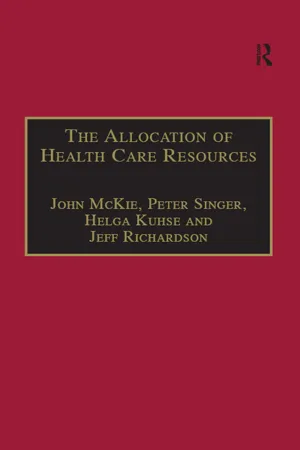
The Allocation of Health Care Resources
An Ethical Evaluation of the 'QALY' Approach
- 168 pages
- English
- ePUB (mobile friendly)
- Available on iOS & Android
eBook - ePub
The Allocation of Health Care Resources
An Ethical Evaluation of the 'QALY' Approach
About this book
The competition for limited health care resources is intensifying. We urgently need an acceptable method for deciding how they should be allocated. But the goods that health care produces are of very different kinds. Health care can extend the lives of children and of older people. It can make it possible for a person to walk, when without health care that person would be permanently bedridden; and it can reduce the pain and distress of people who are terminally ill. How can we possibly decide which of these - and many more - diverse achievements of health care are more deserving than others? We need a common unit by which we might be able to measure these very different goods. The Quality-Adjusted Life Year, or QALY, is the most developed proposal for such a unit of measure. In this book a distinguished team of ethicists and economists defend the core of the QALY proposal: that health care resources should be used so as to produce more years of life, of the highest possible quality. This leads to a discussion of such fundamental questions as whether all lives are of equal value, whether health care should be allocated on the basis of need and whether the QALY approach incorporates an adequate account of fairness or justice. The result is the most thorough account yet of the ethical issues raised by the use of the QALY as a basis for allocating health care resources.
Information
1 | Introduction |
Can we place a monetary value on a human life? Many people reject the very idea of doing so. How could we possibly arrive at any figure that would represent the value of a human life? And even if we could, would that not be a crass attempt to convert to money values something that is, quite literally, beyond any price? What would we think of a society that, after spending a certain amount in attempting to save the lives of miners trapped after an underground mishap, said that it had reached the limit of the value of the miners’ lives, and left them to die rather than spend more on rescuing them?
Yet we do live in a society that allows people to die when it costs too much to save them. It happens all the time, in areas like road safety, workplace safety, overseas aid and – the subject of this book – in health care. In every society there are limited budgets for these matters, and spending more could save more lives. In many cases we even know roughly how much it would be necessary to spend to save another life. Overseas aid undoubtedly offers the least expensive way of saving lives, since providing very basic medical care can save large numbers of lives in developing countries. The fact that we do not do this implies that we value the lives of members of our own society far more highly than we value the lives of members of other societies. Although this is a major ethical issue, it is not the one with which this volume is concerned. Henceforth we focus on decisions about the value of the lives of members of our own society, and leave problems about the international allocation of resources to one side.
Road accident statistics enable us to identify a country’s 10 most dangerous intersections. Suppose that they tell us that, if nothing is done about these intersections, 60 people will lose their lives at them over the next five years. We also know that it would cost $100 million to modify all of these intersections to bring them up to the safety standards of other, less dangerous intersections. We could then expect that, instead of 60 deaths over the next five years, there would only be 10 deaths. If we do not allocate the funds to do this, we are saying that we are not willing to spend $2 million to save a human life. We do not know, from these facts, what the implicit value of a human life in this society is, but we know that it is less than $2 million. In fact, since the modifications would presumably reduce the much larger number of non-fatal accidents as well, and we would surely be willing to spend something to do that, the implicit value of a human life in this imaginary scenario would be significantly less than $2 million. We have also taken no account of the value of the lives saved over a longer period than five years. But the details are not important here. This is an imaginary example, and the figures would vary from country to country, but it is not an unrealistic example.
In the same way, a financial limit on our efforts to save human life is present in every national health care budget. We may know that providing better screening to detect the early stages of some forms of cancer would save a specific number of lives, and yet often we do not do it because the cost is too high. This is generally also true of the amount we allocate to intensive care. Providing more intensive care beds in our major hospitals would, over a year, save some lives, but intensive care beds require a high staff/patient ratio and so cost a lot of money. The budgets that each society sets in various areas implicitly place monetary values on human lives, although it is not necessarily the same value in each area. These budgets say that it is not worth spending a larger amount, even when it is clear that, if this larger amount was spent, more lives would be saved.
Are we then in the position of the society that allows entombed miners to die because the costs of rescuing them are too high? One difference is that, in the case of the miners, we know who the victims are. We can more easily identify with them, and they will presumably have families and friends who will be distraught at their peril, and desperate for their rescue. In contrast, we do not know, when we set our road safety budget, who will be killed at dangerous intersections during the coming year (although we will be able to find out, as the year unfolds, who we might have saved). In the case of cancer screening programmes, we do not know when we make the decision who will be affected by our decision not to fund the programme, and we may never be able to find out, because some of these cancers may prove fatal no matter when they are detected.
This difference is psychologically significant. To abandon identifiable people to certain death when they could be saved appears to be a more heartless decision, and to symbolize a lack of concern for human life to a far greater degree, than a failure to reduce the road toll. On reflection, however, it is hard to place much moral weight on this psychological difference. Those killed in car crashes on dangerous intersections, and those who die from preventable cancers, will themselves be people who are no less real than the trapped miners, and their families will grieve no less for their deaths.
Still, as we have said, every society sets some limits on how much it will spend to save lives; and while we may well think that present limits are too low, it can hardly be denied that there have to be such limits. Otherwise, in the end, we would have to stop spending money on everything else we value – including education, the preservation of wilderness, and cultural pursuits – in order to increase our chances of saving one more life. Such a decision would be difficult to justify. Life is a great good, but is it the only good? Without life, we cannot experience any of those goods, such as pleasure, aesthetic appreciation or friendship, that require the existence of a subject capable of experiences. But if being honoured after one’s death is a good, then there are some goods that can accrue to people after they die, and so being alive is not a precondition of all goods. Paradoxical as the notion may seem, many people have, rightly or wrongly, chosen death before dishonour.
In any case, putting aside tricky philosophical questions about whether good things can happen to you after you die, there is a difference between preferring some other good to life itself, and rejecting all other goods in order to avoid a small risk of losing one’s life. We all do things that involve a slight but measurable risk of death in order to do other things we value. We drive to the beach, or board a plane to go to a conference, when we could be sitting safely at home. So our own behaviour strongly suggests that, while we think life is a great good, we do not think that it is the only good. We can therefore ask: how great a good is it? What should we be prepared to give up for it, and what should we not be prepared to give up?
This is the most fundamental ethical question in the debate over the allocation of health care resources. There are, however, some who think that it is a mistake to ask how much we, as a society, should spend on health care. Instead, they say that we should leave this decision to every individual member of society. Individuals can decide for themselves, they say, how much health care they wish to buy. In a free market for health care insurance (including, under this label, health maintenance schemes), providers will compete by offering various levels of service at appropriate prices. If you want to spend half your income on a blue-ribbon scheme to ensure that you receive the absolute best in health care whenever you need it, you will be able to do so. If, on the other hand, you prefer to spend most of your income on other things and take your chances with whatever kind of treatment you can afford at the time you happen to fall ill, you will be under no compulsion to buy any health insurance at all. Such an arrangement, its advocates claim, eliminates paternalistic coercion by the state, and maximizes freedom of choice.
One obvious objection to this proposal is that some people will be unable to buy an adequate level of health care insurance, no matter how high a proportion of their income they would like to put into it, simply because they earn so little that, after providing for the necessities of life, there is not enough left. Thus a free market allocation of health care resources will mean that some people die because they are unable to afford the most basic health care services, such as calling a doctor when they are seriously ill.
Some opponents of state paternalism acknowledge the injustice in the existing distribution of income. They seek to remedy this, and yet still maximize freedom of choice, by suggesting that we provide everyone with a guaranteed minimum income, leaving them free to spend it as they wish. But while this may go some way towards providing a more just distribution of income, it does not solve the problem of people dying because they cannot pay for basic health services. For among those receiving the guaranteed minimum income there would be some who would prudently set aside a proportion of it for health insurance, and others who would do no such thing. A few would even gamble it away or spend it on alcohol. Tough-minded defenders of individual choice might feel that such people should face the consequences of their choices, even if that means that they are left to die outside the doors of our hospitals. But are there any who are so hard-hearted as to believe that the children of these gamblers and alcoholics should meet the same fate?
If we, as a community, find it unacceptable to allow our fellow-citizens – and their children – to die from diseases that could easily be cured by medical treatments available at modest cost to most members of society, we cannot avoid some community involvement in health care and we must ask how much we, as a society, should spend on it.
The discussion that follows begins with the assumption that a society has allocated a certain quantity of resources to health care. In doing so, the society will have answered, whether deliberately or (more probably) haphazardly and without fully realizing what it is doing, the fundamental question of how much it is prepared to spend to save a human life. Now a further and scarcely less significant ethical question arises: given that we have a finite health care budget, how can we best spend it? This book is a contribution towards the search for an answer to this question. It does not attempt to answer it by giving concrete spending suggestions. We are not in a position to say that it is better to spend our money on, say, preventive health services rather than intensive care units. Before such specific proposals can even be discussed in a fruitful way, we need to have a clear understanding of what we mean by a ‘better’ way of spending our money. Is it, for example, better to distribute health care resources as equally as possible, so that everyone gets the same amount? Or should we seek to distribute the resources so that they will bring about the greatest benefits? The issue rapidly appears to become a choice between justice and utility. But is it really? Are justice and utility incompatible here? These are deep ethical questions, with a long history. Before we go further into them it will be helpful to distinguish between different kinds of ethical questions.
The questions we are considering are general theoretical questions about the kinds of goals we should pursue. To answer them we need to think critically about what we value most. Is the ultimate goal the welfare of all human beings, or perhaps of all sentient beings? Or are there some things, for example some forms of injustice, that are wrong in themselves, irrespective of their consequences? These are issues in what is usually known as ‘normative ethics’. But what kind of a discussion are we having, when we discuss what our goals ought to be, and whether some things are wrong irrespective of their consequences? Is there something that we are seeking to know, in much the same way as we may seek knowledge of how to live to a ripe old age? Is it possible to discover objective values, or objective rules of conduct? Or are we discussing a field in which we can only state our preferences, as we may do when discussing our gastronomic tastes, or perhaps our ranking of the paintings of one artist above those of another? These questions take us into the realm of ‘meta-ethics’, a part of the philosophical discussion of ethics that includes questions about, rather than within, normative ethics. Because much of this book is a discussion of ethical issues, it may be worthwhile at this point to say something about the nature of ethics itself.
Since ancient Greek times there have been thinkers who have denounced ethics as in some way a fraud or deception. The Greek sophist Thrasymachus, for example, is portrayed by Plato in his Republic as claiming that what we call ‘just’ simply represents the interests of the stronger: in other words, that our ideas of right and wrong are imposed on us by those with the power to do so, for their own advantage. More than two thousand years later, Karl Marx sometimes appeared to take a similar view, when he suggested that all morality is ‘class morality’ and that, in a capitalist society, the dominant moral ideas will serve the needs of the capitalist economy. Friedrich Nietzsche argued for the mirror image of Thrasymachus’s idea – namely, that ethics, or more specifically, Christian ethics, are imposed on the strong by the masses of weak people, to prevent them realizing their heroic strengths (Nietzsche, 1955). But these thinkers who protest about the allegedly fraudulent nature of particular moralities only serve to show the inescapability of morality as such, since, if there were no such thing as morality, fraud itself would be nothing to be concerned about. Nor is the condemnation of fraud the only moral view that such thinkers hold, explicitly or implicitly. No one who has read the chapter of Capital in which Marx describes the sweatshops of 19th-century England can mistake his powerful sense of moral outrage at a system that builds the wealth of the few on the misery of so many.
If we cannot, without self-contradiction, denounce morality as a fraud, can we say that it is nevertheless entirely a matter of subjective judgment, and therefore nothing that we can argue about? This is also a view with a long history. Early subjectivists believed that to say an action is right is merely to say that one has a positive feeling towards it, whereas to say that an action is wrong is to say that one has a negative feeling about it. But this view was liable to a fatal objection: it implies that, when A says that an action is wrong, and B says that the same action is right, they are not really disagreeing. For each is simply describing his or her attitude, and it is clearly true that they have different attitudes. The situation should be similar to A saying ‘Coffee keeps me awake at night’ and B saying ‘I fall asleep as soon as my head hits the pillow, no matter how much coffee I drink.’ The expression of contrary moral judgments, however, is not simply a matter of two compatible descriptions; it is a disagreement, often the most serious kind of disagreement that there can be, and any analysis of the nature of moral judgment must be able to account for this fact.
In the mid-20th century, a more sophisticated form of subjectivism, known as emotivism, was formulated. It avoided the objection just discussed by denying that moral judgments describe anything at all. Instead, the emotivists said, they are used to express emotions or attitudes. On this view, to say ‘euthanasia is wrong’ does not state any facts about euthanasia, not even the fact that the speaker has a negative attitude to euthanasia. It is, crudely put, rather as if one had said: ‘Euthanasia, Boo!’ Conversely, those who say that euthanasia is justifiable are saying ‘Euthanasia, Hurrah!’. On this account it is easier to understand why people on different sides of a moral issue should feel that they are in disagreement with each other, for that is certainly how the rival groups of supporters feel at a football match as they barrack each other’s teams. But while the problem of explaining why there is disagreement in ethics may thus be solved by emotivism, there is still something unsatisfactory about this analysis. Football supporters generally do not try to convince supporters of other teams that they should switch their allegiances. They may explain why they support the team they follow – for example, by saying that they grew up near its home ground, or their Dad always followed it – but they do not pretend that these are reasons for everyone to follow that team. Moral disagreement therefore remains different from the disagreement between the supporters of rival football teams, and the difference lies in the nature of the reasons that we use, or try to use, to defend our moral views. They are reasons that, we feel, should be persuasive to everyone.
Before we explore the implications of this account of the role that reason plays in moral dispute, there is one other popular view of the nature of ethics that needs to be mentioned. Many people reject subjectivism on the grounds that it is not individual attitudes that determine what is right or wrong, but the attitudes of the culture in which we live. In the 19th century, anthropologists came to know many different cultures, and found that the people of those cultures had ethical views very different from those that were standardly taken for granted in European society. This led some anthropologists and others to hold that, since morality is relative to culture, no culture can have any basis for regarding its morality as superior to any other culture. Although this view may seem like a much-needed weapon against western cultural imperialism, it has implications that few would want to embrace. Again, some of these implications relate to the nature of moral disagreement. Relativism is like subjectivism writ large. For a relativist, when people from two different cultures appear to disagree about an ethical issue, they are really each just reporting the views of their own culture. Hence, if these cultures do in fact have different views on the issue, there is really no disagreement, there can be no resolution, and it is impossible to say that one is right and the other is wrong. Bearing in mind that some cultures have practised slavery, or the burning of widows on the funeral pyre of their husbands, this is hard to accept.
A more promising alternative to all of the meta-ethical views mentioned so far is universal prescriptivism, an approach to ethics developed by the Oxford philosopher R.M. Hare (1963; 1981). Hare shares with the emotivists the premise that ethical judgments do not state facts and hence are not true or false in the ordinary sense that descriptive statements may be true or false in virtue of the accuracy of their descriptions. Instead, he classifies ethical judgments as a form of imperative or, more specifically, as prescriptions. Ethical judgments prescribe conduct. But Hare parts company with emotivists in the role he allows for reasoning in ethics. This role is made possible by the claim that ethical judgments form a special family of prescriptions, namely universal prescriptions. It is important to be clear about exactly what this means. It does not mean that ethical judgments are exceptionless moral rules, such as ‘Never tell a lie’. On the contrary, on Hare’s view, ethical judgments can be very specifically tailored to particular circumstances. But ethical judgments are, Hare claims, universalizable in the sense that, if I make an ethical judgment, I must be prepared to state it in universal terms and apply it to all relevantly similar situations. The requirement that the judgment be stated in ‘universal terms’ means that it must be possible to formulate it in a way that avoids such things as proper names or personal pronouns. A judgment that tax avoidance is wrong unless I am the one who avoids paying tax is not a universalizable judgment, although a judgment that tax avoidance is wrong unless the tax avoided is used to save the lives of people dying from hunger would be. A universalizable judgment cannot be based on the role that I play – or, in particular, whether I benefit or lose by the action that is being judged.
The universal aspect of ethical judgments forms a bridge between meta-ethical analysis of the meanings of moral terms and normative moral argument. Given that ethical judgments must be universalizable, whenever I purport to make an ethical judgment I can be challenged to put myself in the position of the parties affected and see if I would still be able to accept that judgment. Suppose, for example, that I own a small factory and the cheapest way for me to get rid of some waste is to pour it into a nearby river. I do not take water from this river, but I know that some villagers living downstream do and the waste may make them ill. The requirement that ethical judgments should be universalizable will make it impossible for me to justify my conduct because, if I were to put myself in the position of the villagers, I would not accept that the profits of the factory owner should outweigh the risk of adverse effects on my health and that of my children. In this way universalizability provides a basis for an element of reasoning in ethical deliberation. It also requires us to take into account the interests and preferences of others affected by our actions. Since the rightness or wrongness of our actions will, on this view, depend on the way in which they affect others, Hare’s universal prescriptivism leads to a form of consequentialism; that is, the view that the rightness of an action depends on its consequences.
An influential contemporary rival to Hare’s approach to ethics is that taken by John Rawls, a professor of philosophy at Harvard University, in his book, A Theory of Justice (1971). It is known as ‘reflective equilibrium’. Instead of searching for a single foundation on which a theory of ethics can be built, Rawls says that ethical theory ...
Table of contents
- Cover
- Half Title
- Title Page
- Copyright Page
- Table of Contents
- List of Tables and Figures
- Acknowledgments
- 1 Introduction
- 2 The Background to the QALY
- 3 Age Discrimination
- 4 Quality of Life
- 5 Double Jeopardy
- 6 Public Opinion
- 7 Conclusion
- Bibliography
- Index
Trusted by 375,005 students
Access to over 1.5 million titles for a fair monthly price.
Study more efficiently using our study tools.
Frequently asked questions
Yes, you can cancel anytime from the Subscription tab in your account settings on the Perlego website. Your subscription will stay active until the end of your current billing period. Learn how to cancel your subscription
No, books cannot be downloaded as external files, such as PDFs, for use outside of Perlego. However, you can download books within the Perlego app for offline reading on mobile or tablet. Learn how to download books offline
Perlego offers two plans: Essential and Complete
- Essential is ideal for learners and professionals who enjoy exploring a wide range of subjects. Access the Essential Library with 800,000+ trusted titles and best-sellers across business, personal growth, and the humanities. Includes unlimited reading time and Standard Read Aloud voice.
- Complete: Perfect for advanced learners and researchers needing full, unrestricted access. Unlock 1.5M+ books across hundreds of subjects, including academic and specialized titles. The Complete Plan also includes advanced features like Premium Read Aloud and Research Assistant.
We are an online textbook subscription service, where you can get access to an entire online library for less than the price of a single book per month. With over 1.5 million books across 990+ topics, we’ve got you covered! Learn about our mission
Look out for the read-aloud symbol on your next book to see if you can listen to it. The read-aloud tool reads text aloud for you, highlighting the text as it is being read. You can pause it, speed it up and slow it down. Learn more about Read Aloud
Yes! You can use the Perlego app on both iOS and Android devices to read anytime, anywhere — even offline. Perfect for commutes or when you’re on the go.
Please note we cannot support devices running on iOS 13 and Android 7 or earlier. Learn more about using the app
Please note we cannot support devices running on iOS 13 and Android 7 or earlier. Learn more about using the app
Yes, you can access The Allocation of Health Care Resources by John McKie,Peter Singer,Jeff Richardson in PDF and/or ePUB format, as well as other popular books in Negocios y empresa & Seguros. We have over 1.5 million books available in our catalogue for you to explore.