Medicine and Humanism in Late Medieval Italy
eBook - ePub

Medicine and Humanism in Late Medieval Italy

The Carrara Herbal in Padua

  1. 244 pages
  2. English
  3. ePUB (mobile friendly)
  4. Available on iOS & Android
eBook - ePub

Medicine and Humanism in Late Medieval Italy

The Carrara Herbal in Padua

About this book

This book is the first study to consider the extraordinary manuscript now known as the Carrara Herbal (British Library, Egerton 2020) within the complex network of medical, artistic and intellectual traditions from which it emerged. The manuscript contains an illustrated, vernacular copy of the thirteenth-century pharmacopeia by Ibn Sar?b?, an Arabic-speaking Christian physician working in al-Andalus known in the West as Serapion the Younger. By 1290, Serapion's treatise was available in Latin translation and circulated widely in medical schools across the Italian peninsula.

Commissioned in the late fourteenth century by the prince of Padua, Francesco II 'il Novello' da Carrara (r. 1390–1405), the Carrara Herbal attests to the growing presence of Arabic medicine both inside and outside of the University. Its contents speak to the Carrara family's historic role as patrons and protectors of the Studium, yet its form – a luxury book in Paduan dialect adorned with family heraldry and stylistically diverse representations of plants – locates it in court culture. In particular, the manuscript's form connects Serapion's treatise to patterns of book collection and rhetorics of self-making encouraged by humanists and practiced by Francesco's ancestors.

Beginning with Petrarch (1304–74) and continuing with Pier Paolo Vergerio (ca. 1369–1444), humanists held privileged positions in the Carrara court, and humanist culture vied with the University's successes for leading roles in Carrara self-promotion. With the other illustrated books in the prince's collection, the Herbal negotiated these traditional arenas of family patronage and brought them into confluence, promoting Francesco as an ideal 'physician prince' capable of ensuring the moral and physical health of Padua. Considered in this way, the Carrara Herbal is the product of an intersection between the Pan-Mediterranean transmission of medical knowledge and the rise of humanism in the Italian courts, an intersection typically attributed to the later Renaissance.

Frequently asked questions

Yes, you can cancel anytime from the Subscription tab in your account settings on the Perlego website. Your subscription will stay active until the end of your current billing period. Learn how to cancel your subscription.
No, books cannot be downloaded as external files, such as PDFs, for use outside of Perlego. However, you can download books within the Perlego app for offline reading on mobile or tablet. Learn more here.
Perlego offers two plans: Essential and Complete
  • Essential is ideal for learners and professionals who enjoy exploring a wide range of subjects. Access the Essential Library with 800,000+ trusted titles and best-sellers across business, personal growth, and the humanities. Includes unlimited reading time and Standard Read Aloud voice.
  • Complete: Perfect for advanced learners and researchers needing full, unrestricted access. Unlock 1.4M+ books across hundreds of subjects, including academic and specialized titles. The Complete Plan also includes advanced features like Premium Read Aloud and Research Assistant.
Both plans are available with monthly, semester, or annual billing cycles.
We are an online textbook subscription service, where you can get access to an entire online library for less than the price of a single book per month. With over 1 million books across 1000+ topics, we’ve got you covered! Learn more here.
Look out for the read-aloud symbol on your next book to see if you can listen to it. The read-aloud tool reads text aloud for you, highlighting the text as it is being read. You can pause it, speed it up and slow it down. Learn more here.
Yes! You can use the Perlego app on both iOS or Android devices to read anytime, anywhere — even offline. Perfect for commutes or when you’re on the go.
Please note we cannot support devices running on iOS 13 and Android 7 or earlier. Learn more about using the app.
Yes, you can access Medicine and Humanism in Late Medieval Italy by Sarah R. Kyle in PDF and/or ePUB format, as well as other popular books in History & World History. We have over one million books available in our catalogue for you to explore.

Information

Publisher
Routledge
Year
2016
Print ISBN
9780367879846
eBook ISBN
9781351997782
Edition
1
Topic
History
Index
History

1
The Carrara Herbal and the traditions of illustrated books of materia medica

When Francesco Novello commissioned the Carrara Herbal in the 1390s, he commissioned a book that participated in two distinct traditions. On the one hand, the book participates in the long history of collection and production of illustrated books of materia medica. This history is separate from – yet runs parallel to – the history of collection and production of their unillustrated counterparts. On the other hand, the illustrations in the Carrara Herbal, while they reflect the composite nature of Serapion’s treatise, also reflect the complex heterogeneous illustrative sets visible across the genre’s history. Illustrated books of materia medica appealed to diverse readers, and neither their readership nor their illustrative traditions were static.
Physicians and pharmacists acquired and studied illustrated books of materia medica, and in this context the books’ illustrations were not necessarily used for identification of plants in the field or even as part of medical pedagogy.1 Rather, at different times in their history, such books served other purposes for these readers, perhaps as indices for finding therapeutic information, as mnemonic devices to assist in study, as methods of communicating medical knowledge irrespective of linguistic barriers or as ways to mitigate the risk of dangerous translation errors.2 Paralleling these aspects of their collection, however, illustrated books of materia medica also appealed to wealthy collectors, often those with political authority and without much knowledge of medicine and its practice.3 Among other purposes, such collectors used these books – together with other, complementary aspects of their patronage – to advance a certain vision of their identities, histories and cultural heritage. Generally, but not always, the quality of the manuscripts and their illustrations distinguish the commissions of powerful and wealthy patrons from their more practical or academic counterparts.
The Carrara Herbal brings together elements not only from the genre’s diverse illustrative traditions but also from its diverse history of collection – a remarkable and new role for an illustrated book of materia medica. It connects to the collection and use of this type of book both by the medical community and by erudite collectors with a specific image to construct or uphold. The illustrative apparatus and content of the Carrara Herbal – with its ties to advances in medicine and curricula at the university – locate Francesco as a patron and reader with one foot in the medical community and the other in the political one.
To establish the place of the Carrara Herbal within particular pictorial and textual traditions, I begin this chapter by describing its variety of imagery. Then, to understand its possible personal and political functions, I examine select examples of illustrated books of materia medica from across the genre’s history that show the wide variety of uses, illustrative sets and collection-histories of these books. In particular, I consider the book given to Anicia Juliana (ca. 462–528), daughter of Byzantine Emperor Flavius Anicius Olybrius (d. ca. 472), as an example of how illustrated books of materia medica may have been amalgamated into strategies of self-representation through contact with different visual rhetorics associated with the owner’s other forms of patronage.
Turning to the Arabic tradition, I consider illustrated copies of Dioscorides’ De materia medica (On Therapeutic Substance) specifically produced for prominent physicians or high-ranking members of the courts at Baghdad and Cordova as examples of how these books could serve both professional and political purposes, which were not necessarily mutually exclusive. Lastly, turning to the Latin and vernacular traditions, I consider the illustrated books of materia medica produced for Holy Roman Emperor Frederick II Hohenstaufen (1194–1250) and those produced for patrons of more regional significance – the physician Manfred de Monte Imperiale (fl. ca. 1330–1340), the signore of Milan, Giangaleazzo Visconti (1351–1402), and perhaps Francesco Novello’s father as well.4 These examples further illuminate the hermeneutical flexibility of the genre and point to its varied uses across social and political lines.

Botanical illustration in the Carrara Herbal

In the Carrara Herbal, many of the plant images are remarkable for their precise attention to the defining visual characteristics of a particular species, not a generic example of it, a characteristic that is unique in fourteenth-century herbal manuscript illumination in the West. Yet many also retain elements of older illustrative traditions in which artists portrayed the plants as schemata, rather than as specific, individual specimens. These illustrations tend to depict the general shape of the plant and its significant parts but avoid the more precise details that convey a sense of illusionistic realness and individuality.5 Furthermore, the artist hybridised aspects of these techniques, creating a completely new type of plant representation. Regardless of the style of their execution, however, the illustrations engage with the pages’ surface area and its text in a variety of ways, all of which arrest the readers’ progress through the text and steal their attention away from Serapion’s words.6
The artist’s representations of malbavisco (Althaea officinalis L. and Lavatera thuringiaca L., genera of marshmallow, f. 52v, Figure 1.1) are characteristic of a
Figure 1.1 Malbavisco (Althaea officinalis L. and Lavatera thuringiaca L., genera of marshmallow)
Carrara Herbal
London, British Library, Egerton 2020, f. 52v
35 Ɨ 24 cm, gouache on vellum, Padua, ca. 1390–1400
Ā© British Library Board, Egerton 2020
style in which observation of single plant specimens played a large role.7 With the goal to create the effect of seeing a particular species of plant, the artist recorded specific identifying details (such as the plant’s fruit and its structure of growth) using techniques of pictorial illusionism like tonal variation, overlapping and chiaroscuro (the variation of light and shadow used by an artist to indicate depth). In the malbavisco representation at the right of the folio (Lavatera thuringiaca L.), for instance, the artist showed the funnel-shaped profile of the plant’s flower and depicted the characteristic three to five sepals that frame the bottom of the petals. He showed the alternate pattern of leaf growth and depicted the underside of one of the leaves to reveal its prominent white veining. The artist also rendered the plant’s distinct pumpkin-shaped fruits three-dimensionally. He portrayed them both frontally and in profile so that the viewer may observe how the bracts characteristically curl over the fruit.8 Since the plant usually completes flowering and goes to seed in October, the artist likely observed and recorded it in late summer or early fall. The second type of malbavisco (Althaea officinalis L.), portrayed on the left side of the folio, shows a similar attention to detail, allowing the viewer to see the similarities and differences between the two genera of marshmallow.
The image of meliloto (Lotus corniculatus L., bird’s foot trefoil, f. 15r, Plate 2) shows a more playful use of pictorial illusionism. Rather than illustrating the three-dimensional aspects of a living plant, as he did in the malbavisco representations, the artist showed the meliloto as a specimen pressed into this very book for preservation and study.9 In his illustration, the artist pushed the plant toward the interior margin, leaving much of the vellum page exposed. This compositional gesture alerts the viewer to the strange positioning of the plant and its parts. The secondary stem, furthest to the left, bends awkwardly back in on itself, and the flowers that branch from the main stem appear squeezed against the page, their petals sandwiched together in a disorderly fashion, their peduncles (which link the flowers to the stem) bent dramatically.10
Although constructing the general illusion of a pressed specimen, the artist continued to articulate the principal identifying characteristics of the plant. He chose a composition that revealed the plant’s underlying structure, showing its alternate arrangement of sessile leaves (which emerge directly from the stem), its flowers and its fruit (the long, disorderly, ā€˜bird’s foot-like’ seedpods) isolated against the blank expanse of the page. The artist tinged the withering, yellow flowers – which resemble sweet peas (Lathyrus odoratus L.) – with a deep red, suggesting the plant’s age.11 Through his technical and compositional choices, the artist added a new dimension of visual play to his representation, a dimension that through its very playfulness draws the viewers’ attention back to the role of the image in this particular book and to their role as readers.
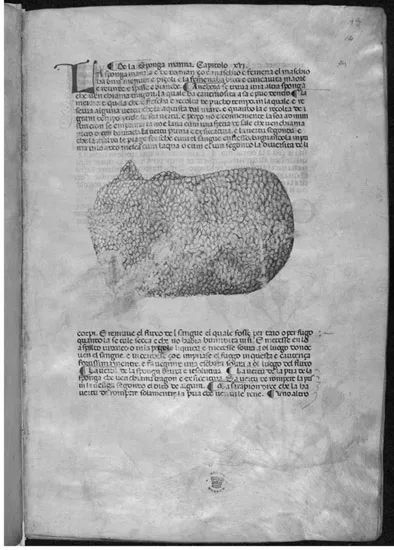
In another type of image, the artist did not use verisimilar techniques. Instead, he used schematic ones. For instance, he depicted the sponga marina (Euspongia officinalis L., marine sponge, f. 14r, Figure 1.2), which Serapion included among plant materia medica, as a distinctly two-dimensional, asymmetrical ovoid mass covered with many small, pointed scales.12 Without the modelling and shading of the more realistic plant images, the marine sponge appears flat on the page. The uniform ivory-grey
Figure 1.2 Sponga marina (Euspongia officinalis L., marine sponge)
Carrara Herbal
London, British Library, Egerton 2020, f. 14r
35 Ɨ 24 cm, gouache on vellum, Padua, ca. 1390–1400
Ā© British Library Board, Egerton 2020
colouration discourages the perception of depth or texture. For the sponga illustration, the artist used a different visual language than he used for the malbavisco and meliloto representations. Instead of incorporating details drawn from observation of the plant in nature, the artist incorporated details drawn from older traditions of herbal illustration.
In his final type of plant imagery, the artist amalgamated techniques from the other types of illustration within the Herbal to create hybrids. In these representations, the artist blended details derived from historical models with details derived from observation. In his illustration of pino (Pinus pinea L., Italian stone pine tree, f. 41r, Figure 1.3), for example, the artist presented his viewer with an aggregate of traditional and new representational types.13 To depict the entire tree on a single page, the artist adapted the tree’s overall proportions. The body of the tree itself is diminutive, while its fruits and leaves are magnified.14 The darker green background of the canopy conveys the treetop’s common bulbous shape, as though seen from a distance. Simultaneously, the artist em...
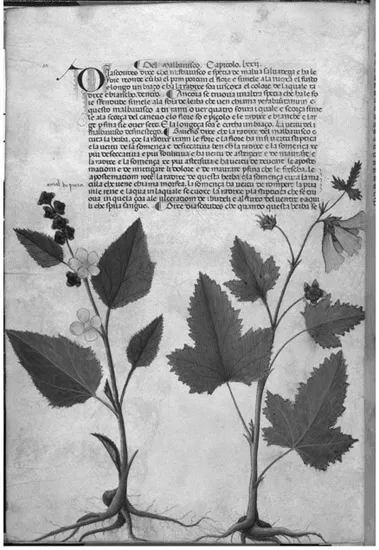
Table of contents

  1. Cover
  2. Title
  3. Copyright
  4. Dedication
  5. Contents
  6. List of illustrations
  7. Acknowledgements
  8. Introduction: Medicine and metaphor at the Carrara court
  9. 1 The Carrara Herbal and the traditions of illustrated books of materia medica
  10. 2 The healthy pleasures of reading the Carrara Herbal
  11. 3 The ā€˜physician prince’ and his book
  12. 4 Portraits of the Carrara
  13. 5 Physiognomy in late medieval Padua
  14. 6 Embodiments of virtue in Francesco Novello’s library
  15. Conclusion
  16. Appendix
  17. Bibliography
  18. Index
  19. Plates