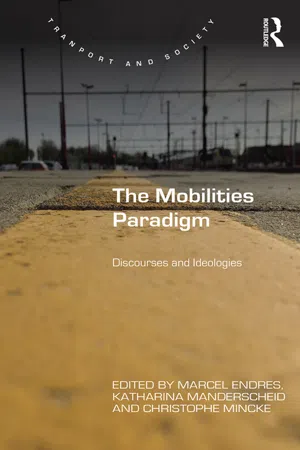
eBook - ePub
The Mobilities Paradigm
Discourses and Ideologies
- 248 pages
- English
- ePUB (mobile friendly)
- Available on iOS & Android
eBook - ePub
The Mobilities Paradigm
Discourses and Ideologies
About this book
Over the last two decades, the conceptualisation and empirical analysis of mobilities of people, objects and symbols has become an important strand of social science. Yet, the increasing importance of mobilities in all parts of the social does not only happen as observable practices in the material world but also takes place against the background of changing discourses, scientific theories and conceptualisations and knowledge. Within the formation of these mobilities discourses, the social sciences constitute a relevant actor. Focussing on mobility as an object of knowledge from a Foucauldian perspective rather than a given entity within the historical contingency of movement, this book asks: How do discourses and ideologies structure the normative substance, social meanings, and the lived reality of mobilities? What are the real world effects of/on the will and the ability to be mobile? And, how do these lived realities, in turn, invigorate or interfere with certain discourses and ideologies of mobility?
Information
Part I Mobility and normativity
1 From mobility to its ideology When mobility becomes an imperative
DOI: 10.4324/9781315555515-1
The springboard for this work was the observation, often repeated, that a ‘mobility turn’ has placed mobility at the heart of our social practices, both concretely and in discourses (Sheller and Urry 2006). We are said to be on the verge of a transition towards new relationships with mobility, expressed by geographic mobility behaviours as yet unseen, but also by the evolution of our collective relation with mobility. Indeed, the social constructions of what mobility is – of the meaning it should hold and the value it confers on mobile entities – is undergoing considerable evolution.
Nonetheless, we should not lose sight of the central concept – mobility itself – if we are to attempt to understand, on the one hand, the phenomena it embodies and, on the other, what it says about the way we relate to the world. This is our first question in this chapter.
Furthermore, the articulation between description and prescription – what is and what should be – must be examined more closely. The accent is most often placed on changes in practices and less frequently on the social representations linked to mobility. Yet the social normativities that emerge from this new relationship with mobility need to be studied. Although it is true that we are developing new representations, what are their effects on social prescriptions? In short, what social norms are linked to mobility’s central role in the way we relate to the world? This will be the second focus of our discussion.
In this chapter, the distinction between description and prescription will be crucial. On the one hand, description is an attempt to produce a discourse that can tell what reality is. Description, of course, is a social construction: a collectively created discourse that is collectively thought to be a ‘true’ description of reality. Description is, thus, about social representations (Berger and Luckmann 2006). On the other hand, prescription is about telling what must be. A prescription is an imperative, telling how reality should be considered and how one should act in relation to it. A coherent set of prescriptions constitutes an ideology: a system of prescriptions, related to practices, founded on an enforced ‘truth’ and exclusive from other systems. Description and prescription need to be conceptually distinguished, even if they are not independent one from the other.1 A specific description of reality limits the scope of possible prescription. In the same way, particular prescriptions need specific descriptions of reality to be sustainable. For instance, if you describe the world as fundamentally mobile, immobility will be a non-natural pattern. Immobility could then be prescribed as a way for mankind to abstract from nature or proscribed as a counterproductive behaviour in a mobile context.
The work we propose here is part of a theoretical reflection that aims to distinguish the general issue of mobility from the more limited context of studying physical movements. More precisely, this involves giving serious consideration to the hypothesis of mobility as a representational and ideological paradigm that is capable of shedding new light on several aspects of our society, in particular the significant mutations we are presently undergoing.
Such an endeavour obviously implies taking the risk of advancing a particular theoretical elaboration. The reader can already note that our work refers to hypotheses that cannot demonstrate their fecundity until they are confronted in the field by empirical studies that are much broader than those undertaken up to now. This is what we are already endeavouring through studies of contemporary discourses on the prison system (Mincke 2010, 2012a, 2012b; Mincke and Lemonne 2013a, 2013b), on (justice) management (Mincke 2013) and on alternative dispute resolutions (Mincke 2014a).
The approach we have chosen is based on a study of social representations and the discourses and practices that illustrate them. It is thus less a question of reporting on concrete mobility practices than it is to analyse the representational relation to mobility, in other words, how it is socially constructed not only as an object (Frello 2008) but also as a collective value, conveying ideological developments. Our central question will thus be that of the universe of meaning linked to mobility.
We shall confront our theoretical construction of the discursive use of mobility to a special field: the legitimisation of the prison in the parliamentary documents of the Belgian Prison Act of 2005. Our hypothesis is that, if mobility is such a value in itself, it can be successfully used to legitimise an institution that once was the symbol of immobilisation; it indicates the current thrust of these ideas.
An approach that is both inductive and deductive
The theoretical construction that we will present follows the example of Boltanski and Chiapello, who theorised on the basis of a corpus of observation of (managerial) discourses (Boltanski and Chiapello 1999). It has been built by induction derived from the observation of a wide range of discourses and practices. It is thus an attempt to rationalise, in a coherent model, a series of features we could trace through various texts and contexts.
We then apply our model deductively to analyse new objects. Although each confrontation with the empiric challenge risks breaking the model, it also works to improve it, especially by refining our understanding of its limits. For as crucial as it is to understand what a model can explain, we learn more when it fails. Thus, in the same process, we induced a model from a large set of observations and then deduced from our model an analysis of specific objects, in particular contemporary discourses on prisons (Mincke and Lemonne 2014).
More specifically, we undertook the study of a discourse that was ‘serious’ in the Foucauldian sense of the term. Our tool was the preparatory work leading to the recent (Belgian) law of 12 January 2005 on principles governing the administration of prison establishments and the legal position of detainees, the so-called Prison Act. One particular text was the report of a study commission of experts to prepare draft legislation. Our aim when we studied these works was to discover the characteristics of this contemporary discourse justifying prisons and, more specifically, those aspects relating to the notion of mobility.
The fact that prisons are a priori the epitome of an immobilising institution clearly entered into our choice of subject. Our initial idea was that if we could even find a usage we call mobilitarian ideology in justifications for incarceration, then we could reasonably conclude that it was a particularly powerful notion.
Mobility, space, time
The simplest definition of mobility is a movement in space over time.2 It will thus be no surprise when we affirm that mobility is intrinsically linked to these two dimensions and that, even more, the mutations that affect the space–time relation would result in corresponding changes in the relation to mobility. And vice versa. Mobility, space and time are thus interdependent notions, and we must think of all three together.
A further point is that, rather than space and time, we will concern ourselves more with space–time. For as we shall see, space and time, as social constructs, are intrinsically linked in particular morphologies. All notions of space do not fit well with all notions of time and vice versa. Corresponding forms of time and space are thus associated in what, together with Bertrand Montulet, we call morphologies (Montulet 1998).
We still need to define the space that will interest us (we’ll come back to time a bit later). To do so, we will start with something self-evident: sociologists are interested in space and time not as objective dimensions – we are not physicists3 – but as social constructions (Mincke 2014b). In all logic, we are looking at the way, in today’s world, our societies construct time and space.
Our understanding of space will be based on a sociology approach, in other words one that considers space as a dimension that structures realities.4 In this perspective, spatiality is the result of a spatialising process. Regardless of the reality to which this spatialisation applies, it leads to spaces being created. Nothing forces sociologists to restrict their understanding to processes that only spatialise physical realities.
This is why we see as spaces all the results of social spatialisation processes, whether they apply to material reality or not. As sociologists, we do not consider space to be a dimension solely of the physical world. Social, conceptual, religious, family and relational spaces are, in our minds, just as much spaces as their geographical counterpart. They are not metaphors but the product of a bona fide process of spatialisation.5
Sociology is familiar with the notion of non-physical space and has used it for years to describe a number of phenomena. Social space (and the related social mobility), field (Bourdieu), uncertainty zone (Crozier) and experience framework (Goffman) are notions that clearly imply a spatialisation. Our proposal thus seems to be directly in line with a long tradition in sociology.
In a very classical way, we shall also consider time as a social construction and not as an objective measure of the fourth dimension in which objects develop their interactions.
It follows that, for the sociologist, mobility concerns more than mere physical spaces and objective time. In the following pages, we will thus often refer to the notions of space and mobility and apply them to non-physical realities. We will defend the idea that our contemporary situation can be explained by a tip of the balance between two spatial–temporal morphologies (the limit-form and the flow-form), which has modified our social representations of space–time and thus influenced our conceptions of mobility.
Limit-form
The limit-form is grounded in a representation of space as an indistinct stretch that is structured by its circumscription (Montulet 1998). The borders traced are what make it possible to define an inside and an outside and thereby order the space. Borders are determined by applying a distinguishing criterion that renders uniform what it encloses and distinguishes it from what is stranger to the circumscription thus constituted. A border is obviously not easy to cross and, with a few exceptions, must remain closed.6 Everything inside state borders thus equally belongs to the national territory. The border itself is one-dimensional and has no ‘thickness’, like a razor’s edge. On the other side is the stranger, uniformly foreign. Multiple circumscriptions can, of course, exist side by side, structuring the space ‘horizontally’ in a collection of territories at the same hierarchical level, for example other nation states. Each circumscription in turn can be divided into lower-level circumscriptions. Provinces, regions, départements, towns are territories that fit into other territories, producing a vertical structuring of sorts broken into different hierarchical levels. The nation states of the late 19th century, in their interrelations and internal structures, are perfect examples of how space is structured in a limit-form. The interplay of physical borders just described corresponds, trait by trait, with other non-physical borders: the national territory reflects the delimitation of a national community formed by the inclusion of some members in the state’s political community, by the attribution of certain rights and obligations (military service, diplomatic protection, tax obligations, etc.) or by the inclusion in a collective national narrative. Likewise, the structuring of a national territory corresponds to an equivalent legal spatialisation that delimits the competences of various authorities through ratione loci (i.e. depending on administrative circumscriptions, legal districts, etc.) but also through ratione materiae (in reference to specific jurisdictions: federal, regional, provincial or local, the attributes of various districts, and so on).
Nonetheless, the border – the key element of this spatial–temporal morphology – can be fathomed only in a context of relative stability allowing it to continue over time. This corresponds to a particular construction of time in a cadence of stases and ruptures. Time is socially constructed through a strict periodisation: periods are clearly distinct and follow from one to...
Table of contents
- Cover Page
- Half Title Page
- Title Page
- Copyright Page
- Dedication
- Contents
- Notes on contributors
- Discourses and ideologies of mobility An introduction
- PART I Mobility and normativity
- PART II Mobile subjects
- PART III Mobilised infrastructures
- Index
Trusted by 375,005 students
Access to over 1.5 million titles for a fair monthly price.
Study more efficiently using our study tools.
Frequently asked questions
Yes, you can cancel anytime from the Subscription tab in your account settings on the Perlego website. Your subscription will stay active until the end of your current billing period. Learn how to cancel your subscription
No, books cannot be downloaded as external files, such as PDFs, for use outside of Perlego. However, you can download books within the Perlego app for offline reading on mobile or tablet. Learn how to download books offline
Perlego offers two plans: Essential and Complete
- Essential is ideal for learners and professionals who enjoy exploring a wide range of subjects. Access the Essential Library with 800,000+ trusted titles and best-sellers across business, personal growth, and the humanities. Includes unlimited reading time and Standard Read Aloud voice.
- Complete: Perfect for advanced learners and researchers needing full, unrestricted access. Unlock 1.5M+ books across hundreds of subjects, including academic and specialized titles. The Complete Plan also includes advanced features like Premium Read Aloud and Research Assistant.
We are an online textbook subscription service, where you can get access to an entire online library for less than the price of a single book per month. With over 1.5 million books across 990+ topics, we’ve got you covered! Learn about our mission
Look out for the read-aloud symbol on your next book to see if you can listen to it. The read-aloud tool reads text aloud for you, highlighting the text as it is being read. You can pause it, speed it up and slow it down. Learn more about Read Aloud
Yes! You can use the Perlego app on both iOS and Android devices to read anytime, anywhere — even offline. Perfect for commutes or when you’re on the go.
Please note we cannot support devices running on iOS 13 and Android 7 or earlier. Learn more about using the app
Please note we cannot support devices running on iOS 13 and Android 7 or earlier. Learn more about using the app
Yes, you can access The Mobilities Paradigm by Marcel Endres, Katharina Manderscheid, Christophe Mincke, Marcel Endres,Katharina Manderscheid,Christophe Mincke in PDF and/or ePUB format, as well as other popular books in Politics & International Relations & Globalisation. We have over 1.5 million books available in our catalogue for you to explore.