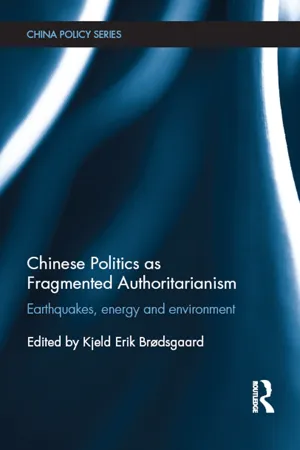
This book explores how far the concept of fragmented authoritarianism remains valid as the key concept for understanding how the Chinese political process works. It contrasts fragmented authoritarianism, which places bureaucratic bargaining at the centre of policy-making, arguing that the goals and interests of the implementing agencies have to be incorporated into a policy if implementation is to be secured, with other characterisations of China's political process. Individual chapters consider fragmented authoritarianism at work in a range of key policy areas, including energy issues, climate change and environmental management, financial reform, and civil-military relations. The book also explores policy making at the national, provincial, city and local levels; debates how far the model of fragmented authoritarianism is valid in its current form or whether modifications are needed; and discusses whether the system of policy making and implementation is overcomplicated, unwieldy and ineffective or whether it is constructive in enabling widespread consultation and scope for imagination, flexibility and variation.
eBook - ePub
Chinese Politics as Fragmented Authoritarianism
Earthquakes, Energy and Environment
- 228 pages
- English
- ePUB (mobile friendly)
- Available on iOS & Android
eBook - ePub
Chinese Politics as Fragmented Authoritarianism
Earthquakes, Energy and Environment
About this book
Information
1 Introduction
On 12 November 2013, China concluded the Third Plenum of the 18th Central Committee of the Chinese Communist Party. Traditionally, the Third Plenum of a new administration serves as a shot across the bow in terms of signalling new policy priorities. What marked that particular meeting, however, was the depth and breadth of its reform impulse: the plenum communiqué adopted a breathtakingly expansive document, outlining 60 points covering the policy universe, from the economy to the rule of law, from reforming the cultural system to improving social services, and from environmental policy to military reform (Xinhua 2013).1 The contrast with the more cautious and consensus-driven Hu Jintao administration was striking.
While many observers focused on the substantive policy implications of the communiqué, another group of scholars was looking deeper, at the tectonic changes that were occurring within and across the Chinese institutions charged with managing these dramatic policy shifts: the creation of a set of leading small groups (lingdao xiaozu) concentrating power at the top, the further erosion of government autonomy from Chinese Communist Party (CCP) authority and the centralisation of supervisory organs such as the Central Discipline Inspection Commission (CDIC). Xi Jinping’s unfolding experiment in institution-building has moved forward in tandem with the more visible nationwide campaign against corruption which he initiated immediately after his appointment as Party leader.
Xi’s unprecedented anti-corruption campaign, targeting both ‘tigers’ and ‘flies’, has brought down in rapid succession former vice-chairmen of the Central Military Commission, generals Xu Caihou and Guo Boxiong, the former security chief Zhou Youkang and, most recently, a number of provincial top officials, including the governor of Fujian province, Su Shulin. This campaign shows no sign of stopping.2 Some three dozen reports describing cadres who have committed suicide or have otherwise broken down in the middle of self-criticism sessions have made the rounds on the Internet, while other stories have abounded in which Xi has personally sat in on provincial-level self-criticism sessions, bringing an almost unbearable amount of tension and pressure into the proceedings (News.ifeng.com 2013; enorth.com.cn 2014).
China scholars have been asking whether the anti-corruption campaign should be understood at face value or whether it is a means towards another specific end. Arguably, such parsing ignores the fact that these two dimensions of the campaign may well be interdependent and mutually reinforcing. As scholars have noted for some time, one of the problems facing the Hu administration was the pushback from local officials that thwarted any attempts to shift the trajectory for the next stage of China’s economic development away from the status quo (Mertha 2012). Both the 11th (2006–2010) and 12th (2011–2015) Five-Year Plans have sought to shift the economy away from the export-led model, which has benefited China for a generation but is no longer sustainable, towards a more consumption- and innovation-based economy (Naughton 2015). The change in development strategy is emphasised even more strongly in the draft proposal for the new 13th Five-Year Plan, which was adopted at the 5th Plenum of the 18th Party Congress in October 2015 (Xinhua 2015). This shift from the status quo does not chime with the self-interests of local officials, and they have attempted to block the proposed changes at every turn.
The economic benefits for these officials appear to decrease the further one moves along the proposed trajectory. The traditional criteria upon which their personal promotions have been based – the one-child policy, increase in GDP and social stability – all of which are relatively easily quantifiable, if not exactly popular among their constituents (O’Brien and Li 1999) – are now being changed in favour of more vague standards, such as environmentally friendly development, social welfare and good governance. Not surprisingly, local officials have been highly resistant to implement these changes to their economic, political and social well-being. But while the anti-corruption campaign appears to be putting the fear of Marx into the hearts of these officials, focusing solely on the campaign rather than its targets or the institutional context in which these battles are playing out misses the most important part of the picture.
• First, it does not give us much of an idea of the actual politico-bureaucratic environment in which it must unfold.
• Second, by ignoring this environment, it leaves us with no way of anticipating ex ante, or explaining ex post, how and why it succeeded or failed.
In order to address these issues – which hold the keys to the future of China’s economic development and the legitimacy of the current regime – we have to describe, analyse and evaluate China’s fragmented institutional landscape upon which these top-down initiatives are to be laid out. That is the goal of this volume.
China’s fragmented bureaucratic system
The idea that China’s bureaucracy is fragmented is not new. Yet we, as China scholars, need to keep reminding ourselves as well as educating less-seasoned or less-experienced China watchers of this fact. Doak Barnett described a pre-Cultural Revolution (Barnett 1967, 1972) system in extraordinary detail, all the way down to the county and commune levels. In his account, he described how various institutional tensions existed within the system and what types of coordinating mechanisms arose to handle these challenges. It is remarkable how much of this remains an accurate description some 50 years later.
In the mid-1980s, another group of scholars who had studied under Barnett struck out on their own and updated his analysis to reflect the realities of reform-era China. In a rough division of labour, Lampton (1987) emphasised the bargaining that was inherent at all levels throughout the policy-making and implementation systems, while Lieberthal and Oksenberg (1988) established the institutional context in which such bargaining took place. The resulting framework for understanding policy-making and implementation in China took on the admittedly unwieldy moniker of ‘fragmented authoritarianism’ (FA), an appellation that has nonetheless remained remarkably accurate over time. The framework challenges alternative explanations that claim that it is primarily power or the aggregation of a rational division of labour and interest that drive policy outcomes in China, arguing instead that power can be easily manipulated, even effectively ‘vetoed’, at the policy implementation stages and that policy rationality is constantly being undermined by the self-interested, short-term and parochial calculations of institutional actors whose support is essential for the policy to even remotely succeed. The result is a constellation of policy outcomes that often bears little resemblance to the policy-makers’ original intent in spirit if not letter, but which takes into account all of the various interests of bureaucratic actors all the way down the line in order to ensure the minimum of success during the implementation stage.
Subsequent work has underscored the durability of the FA framework across policy areas. In 1992, Lieberthal and Lampton published the edited volume Bureaucracy, Politics, and Decision Making in Post-Mao China, in which then-junior scholars (now senior movers and shakers in the field of Chinese politics) applied the FA framework to a number of policy arenas (economics, education, cadre recruitment policy and military affairs) and administrative levels of analysis (central, provincial and municipal), and along various conceptual dimensions (strategic bargaining and unintended consequences).
In the early 1990s, studies of bureaucratic politics were overtaken and supplanted by a new focus on political economy or state–society relations in the scholarship of Chinese politics. Bureaucratic politics was seen to be passé, an artefact of earlier approaches to China, out of sync with developments in the discipline of political science more generally.3
In recent years, an emphasis on Chinese institutions as explanatory variables to understanding the processes and outcomes of the political process in China has gathered steam. In one such revival of the concept of fragmented authoritarianism, Mertha posited that the policy-making process in China could still be viewed within the fragmented authoritarianism framework, but that the process had become increasingly pluralised in ways not anticipated by earlier manifestations of the FA framework (Mertha 2008, 2009). This pluralisation was brought about by the entry of ‘policy entrepreneurs’, who, as a result of the fragmentation of the political system, were able to take advantage of ‘spaces’ created by social and political change. The point of entry into the political process was ‘through the agency slack that results from the inability of institutions to adapt sufficiently to rapid socio-economic change, the aggressive lobbying of pressure groups or the changed expectations of the citizenry’ (Mertha 2009: 996). The role of outside actors was not as radical reformers, much less revolutionaries, but as tentative participants adopting the rule of the game previously only open to bureaucrats as a viable avenue for activating policy change. This work identified three new types of policy entrepreneurs: officials opposed to a given policy who often are able to voice their disagreement; journalists and editors who are emerging due to the expanding liberal media environment; and individuals within Chinese non-governmental organisations (NGOs), of whom there were hundreds of thousands at the time of writing.
Fragmented authoritarianism, as defined by Lieberthal and Oksenberg and by Lampton, explained the policy arena as being governed by incremental change via bureaucratic bargaining. Policies are often changed or reshaped in the implementation phase. Bargaining takes place at and between all levels and Lampton has therefore dubbed the system ‘the bargaining treadmill’. Policy entrepreneurs introduce a new dynamic element into the bargaining process, in both the formulation and implementation phases. They often link together to interpret ideas in new ways or to recruit potential supporters. In this way they introduce pluralism into the policy arena. By repackaging existing ideas in new ways or by rearticulating how an issue is described, policy entrepreneurs also gain influence through issue framing. Often this takes place on web-based discussion forums. This is an example of unofficial framing as opposed to the official framing of issues by official propaganda agencies.
The framework of fragmented authoritarianism has the theoretical power to analyse and explain factors and developments that produce change within the Party-state system. The revised formulations of the concept can also explain changes in state–society relations within the overarching framework of the Party-state. But it does not fully capture the dynamics of autonomous social or political agents and organisations. This is a basic weakness. However, since this kind of civil society is largely absent in China and therefore not a focal point of analysis, it is a weakness that does not significantly reduce the value of the FA approach. In short, even as fads in the field of China studies come and go, the FA framework remains remarkably durable.
But, whereas this recent work has stressed pluralisation, another strand of FA interpretation of Chinese politics emphasised the continued importance of the centre and the hierarchical order of the Chinese Party-state. In order to categorise this top-down interpretation, Hamrin and Zhao proposed the concept of bureaucratic authoritarianism in which bargaining and policy-formulation took place within a hierarchical Party system (Hamrin and Zhao 1995).
In an edited volume published in 2004, Brødsgaard and Zheng also focused on the factors that keep the Chinese political system together (Brødsgaard and Zheng 2004). They argued that the Party was the main force and institution at the heart of the system and called for ‘bringing the Party back in’ when studying Chinese politics. In subsequent studies, other scholars have in a similar way drawn attention to the monistic leadership of the Party in the overall political system (Burns 2006; Shambaugh 2008; Landry 2008). The original FA-inspired research agenda focused on bargaining and authority relations between parties and institutions of equal bureaucratic rank, giving less attention to elite–bureaucracy interaction. In short, it did not fully capture that China is a ranking-stratified society with the CCP at the centre. Moving the field forward, it is therefore important to determine the administrative ranking and function of the institutions and organisations engaged in bargaining and policy-formulation within the various policy areas. This volume provides useful insights and analyses that will bring readers closer to this goal.
In particular, the CCP has established a number of leading small groups to coordinate the work of various bureaucracies. Since the leading small groups are usually headed by a Party official at the Politburo or Politburo Standing Committee level, they normally outrank various ministries that are represented in a leading small group within a given policy area. This system of leading small group governance has been a hallmark of Xi Jinping’s tenure. Xi personally heads nine leading small groups, including the newly established powerful ‘small group for comprehensively deepening reform’ (Zhongyang quanmian shenhua gaige lingdao xiaozu). These directorships give him an unprecedented institutionally based position in central policy-formulation and implementation in key policy areas, even acting to potentially mitigate against the intrinsic unpredictability and inherent ambiguity in policy-making and implementation. Structured uncertainty as an institutional feature that guarantees a plurality of behaviours has been replaced by a strongly organised top-down political rule. In order to understand the implications of these institutional changes, the majority of contributors to this volume underline that fragmentation and integration go hand in hand in describing the core of CCP-led governance in China.
Although investigating different policy areas and approaching the topic from different angles, the contributors are united in viewing China as an authoritarian system with various integrative mechanisms that hold the system together. Conclusions as to whether it has become more deliberative or more consultative very much depend on the policy arena being studied. Nonetheless, the contributors to this volume maintain that the polity continues to be fragmented, although fragmentation is held in check by a centralised power structure with the Party at the core. This tension between fragmentation and authoritarianism/integration provides the dynamics for political change and development. It is yet another example of the paradoxical nature of Chinese politics.
Organisation by policy area
In formulating this volume, we have deliberately chosen policy areas that correspond to some of the most policy-substantive yet organisationally contested areas in contemporary Chinese politics. These policy areas also link with the earlier scholarship within the FA framework (energy and hydropower), while also privileging policy areas that are at the forefront of the minds of China’s leaders today (health care, environmental issues, SOE reform, foreign policy and defence).
Central bureaucracy: institutions and actors
The chapter by Niels Grünberg sets the stage for fragmentation at the very top of the system. Specifically, Grünberg reassesses the validity of fragmented authoritarianism as concept to describe structural and bureaucratic features of the Chinese political system. He provides an overview of China’s energy administration, paying particular attention to the institutional path of central authorities in the energy sector. Using the case of the National Energy Commission to illustrate the continuous fragmentation of authority among several central bodies – including the National Development and Reform Commission, the Leading Small Group on Climate Change and other powerful institutions – Grünberg shows that bureaucratic institutions in China continue to fight over authority and resources. Policy effectiveness often remains a distant goal, even as the Chinese Communist Party (CCP) continues to be a strong integrative agent within a complex social and political environment. In his view, FA thus still remains compelling for explaining competition among political institutions and logics of bureaucratic bargaining, even as Grünberg suggests that the integrative forces of China’s one-party system seem to play an equally important role as fragmentation in explaining processes and outcomes.
Kjeld Erik Brødsgaard’s chapter looks at the interplay between continuity and change, unity and fragmentation, from the perspective of business–Party relations in China. Brødsgaard argues that China’s large companies, under the State-owned Assets Supervision and Administration Commission (SASAC), have turned into powerful enterprises headed by a new corporate elite of managers who enjoy unprecedented levels of remuneration and a high degree of managerial independence from government agencies. However, through the nomenklatura system the Party controls the appointment of business executives in the 53 most important of these enterprises, which enjoy vice-ministerial or ministerial rank and are to be found in the strategic industrial sectors of the economy. To capture the coexistence of increasing enterprise autonomy and continued Party control that characterises the evolving relationship between business groups and the Party-state, Brødsgaard proposes the notion of ‘integrated fragmentation’.
Health care
In his chapter on tobacco policy in China, Qian Jiwei argues that tobacco control policies in China are not very effective in at least two way...
Table of contents
- Cover
- Half Title
- Title Page
- Copyright Page
- Table of Contents
- List of figures
- List of tables
- List of contributors
- Acknowledgements
- List of abbreviations
- 1 Introduction
- 2 Revisiting fragmented authoritarianism in China’s central energy administration
- 3 ‘Fragmented authoritarianism’ or ‘integrated fragmentation’?
- 4 Tobacco control in China: institutions, bureaucratic noncompliance and policy ineffectiveness
- 5 Unorthodox approaches to public participation in authoritarian regimes: the making of China’s recent health care reforms
- 6 Private interests in Chinese politics: a case study on health care sector reforms
- 7 Bargaining science: negotiating earthquakes
- 8 ‘When one place is in trouble, help comes from all sides’: fragmented authoritarianism in post-disaster reconstruction
- 9 Urban climate change politics in China: fragmented authoritarianism and governance innovations in Hangzhou
- 10 The domestic politics of China’s financial reform
- 11 Fragmented party control of the gun: civil–military relations in China
- Index
Trusted by 375,005 students
Access to over 1.5 million titles for a fair monthly price.
Study more efficiently using our study tools.
Frequently asked questions
Yes, you can cancel anytime from the Subscription tab in your account settings on the Perlego website. Your subscription will stay active until the end of your current billing period. Learn how to cancel your subscription
No, books cannot be downloaded as external files, such as PDFs, for use outside of Perlego. However, you can download books within the Perlego app for offline reading on mobile or tablet. Learn how to download books offline
Perlego offers two plans: Essential and Complete
- Essential is ideal for learners and professionals who enjoy exploring a wide range of subjects. Access the Essential Library with 800,000+ trusted titles and best-sellers across business, personal growth, and the humanities. Includes unlimited reading time and Standard Read Aloud voice.
- Complete: Perfect for advanced learners and researchers needing full, unrestricted access. Unlock 1.5M+ books across hundreds of subjects, including academic and specialized titles. The Complete Plan also includes advanced features like Premium Read Aloud and Research Assistant.
We are an online textbook subscription service, where you can get access to an entire online library for less than the price of a single book per month. With over 1.5 million books across 990+ topics, we’ve got you covered! Learn about our mission
Look out for the read-aloud symbol on your next book to see if you can listen to it. The read-aloud tool reads text aloud for you, highlighting the text as it is being read. You can pause it, speed it up and slow it down. Learn more about Read Aloud
Yes! You can use the Perlego app on both iOS and Android devices to read anytime, anywhere — even offline. Perfect for commutes or when you’re on the go.
Please note we cannot support devices running on iOS 13 and Android 7 or earlier. Learn more about using the app
Please note we cannot support devices running on iOS 13 and Android 7 or earlier. Learn more about using the app
Yes, you can access Chinese Politics as Fragmented Authoritarianism by Kjeld Erik Brødsgaard in PDF and/or ePUB format, as well as other popular books in Social Sciences & Ethnic Studies. We have over 1.5 million books available in our catalogue for you to explore.