- 216 pages
- English
- ePUB (mobile friendly)
- Available on iOS & Android
eBook - ePub
An Introduction to Jean-Yves Lacoste
About this book
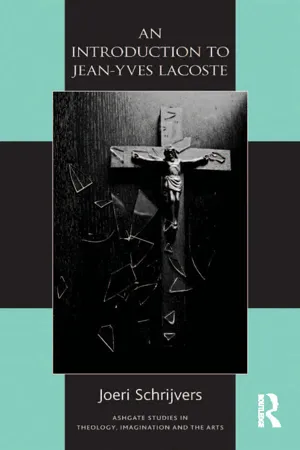
Introducing the thought of philosopher and theologian Jean-Yves Lacoste, this book provides an overview spanning Lacoste's earliest works on sacramentality to his latest work Etre en Danger (2011) in which Lacoste opens up the liturgical experience onto a spiritual experience of life. Schrijvers unfolds the logic of what Lacoste calls 'the liturgical experience' from its violent variety in Expérience et Absolu to the logic of love and love's possibility as it is developed in the later works. Throughout the book, the focus is on Lacoste's dialogue with Heidegger and through this his attempt to widen the scope of phenomenology to include the phenomenality of the divine.
Information
Chapter 1
Phenomenology of Confession
There are many reasons to dislike the sacraments. First of all, they differ considerably from the on-demand spiritualities so popular these days. Sacraments are not available online, and they force you to go to places at times not always suited to the ordinary occupations of one’s life. In this sense, they entail an active decision on the part of the human being to attend Mass. A second reason is that the sacraments inform us about a truth that precedes our being and forces us to abandon the comfortable and secure position of the autonomous subject. Infant baptism may serve as an excellent example of this. Well before I could have decided to enter the Church, the fact of my baptism was decided for me. Autonomy comes afterwards. It is through this being placed in relation with the Absolute that I may, later, sense that God indeed is the first on the scene and ‘has loved me first’ before I knew of such a love. What is more, were it not for this heteronomous moment, I would perhaps not understand the basics of the sacramental experience, namely that relating to God only ever happens when God has already turned towards me. This is the religious truth that I intend to show throughout the portrayal of Lacoste’s liturgical experience and through this will also explore the interplay between activity and passivity that is at issue in this experience of sacramentality.
This chapter will explore Lacoste’s take on the various sacraments. This will help to understand some of the peculiarities of the later liturgical experience, most notably its individual-existential and often brutal, if not violent, character. Lacoste will later write that ‘liturgical experience is a sacramental experience’ (PP 131), although, perhaps, not all ‘liturgical experiences’ need to be considered as sacramental experiences. It is only proper then to begin with an understanding of the sacraments. Only afterwards can we understand just how liturgical experience, for Lacoste, might be one of those instances that might point to an overcoming of metaphysics, if only because of its ‘barely modern’ character and the response to technology and the nihilism of our days that it entails. In short, liturgical experience instructs us about the use of uselessness in and through its abandonment of all efficient causality, of all means and ends. Methodically, this chapter will mainly build upon the early work of Lacoste, if only to make evident just how much the liturgical experience of Expérience et Absolu is in continuity with Lacoste’s view on sacraments such as confession, baptism, marriage and others. Nevertheless, if Expérience et Absolu speaks of a logic before God ‘writ large’ (EA 2/2), one still has to ponder just how large this writing is, and whether liturgical experience indeed could dispense with its theological origins.1
In what follows, I will first sketch Lacoste’s early phenomenology of confession in order to introduce the barely modern, and somewhat anti-anthropological, elements of liturgical experience.
Phenomenology of Confession
The sacraments speak to us of a truth prior to our being. This truth counters that which the autonomous individual configures as truth, for instance, a complete and transparent possession of one’s will, one’s power and one’s desire. The liturgical sacramental experience will indeed contradict these abilities and aptitudes one by one. Liturgical experience will convey a passivity prior to all activity. In Lacoste’s words: ‘the sacraments signify […] a divine project with the human being before being a human project’.2 If, however, as I will show, liturgical experience nevertheless originates from a human project, it is to be noted that it is the Absolute that in the end will take hold of this free human project, for ‘it is indeed when the order of the project is disqualified – I do not do anything in the Eucharist, and I do not actualize my self – that the project of God with the human being can accomplish itself’.3
These two formulas may designate the later liturgical experience in a nutshell. The reasons, moreover, for describing this experience as the experience of ‘the one placing himself under the protection of God’ (PD 9) are drawn from the theology of the incarnation and of the sacraments as they are in opposition to a perhaps all too rational approach to God: ‘the theology of the incarnation and of the sacraments’ function is […] to affirm the over-determination of God’s transcendence by God’s condescension, of God’s omnipresence by his being-there, of God’s inaccessibility by God’s proximity’ (Carmel 29). To confront the Absolute, then, is to confront God as coming towards the human being – condescension: God’s taking of flesh means that God assumes a body and is to be encountered in certain particular places rather than others and is closer to the human being than a simple stress on the divine’s transcendence supposes.
Liturgical experience is caught between the difference of creation and world (NT 73–142). This means above anything else that being-in-the-world first appears as that which keeps the Absolute at a distance. This distance, Lacoste argues, has to be named sin. Yet the distance between creation and world takes place within the world. This allows liturgical experience to incorporate both a moment continuous with being-in-the-world and some discontinuity and rupture with our native condition. We will see Lacoste struggling with both moments throughout this work, most notable in Chapter 3 – continuity through an unrest underlying our ontological constitution – and discontinuity – the ontic act of prayer and of liturgy adding something new to ontology. This novelty is what we can call a Christian worldview: once we have entered into the logic of the sacraments and in the liturgy, it becomes unthinkable that God could not be present in that very world. The sacraments speak to us of a ‘between’ within the world and creation: the sacraments create a passageway from the world to God’s grace to such an extent that the boundaries between them tend to evaporate, or at least are ‘redefined’ (PP 110), and something like ‘pure nature’ or pure world would reveal itself unthinkable.
Yet in our search for the sacrament’s ability to speak to a non-Christian and even secular worldview, or how ‘liturgical’ experience can turn to a ‘spiritual’ experience shared by all, one must be prepared to face the reality of sin. Lacoste’s phenomenological approach to confession is obvious: ‘before assuming that, in a world where reconciliation has a realistic, social and political face, its sacramental side would be merely privatization of grace and inefficient; in short, before turning it into ideology […] it could perhaps be convenient to see what [confession] says of itself’.4 One needs to hear the echo of Heidegger’s definition of the phenomenon as ‘that which shows itself from itself’5 here. Lacoste proposes to direct the phenomenological gaze to the practice of confessing in order to make it apparent how this phenomenon shows itself without the interference of any – for instance, political or social – interpretations.
The confession is a confession of one’s sins. Confession ‘starts with the intimate examination of one’s conscience’6 and results in doing penance. Penance, then, is ‘the precise place where conscience can refine itself’7 and aim at its conversion. Penance, for Lacoste, ‘has a peculiarity which it shares with baptism: it is, in one way or another, a sacrament of the margins and of a transition through reintegrating in […] the ecclesial being those who admit being more or less turned away’.8 Second, the phenomenology of confession starts with an experience of frontiers: I cannot forgive myself for my own sins all the while knowing that the appeal to ethics, as the worldly realization of some sort of eschaton, is often misheard or ignored. ‘It is therefore necessary that the question of peace and reconciliation is posed while presupposing the failure of the human being to be human’.9 Only liturgical experience will show us just how to be human.
The sacrament of confession brings the penitent to the margins of autonomy. In these margins, the believer will encounter the limits of his willing, knowing and desire and God is revealed as the instance who acts wherever we can no longer act, who knows what we cannot know; in short, as the one ‘who gives what we cannot give to ourselves’:10 grace, redemption, reconciliation, and authentic humanity.
The sacraments start from a lack: the lack of being sufficiently human. This lack is obvious also from the point of the weal and the woe of conscience and consciousness during confession. The examination of one’s conscience is a necessary but not a sufficient condition for the phenomenon of confession. More is at issue than that which consciousness can bring before itself: the sin committed or considered is always and already a sin towards the other as well. It is, in any case, not up to me to forgive my (own) sins; a third party is always involved, whether I am conscious of it or not. Lacoste is arguing here for a retrieval of the theory of the venial sin: although not all sins are to be considered as mortal sins, my salvation from even the tiniest sin is not up to me only and it is this that makes for ‘the existential seriousness of the spiritual gaze directed to my sins’.11
The sacrament of confession speaks to us about a lack of knowledge about God and a lack of community. If it is not up to me to decide how grave my sins are, or even to forgive myself (if such a thing were possible), then this is so because of the complexity of sin. Sin is not just a dilemma in which one decides more or less consciously whether one act is for or against the divine. More often than not, one does not know whether one’s actions are just and good. More often than not, what seems good can entail consequences that defy our conception of the good. In short, ‘I know that I have sinned better than that I know what exactly my sin is’.12
This, then, is the drama of sin: I know that it is me – my salvation and my well-being – that is at stake, but the remedy, if one may call it that, is beyond me. I know that my presence and my confession are required to be forgiven, but I do not know what exactly is required of me. This is why Lacoste writes that ‘sacramental mysticism […] cannot separate itself easily from ethics here’.13
This is why sin is always midway between knowledge and ignorance. The spiritual gaze that I (or the priest) direct towards my sin is objective and subjective at the same time.14 It is objective in the sense that, through the distance created between the sin and myself via penance, I am aware of myself as a sinner and open myself to a future of grace. The distance created between my sin and myself through confession distances me from what keeps me at a distance from God. Yet the objectivity of my being a sinner does not resonate with a subjective consideration of which sin is important or not. Subjectively, although I confess to be a sinner, I have never repented enough for this or that sin simply because I am not in a position to recognize the importance of these diverse sins. This ignorance about salvation is what makes the situation of confessing a sure sign of the lack of theological knowledge of the divine. This ignorance, too, is why Lacoste shows himself to be a vehement opponent of all theories of collective absolution where the confession of penance would be reserved for mortal sins: ‘it ruins the most severe existential aspect of penance’.15
Yet the stress on the existential aspect of confession should not be overestimated either, since the reality of the sin concerns, because of its interpersonal character, the other, more than it does me. This is why the phenomenon of confession, after a first moment of active engagement on my part, involves the participation of the entire community through the third party that is the priest. Through the eyes of the priest, one might say, the whole of the Christian community is present. The lack of certainty with regard to my sins opens onto the lack of community. In a footnote which captures Lacoste’s entire thinking of community, he writes: ‘one must not rush when speaking of communities there, where what is present is first of all the desire for community’.16 Sin is that which ruins every community and encounter with the other: where sin is present, community is simply absent. In this way, the confessions of sins express a desire for, more than anything else, a restoration of the relationship with the other person. It is here as well that the limits of intersubjective dialogue, for Lacoste, are encountered, for there might be sins that simply exceed the forgiveness that I can give to the other or that the other person can give to me. Both of us are, in the liturgical regime, bound to that which the human being cannot give to itself, that is, absolution and reconciliation in full knowledge.
Liturgical experience’s first word is that of dispossession. ‘Confession introduces into a critique of common representations of intersubjective encounter. Symmetry […] finds itself ruptured there’.17 This is, in effect, what the curtain or the screen which separates me from the priest symbolizes. It guarantees the bracketing of all (too) personal relations and secures the anonymity of the confession: the priest cannot see my face nor can I see his.
This anonymity, for Lacoste, must be interpreted as a ‘return to the theological self’, absolved from all empirical and ontic peculiarities. During confession, it does not matter how eloquent my tale of my sins is nor does it matter how the priest emotionally reacts to my account. The priest does not appear in confession as a friend and perhaps not even as a superior: brought back to the bare essentials, he and I appear to one another through ‘the naked fac...
Table of contents
- Cover Page
- Title Page
- Copyright Page
- Contents
- Preface
- List of Abbreviations
- Introduction
- 1 Phenomenology of Confession
- 2 Phenomenology of the Body
- 3 Phenomenology of Prayer
- 4 Phenomenology of Conversion
- 5 Phenomenology of the Fool
- 6 The Fate of Non-experience
- 7 The World and the Absence of Art
- 8 Life as Strong as Death? Of Being and Danger
- Conclusion: A Phenomenology of (Spiritual) Life
- Bibliography
- Index
Trusted by 375,005 students
Access to over 1.5 million titles for a fair monthly price.
Study more efficiently using our study tools.
Frequently asked questions
Yes, you can cancel anytime from the Subscription tab in your account settings on the Perlego website. Your subscription will stay active until the end of your current billing period. Learn how to cancel your subscription
No, books cannot be downloaded as external files, such as PDFs, for use outside of Perlego. However, you can download books within the Perlego app for offline reading on mobile or tablet. Learn how to download books offline
Perlego offers two plans: Essential and Complete
- Essential is ideal for learners and professionals who enjoy exploring a wide range of subjects. Access the Essential Library with 800,000+ trusted titles and best-sellers across business, personal growth, and the humanities. Includes unlimited reading time and Standard Read Aloud voice.
- Complete: Perfect for advanced learners and researchers needing full, unrestricted access. Unlock 1.5M+ books across hundreds of subjects, including academic and specialized titles. The Complete Plan also includes advanced features like Premium Read Aloud and Research Assistant.
We are an online textbook subscription service, where you can get access to an entire online library for less than the price of a single book per month. With over 1.5 million books across 990+ topics, we’ve got you covered! Learn about our mission
Look out for the read-aloud symbol on your next book to see if you can listen to it. The read-aloud tool reads text aloud for you, highlighting the text as it is being read. You can pause it, speed it up and slow it down. Learn more about Read Aloud
Yes! You can use the Perlego app on both iOS and Android devices to read anytime, anywhere — even offline. Perfect for commutes or when you’re on the go.
Please note we cannot support devices running on iOS 13 and Android 7 or earlier. Learn more about using the app
Please note we cannot support devices running on iOS 13 and Android 7 or earlier. Learn more about using the app
Yes, you can access An Introduction to Jean-Yves Lacoste by Joeri Schrijvers in PDF and/or ePUB format, as well as other popular books in Philosophy & Existentialism in Philosophy. We have over 1.5 million books available in our catalogue for you to explore.