- 280 pages
- English
- ePUB (mobile friendly)
- Available on iOS & Android
eBook - ePub
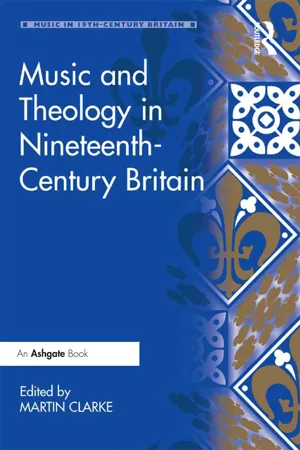
Music and Theology in Nineteenth-Century Britain
About this book
The interrelationship of music and theology is a burgeoning area of scholarship in which conceptual issues have been explored by musicologists and theologians including Jeremy Begbie, Quentin Faulkner and Jon Michael Spencer. Their important work has opened up opportunities for focussed, critical studies of the ways in which music and theology can be seen to interact in specific repertoires, genres, and institutions as well as the work of particular composers, religious leaders and scholars. This collection of essays explores such areas in relation to the religious, musical and social history of nineteenth-century Britain. The book does not simply present a history of sacred music of the period, but examines the role of music in the diverse religious life of a century that encompassed the Oxford Movement, Catholic Emancipation, religious revivals involving many different denominations, the production of several landmark hymnals and greater legal recognition for religions other than Christianity. The book therefore provides a valuable guide to the music of this complex historical period.
Information
Chapter 1
The Theology of the Victorian Hymn Tune
The seeds for this chapter were sown during a conference entitled ‘Liberal Voices’ organized by the Free to Believe network of the United Reformed Church in October 2008. It included much singing of hymns written by two of the great ‘liberal voices’ of later twentieth-century hymnody, Brian Wren and Fred Kaan. It became increasingly clear to me and to others that the predominantly late twentieth-century tunes to which these hymns were set, and for which they had in most cases been especially written, did not serve their open, inclusive, liberal theological outlook and message very well. They were convoluted and difficult to sing, lacking in clear melodic line and flow and often set in a rather depressing minor key. How much better, I kept feeling, to have been singing them to one of the great affirmative, melodic Victorian hymn tunes.
I tested this thesis out at the conference, where I was principal speaker along with Brian Wren, when I introduced delegates to the work of Andrew Pratt, the contemporary Methodist hymn writer who writes from a distinctly liberal theological perspective. We sang his hymns exclusively to nineteenth-century hymn tunes and the general view was that they fitted Pratt’s liberal theology much better than the late twentieth-century tunes had for the not dissimilar sentiments of Wren and Kaan. It is, indeed, noticeable that while Pratt often seeks and commends new tunes for his hymns, he also regularly suggests singing them to Victorian classics. A trawl through his collection Whatever Name or Creed reveals that his favourite Victorian tune is Richard Redhead’s LAUS DEO, which he suggests for three of his own hymns. S.S. Wesley’s AURELIA is recommended for two: the particularly open and inclusive ‘O source of many cultures’ and a hymn based on Stephen Hawking’s A Brief History of Time. W.H. Gladstone’s OMBERSLEY is suggested for a further two, and J.B. Dykes gets a good showing with ST OSWALD, DOMINUS REGIT ME, GERONTIUS and MELITA all featuring as suggested tunes.1
It is not just liberal hymn writers who recommend Victorian tunes as often providing the best accompaniments to their verses. The list of suggested tunes in the collected hymns of Timothy Dudley-Smith, who stands in the Anglican Evangelical tradition reveals a clear preference for twentieth century tunes and those derived from English and Welsh folk tunes, but still includes a good sprinkling of Victorian favourites.2 Dudley-Smith, whose collection is more than double the size of Pratt’s, with 285 hymns as against 135, shows a particular preference for Dykes’ MELITA, which is suggested eight times, with S.S. Wesley’s AURELIA coming a close second with seven mentions, followed by Henry Smart’s REGENT SQUARE (five) and Redhead’s PETRA, Henry Gauntlett’s IRBY, George Elvey’s ST GEORGE’S WINDSOR, Edward Hopkins’s ELLERS, S.S. Wesley’s CORNWALL, George Martin’s LEOMINSTER and Arthur Sullivan’s LUX EOI each with three.
If the choices of these two leading contemporary hymn writers suggest that Victorian hymn tunes appeal equally to those writing from a liberal and an Evangelical standpoint, a comparison of two relatively recent hymn books of sharply contrasting theological hue seems to indicate that among hymnal editors, liberals are considerably more likely than conservative Evangelicals to favour Victorian tunes. The two that I have compared, both published in the same year (1987), are the ultra-liberal Hymns for Living, the hymnal of the Unitarian Church, and the conservative Evangelical Songs and Hymns of Fellowship, published by Kingsway. The Unitarian collection has just half the number of hymns (317 against 645 in Songs and Hymns of Fellowship) but includes a much greater number of tunes by Victorian composers led by Dykes with nine, Stainer (six), Gaunlett (four), Sullivan and Hopkins (three each) and Barnby (two). In Songs and Hymns of Fellowship, the only Victorian composers to achieve more than one appearance are Dykes, with six, and Monk and Sullivan with two each.
Of course, Victorian tunes are still regularly chosen by modern hymn writers and hymn book editors across the denominational and theological spectrum primarily because they are well-known and singable rather than out of any theological considerations. However, my experience at the ‘Liberal Voices’ conference and the striking difference in the use of Victorian tunes in Hymns for Living and Songs and Hymns of Fellowship raise the question of the theology of the Victorian hymn tune. Does this distinctive musical genre, rightly recognized as such by musicologists, also express or embody a distinctive theology or, rather, does it encompass a range of theologies reflective of its time?
Certain hymn tunes from the late eighteenth and early nineteenth century do seem to me to display very clear and distinct theologies. One need go no further than two of the melodies to which Charles Wesley’s ‘O for a thousand tongues’ is nowadays most usually sung. RICHMOND, composed by Thomas Haweis around 1792 for his own hymn ‘O Thou from whom all goodness flows’ superbly represents musically from its opening arpeggio and through its elegantly structured and spacious phrasing the broad, latitudinarian strain in eighteenth-century theology. It is really much too stately, laid-back and comfortable for the Evangelical fervour of Wesley’s text, to which it was not wedded until 1933, by the editors of the Methodist Hymn Book, and is better kept for the broad, spacious theology of the Unitarian-inclined Samuel Johnson’s ‘City of God, how broad and far’. Much more appropriate to the sentiments and message of ‘O for a thousand tongues’ is the fervent, hearty, fuging counterpoint of Thomas Jarman’s LYNGHAM first published in 1803 and, again, only set to Wesley’s verses in the twentieth century. These two tunes express two dominant theological movements of the times from which they date. RICHMOND perhaps marks a final flowering of comfortable, optimistic eighteenth century deism – MOSCOW (1769) represents an earlier expression of the same general outlook – while LYNGHAM is one of the first of those great artisan-crafted fuging tunes of the early nineteenth century – SAGINA (1825) and LYDIA (1844) are among its finest successors – which express the full emotional fervour of Evangelical Nonconformity and are so decidedly un-Anglican and non-Establishment in their colour and contours.
Are there similarly clear theological statements in Victorian hymn tunes? Musically, they range from the restrained four-square settings of Goss and Smart, through the harmonic eccentricities of S.S. Wesley to the high Victorian sentimentality and part-song style of Dykes and Barnby. Yet there is one overwhelming characteristic that nearly all Victorian hymn tunes share and that is their careful matching to particular words. This was achieved in one of two ways – either by the writing of a melody to fit a specific text, rather than, as the practice had largely been before, just to provide a stock tune in a particular metre which could do service for a whole range of hymns, or by the pairing in hymn books of a text and a tune in an exclusive way that had not been done before and which established that indissoluble association between particular words and music which was at the heart of the Victorian love affair with hymns and which has largely continued ever since. Victorian composers excelled at crafting tunes to fit the mood and message of a text and Victorian hymn book editors, led by those responsible for Hymns Ancient and Modern, excelled at finding the right tune for each item in their collection. The dedicated hymn tune, specially written or chosen for a particular text and firmly and exclusively wedded to it, was as much a Victorian invention as the penny postage stamp or the railway system.
Given this close attention to words, their meaning and mood, one would expect Victorian hymn tunes to express the full gamut of Victorian theology. Within the Church of England, where most of those writing hymns in the middle and later nineteenth century were located (Nonconformists having experienced their great creative burst of hymn writing in the eighteenth century and Roman Catholics being still largely yet to experience the full joys of congregational hymn singing), there were four main theological movements and parties: conservative, traditional high church; Tractarian / Anglo-Catholic; Evangelical / low church; and liberal / broad church. These theological and ecclesiological divisions were to a lesser extent mirrored in other churches, most notably in the established Church of Scotland where the main parties were the Evangelicals and the Moderates, with a small but significant group of Scoto-Catholics representing a high-church, liturgical tendency. Across all the hymn-writing and hymn-singing denominations, there were, as there still are, fundamental tensions between those of a more conservative and those of a more liberal theological bent. Victorian hymn writers included high churchmen (and those from that stable were almost all men) led by Sir Henry Baker, editor of Hymns Ancient and Modern; Tractarian devotees of the Oxford Movement, like John Keble; Evangelicals, among whom women were particularly well represented by the likes of Frances Ridley Havergal and Charlotte Elliott; those of a broad-church perspective, including John Ellerton in the Church of England and George Matheson and Norman Macleod in the Church of Scotland; and also those deeply affected by the Victorian crisis of faith who might perhaps best be described as doubt-ridden believers, agnostics or idealistic theists, chief among whom should perhaps be counted Alfred Tennyson.
This considerable theological variety on the part of those who wrote hymns in the latter half of the nineteenth century was not matched among those who composed the tunes to which their words were largely set and sung. The latter were overwhelmingly of high-church Anglican background and/or Tractarian sympathies. I cannot think of a single leading Victorian hymn-tune composer who could be described as Evangelical in theology and there are very few who can be located in the broad-church camp. An analysis of the tunes across a range of later nineteenth-century hymnbooks reveals that fourteen composers stood head and shoulders above the rest in terms of popularity and frequency of usage. They were, in alphabetical order, Joseph Barnby, John Bacchus Dykes, George Elvey, Henry Gauntlett, John Goss, Edward Hopkins, William Henry Monk, Herbert Oakeley, Frederick Ouseley, Richard Redhead, Henry Smart, John Stainer, Arthur Sullivan and S.S. Wesley.3 Of these fourteen, all but two are usually identified as having high-church and/or Tractarian associations or sympathies.
Some words of caution are needed here. In many cases, we have little or no evidence of any actual theological writings or utterances on the part of these musicians and the identification of their particular position within the Victorian Church of England (to which they all, without exception, belonged or conformed, making them together with their exclusive maleness a much less heterogeneous company than the writers whose texts they set) is more often made on ecclesiological and liturgical rather than theological grounds. They are often described by biographers and musicologists as high church or Tractarian on the basis of the churchmanship of the churches where they were organists and on their position regarding certain liturgical practices, notably the revival of Gregorian chant which is seen as a mark of Tractarian sympathy. Bennett Zon, author of the most comprehensive account of the plainchant revival in the Victorian Church of England, is one of a number of modern historians of nineteenth-century music who regard this movement as a talisman of both high churchmanship and Tractarianism. In his words, ‘the Anglican plainchant revival is … the aesthetic realization of high churchmanship within the Established Church, the most obvious manifestation of which is Tractarianism or the Oxford Movement’.4
There are two problems with this approach. First, it conflates two different and distinct movements – traditional, conservative, ‘high and dry’ high churchmanship and the more recent and much more Catholic Tractarianism of the Oxford Movement with its emphasis on ritualism and eucharistic theology. Secondly, it takes what is essentially an aesthetic and liturgical preference, for Gregorian chant, and erects into a theological position. These caveats having been made, it is probably right to assign virtually all the leading Victorian hymn-tune composers either a high-church or Tractarian label. Smart, Goss, Oakeley and Elvey are probably best described as traditional high churchmen. They display the conservative, antiquarian preferences associated with this grouping. Significantly, they were not all fans of the plainchant revival. Smart, indeed, was strongly opposed to it. He once rounded on a young Tractarian curate, next to whom he found himself sitting at a dinner party and who had expressed his enthusiasm for Gregorian chant: ‘Who asked your opinion upon a musical question of which you know absolutely nothing? You may rely on it, that some day when you and your friends are shouting those ugly Gregorian chants, Heaven will punish you, and rain down bags of crochets on your heads.’5
A clear majority of the group, eight out of the fourteen, can fairly safely be identified as Tractarian in sympathy although, as already pointed out, this should be taken more as an aesthetic and liturgical preference than a theological position. The extent of their commitment to the ritualistic and doctrinal aspects of the Oxford Movement...
Table of contents
- Cover Page
- Dedication
- Title Page
- Copyright Page
- Contents
- List of Figures
- List of Tables
- List of Musical Examples
- List of Contributors
- Preface
- General Editor’s Series Preface
- Introduction
- 1 The Theology of the Victorian Hymn Tune
- 2 ‘Meet and Right it is to Sing’: Nineteenth-Century Hymnals and the Reasons for Singing
- 3 Sacred Sound for a Holy Space: Dogma, Worship and Music at Solemn Mass during the Victorian Era, 1829–1903
- 4 ‘Thy Love … Hath Broken Every Barrier Down’: The Rhetoric of Intimacy in Nineteenth-Century British and American Women’s Hymns
- 5 Christianity, Civilization and Music: Nineteenth-Century British Missionaries and the Control of Malagasy Hymnology
- 6 ‘Sing a Sankey’: The Rise of Gospel Hymnody in Great Britain
- 7 ‘Singin’ in the Reign’: Voice, Faith and the Welsh Revival of 1904–1905
- 8 Beyond the Psalms: The Metamorphosis of the Anthem Text during the Nineteenth Century
- 9 From Elijah (1846) to The Kingdom (1906): Music and Scripture Interacting in the Nineteenth-Century English Oratorio
- 10 Confidence and Anxiety in Elgar’s Dream of Gerontius
- 11 ‘Spiritual’ Selection: Joseph Goddard and the Music Theology of Evolution
- Bibliography
- Index
Trusted by 375,005 students
Access to over 1.5 million titles for a fair monthly price.
Study more efficiently using our study tools.
Frequently asked questions
Yes, you can cancel anytime from the Subscription tab in your account settings on the Perlego website. Your subscription will stay active until the end of your current billing period. Learn how to cancel your subscription
No, books cannot be downloaded as external files, such as PDFs, for use outside of Perlego. However, you can download books within the Perlego app for offline reading on mobile or tablet. Learn how to download books offline
Perlego offers two plans: Essential and Complete
- Essential is ideal for learners and professionals who enjoy exploring a wide range of subjects. Access the Essential Library with 800,000+ trusted titles and best-sellers across business, personal growth, and the humanities. Includes unlimited reading time and Standard Read Aloud voice.
- Complete: Perfect for advanced learners and researchers needing full, unrestricted access. Unlock 1.5M+ books across hundreds of subjects, including academic and specialized titles. The Complete Plan also includes advanced features like Premium Read Aloud and Research Assistant.
We are an online textbook subscription service, where you can get access to an entire online library for less than the price of a single book per month. With over 1.5 million books across 990+ topics, we’ve got you covered! Learn about our mission
Look out for the read-aloud symbol on your next book to see if you can listen to it. The read-aloud tool reads text aloud for you, highlighting the text as it is being read. You can pause it, speed it up and slow it down. Learn more about Read Aloud
Yes! You can use the Perlego app on both iOS and Android devices to read anytime, anywhere — even offline. Perfect for commutes or when you’re on the go.
Please note we cannot support devices running on iOS 13 and Android 7 or earlier. Learn more about using the app
Please note we cannot support devices running on iOS 13 and Android 7 or earlier. Learn more about using the app
Yes, you can access Music and Theology in Nineteenth-Century Britain by Martin Clarke in PDF and/or ePUB format, as well as other popular books in Media & Performing Arts & Music. We have over 1.5 million books available in our catalogue for you to explore.