- 260 pages
- English
- ePUB (mobile friendly)
- Available on iOS & Android
eBook - ePub
About this book
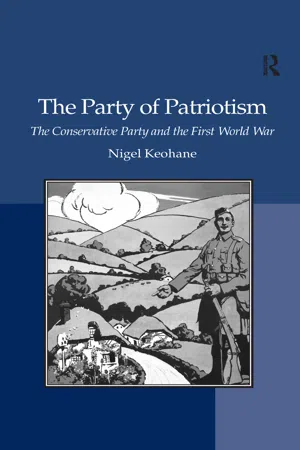
The First World War was a period of turbulent and unprecedented political upheaval that witnessed contrasting fortunes for Britain's major political parties. This book demonstrates how the Conservative Party was able to respond effectively in these years by refining a wartime patriotism that ensured its unity as a party, helped define its electoral fortunes and shaped ideological cohesion. Concepts of patriotism determined not only attitudes to the prosecution of the war, to voluntary and forced military enlistment, but also to class politics, Irish Unionism, democratic reform and the relationship between citizen and state. Fundamental conclusions about modern Conservatism emerge: its organic ideological genesis into a property-defending party; its peculiar willingness and capacity to adapt not only to the immense challenges of 'total war', but also to the new political climate awakened by the conflict. Conservatism was therefore at once flexible and ideological. Filling the historiographical gap created by an overemphasis upon its rival Liberal and Labour parties, and using previously unused party sources, this study sheds new light on many aspects of the war, of Conservative Party history and its regeneration following three disastrous general election defeats in succession, and of British politics in the twentieth century.
Chapter 1
War, Politics and Military Strategy
On first acquaintance to British eyes the First World War presents itself in starkly demarcated periods: naïve and bombastic enthusiasm in August 1914; stubborn and traumatizing conflict in the middle years; a barren victory in 1918, marred further by a malignant peace. On closer analysis this, of course, proves an overly crude interpretation. Nonetheless, politically, the war can be divided conveniently into three periods: Asquith’s Liberal Government, August 1914 to May 1915; Asquith’s Coalition Government, June 1915 to December 1916; and Lloyd George’s Coalition Government, January 1917 to November 1918. Each administration had its own individual characteristics and all shared common features. This chapter analyses key aspects of the politico-strategic dimension which united and divided these periods of government, including the military and political context within which wartime decisions were made, the clarification of a Conservative approach to war and the domestic political opportunities presented by war to particular political groupings. The traditional interpretation of the war has been that it was implicitly beneficial to the Conservative Party. As will be seen throughout this study, this is hardly a fair reflection of its actual impact. If on the simple issue of the fact of war itself this bold assertion is un-controversial, it can easily betray the level of nuance inherent in the Conservative approach to ‘total war’.
The Decision for War: August 1914
In July 1914 the long, drawn-out diplomatic contest with which international ambassadors, governments and pressure groups had been occupying themselves for a decade drew to a close. The assassination of the Austrian Archduke Franz Ferdinand in Sarajevo led to a catalogue of ultimatums from Austro-Hungary and Germany to their neighbours, first Serbia, then Russia, France and Belgium. Across Europe, the metaphoric beacons of the intricate network of international alliances – which had been built up to in the understanding that they would never be lit – were ignited. Between 28 July and 4 August, from one country to the next, fires blazed upon the horizon giving notice of the calls upon diplomatic honour and national interests: Serbia to Russia; Russia to France and Britain; France to Britain; and Belgium to Britain. On 3 August, Germany invaded France; later that day the British Foreign Secretary Edward Grey served notice to Germany that, in the event of the violation of Belgian neutrality, Britain would declare war upon the aggressor. On 4 August, in response to the movement of German troops across the Belgian border, Britain declared war against Germany. The beacons had failed in their first purpose to prevent war; they were more effective in ensuring that all soon were to be involved in war.
Sufficient ink has been split by protagonists and historians alike over the rationale for war that blotting paper, rather than yet further ink, is called for. Through the smudge of self-aggrandizement and recrimination of contemporary accounts, a clear outline of why the British Cabinet decided to go to war in July and August 1914 has emerged.1 It was in truth a huge game of hedging, of waiting for the Central Powers to play their hands and of waiting for colleagues to decide their minds. Within this environment of quickly changing tides and strong undercurrents of pro-war and anti-war movements within the Cabinet, the Conservative Party navigated a determined line. That the Conservative leaders dispatched a letter to Prime Minister Herbert Asquith on Sunday 2 August has never been in doubt; neither is the fact that Asquith brought mention of this communication to the attention of the Cabinet when it met later that day. This letter argued that ‘it would be fatal to the honour and security of the United Kingdom to hesitate in supporting France and Russia at the present juncture’ and pledged the ‘united support’ of the Conservative Party in all measures required by the Government in England’s intervention in the war.2 Nevertheless, controversy has surrounded two particular aspects of this story: whether the Conservative communication influenced the Government’s decision for war and whether the Conservative leadership had to be cajoled into action by its backbenchers. On the first point, the overriding issue is surely that few Liberals can have been ignorant of the Conservatives’ likely stance on the continental commitment – the Agadir crisis in 1911 and the campaigns of the National Service League cannot have been forgotten overnight. If these had not laid the Conservative position bare, the First Lord of the Admiralty Winston Churchill had already conveyed to Cabinet a message from the Conservative F.E. Smith stating that the opposition would definitely support intervention, especially in the event of the violation of Belgian neutrality.3 As it was, Keith Wilson is surely right to point to the fact that Asquith brandished the Conservative letter in front of Liberal ‘waverers’ as a veiled threat that the appalling outcome of any irresolute response would be a Conservative coalition.4 Together, the prospect of a German Belgium and a Conservative administration gave Asquith the necessary leverage to carry his Cabinet in an interventionist policy.
Of more significance to this study is identifying the actual force behind the letter to Asquith. If the Conservative communication was more of a supporting buttress than a keystone on which British intervention was built, it is apparent that the traditional story of vacillation among the Tory leaders is without sound foundation. Retrospectively, the actions of the Conservative leaders certainly appear rickety. In their defence, many remained unaware of the severity of the European situation and were more concerned with an Irish, rather than Balkan, conflict. As late as Saturday 1 August 1914, Lord Crawford was returning from listening to Wagnerian opera in Germany. ‘The Austro-Servian crisis [was] wrecking Bayreuth!’, he moaned with barbarous composure.5 Even those Conservatives who were aware of continental developments, however, were still scattered far and wide enjoying weekends in the country: Austen Chamberlain at Westgate-on-Sea; the party leader Andrew Bonar Law, Edward Carson and ‘F.E.’ at Wargrave; Lord Lansdowne at Bowood House in Wiltshire; Arthur Balfour planning not only to retreat to Hatfield, but also until very late in the day contemplating an Austrian break.6 Subsequently, it has been argued that it was only through the force of a coterie of right-wing Conservatives, including General Henry Wilson, Leopold Maxse, George Lloyd, Admiral Lord Charles Beresford and Leo Amery, that the party leaders took any action at all.7 Such was Bonar Law’s imperturbability that, ‘like another Drake’, he insisted on finishing a tennis set before listening to an agitated Lloyd. Even then, Lloyd was forced to set Beresford, purple with rage and shouting, on his leader in order to persuade him to accompany them back to London.8
But was British participation in the First World War really due to this bunch of angry radical Tories? Did this represent a victory for the radical right? Rhodri Williams has written of ‘the relative impotence of the hard men on the Conservative backbenches’ in the pre-war political climate.9 Other research has borne this out, classifying the anti-German scaremongering of pre-war Conservatism as carried out by ‘outcasts’.10 It has subsequently been argued that the leadership was in ‘no way persuaded’ by this rank and file movement.11 Admittedly, Bonar Law had himself outlined the requirements for Conservative support for the Government to Grey and Asquith, but the mode of expression of this policy cast doubt on the commitment of the leadership. In late July and early August 1914, the radical right demonstrated itself to be a vital force in contrast to a sluggish leadership. Several factors vindicate the apparent reticence at the top: Chamberlain felt there was little the opposition could do to force the Government to act and also believed that forceful Conservative pressure would only rally an anti-war coalition; Lansdowne, the party leader in the House of Lords, feared splitting the Government and that ‘a change of Govt. would [have been] deplorable at such a moment’.12 Other factors lay beneath. Foreign and diplomatic policy was perceived as the province of the sitting government and confidential information was treated as such. Pre-war controversies suggest that the Conservative leaders would not have played quite such a straight bat had the issue been Irish Home Rule or House of Lords reform rather than a European war. What these excuses constituted at a broader level was traditional propriety, or the ‘political correctness’ of the late ninete...
Table of contents
- Cover Page
- Title Page
- Copyright Page
- Contents
- Abbreviations
- Acknowledgements
- Introduction
- Chapter 1 War, Politics and Military Strategy
- Chapter 2 Coalition and Leadership
- Chapter 3 Irish Unionism
- Chapter 4 Patriotism and Anti-socialism
- Chapter 5 Electoral Reform
- Chapter 6 Collectivism
- Bibliography
- Index
Trusted by 375,005 students
Access to over 1.5 million titles for a fair monthly price.
Study more efficiently using our study tools.
Frequently asked questions
Yes, you can cancel anytime from the Subscription tab in your account settings on the Perlego website. Your subscription will stay active until the end of your current billing period. Learn how to cancel your subscription
No, books cannot be downloaded as external files, such as PDFs, for use outside of Perlego. However, you can download books within the Perlego app for offline reading on mobile or tablet. Learn how to download books offline
Perlego offers two plans: Essential and Complete
- Essential is ideal for learners and professionals who enjoy exploring a wide range of subjects. Access the Essential Library with 800,000+ trusted titles and best-sellers across business, personal growth, and the humanities. Includes unlimited reading time and Standard Read Aloud voice.
- Complete: Perfect for advanced learners and researchers needing full, unrestricted access. Unlock 1.5M+ books across hundreds of subjects, including academic and specialized titles. The Complete Plan also includes advanced features like Premium Read Aloud and Research Assistant.
We are an online textbook subscription service, where you can get access to an entire online library for less than the price of a single book per month. With over 1.5 million books across 990+ topics, we’ve got you covered! Learn about our mission
Look out for the read-aloud symbol on your next book to see if you can listen to it. The read-aloud tool reads text aloud for you, highlighting the text as it is being read. You can pause it, speed it up and slow it down. Learn more about Read Aloud
Yes! You can use the Perlego app on both iOS and Android devices to read anytime, anywhere — even offline. Perfect for commutes or when you’re on the go.
Please note we cannot support devices running on iOS 13 and Android 7 or earlier. Learn more about using the app
Please note we cannot support devices running on iOS 13 and Android 7 or earlier. Learn more about using the app
Yes, you can access The Party of Patriotism by Nigel Keohane in PDF and/or ePUB format, as well as other popular books in History & World History. We have over 1.5 million books available in our catalogue for you to explore.