eBook - ePub
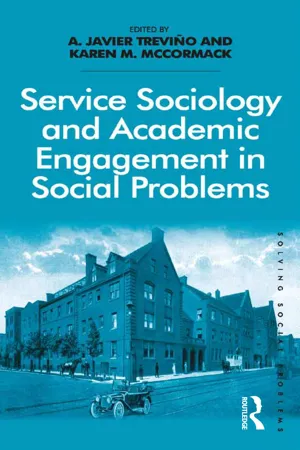
Service Sociology and Academic Engagement in Social Problems
- 262 pages
- English
- ePUB (mobile friendly)
- Available on iOS & Android
eBook - ePub
Service Sociology and Academic Engagement in Social Problems
About this book
This book challenges sociologists and sociology students to think beyond the construction of social problems to tackle a central question: What do sociologists do with the analytic tools and academic skills afforded by their discipline to respond to social problems? Service Sociology posits that a central role of sociology is not simply to analyse and interpret social problems, but to act in the world in an informed manner to ameliorate suffering and address the structural causes of these problems. This volume provides a unique contribution to this approach to sociology, exploring the intersection between its role as an academic discipline and its practice in the service of communities and people. With both contemporary and historical analyses, the book traces the legacy, characteristics, contours, and goals of the sociology of service, shedding light on its roots in early American sociology and its deep connections to activism, before examining the social context that underlies the call for volunteerism, community involvement and non-profit organisations, as well as the strategies that have promise in remedying contemporary social problems. Presenting examples of concrete social problems from around the world, including issues of democratic participation, poverty and unemployment, student involvement in microlending, disaster miitigation, the organization and leadership of social movements, homelessness, activism around HIV/AIDS and service spring breaks, Service Sociology and Academic Engagement in Social Problems explores the utility of public teaching, participatory action research, and service learning in the classroom as a contribution to the community.
Information
Contextualizing Service Sociology: History and Policy
Chapter 1
Debating Service Sociology: The Settlements, the Academy, and the Social Work Profession, 1890–1930
One of the oldest debates in the history of sociology has recently been reignited at a crucial moment for the discipline: the place of service in sociology (Treviño 2012). This chapter presents three historic contexts for the call for service sociology. The first context is that of the position of sociology as a discipline in the contemporary world. The second is that of the period of sociology’s origins (1865–1890) and institutionalization (1890–1930) in the United States, the period when the debate over the place of service in the practice of sociology was a crucial dividing line among the three then-acknowledged sites of sociological practice—settlements, social work agencies, and the academy. The third context is the future, both immediate and long-range, of sociology. It is important to draw lessons from the past that might inform future endeavors by individuals and organizations like the Society for the Study of Social Problems (SSSP) to practice a sociology of service.
Current History—The Present Context
History is understood here as a record of individual events as they unfold in time—thus, history is not only the past but also the present moment in which we live and act. This present moment is a challenging one for sociology, a challenge that is partly being met by a return to debates over service sociology. The significance of the challenge can be illustrated in two ways: one, by the search for a vocabulary with which to recapture the original project of sociology in the United States—a field of study shaped by its active commitment to be of use to people in their daily lives; and two, by the current perception of sociology as a field irrelevant to national debates.
Sociologists are currently seeking an appropriate term to describe their discipline as one that is engaged in an active relationship with the communities it studies and in which it is located, hence, the proliferation of adjectives like “applied,” “practical,” “policy,” “extramural,” “public,” and “service” to refer to such a sociology. As we note below, the nineteenth century designation was “practical sociology”; the twentieth century promoted as a subfield, “applied sociology,” and from the New Deal on many sociologists sought employment as “policy” experts. As for the twenty-first century, it has been marked, first, by Charles Lemert’s (1995, 208–9) calling attention to the importance of what he styled “extramural” sociologists—people such as Trinh T. Minh-ha, Henry Louis Gates, Toni Morrison, Spike Lee, Gloria Anzaldúa—who are “writing the sociologies of our time”; by Michael Burawoy’s 2004 American Sociological Association (ASA) presidential call for “public sociology” followed by A. Javier Treviño’s 2011 SSSP presidential challenge to undertake a “sociology of service.” These are all attempts to recover American sociology’s original commitment to addressing social problems in ways that both correct their causes and that ameliorate suffering in the individual lives disadvantaged by them.
The need for such a renewal of mission is partly suggested by mounting evidence that sociology is missing in action from the major debates that are shaping social and economic policy. This is not an empty rhetorical flourish; instances of sociology’s second-class status in public life are legion. We give five examples here.
Example One: In 2010 the US Army released the Health Promotion, Risk Reduction, and Suicide Prevention Report examining the rising suicide rates among soldiers. This 200-page document included only a one-sentence reference to Émile Durkheim; yet any sociologist studying the report would recognize that the Army’s approach to the increase in suicides could be improved if there were sociologists on the ground offering a Durkheimian analysis and applying that analysis in functioning military units.
Example Two: Again in 2010, the film Inside Job, winner of the Academy Award for best documentary, described the economic meltdown that continues to threaten the global economy and makes not a single mention of sociology or sociologists; yet this film would have been enriched by sociological insights into the workings of organizations and the development of organization cultures.
Example Three: In 2011, the American Sociological Association submitted an amicus curiae brief in the sexual discrimination case against Wal-Mart, Wal-Mart v. Dukes et al. At the time of the submission, ASA Executive Officer Sally Hillsman rightly pointed out:
While the substance of this case is about sexual discrimination at Wal-Mart, the issue before the Supreme Court is not whether Wal-Mart does or does not discriminate. Rather it is about whether social science, and sociology in particular, is authoritative and provides valid scientific evidence for helping to define a “class” in class-action cases, and for supporting the contention that social phenomena such as “corporate culture” can and do exist. The implications of this case, therefore, are significant for the discipline. Not hearing from the ASA through an amicus brief would be most surprising and possibly detrimental to our discipline. (Hillsman 2011, 1)
Hillsman concluded that, “ … if the Supreme Court rules in favor of Wal-Mart, the validity of social science research in legal opinions could be significantly diminished”; the Supreme Court so ruled in the summer of 2011. That judicial decision reversed over a century of legal opinion, beginning with the sociologically potent Brandeis brief of 1908, Muller v. Oregon, supporting social science research as valid evidence in a court of law. The Brandeis brief was both a product of and a triumph for service sociology as it was practiced at the beginnings of sociology in America.1
Example Four: On March 2012, Peter Whoriskey wrote in The Washington Post a widely reprinted article, “If you’re happy and you know it, tell the government,” about a new US government panel, convened the previous year, to measure happiness or well-being. The panelists are described as “experts in psychology and economics” (Whoriskey 2012), but not in sociology.
Example Five: Today there is not, nor has there ever been, a sociologist on the President’s Council of Economic Advisers. Nor has there ever been a Council of Sociological Advisers to advise the president on social policy.2
This chapter endeavors to answer the question these examples force upon us: How did sociology as a discipline arrive at such a point of seeming marginality and inconsequence?
Past Exemplars
We may find one answer, or at least refine our question, by looking at negotiations about professional identity that transformed the discipline from the 1890s to the 1930s and in which the meaning of service emerged as a key point of difference among the contesting parties. We present an analysis of these negotiations in four parts: (1) a discussion of the role of history in the production of disciplinary identity; (2) a description of the sites where American sociology was practiced in its first decades of existence—viz., the academy, charitable organizations, and social settlements; (3) an analysis of the relationship among these sites and with the general public in terms of their attitudes toward service; (4) the results of these negotiations for sociology as charity organizations transformed into the discipline of social work and abandoned sociology—settlement sociology carved out an ideal of service based in social critique, and academic sociology emerged as the undisputed home of the discipline, embodied in the hegemony of the career academic at an elite university.
The History of Sociology
One way a discipline or a profession socializes new members is by recounting its history as an account of its authoritative texts, discoveries, thinkers, and ideas—the discipline’s “canon” as it were. The history, sociologists tell themselves, matters because it reaffirms for the teller and the audience a sense of identity: who sociologists are, what they do, which aspects of social life they examine (Halbwachs 1992). The history of sociology is typically conveyed as the history of its theorists and their theories.
But the history of sociology is also one of action. American sociology does not, contrary to what is frequently assumed, grow out of a seamless transplant of European ideas to the United States. American sociology is as much indebted for its existence to the struggles of people to cope with massive social change and to solve social problems as it is to encounters by its cultural elites with the ideas of its founders Auguste Comte and Herbert Spencer.
Sites of Sociology in its Beginnings
American sociology in the nineteenth century was practiced in four major locales that overlapped in the problems they addressed and in the actors who participated in them. In all these sites American sociology was deeply and heavily committed to what we now refer to as service sociology—that is, practitioners of sociology both believed in service and reflected that belief in their work, whether expressed in an academic article or a settlement.
The first location was in professional associations of which the premier was the American Social Science Association (hereafter ASSA) founded in 1865, which gave birth to a host of other associations including the National Conference on Charities and Corrections, the American Historical Association, and the American Economics Association, which in turn eventually produced the American Sociological Society (see Haskell 2000 for a full history). Sociology was also popularly done in organizations like the Woman’s Christian Temperance Union, the Immigrant Protection League, and labor unions.
The ASSA spelled out its mission to members and the public in the papers formally presented at semi-annual national meetings and published in its official periodical, the Journal of Social Science (JSS). Within JSS readers found abstract statements of social theory mingled with a jostling throng of statements about current social problems with activists’ accounts of programs for addressing those problems: from house drainage to inebriety to new methods of historical research and the Dewey decimal system. Here social science was a democratic undertaking with contributions from men and women, whites and blacks, amateurs, public intellectuals, activists, academics, as well as from professionals like lawyers, ministers, and doctors.
A second key locale for sociology was in charitable organizations such as the National Conference of Charities and Corrections (hereafter NCCC) organized by ASSA members who were battling poverty at the local level and the Charity Organization Societies (COS) begun in Buffalo, New York in 1877. The COS’s were inspired by a British model with a program that called not simply for aid to the poor but for “scientific charity” (Popple and Reid 1999). The COS idea became widely popular across the United States; by 1883 about 25 cities had a COS and by 1900 there were 138 such organizations.
Scientific charity called for the systematic investigation and assessment of individual need before aid was given. Volunteer “friendly visitors” who were expected both to evaluate the conditions of aid applicants and to provide “moral uplift” conducted these investigations; there was frequently a small paid office staff to keep records. Underlying scientific charity was the untested hypothesis that the problems of poverty were due to character. Yet despite this methodological weakness, the charity organizations frequently presented an impressive triumph of empiricism as they moved to critique the structures producing poverty for individuals. For instance, Josephine Shaw Lowell, of the New York COS, began firmly opposing giving money to the poor, then turned to preventing poverty, and in the early twentieth century became a socialist (Reisch and Andrews 2001).
A third site for sociology was in the colleges and universities, most usually in the form of courses in social problems. The first social science course was taught at Oberlin College in 1858; William Graham Sumner introduced “sociology” into a course title at Yale in 1875. A review of 231 college and university catalogues from 1890 shows that while only some 30 schools offered courses with “social science” in the title, every school had a course in “Social Problems,” or in “Practical,” “Applied,” or “Christian” Ethics (Bernard and Bernard 1943). At Harvard, Professor of Philosophy F.G. Peabody’s course “Practical Ethics” focused on the study of practical social problems like “Charity, Divorce, the Indians, the Labor Question, Intemperance,” requiring each student to undertake personal observation and draw out the ethical principles involved (Bernard and Bernard 1943, 615–16). Between 1885 and 1893 Peabody’s course turned out several presidents of the National Conference of Charities and Corrections including a pioneer in child welfare, a leader of the Boston Provident Association, and a Boston Juvenile Court judge (Bruno 1957).
The fourth major site of sociological practice, the social settlements, offered a different path from the above, though they overlapped with all three. Settlement workers were active in the American Social Science Association through the NCCC, where various settlement heads, including Jane Addams and Graham Taylor served as president. They were engaged in social work and frequently met at conferences with practical sociologists like Charles A. Ellwood, who administered charity through the COS. Settlement workers also taught courses at universities and had university professors work with them on various service projects (see Deegan 1988).
The settlement idea was inspired by Toynbee Hall located in London’s East End. It constituted an attempt to bridge class differences by having privileged young men live among the working poor. Stanton Coit in New York City’s Lower East Side founded the earliest American settlement house in 1886; in 1889, Addams and Ellen Gates Starr opened what would become the most famous settlement, Hull House, in Chicago’s desperately poor Nineteenth Ward. By 1897 there were 74 settlements in the US and by 1910, 413 in 33 states and Hawaii.
The distinctive nature of the settlements rested on the proposition of “the neighborly relation”: settlement workers lived as neighbors among the immigrant poor and tried to work with them to find solutions to common problems—problems made common by the fact of their living together in the same community. Settlement sociologists did research out of this neighborly relation which let them, as Addams (1895, 184) wrote, “to see as no one but a neighbor can see, the stress and need of those who bear the brunt of the social injury.” From this perspective, they came to recognize that what was needed was not individual uplift but collective organization for structural change.
Attitudes Toward Service
By the mid-1890s, sociology was understood by both the general public and its practitioners as being done out of these several sites, with an ongoing overlap among their members, and to involve the development of knowledge about society for the purpose of practical application to social problems. In other words, they were all engaged in varying ways in “service sociology,” along lines described by Treviño (2012): “a sociology, or better yet an ethos of sociology—one that is not only practically and conceptually distinct from other sociologies, but that also emphasizes its moral character” (3). “Motivated by care and compassion, a service-oriented sociology is a sociology of social problems aimed at helping people meet their pressing social needs” (11). He then urges sociologists to “take up this challenge and reach out to our fellow human beings in neighborly service” (18). Elsewhere Treviño (2013, 96–7) assigns two meanings to “service”—practical utility and valuational action, the latter of which he associates with the concept of profession in its original Latin meaning, “to declare one’s values openly.”
It was, however, on the understanding of service that the amalgam that had been sociology disintegrated, the settlement hewing to an understanding close to Treviño’s, while sociologists in the academy and in charity organizations embraced a different concept of profession and in different ways questioned the utility of sociological knowledge—in the case of social workers, whether it was useful and in the case of academic sociologists whether it should be useful.
What both academic sociologists and charitable agency sociologists came to want was a professionalism based in expertise, which was in turn understood to be based on objectivity. The embrace of this understanding of professionalism, as expertise and objectivity, by both academic sociologists and social workers had at least two origins—one intellectual, the other practical—but these become so intertwined in human action they were difficult to separate. The separation we offer here is analytic rather than actual.
Intellectually, both academic sociologists and social workers felt their expertise was anchored in a knowledge that could repeatedly be verified because other observers would arrive at the same conclusion. They sought knowledge based in empirical experience not valuational action. Practically, both wished to secure a living in a world fraught by the inequities of capitalism and patriarchy. The intellectual origins are based in a politics of knowledge, the practical in a politics of gender.
The changing understandings of academic sociology can be traced to two papers by Albion W. Small. In 1895, in the lead article in the first issue of the American Journal of Sociology (AJS), Small took a middle g...
Table of contents
- Cover Page
- Title Page
- Copyright Page
- Contents
- List of Tables
- Notes on Contributors
- Foreword
- Acknowledgments
- Introduction: What is Service Sociology?
- PART I CONTEXTUALIZING SERVICE SOCIOLOGY: HISTORY AND POLICY
- PART II BRIDGING CLASSROOM AND COMMUNITY
- PART III SERVICE SOCIOLOGY IN THE COMMUNITY
- PART IV SOCIOLOGY FOR WHOM?
- Index
Trusted by 375,005 students
Access to over 1.5 million titles for a fair monthly price.
Study more efficiently using our study tools.
Frequently asked questions
Yes, you can cancel anytime from the Subscription tab in your account settings on the Perlego website. Your subscription will stay active until the end of your current billing period. Learn how to cancel your subscription
No, books cannot be downloaded as external files, such as PDFs, for use outside of Perlego. However, you can download books within the Perlego app for offline reading on mobile or tablet. Learn how to download books offline
Perlego offers two plans: Essential and Complete
- Essential is ideal for learners and professionals who enjoy exploring a wide range of subjects. Access the Essential Library with 800,000+ trusted titles and best-sellers across business, personal growth, and the humanities. Includes unlimited reading time and Standard Read Aloud voice.
- Complete: Perfect for advanced learners and researchers needing full, unrestricted access. Unlock 1.5M+ books across hundreds of subjects, including academic and specialized titles. The Complete Plan also includes advanced features like Premium Read Aloud and Research Assistant.
We are an online textbook subscription service, where you can get access to an entire online library for less than the price of a single book per month. With over 1.5 million books across 990+ topics, we’ve got you covered! Learn about our mission
Look out for the read-aloud symbol on your next book to see if you can listen to it. The read-aloud tool reads text aloud for you, highlighting the text as it is being read. You can pause it, speed it up and slow it down. Learn more about Read Aloud
Yes! You can use the Perlego app on both iOS and Android devices to read anytime, anywhere — even offline. Perfect for commutes or when you’re on the go.
Please note we cannot support devices running on iOS 13 and Android 7 or earlier. Learn more about using the app
Please note we cannot support devices running on iOS 13 and Android 7 or earlier. Learn more about using the app
Yes, you can access Service Sociology and Academic Engagement in Social Problems by A. Javier Treviño,Karen M. McCormack in PDF and/or ePUB format, as well as other popular books in Social Sciences & Social Science Research & Methodology. We have over 1.5 million books available in our catalogue for you to explore.