- 352 pages
- English
- ePUB (mobile friendly)
- Available on iOS & Android
eBook - ePub
About this book
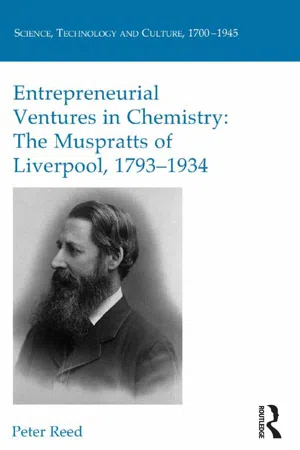
The Muspratt family form a fascinating dynasty in the history of British commerce and manufacturing. Associated principally with the development of the chemical industry in Liverpool - James Muspratt (1793-1884) was the first person to make alkali on a large scale using the Leblanc Process - the three generations of the family also contributed to wider Victorian and Edwardian culture through their interests in politics, education (founding the Liverpool College of Chemistry in 1848), art, literature and theatre. This is the first study to present the history of the Muspratts as a family group and to consider the entrepreneurial spirit they brought to chemical manufacture in Britain and to their many other ventures.
Chapter 1
Introduction, Family Firms and Entrepreneurship
Introduction
My interest in the Muspratt family began in 1975 when I moved to Liverpool to join the staff of Liverpool Museum, then part of Merseyside County Museums (and now part of National Museums Liverpool). Before moving to the North West I had taught chemistry and general studies at the Grammar School, Henley on Thames in Oxfordshire, and while there had the opportunity to develop my interest in the history of science, technology and medicine and to attend several courses in industrial archaeology (IA). IA at that time was a relatively new discipline but it was beginning to attract a keen following among both professionals and amateurs since so much of our industrial heritage had disappeared or was in the process of doing so. It brought together experts from many different fields: architects, surveyors, economic historians, industrial historians, historians of science and historians of technology; all contributed their expertise and knowledge alongside enthusiastic amateurs. It was an exciting period for IA as the many books testify, and led to a much greater appreciation of our industrial heritage and the part industry has played in shaping Britain.
Liverpool Museum provided staff support as well as a working base for the local industrial archaeology society, North Western Society for Industrial Archaeology and History (now Merseyside Industrial Heritage Society), because of the complementary work of both organizations. The activities of the Society brought me into contact with some of the important industrial developments in Merseyside (and the surrounding area), many originating during the period of mass industrialization from the mid-eighteenth century (referred to as the Industrial Revolution), extending through the nineteenth century and continuing into the twentieth century, such as canals, railways and docks, as well as many industrial sites, factories and warehouses. By the 1970s many sites were in a derelict state and required detailed recording before they finally disappeared. It was not long before I began to investigate the surviving evidence of the early nineteenth-century chemical industry across the Merseyside region that included Liverpool, St Helens, Newton-le-Willows and Widnes. As a result of government-initiated land reclamation schemes, by the mid-1970s physical evidence of past activities was fast disappearing even in places such as Widnes, which during the 1880s had become the iconic ‘chemical town’ with its plumes of black smoke and rich affluvia in the air, and had remained a centre of chemical manufacture. Recording these physical remains led to an examination of surviving records and documents associated with the industry. As these researches continued and their scope expanded, one family name kept recurring in several different contexts; this was the Muspratt family.
A remarkable story unfolded spanning three generations of the family and their leading role in chemical manufacture in Britain over the period 1814 to 1934. From 1814, when James, aged 21, started manufacturing chemicals on a small scale in the centre of Dublin, extending through the nineteenth century with his sons Sheridan, Richard, Frederic and Edmund, working in the family chemical businesses across the North West of England and in North Wales, with Edmund and the United Alkali Company (UAC) (that brought together all the Leblanc manufacturers in Britain into a combine of 48 works) from 1890, with Max (James’s grandson and Edmund’s son) during the First World War leading UAC’s response to urgent government demands for chemicals, and reaching 1926 when Max as Chairman of the United Alkali Company became a founding director of Imperial Chemical Industries Limited (ICI). ICI was formed as a giant corporation by rationalization of the British chemical industry by bringing together four major companies – Nobel Industries Limited, British Dyestuffs Corporation Limited, Brunner, Mond Limited and United Alkali Company Ltd – in response to competition from Germany’s chemical combine, I.G. Farben and major US companies, Dow and Du Pont. James Muspratt’s leadership role in developing the British chemical industry during the first half of the nineteenth century was recognized later when he acquired the sobriquet – ‘Father of the British Heavy Chemical Industry’.1 The family’s involvement in chemical manufacture ended with Max’s death in 1934, a span of 120 years (Chapters 2, 3, 4, 5, 10, 12 and 13).
As research broadened out, family ventures other than manufacturing chemicals began to emerge. James was one of the early pioneers of the Leblanc process for making soda from salt, and he adopted it on such a very large scale that he and his works were regularly indicted for causing a ‘nuisance’ due to the hydrogen chloride gas (or acid gas as it was called in the alkali trade) released from very tall chimneys that became a characteristic feature of these alkali works. Examination of the Muspratt court cases, in particular the 1838 case, gives an insight into the difficulty of getting financial redress through the then existing laws. This unsatisfactory position led Parliament in 1863 to pass the Alkali Act, the first legislation to control pollution from chemical works, and thereby establish the Alkali Inspectorate with a team of inspectors under the leadership of Robert Angus Smith. The Inspectorate still operates today but as H.M Inspectorate of Pollution under the auspices of the Environment Agency (Chapter 6).
With the success of his chemical businesses, James had become a wealthy businessman by the late 1830s, and while never interested in acquiring a country estate as with many other wealthy industrialists, he built Seaforth Hall, a stone mansion in classical style with extensive grounds on the outskirts of Liverpool near the mouth of the River Mersey. This mark of improved standing and importance in society (while never of course achieving the status of the landed gentry), epitomized what economic historians have termed gentrification.2 The interior of the Hall did not try to replicate the stately home, but was nevertheless furnished throughout in elegant styles of the period. The family built up a fine collection of pictures and sculpture – several specially commissioned from the family’s travels in Europe. While it was principally a family home, the Hall also allowed James and his sons to take time out from their business ventures and enjoy life in more refined surroundings, entertaining fellow businessmen and politicians, and enjoying the company of a wide circle of literary, artistic and theatrical friends such as Charles Dickens, Mark Lemon, William Linton and William Macready. For the Muspratts, the refined, convivial surroundings and social ethos of Seaforth Hall stood in stark contrast to their industrial chemical businesses (Chapters 4 and 9).
Members of the Muspratt family were strong advocates and supporters of advances in education that became such an important feature of the Victorian period. In Liverpool, these included the Liverpool Mechanics Institute, the Liverpool College of Chemistry (founded in 1848 to provide the same educational opportunities in Liverpool as the Royal College of Chemistry in London), University College Liverpool and the University of Liverpool. The development of these institutions shows the Muspratt family’s imprint, and as a group form an important part of the Muspratt legacy (Chapter 7).
While all James’s sons had an understanding of chemistry from their times spent studying with Thomas Graham in Glasgow and London and with Justus Liebig in Giessen and Munich, it was Sheridan who having shown a lack of business acumen, decided to pursue a career teaching chemistry (as founder of the Liverpool College of Chemistry) and acting as a chemical consultant and an analytical chemist. The Royal Society Catalogue of Scientific Papers lists 39 papers for Sheridan, including 20 relating to analysis of spa waters, 10 to organic chemistry and seven to inorganic chemistry. In most papers Sheridan is the sole author but several including those on the issue of chemical type in organic chemistry are authored with Wilhelm Hofmann, Liebig’s assistant at Giessen and later Director of the Royal College of Chemistry in London. Sheridan took a very active role exposing those responsible for adulterating food and drink, and also appeared as an expert witness in court cases involving poisoning. He wrote four books of which the most important and influential is Chemistry, Theoretical, Practical and Analytical as Applied and Related to Arts and Manufactures, initially issued in 66 monthly parts, each comprising about 32 pages (1852–1859), and later published as a fine two-volume set (1860) and in several languages. The two-volume set follows a dictionary style comprising nearly 2,000 pages covering 86 main entries, with many fine engravings of machinery and chemical plant. Chemistry provides a very good summary of chemical understanding and its applications in the 1850s (Chapter 8).
Family members were also forthright in their political views; they were liberals in outlook and strong supporters of free trade. James stood for Liverpool Town Council in the 1835 local elections following the Municipal Reform Act of the same year, and later his sons Richard and Edmund were elected to Flint Town Council and Liverpool Town Council respectively, with Richard also regularly elected Mayor. Edmund also stood as the Liberal candidate for the Widnes constituency in the 1885 General Election, while his son Max was elected to Liverpool City Council in 1903 as a Liberal but later switched to the Conservative Party following the fragmentation of the Liberal Party during the 1920s. In the General Election of January 1910 Max was elected as the Member of Parliament for the Exchange Division of Liverpool before losing the seat in the December 1910 election. He unsuccessfully contested the Bootle constituency in the March 1911 General Election. These political commitments and civic duties reflect the mid-nineteenth-century movement that saw prominent and successful businessmen taking an increasingly active role in Parliament and civic institutions to improve the well-being and welfare of the communities they served, often while continuing with their business commitments (Chapters 11 and 13).
Family Firms
Family firms have been ‘crucial features of the business landscape for centuries’.3 Indeed, the Victorian age is commonly represented as ‘the age of the family firm’.4 Family firms are difficult to define because of ‘their multi-dimensional nature’, but Andrea Colli and Mary Rose have offered a useful working definition, as ‘one where a family owns enough of the equity to be able to exert control over strategy and is involved in top management positions’.5 The Muspratt firms through three generations of the family formed an important part of the British business scene during the Victorian and early-Edwardian periods. Studying the Muspratt businesses shows how the family’s involvement and control changed from James as sole owner or proprietor to private partnerships with his sons and business associates, joint stock companies, limited liability companies, and finally to his grandson as a director of Imperial Chemical Industries Ltd. It is important to point out at this stage that this book is not a business history because very few business records for the period before the formation of the United Alkali Company in 1890 have survived.
Some historians including Alfred Chandler have attributed Britain’s economic decline towards the end of the nineteenth century to family businesses that ‘lacked both the financial and human capital to pursue sustained business growth in capital and technology intense industries’.6 Other historians such as Martin Wiener attributed the economic decline to the role of gentrification whereby finance was taken out of the family firms to provide personal aggrandizement such as country houses or country estates.7 Following on from these two claims, business historians have focused on several different perspectives, including the role of succession in family firms, the role of the family firm in managing the family’s inheritance and the link between the family firm and the aspirations and motivations of the family. Succession in family firms was critical for their longevity, particularly after the death of the founding owner. The relationship between the founding owner and the family firm is likely to be extremely emotional, having seen the original business opportunity, and then through hard work secured its future and the wealth of the family. The prospect of other family mem...
Table of contents
- Cover Page
- Title Page
- Copyright Page
- Contents
- List of Figures
- List of Tables
- Acknowledgements
- Permission for Quotations
- List of Abbreviations
- Muspratt Family Tree
- Muspratt Chemical Works
- 1 Introduction, Family Firms and Entrepreneurship
- 2 James Muspratt and the Early Years, 1793–1822
- 3 Entrepreneurial Spirit to the Fore and Overseas Disputes, 1822–1840
- 4 Gentrification with Seaforth Hall and Conflict in the North American Trade, 1841–1851
- 5 Business Expansion and Changes in Leadership, 1852–1870
- 6 Causing a Nuisance! ‘The Monster Nuisance of All’
- 7 The Muspratts and Advancements in Education
- 8 Sheridan’s Pursuit of Chemistry
- 9 Patronage of the Arts
- 10 Business Uncertainty and the United Alkali Company, 1871–1890
- 11 Political Aspirations and Civic Responsibilities
- 12 Innovation, War and Further Business Rationalization, 1891–1926
- 13 End of a Dynasty, 1926–1934
- 14 The Muspratt Legacy and the Epilogue
- Muspratt Bibliography
- General Bibliography
- Index
Trusted by 375,005 students
Access to over 1.5 million titles for a fair monthly price.
Study more efficiently using our study tools.
Frequently asked questions
Yes, you can cancel anytime from the Subscription tab in your account settings on the Perlego website. Your subscription will stay active until the end of your current billing period. Learn how to cancel your subscription
No, books cannot be downloaded as external files, such as PDFs, for use outside of Perlego. However, you can download books within the Perlego app for offline reading on mobile or tablet. Learn how to download books offline
Perlego offers two plans: Essential and Complete
- Essential is ideal for learners and professionals who enjoy exploring a wide range of subjects. Access the Essential Library with 800,000+ trusted titles and best-sellers across business, personal growth, and the humanities. Includes unlimited reading time and Standard Read Aloud voice.
- Complete: Perfect for advanced learners and researchers needing full, unrestricted access. Unlock 1.5M+ books across hundreds of subjects, including academic and specialized titles. The Complete Plan also includes advanced features like Premium Read Aloud and Research Assistant.
We are an online textbook subscription service, where you can get access to an entire online library for less than the price of a single book per month. With over 1.5 million books across 990+ topics, we’ve got you covered! Learn about our mission
Look out for the read-aloud symbol on your next book to see if you can listen to it. The read-aloud tool reads text aloud for you, highlighting the text as it is being read. You can pause it, speed it up and slow it down. Learn more about Read Aloud
Yes! You can use the Perlego app on both iOS and Android devices to read anytime, anywhere — even offline. Perfect for commutes or when you’re on the go.
Please note we cannot support devices running on iOS 13 and Android 7 or earlier. Learn more about using the app
Please note we cannot support devices running on iOS 13 and Android 7 or earlier. Learn more about using the app
Yes, you can access Entrepreneurial Ventures in Chemistry by Peter Reed in PDF and/or ePUB format, as well as other popular books in History & 19th Century History. We have over 1.5 million books available in our catalogue for you to explore.