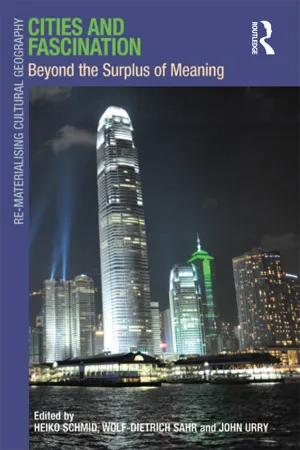
eBook - ePub
Cities and Fascination
Beyond the Surplus of Meaning
- 262 pages
- English
- ePUB (mobile friendly)
- Available on iOS & Android
eBook - ePub
Cities and Fascination
Beyond the Surplus of Meaning
About this book
Bringing together leading urban scholars, this book discusses the linkages between the economic, social and psychological factors of the urban environment. It focuses on the growth of private urbanity that has led to a 'spectactularization' of the city, the most extreme component of attention being the fascination which is aroused by attractions and state-managed events. The complex characteristics of this fascination are examined under the dimensions of aesthetics, emotions, lived experiences and power structures and governance. The interdisciplinary nature of this collection has wide international appeal and will be of interest to academics of social and cultural geography and cultural and media studies.
Chapter 1
Cities and Fascination: Beyond the Surplus of Meaning
In the course of economic and cultural globalization most large cities and metropolises have undergone far-reaching transformations induced by an increasing commercialization of urban space and, as a ‘postmodern’ consequence, intense processes of semiotization and emotionalization. Thus, urban configurations are more and more supplemented by semiotic and psychological processes. When hypermarkets and shopping centres turn into themed environments, when pedestrian zones become festival market places, when traditional housing is transformed into gated communities, and when even lower-class housing areas are increasingly covered with cultural expressions and advertisements, then the urban environment appears much more semiotic than traditional approaches of sociological and geographical research can capture. The induced social modifications result in new power relations, where rational competences and responsibilities are increasingly transferred to socio-psychological and cognitive processes. This new social configuration is accompanied by new constellations of urban actors, diminishing the influence of public actors and transferring their power to private and semi-state actors.
Such a situation calls for a more comprehensive approach combining semiotic, cognitive and emotional elements. The growth of private urbanity through spectacularization is followed by the creation of new ‘urban’ subjectivities. These are partly based on consumer attitudes that refer to hedonistic and mass-oriented behaviour. Several classic authors have already pointed to this phenomenon. Initially, they referred to the ‘bourgeois’ as the new rising class, as predicted poetically by Baudelaire and the symbolist French poets. Some decades later, Thorstein Veblen’s famous The Theory of the Leisure Class (1899), and Georg Simmel’s writings about the emotional consequences of life in large cities, as well as the profound reflections of Walter Benjamin on the passages of Paris, have put such a new socio-psychological disposition in scientific terms. But it was only when Guy Debord published his famous La Societé du Spectacle [Society of the Spectacle] (1967) that the phenomenon of theming became recognized as a sociopolitical structuration element in the city, revealing the function of the aesthetic in forming urban space.
Consequently, since the 1980s and 1990s, several authors have increasingly focussed on the semiotic effects of this phenomenon, principally in the French and English speaking communities. In 1986, Gottdiener and Lagopoulos in The City and the Sign related signification to material culture. Later on, Mark Gottdiener (1995) examined aesthetical processes based on a specific socio-semiotic approach, examining examples such as shopping malls. Other authors, like Lash and Urry (1994) in Economies of Signs and Space, addressed the phenomenon of a commodification of signs from the consumption side, interpreting the aestheticization of material objects as crucial in an emerging economy of signs. Among German speaking authors, we highlight a slightly different discussion, with Georg Franck’s approach of an Ökonomie der Aufmerksamkeit [Economy of Attention] (1998), Gerhard Schulze’s reflections of Die Erlebnisgesellschaft [The Event Society] (1992), Bernhard Waldenfels’ Sinnesschwellen [Senses’ Thresholds] (1999) or Hartle’s Der geöffnete Raum. Zur Politik der ästhetischen Form [The Opened Space – Politics of the Aesthetic Form] (2006). While most English speaking authors have referred to critical and/or semiotic, including neo-Marxist, approaches, German speaking authors usually refer to more phenomenological perspectives. However, rarely have both tendencies been discussed together. Therefore this book tries to open up such a dialogue, in spite of some aspects of incompatibility, between these different approaches.
Specifically, Georg Franck’s contribution, an Economy of Attention (1998), tries to bridge the diverse perspectives. Franck analyzes processes of scarcity, as a basic principle for price mechanism in capitalism, but also as a socio-psychological process of individuation that focuses on attention. Attention then is interpreted as a specific form of ‘income’, gaining its value as reputation or prominence, as ‘payment of attention’, mingling economic, psychological, and phenomenological factors. In this perspective, the actual city appears as a battle field for attention, and not only as an expression of use and exchange value as it was commonly marked in classical economic approaches. Psychology and phenomenology now assumed the function of a kind of parallel economy. In this respect, fascination – as a component of socio-psychological attention – is embedded into a wide ranging field of emotional attitudes, like fear, rejection, and repulsion on the negative side, and relaxation, comfort, and attraction on the positive side. What is at stake here, is on one hand the psychological forming of an urban sensitivity and cultural emotional competence, but also the manipulation of attraction and repulsion by urban actors. Thus, psychological attitudes and stage-managed events often have a magnetizing and captivating effect on the consumer, so that economic and social decisions are no longer rational. Perception and consumption of experience becomes a ‘vice’. In this sense, ‘fascination’ is not only described as an externally structured compulsion and binding process (enchantment), but also forms the internal desire for seduction and happiness. It thus plays a key role in the commercialization of theming and in the economic utilization of urban landscapes. An ‘Economy of Fascination’ (Schmid 2006, 2009) is situated right in this intermediate field between economy, psychology, and phenomenology. It becomes an effective link between economic rationality and emotionality in the life world, which requires an intense and dialogical reflection of both critical and phenomenological attitudes. Therefore, this book is an attempt to bring together these sometimes very diverse theoretical and/or empirical aspects that highlight the interface between ratio and feeling by focussing on the fact of fascination in the city.
Fascination from Enchantment to Delight: (Etymological) Roots as Representations of Social Transformations
The word fascination has passed through several reinterpretations and resemanticizations, changing from a word meaning witchcraft to one associated with social experience and popular culture (Weyand 2009: 208). This transformation has not been linear, but has taken place in several shifts, moving from magic to interpersonal relations, and then to the attraction for things and events in general: ‘The history of the term goes back to antiquity, linked for a long time with the belief in witches until it developed in the nineteenth century to a form of interpersonal gravitation and since the twentieth century to an attractiveness of things and events of all types.’ (Hahnemann and Weyand 2009: 9).1
The term fascination originates from the Latin fascinus, which means spell or witchcraft. Among linguists, it is debated if fascinus itself has been borrowed from the Greek báskanos [sorcerer, bewitcher] or if báskanos only stands for ‘to speak’ traced back to Thracian bask (Klein 2003: 274, Barnhard 2002: 370). In the centuries following antiquity, ‘fascination’ in Europe was still related to the meaning of witchcraft, although the word was not excessively used in the Middle Ages. It was the witch hunting era in the early modern period, between the late fifteenth and early nineteenth century, that induced a certain (re)naissance of the term. In European literature, ‘fascination’ is documented for the first time in the late sixteenth and early seventeenth centuries: e.g. in Francis Bacon’s Advancement of Learning from 1605. Symptomatic for the sporadic use of the terminus at that time is William Shakespeare’s tragedy Macbeth, in which the author addresses the topic of witchcraft, prophecy, and suggestion, but without ever using the word ‘fascination’ (Seeber 2009).
In the era of Enlightenment ‘fascination’ gradually veers away from the semantic field of witchcraft becoming more and more associated with interpersonal attraction. Several patterns of explanation exist for this process of resemanticization: one explanation is the rationale-based rejection of any mystic idea of witchcraft. At that time the acceptance of a ‘catching’ eye (contact) was interpreted by some authors as a ‘visual’ infection, as it was by the German physician Sennert.
A more socio-psychological perspective was introduced through the principle of sympathy. Following this idea, the German philosopher Sloterdijk (1998: 212) interprets fascination as sympathy that interpersonally originates from the reciprocity of love, a romantic bourgeois concept that arises in the seventeenth century and matures in the Enlightenment. In this context erotic aspects and the (corporeal) desire are addressed, so that Sloterdijk (1998: 261) speaks of fascination as ‘a magical state of being enravished in mutually erotic enchantment.’2 One prime expression of this feeling can be found in Baudelaire’s lyrics of the nineteenth century, when he speaks of fascination as an almost mesmerizing encounter with a beautiful woman, combining an aesthetic situation of unexpectedness, spirituality, and erotic desire: ‘The sweetness that fascinates and the desire that kills’ (Baudelaire, quoted in Seeber 2009: 97).3 The word ‘mesmerize’, very common in French spiritualism as a counter reaction to rationalist positivism, leads to a specific physical aspect in the interpersonal social relations of fascination: that of hypnosis, the manipulation of consciousness. In late eighteenth century Europe, the ‘disease-philosophical approach’4 of the German physician and astrologist Franz Anton Mesmer had become very popular (Sloterdijk 1998: 228). Mesmer described the influence of the planets on the human body and on disease and used this idea for the treatment of patients through hypnosis: ‘The power of the mesmerist to fascinate or entrance his subjects was most commonly explained as the effect of magnetic or electrical forces originating in the body of the mesmerizer and passing across to his subjects.’ (Connor 1998: 11). Although the idea of mesmerism was heavily disputed, it had established itself as an almost scientific theory for interpersonal relations.
Sloterdijk (1998: 257ff.) also points to a third tradition of fascination, mentioning Johann Gottlieb Fichte’s Ekstase der selbstlosen Aufmerksamkeit [ecstasy of a selfless attention]. The German philosopher of Enlightenment had adapted the idea of Mesmer’s magnetism to his idealism and assigned it to the situation of a student paying his full attention to the rhetoric of his teacher. The student’s attentional ecstasy in this situation symbolizes, according to Fichte (1835, quoted in Sloterdijk 1998: 260f.), a devotion and self-abandonment before God, reflecting the Grundpunkt der Individualität [point of origin of individuality].
In the twentieth century ‘fascination’ developed a more general meaning in the sense of delight and attraction. This conversion into a psychological power coincides with a shift from a transitive to an intransitive relation, and therefore points to an indefinite and vague form of attraction. Now, fascination is no longer attributed to magic and interpersonal attraction: ‘Attention has shifted away from the power to fascinate possessed by certain persons or beings, to the power of fascination as it may be lent to or bestowed upon fascinating objects, ideas or persons.’ (Connor 1998: 12). Leaving most of its former semantic ballast behind, it became a widely adapted term of popular culture. But at the same time, ‘fascination’ retained a kind of mystification by its inherent vagueness and by not revealing its own secret completely (Seeber 2009). This makes ‘fascination’ a variable ‘projection screen for the imagination of the consumer’5 as Hahnemann and Weyand proclaim (2009: 7). Drawing on Roland Barthes’s theorization on photography in La Chambre Claire [Camera Lucida] (1980), Hahnemann and Weyand argue that ‘fascination’ is an aesthetic experience that is based on an inner restlessness that occurs when something can not be denominated (2009: 22).
Against this background, it seems that ‘fascination’ is construed as a force that includes attraction, desire, and mystification, but also terror and fear, far beyond a materialism and conception of the rational subject.
Ambivalences as Definite Characteristics: Gazes and Dualities
Departing from this etymological background of ‘fascination’, which represents the transformative history of its social function, this book develops theoretical and empirical ideas for fascination that focus on the phenomenological aspects of proximity and distance, the psychological permutation of self and not-self, the ambivalence of positive and negative aesthetics, and especially the commercialization of fascination that intrudes upon and emotionally shapes the consumer’s lived experience.
The dichotomy of proximity and distance is probably the most important aspect in the phenomenology of fascination. To a certain extent, fascination neutralizes the Euclidean distance by a ‘touching gaze’. This is particularly evident in the writing of French novelist Maurice Blanchot, who situates, as Weingart (2002: 24) expresses it, ‘fascination in the tension of distance and touch, of separation and encounter, of blindness and vision’.6 Fascination overcomes, and at the same time results from these dichotomies: ‘Whoever is fascinated doesn’t see, properly speaking, what he sees. Rather, it touches him in an immediate proximity; it seizes and ceaselessly draws him close, even though it leaves him absolutely at a distance.’ (Blanchot 1989: 33).
The lack of distance in perception and the process of distancing between the observer and the observed has been conceptualized by the German philosopher Bernard Waldenfels in his Phänomenologie der Aufmerksamkeit [Phenomenology of Attention] (2004). Waldenfels highlights a Doppelbewegung [reciprocal dynamic] between salience and attending, between the ‘things’ that are salient and the ‘subjects’ who attend to things. He thus proposes an intermediary between ‘things’ and ‘subjects’ that can be represented through various techniques and social practices that incorporate power and control in politics and an economy of attention (Waldenfels 2004: 228).
The dissolution of distance between the self-determined subject that is a constructive principle of modernity, and the objects of his (also constructed) desires in a postmodern capitalist system induce new aesthetic-moral attitudes, both in an affirmative and a rejective stance. The affirmative includes a gaze, where imagination leads to the satisfaction of a supposed inner desire. The negative aspect is related to the sphere of manipulation, where mechanisms of infatuation and mesmerization consciously or unconsciously distort the free will of a person. This gives ‘fascination’ a social and political ambivalence that, following Connor (1998: 12) appears as a kind of self-determined arrest: ‘The desire for fascination is a desire for arrest, but of a certain enlivening kind, in which the subject of fascination is at once enthralled and aroused.’ Thus, the modern subject is caught between their own desires as supposed self-expressions and their consciousness about manipulation processes that might have caused these through seduction.
Desire and seduction are also key processes in the commodification of this phenomenon. Here, fascination serves as an emotional multiplicator in the consumption process. It addresses emotional needs, while offering satisfaction. Due to the fact that such satisfaction is limited to a short moment, a continuous process of desiring is induced calling for new satisfaction – sometimes in an addictive way. Against this background, fascination is most attractive for an expanding market economy. Industry now produces desires and addictions, using processes such as excessive attention and stimulus satiation, and thus relies basically on human emotions.
Fascination represents a socio-psychological construction of a specific (incomplete) duality. It cannot be forced by means of enchantment alone, but is always dependent on the disposition to ‘receive an external will’ (Weingart 2009: 48).7 Schmid (2009: 25) has expressed this relation between economy and emotion as follows: ‘Fascination works in two respects: on the one hand it is an externally structured compulsion (enchantment), and at the same time it takes the form of an internal desire on the part of the consumer, which is directed at the exotic and the unique, and also at the thrill of gratification and seduction.’ From this perspective, fascination is based on mainly individual (sometimes also collective) desires and political structuration. In a capitalist economy, it appears in the space of ‘inbetweenity’ of producing a psychologically construed self (the consumer) and a gigantic system of structures of seduction (the market), where even profit (understood as the transformation of the Nietzschean desire for power into a market equivalent) turns out to be a secondary element. Such ‘inbetweenity’ of fascination explains, why epistemologically the authors of this book argue in such a diverse manner – sometimes they try to understand the phenomenon from a more theoretical position, torn between phenomenological, neo-Marxist, and/or (post-) structuralist approaches,...
Table of contents
- Cover Page
- Half Title page
- Title Page
- Copyright Page
- Contents
- List of Figures and Table
- Preface
- Acknowledgements
- List of Contributors
- Cities and Fascination: Beyond the Surplus of Meaning
- Revealing Fascination: Theoretical Horizons
- Focusing Fascination: Crossing Theoretical and Empirical Perpectives
- Implementing Fascination: Case Studies
- Consequences of Fascination: New Horizons
- Index
Trusted by 375,005 students
Access to over 1.5 million titles for a fair monthly price.
Study more efficiently using our study tools.
Frequently asked questions
Yes, you can cancel anytime from the Subscription tab in your account settings on the Perlego website. Your subscription will stay active until the end of your current billing period. Learn how to cancel your subscription
No, books cannot be downloaded as external files, such as PDFs, for use outside of Perlego. However, you can download books within the Perlego app for offline reading on mobile or tablet. Learn how to download books offline
Perlego offers two plans: Essential and Complete
- Essential is ideal for learners and professionals who enjoy exploring a wide range of subjects. Access the Essential Library with 800,000+ trusted titles and best-sellers across business, personal growth, and the humanities. Includes unlimited reading time and Standard Read Aloud voice.
- Complete: Perfect for advanced learners and researchers needing full, unrestricted access. Unlock 1.5M+ books across hundreds of subjects, including academic and specialized titles. The Complete Plan also includes advanced features like Premium Read Aloud and Research Assistant.
We are an online textbook subscription service, where you can get access to an entire online library for less than the price of a single book per month. With over 1.5 million books across 990+ topics, we’ve got you covered! Learn about our mission
Look out for the read-aloud symbol on your next book to see if you can listen to it. The read-aloud tool reads text aloud for you, highlighting the text as it is being read. You can pause it, speed it up and slow it down. Learn more about Read Aloud
Yes! You can use the Perlego app on both iOS and Android devices to read anytime, anywhere — even offline. Perfect for commutes or when you’re on the go.
Please note we cannot support devices running on iOS 13 and Android 7 or earlier. Learn more about using the app
Please note we cannot support devices running on iOS 13 and Android 7 or earlier. Learn more about using the app
Yes, you can access Cities and Fascination by Wolf-Dietrich Sahr, Heiko Schmid,Wolf-Dietrich Sahr,John Urry, Heiko Schmid in PDF and/or ePUB format, as well as other popular books in Social Sciences & Geography. We have over 1.5 million books available in our catalogue for you to explore.