eBook - ePub
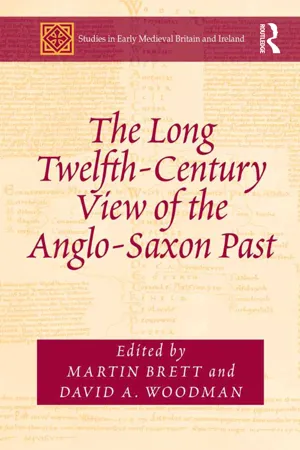
The Long Twelfth-Century View of the Anglo-Saxon Past
- 438 pages
- English
- ePUB (mobile friendly)
- Available on iOS & Android
eBook - ePub
The Long Twelfth-Century View of the Anglo-Saxon Past
About this book
Scholars have long been interested in the extent to which the Anglo-Saxon past can be understood using material written, and produced, in the twelfth century; and simultaneously in the continued importance (or otherwise) of the Anglo-Saxon past in the generations following the Norman Conquest of England. In order to better understand these issues, this volume provides a series of essays that moves scholarship forward in two significant ways. Firstly, it scrutinises how the Anglo-Saxon past continued to be reused and recycled throughout the longue durée of the twelfth century, as opposed to the early decades that are usually covered. Secondly, by bringing together scholars who are experts in various different scholarly disciplines, the volume deals with a much broader range of historical, linguistic, legal, artistic, palaeographical and cultic evidence than has hitherto been the case. Divided into four main parts: The Anglo-Saxon Saints; Anglo-Saxon England in the Narrative of Britain; Anglo-Saxon Law and Charter; and Art-history and the French Vernacular, it scrutinises the majority of different genres of source material that are vital in any study of early medieval British history. In so doing the resultant volume will become a standard reference point for students and scholars alike interested in the ways in which the Anglo-Saxon past continued to be of importance and interest throughout the twelfth century.
Chapter 1
Introduction
The chapters published below originated in a conference held at Robinson College, Cambridge on 29–30 March 2011. This was structured around three convictions of the organisers, each amply confirmed by the papers that were given, and the discussion that they provoked. The first was that the ways in which post-Conquest writers and artists positioned themselves in relation to the Anglo-Saxon past could tell one much about the world they thought they inhabited themselves. The second was that a great deal of valuable work was being done in all these fields, and that it would be useful to take stock of the present state of scholarship, at least under some of its aspects. The third was that the topic continues to reward study long after Anglo-Saxon England became Anglo-Norman England or even a Plantagenet empire. The constraints of time and space demanded that this could be explored only until the opening years of the thirteenth century, but much might be said of succeeding centuries too. The choice of contributors also reflected a desire to avoid any tendency for subject specialists to treat 1066 as a watershed in scholarship as well as in experience. The intention was to ensure that experts in the pre-Conquest period would be able to control exaggerated claims which might be made for innovation in the twelfth century, or indeed for the survival of earlier intellectual or practical patterns.
At one level the questions we ask are part of the most enduring issue in all English historiography. Why and how the Norman Conquest happened, and what consequences followed from it, are problems which were central to the first great flowering of historical activity in England among the chroniclers writing in the reigns of Henry I and Stephen,1 were as critical to the ecclesiastical polemic of Matthew Parker in the sixteenth century, for whom the Conquest marked the moment in which the English Church turned from its apostolic origins to Romish error, and played a leading role in the great debates over law, kingship and the social order of the seventeenth century. Nineteenth-century historians, in Germany and France as well as England, sought to identify the contribution of notions of Germanic and Roman or at least Latin social order to the origins of representative government. If such great narratives began to fragment in the twentieth century, particularly with a growing recognition of the resemblances between English history and that of Europe rather than their differences, historiographic debate continued unabated. In recent years one could point, for instance, to the high claims advanced for the nature and powers of the late Saxon state,2 or even for some kind of ‘English conquest’ over the Normans in the four or five generations before 1200.3
Such great questions commonly expect large answers, but large answers tend to become less convincing in detail the more they seek to explain. Our concern was to explore the diversity of answers which might be given, rather than to offer a single new synthesis.
While the contributors all addressed the general theme of twelfth-century understandings of the shaping power of the past, they approached it by exploring particular sources in which they were expert, not only chronicles and saints’ lives, but law tracts and charters, manuscript painting, building and vernacular romance. Predictably, it soon became apparent that the answers offered in one field are often far from easy to align with those in another, and that these differences provoke new and sometimes unexpected questions.
The variety of sources one could examine for the purpose is wide, but some more or less demanded inclusion. The cult of the saints must figure very largely in any enquiry, for their shrines, and the habit of devotion to them, were a fixed point in the landscape whatever the turmoil around them, and their rights were central to the prosperity of the religious centres which gathered round them, whoever now ruled the community. The devotion to earlier saints always required a continuous tradition of reshaping according to changing views of their function and the challenge of new forms of devotion. The arrival with the Conquest of a new audience gave this general proposition a distinctive character in the English twelfth century. The chapters by Bartlett and Love explore this process, examining the influence of hagiographic models little exploited earlier, the ways in which the urgent concerns of ancient houses led to a vigorous literature in which Saxon texts were adapted to new debates, or demanded the composition of accounts of Saxon saints compiled often on the basis of minimal earlier information. The pervasive influence of Bede in twelfth-century writing is a commonplace of modern scholarship; within months of Archbishop Lanfranc’s arrival at Canterbury he could rely on his potent authority as the doctor Anglorum, the more significantly since he was seeking to invoke it in the service of a doctrine of primacy that was as novel in England as it was anywhere in Europe. Webber’s examination of the use of lections from Bede in the liturgy of the night office of matins is a significant demonstration of the ways in which his influence could be diffused much more widely than is obvious in the study of purely narrative texts. To start with hagiography is more than a matter of convenience, for the saints’ lives were the first narrative responses to the Conquest to survive in England, and many of the chroniclers who addressed the relation of past and present from the reign of Henry I to the end of the twelfth century were hagiographers as well as, and sometimes before, becoming historians.4
These extended chronicles of the English in the twelfth century have been the subject of numerous modern studies, and particularly those of Sir Richard Southern in 1973 and James Campbell in 1984 were the starting point for several further chapters.5 All appear in some sense to be shaped by a determination to reassert an underlying continuity across the Conquest, and a distinctively English one at that. One has to wait until the Abbreviationes by Ralph of Diss at the end of the century for a chronicler who looks at length beyond English sources to write something approximating to a chronicle of the Angevin lordship as a whole.6
There have been new editions and much detailed discussion of the set of chronicles in the names of Eadmer, William of Malmesbury, John of Worcester and Henry of Huntingdon,7 all of whom depended heavily on the Anglo-Saxon Chronicle, but the Durham Historia regum has been more neglected.8 Rollason shows in new detail how Durham’s idiosyncratic pre-Conquest traditions were articulated around a larger narrative of England developed in other monastic centres further south as part of a widespread collaborative enterprise. The Historia regum is in part an exercise in connecting the years after the Conquest with the long history of St Cuthbert earlier, in part a fuller incorporation of the world of St Cuthbert in the story of the realm of England before as much as after the Conquest.9
Barrow surveys the struggle of twelfth-century writers to explain apparent discontinuities in the history of extant religious houses, and equally the extinction of religious life at sites known or said to have been communities earlier, and refounded (or said to be so) more recently. It is striking that post-Conquest authors found it necessary to invoke heathen destruction far more widely than had their tenth-century predecessors, reflecting apparently a need to supply earlier explanations which their sources embarrassingly lacked.
Thomson demonstrates the remarkable way in which William of Malmesbury in his later years came to express a startlingly hostile view of the Normans quite unlike the more measured judgements familiar in his earlier works.10 The passage challenges almost all conventional accounts of the decline of ‘ethnic’ hostilities by the mid-century, and the more so since Malmesbury seems to assume that his audience might be at least receptive. William’s mind and art were of exceptional subtlety, and no single explanation for his larger works will do much to explain them. Nevertheless they can be interpreted in some part as an effort to interpret the Anglo-Saxon past to a partially Norman audience. The passage Thomson discusses, appropriately enough from the commentary on the Lamentations of Jeremiah, suggests that William may have approached the task with less optimism or readiness than we have supposed.
The degree to which Norman writers after 1100 absorbed any part of the longer narrative of Britain has been little treated outside Chibnall’s magisterial studies of Orderic Vitalis.11 Liesbeth van Houts takes up the topic, in her account of the very modest place of Anglo-Saxon or even post-Conquest history of England in Norman chronicles, apart from Orderic, until Robert of Torigni’s annals came to provide an account of the twelfth century which does treat the Norman lordship either side of the Channel as something more like the Norman empire of much recent scholarship.12 Up to this point the contributors have been discussing the influence of a vision of the Anglo-Saxon past which can claim to rest on written record or living memory, however incomplete or tendentious. Robert of Torigni, however, introduces the ever more powerful influence of the fictive history of Britain of Geoffrey of Monmouth – which Robert first showed to an astonished Henry of Huntingdon.
The influence of Geoffrey is demonstrated by Gillingham in what might well seem the least expected of places, and certainly one of the least studied, in the largely unpublished work of Richard of Devizes. Richard has often been represented as the most sceptical, ironic and even secular-minded of observers of his own time. There is no doubt that he speaks in a distinctive voice, but Gillingham shows that he was prepared to give significant space to Geoffrey’s imaginary world, and indeed to do more, for Richard seems to have worked over his source with some imagination and thought. James Campbell’s ‘tide of nonsense’ is shown to have risen higher, and spread further, than we had supposed – so that the relative value attached to the fictional history of Britain as against the (partially) sober history of Anglo-Saxon England becomes a yet more pressing object for reflection.
The next group of studies turn from hagiography and chronicle to issues of law and government. Vincent analyses the charters of the Norman and Angevin kings up to the reign of John, tracing the extent to which these draw explicitly on the acts of their Anglo-Saxon predecessors. His conclusion, based as it is on a comprehensive corpus for the period, is striking, for he finds that these are barely represented at all in genuine texts, with the qualified exception of those of Edward the Confessor. This is a challenging result, for it has to be set against the apparently widespread production of forged charters in the name of many more pre-Conquest kings, as well as bishops and occasional laymen, which are attributed more or less securely to the twelfth century. Vincent’s conclusion is surely sound, and if so the origins and purpose of this large corpus of later forgery demands much further thought than it has yet received. It also fits uneasily with recent discussion of the Norman claim to a direct line of legal transition from the Saxon kings, suggesting that such arguments, though clearly discernible in some sources, were far from universal, or even perhaps prevalent.
Julia Crick’s minute examination of a number of examples of the conscious imitation of earlier script in some post-Conquest examples of royal acts illustrates the same problem in a particular aspect, and with great clarity. It is particularly convenient that she provides a list of the single-sheet representations of pre-Conquest diplomas which are certainly or probably later – of these only some 20 per cent are attributed to the Confessor. The list, of course, would be enormously extended if it incorporated copies too. She is able to demonstrate two points of particular relevance – the extreme care with which many of them were executed, and the complexity of the motives for which the enterprise may have been conducted. In a broader perspective she compares her findings with those of French diplomatic, with the surprising observation that English forgers manufactured documents predominantly from the tenth and early eleventh century, while the French preferred to father their efforts on late Merovingian or early Carolingian authors.
Vincent’s programme is also difficult to harmonise with the lessons taught by the numerous twelfth-century law-codes, mostly attributed to Cnut and the Confessor, examined by Bruce O’Brien, building on the work of Patrick Wormald.13 His study underlines the remarkable energy and care with which these pseudonymous compilations were constructed, the elaboration of their claims to ancient authority and the apparent value attached to them into the thirteenth century, attested by the number and date of the copies in which they survive. The specific case of the ‘Colbertine’ Cnut is a powerful demonstration of the minute attention which could be devoted to these texts. It has long been remarked that this is a significant problem, for the gap between the late-twelfth-century editions of the old codes and the handbook of ‘Glanvill’ of the same date is as wide as the Atlantic, and there is very little reason to suppose that the law of these compilations continued to be practised on any scale. O’Brien observes that these apparently antiquarian collections can travel in the company of undoubtedly current texts, Roman law tracts on procedure or even early collections of the decretals of Alexander III. The difficulty of explaining this fact has long been familiar, and it is striking that placing it more fully in the context of charter and script only increases the difficulty.
The study of Judy Weiss on Anglo-Saxon England in vernacular romance reveals a complex set of references to the Anglo-Saxon past, which cannot be forced into any easy pattern of thought. She does however contribute a new piece of evidence to the problem of ideal and current law. The theme of the good law of King Edward reappears in her analysis of Waldef, where it is expounded at London against the tyrannical conduct of ‘King Fergus’ of London, by the authoritative voice of Edward the sheriff, ‘very old and … wise in the laws and royal customs’. Waldef is thought to have been written in East Anglia around 1200–1214, so this is a specially resonant observation. The law codes later attributed to King Edward show a clear concern for good law as ancient law, and particularly for consent. Much beloved by seventeenth-century lawyers, these passages were soon dismissed by Anglo-Saxonists as manifest alterations made in the twelfth century. O’Brien’s study reminds us how carefully the passages were framed and revised, and Weiss shows the effect of that association of ideas among a lay audience. As is well known, they figured largely in the Leges Londinienses of c.1200, which in turn seems to have influenced the East Anglian and northern magnates whose rising led ultimately to the drafting of the Great Charter. If this very plausible suggestion is adopted, there is a certain irony in the fact that Edward is represented as frustrating the arbitrary punishment of a mercenary, for King John’s mercenaries were singled out for pros...
Table of contents
- Cover Page
- Title Page
- Copyright Page
- Contents
- Acknowledgements
- List of Figures
- List of Tables
- Abbreviations
- 1 Introduction
- PART I: THE ANGLO-SAXON SAINTS
- PART II: ANGLO-SAXON ENGLAND IN THE NARRATIVE OF BRITAIN
- PART III: ANGLO-SAXON LAW AND CHARTER
- PART IV: ART HISTORY AND THE FRENCH VERNACULAR
- Bibliography
- General Index
- Index of Manuscripts
Trusted by 375,005 students
Access to over 1.5 million titles for a fair monthly price.
Study more efficiently using our study tools.
Frequently asked questions
Yes, you can cancel anytime from the Subscription tab in your account settings on the Perlego website. Your subscription will stay active until the end of your current billing period. Learn how to cancel your subscription
No, books cannot be downloaded as external files, such as PDFs, for use outside of Perlego. However, you can download books within the Perlego app for offline reading on mobile or tablet. Learn how to download books offline
Perlego offers two plans: Essential and Complete
- Essential is ideal for learners and professionals who enjoy exploring a wide range of subjects. Access the Essential Library with 800,000+ trusted titles and best-sellers across business, personal growth, and the humanities. Includes unlimited reading time and Standard Read Aloud voice.
- Complete: Perfect for advanced learners and researchers needing full, unrestricted access. Unlock 1.5M+ books across hundreds of subjects, including academic and specialized titles. The Complete Plan also includes advanced features like Premium Read Aloud and Research Assistant.
We are an online textbook subscription service, where you can get access to an entire online library for less than the price of a single book per month. With over 1.5 million books across 990+ topics, we’ve got you covered! Learn about our mission
Look out for the read-aloud symbol on your next book to see if you can listen to it. The read-aloud tool reads text aloud for you, highlighting the text as it is being read. You can pause it, speed it up and slow it down. Learn more about Read Aloud
Yes! You can use the Perlego app on both iOS and Android devices to read anytime, anywhere — even offline. Perfect for commutes or when you’re on the go.
Please note we cannot support devices running on iOS 13 and Android 7 or earlier. Learn more about using the app
Please note we cannot support devices running on iOS 13 and Android 7 or earlier. Learn more about using the app
Yes, you can access The Long Twelfth-Century View of the Anglo-Saxon Past by Martin Brett, David A. Woodman, Martin Brett,David A. Woodman in PDF and/or ePUB format, as well as other popular books in History & European Medieval History. We have over 1.5 million books available in our catalogue for you to explore.