eBook - ePub
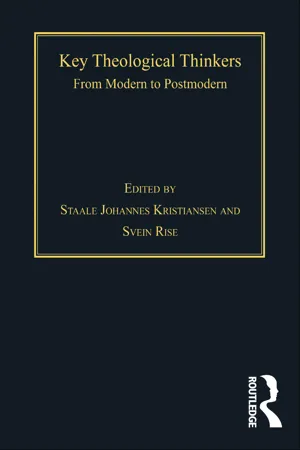
Key Theological Thinkers
From Modern to Postmodern
- 800 pages
- English
- ePUB (mobile friendly)
- Available on iOS & Android
eBook - ePub
About this book
The 20th and 21st Centuries have been characterized by theologians and philosophers rethinking theology and revitalizing the tradition. This unique anthology presents contributions from leading contemporary theologians - including Rowan Williams, Fergus Kerr, Aidan Nichols, G.R. Evans and Tracey Rowland - who offer portraits of over fifty key theological thinkers in the modern and postmodern era. Distinguished by its broad ecumenical perspective, this anthology spans arguably one of the most creative periods in the history of Christian theology and includes thinkers from all three Christian traditions: Protestant, Catholic and Orthodox. Each individual portrait in this anthology includes a biographical introduction, an overview of theological or philosophical writing, presentation of key thoughts, and contextual placing of the thinker within 20th Century religious discourse. Overview articles explore postmodern theology, radical orthodoxy, ecumenical theology, feminist theology, and liberation theology. A final section includes portraits of important thinkers who have influenced Christian thought from other fields, not least from Continental philosophy and literature.
Information
PART I
Introductions
Chapter 1
A Century of Theological Creativity: Perspectives on the Renewal and Development of the Christian Tradition
The last century was arguably one of the most creative centuries in the history of theology. The most striking examples are the many impressive writings by religious geniuses such as Karl Barth, Dumitru Stăniloae, Karl Rahner, and Hans Urs von Balthasar, but the picture is much more comprehensive. We shall illustrate this by means of fifty-two portraits of religious thinkers from the Christian tradition, from the early twentieth century to the early twenty-first century.
In many of these modern and postmodern thinkers, we find exciting attempts to integrate theology into a larger cultural discourse. The links between theology and forms of expression such as literature, music, and the visual arts are important here, not least in several large-scale endeavours to read theology and philosophy in tandem. This makes it natural to compare the twentieth century with brilliant theological epochs such as the fourth and fifth centuries, or the thirteenth and fourteenth, or the sixteenth centuries; depending to some extent on which theological tradition we are speaking about. The last chapter of the present book reflects the fact that several of the most important contributions to the renewal of Christian theology and of the Christian understanding of reality in the last century come from thinkers outside the circles of school-theology.1 In the transitions between the theological and the philosophical realms, or between the religious and the literary realms, several postmodern perspectives become more explicit. This is not surprising, given that much postmodern thinking is characterized by a will to overcome modernity’s tendency to divide things up into academic segments. Postmodern theological thinkers seek to counter this by means of interdisciplinary approaches to the existential and religious challenges of the present day.
A radical reorientation occurred within all three traditions – Protestant, Catholic and Orthodox – in the decades after the First World War.2 In many ways, the tragedy of war cleared the ground for the emergence of something new. It dealt a death-blow to an optimistic faith in development, and opened the door at the same time to an incipient growth of ways of thinking (both religious and secular) that were interested in the existence of the individual rather than in the continuation of the great cultural traditions.3 The new generation of theologians felt strongly that they were living between two epochs. The question now was what new response theology ought to make to modernity. This question left its mark on the first two generations of the theologians who are represented in this anthology – and continues to leave its mark on contemporary theological discourse.
As the book’s subtitle indicates, this collection of portraits covers something of the historical breadth in the theology and the theological thinking of the twentieth century – From Modern to Postmodern. Although this book is not primarily a study of the transition between modern and postmodern theology, many of the portraits and overview articles seek to show that there is more overlapping and continuity in this process than one might initially think. Already in the first generation of twentieth-century theologians, we find authors who anticipate fundamental insights in postmodern theology. From the period between the Wars onwards, we find more and more thinkers who dynamically combine a positive development of the Enlightenment progress, on the one hand, and a conscious break with what was regarded as the reductionism inherent in the Enlightenment project, on the other hand. Accordingly, several explicitly postmodern theologians have consciously developed insights from the first half of the century, for example, the emphasis on the divine otherness in Karl Barth or linguistic-critical and apophatic-theological insights in writers such as Vladimir Lossky and Hans Urs von Balthasar.4 It is important to bring out these links, but at the same time, it must be said that we find radical new thinking in postmodern theological thought, a radicality that emerges more clearly from the 1990s onwards. This involves not least a renewed attitude to the mystery in the Christian faith, linked to key concepts in the philosophy of religion such as “gift”, “otherness”, “the impossible”, and “messianity”.5 There is a clearer theological hermeneutical awareness of theology’s attitude to “the other”, to “the coming of something we did not see coming”.6
We find already in the 1970s the first beginnings of the theological development that came to be known in the 1980s as “postmodern theology”. As Jayne Svenungsson has pointed out, the growth of a postmodern theological thinking during these two decades was marked by a more or less clear opposition between those who wanted to develop further the liberal theological inheritance (the deconstructivist “Death of God” theology pioneered by Mark C. Taylor, and thinkers who offered more revisionist approaches, such as David Tracy and Sallie McFague) and those who wanted to renew Karl Barth’s more traditional theological alternative (Hans Frei and George Lindbeck, and other postliberalists).7 This more Protestant dichotomy gradually became less prominent in the postmodern discourse in the 1990s – both as a consequence of Tracy’s open dialogue with several of the postliberal theologians, and also as a consequence of the significance that other Catholic philosophers of religion such as Jean-Luc Marion and John Caputo took on.8 Their dialogue with Jacques Derrida and their theological implementations of insights in his more explicitly religious writings played an important role here in the 1990s.9
We should note the supra-confessional element in later postmodern discourse. Although one can say that the postmodern element is not so strong in an Orthodox context, a Greek philosopher such as Christos Yannaras contributed, early on, an exciting theological reading of Heidegger in tandem with the church fathers, and later contributed to what he has called “postmodern metaphysics”.10 In recent years, David Bentley Hart has made impressive contributions to a theological evaluation of the relationship between the Western metaphysical tradition and central Christian dogmas, in a lively application of theological aesthetics.11 We find a similar application of holistic theological thinking in an Anglican context. The neo-Barthian movement of Radical Orthodoxy, represented by thinkers such as John Milbank, Catherine Pickstock, and Graham Ward, presents a broad critique of modernity, inspired both by Balthasar’s theological aesthetics and by Henri de Lubac’s critique of modernity’s idea of pura natura.12
Theological Variety and Renewals of the Tradition
It is possible to identify a number of essential common traits in the theological development of the twentieth century, but it is first and foremost the theological diversity that typifies that century in comparison to earlier centuries. In other words, we are confronted by a more complex and many-faceted theological landscape. The contributions to both theology and the philosophy of religion point in different directions, cutting across the three main ecclesial traditions, but also point at different theological approaches within each of the traditions. Historically speaking, the defence of a plurality of theological methods characterizes this period – a gradually increasing awareness that we need a variety of polyvalent approaches to what has been called the polyphony in the Christian revelation.13 The twentieth century has the merit of giving Christian theological thinking a large room for intellectual freedom.
In the midst of the variety, we find interesting connecting lines and shared traits in the theological thinking of the twentieth century, with interesting similarities that cut across the confessional lines. One major driving force in modern theology is the wish to bring theology up to date in the contemporary world, to make it relevant both in the form of ecclesial aggiornamento – we find a basis for this motto of Pope John XXIII already several decades earlier, in all three ecclesial and theological traditions – and in the form of a dialogue with contemporary philosophy. The theological aggiornamento entails first and foremost the attempt to give a fresh and new presentation of the Christian truths. At the same time, it points to a process of becoming aware of the church’s role in political life, especially in the defence of the individual and of the eternal inviolability of the human person.
From the 1930s onward, we find theological presentations that give an account of the dramatic character of human life, of its fundamental uncertainty, in a way that recalls the insights of existentialist thought. Central names here include Rudolf Bultmann, Jacques Maritain, Karol Wojtyła, Paul Tillich, K.E. Løgstrup, Edward Schillebeeckx, Edith Stein, and Hans Urs von Balthasar. The parallel to existentialist philosophy is connected in part with the encounter several of the modern theologians had with Martin Heidegger and his work, but also to their reading of the same Christian source texts that provided Heidegger with inspiration – especially Meister Eckhart, Thomas Aquinas, and their forerunners in the early Christian mystical tradition.14 Here we have a key point in the modern attempts to bring Christian theology up to date: the new theological thinking takes the form of a revitalization of the tradition.
We find a compressed expression of this in an often-quoted essay published by the Jesuit and patristic scholar Jean Daniélou in 1946, in which he writes about the “Modernist crisis” of the end of the nineteenth and beginning of the twentieth centuries. He regards this crisis as unresolved, because the church and the theologians had not sufficiently grasped the existence of what he calls a “rupture between theology and life”.15 Although Daniélou criticizes the agnosticism of Modernism and the wrong paths its exegesis takes, he believes that the condemnation of Modernism by the church leadership cannot be the last word in this matter. Modernism had grasped the distance between theology and people’s concrete lives, and had posed a question mark against this. Now, after World War II, according to Daniélou, many instances in contemporary culture are reminding us of the same situation – contemporary voices that make the future “full of promise”.16 Daniélou’s essay is programmatic for the rethinking and renewal of Catholic theology in the next decades, a renewal in which he himself took part. He writes that a renewal requires that we do justice to three circumstances that go to the core of the schism between theology and everyday existence.
First of all, theology must “treat God as God, not as an object, but as the Subject par excellence”.17 And such a renewal demands a “return to the sources” (ressourcement), going back to scripture, the church fathers, and the liturgy, in the attempt to overcome the old schisms between exegesis and theology, and bearing in mind the historical character of theology. Here, Daniélou also points to a renewal of the relationship between theology and spirituality and to the restoration of the liturgical view of the world, in which all things have a sacramental character and where nothing that is human is excluded from theology’s field of interest. Secondly, the intended overcoming of the schism between theology and life demands that one enters into dialogue with the contemporary philosophical development – and this means first of all, according to Daniélou, a critical dialogue with Marxism and Existentialism. He refers in particular to Søren Kierkgaard’s personal and non-objectifying image of God. Thirdly, theology must give “a response that engages the entire person, an interior light of an action where life unfolds in its entirety”.18 Daniélou emphasizes the importance of the vocation of the laity in marriage and in societal life – for it is only in this way that the universal concern of theology can truly be incarnated in the various cultures.
We find parallel rethinkings of the relationship between theology and everyday life in several of the theologians whose portraits are presented below. For example in Paul Tillich’s program for a cultural theology, where religion is acknowledged to constitute a deep dimension of culture, and where theology must continuously strive to find new forms – based on the Christian communio.19 We find a different approach to the same concern in Alexander Schmemann’s emphasis on a liturgical form of life as the only thing that can open up the church to the world, while at the same time creating an ecclesial “backbone” that resists destructive aspects of secularization.20
There are clear parallels in the Orthodox and the Catholic traditions from the 1930s onward with regard to this need for theological renewal through a return to the sources. In Paris, we find an Orthodox renewal in the Russian émigré milieu, where Georges Florovsky and Vladimir Lossky were the principal theologians who set the tone in what has been called the “neo-patristic school”.21 Both men wanted to regain the special character of Orthodox theology (which they believed had been lost due to Western influence) in the form of a return to the church fathers’ writings and to their theological-philosophical concept...
Table of contents
- Cover Page
- Half Title page
- Title Page
- Copyright Page
- Contents
- List of Contributors
- Preface
- Acknowledgements
- Part I: Introductions
- Part II: Protestant Theologians (Continental and Scandinavian)
- Part III: Catholic Theologians
- Part IV: Orthodox Theologians
- Part V: British and American Theologians
- Part VI: Theological Movements and Developments
- Part VII: Theology, Philosophy and Literature
- Index
Trusted by 375,005 students
Access to over 1.5 million titles for a fair monthly price.
Study more efficiently using our study tools.
Frequently asked questions
Yes, you can cancel anytime from the Subscription tab in your account settings on the Perlego website. Your subscription will stay active until the end of your current billing period. Learn how to cancel your subscription
No, books cannot be downloaded as external files, such as PDFs, for use outside of Perlego. However, you can download books within the Perlego app for offline reading on mobile or tablet. Learn how to download books offline
Perlego offers two plans: Essential and Complete
- Essential is ideal for learners and professionals who enjoy exploring a wide range of subjects. Access the Essential Library with 800,000+ trusted titles and best-sellers across business, personal growth, and the humanities. Includes unlimited reading time and Standard Read Aloud voice.
- Complete: Perfect for advanced learners and researchers needing full, unrestricted access. Unlock 1.5M+ books across hundreds of subjects, including academic and specialized titles. The Complete Plan also includes advanced features like Premium Read Aloud and Research Assistant.
We are an online textbook subscription service, where you can get access to an entire online library for less than the price of a single book per month. With over 1.5 million books across 990+ topics, we’ve got you covered! Learn about our mission
Look out for the read-aloud symbol on your next book to see if you can listen to it. The read-aloud tool reads text aloud for you, highlighting the text as it is being read. You can pause it, speed it up and slow it down. Learn more about Read Aloud
Yes! You can use the Perlego app on both iOS and Android devices to read anytime, anywhere — even offline. Perfect for commutes or when you’re on the go.
Please note we cannot support devices running on iOS 13 and Android 7 or earlier. Learn more about using the app
Please note we cannot support devices running on iOS 13 and Android 7 or earlier. Learn more about using the app
Yes, you can access Key Theological Thinkers by Svein Rise, Staale Johannes Kristiansen in PDF and/or ePUB format, as well as other popular books in Theology & Religion & Religion. We have over 1.5 million books available in our catalogue for you to explore.