- 220 pages
- English
- ePUB (mobile friendly)
- Available on iOS & Android
eBook - ePub
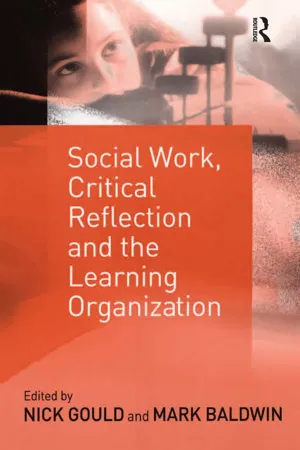
Social Work, Critical Reflection and the Learning Organization
About this book
A critical characteristic of human service organizations is their capacity to learn from experience and to adapt continuously to changing external conditions such as downward pressure on resources, constant reconfiguration of the welfare state and rapidly changing patterns of social need. This invaluable, groundbreaking volume discusses in detail the concept of the learning organization, in particular its relevance to social work and social services. Contributors join together from across Europe, North America and Australia to explore the development of the learning organization within social work contexts and its use as a strategic tool for meeting problems of continuous learning, supervision and change. The volume addresses a range of important topics, from strategies for embedding learning and critical reflection in the social work learning organization, to the implications of the learning organization for the new community-based health and social care agenda.
Information
Chapter 1
Supervision, Learning and Transformative Practices
Introduction
Professional and management discourses often share a similar feature, the tendency to take a prescriptive approach towards practice. Of course, in many respects this would be expected in applied domains that involve purposive action. Furthermore, it might be argued that educating for professional and management practice involves socializing members into methodologies and technologies of practice as an integral part of the acculturation process. At the same time, a corresponding theme in professional and management discourse concerns ‘the gap’ – the gap between theory and practice, rhetoric and reality, the espoused and the enacted. Among other things, the gap speaks of a disjuncture between the imperatives for practice that are to be read off of encoded models and theories, and the circumstances of their supposed application. In the face of this disjuncture, practitioners might speak of finding compromises between the ideals and the realities, or they might abandon the encoded models and theories as ones that belong to a different order – an order sometimes perceived as the comfortable and somewhat protected world of those who generate them.
In this chapter, the models and theories of professional supervision and learning organizations are considered in relation to one another, but also in regard to the critiques that have surrounded them. It is suggested that these critiques largely reflect the limitations of prescriptive models and theories, detached from the contexts of their application. In particular, the chapter suggests that professional and management discourses are more properly understood by situating them within the historical and political contexts in which they have arisen.
Contextualizing Professional Supervision in Human Services
Supervision in human services holds a pivotal place in professional and organizational fortunes (Jones, 1999). On the one hand, supervision has been considered crucial to professional development and effective practice. While the forms it might assume have varied according to the dominant practice models of the day (Tsui, 1997a), the presence of good supervisory structures and processes has been taken as an indicator of the relative health of the professional body (Tsui, 1997b). At the same time, supervision has also been considered an important component in the administration of professional activity, and a means of aligning the work of semi-autonomous members with organizational goals and procedures (Jones and May, 1992). The question as to how these objectives might best be achieved has given rise to a discourse on supervision which exhorts principles of good practice in this field.
Every so often, the generation of such discourse has received added momentum through public inquiries into high profile tragedies. Hughes and Pengelly (1997) have spoken of the reports into child deaths, for example, which have ‘highlighted with depressing repetitiveness the failures of supervision in social work … and re-emphasised the central importance of effective supervision in promoting safe practice’ (ibid.: 26). Effectiveness has been associated with ‘the marrying of managerial and professional aspects of supervision’ and ‘a proactive supervisory stance in thorough decision-making, relating to workers’ feelings, and so on’ (Hughes and Pengelly, 1997: 26–7). The intrinsically stressful nature of much of social work has been emphasized consistently in such considerations, and importance attached to supervision as a way of assisting staff to deal with the emotional impact of the job (Stanley and Goddard, 1993).
Something of an orthodoxy has evolved on supervision, inspired largely by the work of Kadushin, who has systematically and in considerable depth promoted and researched the nature of supervision. Kadushin (1992) defined its three primary functions as administrative, educational and supportive, and these have become widely accepted as the hallmarks of good supervisory practice. Others have augmented and refined this framework, adding the function of mediation for example (Austin, 1988; Morrison, 1993), yet the appeal has remained relatively constant through to recent times.
The appeal lies in part with the persuasive way in which this prescriptive framework for supervision has been congruent with the prevailing policy and organizational context. The social settlement of many western welfare agencies provided for a trade-off between pervasive management practices and the professional cohort (Jones, 1999). The regulation of professional behaviour was to be conducted through the supervision of front-line practitioners, a role largely performed by staff with professional experience promoted into management positions. Embodying both professional and organizational concerns, supervision existed at the interface, sufficient to satisfy organizational requirements while retaining licence for the exercise and moderation of professional judgement and support.
This configuration was not without its points of tension. The heavy reliance on the capabilities of the supervisor to ‘pull it off’ created considerable sources of strain (Clare, 1988). The ‘piggy in the middle’ dynamic, common to most supervisory positions, was compounded by the conflict of moral commitments, fuelled through connection with a sense of professional mission and longstanding antagonisms between the professionals and the managers (Laragy, 1997). Furthermore, the arrangement provided no ready place for the inclusion of user/client perspectives and arguably carried the contradiction of colonizing-liberating praxis (Ife, 1997).
Following a period of relative stability for this social settlement, there has been significant and continuing disruption. The nexus has been broken, dislocating supervision and making it available for appropriation by competing interests. The waves of new public management ideologies that swept through the human services industry, when challenged to break alleged cycles of welfare dependency and self-serving professionalism, inevitably caught supervision in their wake (Hough, 2003; Lewis, 1998). A series of studies have described how these new systems of governance have reconstructed the role and relations of professionals within changing organizational contexts (Scarborough, 1996).
Commentaries on the implications for supervision have been offered at various transitional phases. Early studies, for example, that were critical of the perceived commodification of social welfare saw a parallel process occurring within the welfare workforce. The emphasis upon efficient and effective achievement of outcomes, it was held, resulted in a convergence of neo-Taylorist management principles with neo-liberal market ideologies (Dominelli, 1997). Workforce planning went ‘back to basics’ by delineating position descriptions according to pre-specified competences required for those tasks necessary to achieve the objectives defined in the organization’s strategic plans. The training for and supervision of competent practice became a focus for controversy and one of the contested sites in redrawing a place for the human services professional (Shapiro, 2000).
The advent of the quality movement provided a further site for contest. Potentially an oppositional discourse to the quantification of outcomes, there were perceived possibilities here to claim a legitimate place for professional knowledge, skills and judgement-making. With quality defined into strategic planning, the professional contribution might be reincorporated not only into practice, but also into policy development. Professional supervision might be retained as the incubator for distinctive perspectives and social practices on which the organization could draw for its achievements of quality. In the event, as we shall see, the possibilities here have proved somewhat slippery, with quality often proving to be rather more politicized than initially it may have appeared (Reed, 1995).
A third area to note concerns the impact upon professional identities. Some observers characterized the professional response to welfare transformations rather in terms of a passive-aggressive reaction to threats – that is to say, loss of territory, loss of income, loss of security. While this interpretation is consistent with an analysis of the professional body as essentially self rather than other serving, it runs a little crudely over the moral sensibilities that appeared to be at stake (Jones, 2000). Practitioners’ accounts of despair, disillusionment and even fear spoke of a different kind of threat, threat to the values which signify a more altruistic dimension of professional identity – the values, for instance, of compassion, humanity, justice. The moderation of value conflicts through supervisory process was felt to be compromised by the erosion of these considerations in the pursuit of predetermined, instrumental outcomes by increasingly generic managers.
Responses to Changing Times
The approach to reinventing supervision for the changing contexts of practice has been varied. The variations themselves reflect alternative political strategies in the transforming relations between the professional workforce and their employing agencies.
One strategy has been to align supervision with the organizational mission (Beddoe, 1997; Kearney, 1996; Scott and Farrow, 1993). Where aspirations to quality are written into organizational goals, for example, there are possibilities for supervision itself to appear in the list of Key Performance Indicators (KPIs), at least in those instances where supervision has retained sufficient profile as a contributor to desired organizational performance. Once on the KPI list, a place is secured for the production of a Supervision Policy for the organization, which may well include requirements for the form and frequency of supervisory practice. Enshrined in policy, staff throughout the organization that are subject to it can be monitored for their compliance with it.
Working within the parameters of organizational governance processes, this strategy may well be successful in keeping supervision on the map. However, it is primarily pursued within the formal structures of the organization. As such, it provides no guarantee as to what transpires within supervision itself. That is to say, it does not necessarily touch the cultural life of the organization and so may have little influence on the interactions between supervisors and supervisees. Consequently, despite being formally anchored in quality, supervisory practices may still be perfunctory, attending more to correct technical performance and little to learning and development (Clare, 2001; Gibbs, 2001; Morrison, 2001).
In some respects, this raises the question as to what counts as supervision. A study by Syrett, Jones and Sercombe (1996) is indicative of a related strategy. The approach here was to split administrative from educational/supportive functions of supervision, locating each within complementary organizational positions of ‘team managers’ and ‘practice supervisors’ to ensure due attention was paid to both sets of functions. The study suggested that practitioners did indeed express satisfaction over the opportunity this afforded to focus with their practice supervisor on practice-related issues and developmental needs.
Perhaps predictably, the overall satisfaction with this arrangement was dependent upon the degree of ‘partnership’ established between the team manager and their practice supervisor. Partnerships were seen to vary in the extent to which the partners were appreciative of the perspectives and priorities of one another. In the worst case scenario, practitioners described themselves as caught between warring parties. Interestingly, the organizational structure clearly situated the practice supervisor as hierarchically subordinate to the team manager, leaving the former feeling somewhat vulnerable to being undermined by the latter. The gendered aspects of such a partnership would have been a relevant topic for further study (Hearn, 1992).
Contemporaneously, a rather different approach was being advocated elsewhere (Bunker and Wijnberg, 1988). This involved a more wholesale redesign of supervision for human services. The starting point was an assumption that high-performing (and by implication, best fit to survive) organizations were ones which could be responsive to an ever-changing environment. Moreover, there was an assumption that in so doing staff were the organization’s greatest resource, and that therefore the engagement of staff in both day-to-day service delivery and ongoing organizational development was vital. The position of supervisor now became highly significant in linking staff with a whole range of organizational processes. In this scenario, supervision took on multiple functions and provided a conduit for information upon which organizational performance depended.
Within this approach, one feature particularly pertinent for the present discussion concerned the reconceptualizing of administrative, professional and inter-personal dimensions as streams of information that were to feed into organizational knowledge management. This represented a break with prior thinking. The functions of supervision became extended (with up to 10 being identified) and were derived from the goals of organizational performance, involving information of differing kinds being duly processed. The significance of this is twofold. First, it locates professional members as contributors to organizational performance. Simplistically, professionals are there to serve the organization rather than vice versa. Secondly, it suggests that the organization’s repositories of professional knowledge are not contained solely within the occupants of professional positions. The information streams that contain professional knowledge may have numerous sources. For example, the dissemination of research through the organization would potentially become a source of professional knowledge; or, the encoding of ‘best practice’ within legal or procedural protocols would provide another form of embodiment of professional knowledge (Jones and Jordan, 1996).
Interestingly, when considering high performance in human service organizations, the authors underwrote this approach with the understanding that such organizations would be pursuing a social mission (Bunker and Wijnberg, 1988: 44). Given this, professional and practitioner knowledge, as well as information that flows from clients and users of the services, were assumed to be invaluable to effective organizational development and performance. This assumption, however, is somewhat problematic. The approach does situate human service organizations systemically within a competitive environment that requires continual adaptation, and it redefines supervision accordingly. Here, the professional contribution finds its safeguard in the convergence of professional and organizational missions rather than in the organizational presence of professionals. Yet, this overlooks the ways in which organizational missions themselves are responsive to their contexts, as well as presuming that such missions have a pervasive influence upon organizational activity.
Observations from a Study of Supervision
Led on by the idea that perhaps something important was happening to supervision, indicative of broader changes to the professional role and relation within human service organizations, a small-scale exploratory study was undertaken recently in the state of Victoria, Australia. The aim was to ascertain the perspectives of supervisors and supervisees across a range of human service organizations, government and non-government, on the ways in which supervisory functions and practices may or may not be changing. The study was limited to front-line practitioners and managers. A questionnaire was distributed (25 respondents), which included an invitation to participate in a subsequent group discussion. Two such discussions were convened (16 participants in total).
The questionnaires were analysed through simple counting procedures, and the discussions subjected to thematic analysis. As an exploratory study, the purpose was to understand what was happening to supervision from the perspectives of the parties directly involved. The findings echoed messages from elsewhere that supervision (broadly conceived) in human services was finding itself somewhat on the defensive. The administrative aspects of supervision (associated with accountability, compliance with organizational procedures and oversight of task performance) were viewed by participants as having increasingly squeezed out educational and supportive aspects. Interestingly, this was what most had now come to expect from supervision, though such an expectation diverged greatly from what most staff thought supervision still ought to be providing. Commitment of time to supervision, allowing for more in-depth examination of practice, was seen to be fragile within an ever busy working environment. Access to supervisors who were felt to understand the nature of practice was not to be taken for granted. For some, the growing presence of computer technologies in the workplace was superseding certain of the more instrumental aspects of the supervisory role.
The study also pointed to a proliferation in the forms of supervision that practitioners were now embracing. The more traditional one-to-one model, while still the most predominant formal arrangement, was for many no longer the mainstay of their supervisory experience. Informal and formal peer group supervision was cited as a way of gaining assistance with current practice dilemmas and exploring longer-term issues. The use of external consultants, via a variety of agreements, was a new departure for a handful of others. Activities undertaken jointly provided another platform for mutual support and feedback, previously outside the realm of the lone practitioner. Generally, the concept of ‘network learning’ would not be an inappropriate term to describe what many felt to be initiatives taken in response to the perceived erosion of supervision. For some, this extended to networks of like-minded but diversely qualified practitioners. For some too, the term did also signify the imaginative use of information and communication technologies to further their professional development.
The study is suggestive, then, of a transitional phase in the meaning and forms of supervision. A tentative conclusion points to supervision being constituted within a more tightly regulated administration of practice accompanied by a growing array of sites and sources for learning. The tensions here are evident, and speak to the changing contexts of not only accountability but also of learning within human services.
Contextualizing Learning within Human Services
While the concept of learning might generally carry benign connotations – with a tendency to be seen as intrinsically ‘a good thing’ – the recent upheavals in human services have perhaps exposed some of its more contentious aspects. In this section, the discussion turns to learning as a political and ethical practice, intimately concerned with the exercise of power and with social values.
In the conventional, triad model propounded by Kadushin (1992), the educational function of supervision stood alongside the administrative and supportive function. Given this combination approach, the positions of learner and educator were hierarchically inscribed by the organizational location of each. Clearly this presented certain dilemmas of its own regarding the learning processes that could pertain between the two. The potential existed, particularly where supervisors transferred hierarchical models of practice into the conduct of their supervisory role, for the relationship to be one of subtle or not so subtle control. Kadushin himself was not unaware of this, contributing to folklore his observations on ‘games people play in supervision’, albeit using a psychological rather than social focus for his analysis (Kadushin, 1968).
As previously described, however, this configuration occurred within welfare regimes in which supervision provided a necessary social glue between the professional workforce and their employing organizations. Subsequently, each factor in this equation has experienced, and continues to experience, substantive changes. The challenges for human service professionals in the ‘new politics of welfare’ (Jordan, 1998) have been extensively documented (Parton, 1994; Uttley, 1994). The emergence of different forms of governance has been transforming the management of the professional workforce (Harris, 1998; Newman, 2000). Yet, a significant and further dimension to these considerations is the place of learning within changing organizational and professional contexts.
While broader socio-economic changes were under way, the concept of workplace learning began to gain considerable ground (Marsick, 1987). It involved assembling ideas particularly from action learning (Revans, 1980) and experiential learning (Boud, Keogh and Walker, 1985; Kolb, 1984) and developing them further in regard to the work setting. It challenged the notion that training occurs at work and education occurs at school or university. Rather in the way of a new social movement, this would undermine any position of dominance held by educational institutions over knowledge-making in the professional and applied disciplines. There was now a promotion of the previously hidden learning that occurs within the workplace and, in some senses, a celebration of its worth and value. As a consequence, workplace learning implied recasting relations of knowledge and power between the workplace and external institutions with a claim over its practices, for example, between ‘industry’ and ‘academia’. Affording legitimacy to workplace learning means that academia relinquishes any pretensions to be the socially dominant producer and transmitter of theory and knowledge relevant to the work setting.
Receptiveness to this position has been fostered by the parallel discourse of reflective learning, by the rapidity and extent of social changes, as well as by the pursuit of productivity. In a fashion somewhat complementary to workplace learning, the reflective approach was similarly reconceptualizing epistemologies of practice. The partnership between Schön, with his interest in professional practice, and Argyris, with his...
Table of contents
- Cover
- Title Page
- Copyright Page
- Contents
- Contributors
- Introduction: The Learning Organization and Reflective Practice – the Emergence of a Concept
- 1 Supervision, Learning and Transformative Practices
- 2 Social Work Supervision: Contributing to Innovative Knowledge Production and Open Expertise
- 3 Critical Reflection: Opportunities and Threats to Professional Learning and Service Development in Social Work Organizations
- 4 Critical Reflection and Organizational Learning and Change: A Case Study
- 5 Multi-professional Teams and the Learning Organization
- 6 Sustaining Reflective Practice in the Workplace
- 7 Using ‘Critical Incident Analysis’ to Promote Critical Reflection and Holistic Assessment
- 8 Evaluation for a Learning Organization?
- 9 Reflecting on Practice: Exploring Individual and Organizational Learning through a Reflective Teaching Model
- 10 Living out Histories and Identities in Organizations: A Case Study from Three Perspectives
- 11 Conclusions: Optimism and the Art of the Possible
- Bibliography
- Index
Trusted by 375,005 students
Access to over 1.5 million titles for a fair monthly price.
Study more efficiently using our study tools.
Frequently asked questions
Yes, you can cancel anytime from the Subscription tab in your account settings on the Perlego website. Your subscription will stay active until the end of your current billing period. Learn how to cancel your subscription
No, books cannot be downloaded as external files, such as PDFs, for use outside of Perlego. However, you can download books within the Perlego app for offline reading on mobile or tablet. Learn how to download books offline
Perlego offers two plans: Essential and Complete
- Essential is ideal for learners and professionals who enjoy exploring a wide range of subjects. Access the Essential Library with 800,000+ trusted titles and best-sellers across business, personal growth, and the humanities. Includes unlimited reading time and Standard Read Aloud voice.
- Complete: Perfect for advanced learners and researchers needing full, unrestricted access. Unlock 1.5M+ books across hundreds of subjects, including academic and specialized titles. The Complete Plan also includes advanced features like Premium Read Aloud and Research Assistant.
We are an online textbook subscription service, where you can get access to an entire online library for less than the price of a single book per month. With over 1.5 million books across 990+ topics, we’ve got you covered! Learn about our mission
Look out for the read-aloud symbol on your next book to see if you can listen to it. The read-aloud tool reads text aloud for you, highlighting the text as it is being read. You can pause it, speed it up and slow it down. Learn more about Read Aloud
Yes! You can use the Perlego app on both iOS and Android devices to read anytime, anywhere — even offline. Perfect for commutes or when you’re on the go.
Please note we cannot support devices running on iOS 13 and Android 7 or earlier. Learn more about using the app
Please note we cannot support devices running on iOS 13 and Android 7 or earlier. Learn more about using the app
Yes, you can access Social Work, Critical Reflection and the Learning Organization by Mark Baldwin, Nick Gould in PDF and/or ePUB format, as well as other popular books in Social Sciences & Social Work. We have over 1.5 million books available in our catalogue for you to explore.