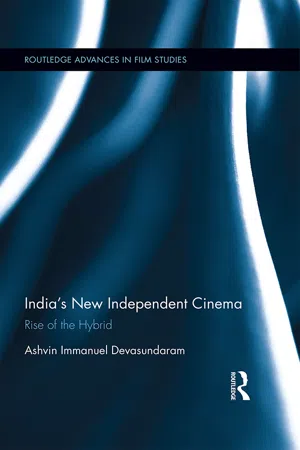
This is the first-ever book on the rise of the new wave of independent Indian films that is revolutionising Indian cinema. Contemporary scholarship on Indian cinema so far has focused asymmetrically on Bollywood—India's dominant cultural export. Reversing this trend, this book provides an in-depth examination of the burgeoning independent Indian film sector. It locates the new 'Indies' as a glocal hybrid film form—global in aesthetic and local in content. They critically engage with a diverse socio-political spectrum of 'state of the nation' stories; from farmer suicides, disenfranchised urban youth and migrant workers to monks turned anti-corporation animal rights agitators. This book provides comprehensive analyses of definitive Indie new wave films including Peepli Live (2010), Dhobi Ghat (2010), The Lunchbox (2013) and Ship of Theseus (2013). It explores how subversive Indies, such as polemical postmodern rap-musical Gandu (2010) transgress conventional notions of 'traditional Indian values', and collide with state censorship regulations. This timely and pioneering analysis shows how the new Indies have emerged from a middle space between India's globalising present and traditional past. This book draws on in-depth interviews with directors, actors, academics and members of the Indian censor board, and is essential reading for anyone seeking an insight into a current Indian film phenomenon that could chart the future of Indian cinema.
- 292 pages
- English
- ePUB (mobile friendly)
- Available on iOS & Android
eBook - ePub
About this book
Information
Part I Enter India's New Indies
DOI: 10.4324/9781315645018-2
1 Bollywood and the Cinemas of India
The Story so Far
DOI: 10.4324/9781315645018-3
Bollywood says you don’t have your own identity – it shows the psyche and inferiority complex of our film industry. For decades we were content just making films for our own audience. That’s why the current changes are looking really promising and exciting.—Irrfan Khan, on Bollywood (Verma, 2013)
Indian Cinema is a growing global phenomenon, particularly as a resilient competitor to Hollywood (Raghavendra, 2009: 15). Originating in Mumbai, commercial Hindi cinema, better known as Bollywood, is the most widespread proponent of Indian Cinema. Bollywood has emerged as a synonym for Indian culture, with financially successful proliferation around the world. These films are popular not just in India, but amongst the South Asian diaspora in the UK, US, Canada and Australia (Gowricharn, 2003; Mishra, 2014: 196).
India contains the world’s largest film industry (Shoesmith, 2011: 246; Thussu, 2008: 98). Jyotika Virdi (2003: 1–2) deems Bollywood the nation’s most dominant cultural commodity, serving as a medium of entertainment to a primarily but not exclusively urban audience. Although Virdi considers Bollywood to be the predominant form of entertainment in terms of market share, it accounts for only around a third of the total number of films made in India (Raghavendra, 2009: 15). In a polyglot milieu of more than 22 national languages, ‘local and vernacular-based industries compete in a highly regionalized market’ (‘Can the Indian Film Industry’, 2011). Bollywood accounts for only about 200 of the 1,000 films produced annually, the rest emerging from ‘regional or non-Hindi productions’ (ibid.). However, Bollywood’s dominance in terms of reach and revenue is reflected in a statement by Jehil Thakkar, consulting firm/consultancy group KPMG’s Head of Media and Entertainment, noting that Bollywood generates 46 percent of the total Indian film industry revenue (ibid.).
Selvaraj Velayutham (2008) highlights the often-overlooked diversity of Indian cinema, attributing this to a general preoccupation with Bollywood. Velayutham extends this proposition to academic scholarship, which he argues, is discrepantly orientated towards ‘Hindi cinema / Bollywood’, underscoring Bollywood’s ‘cultural dominance and hegemony’ that has obliterated the ‘rich complexities and ethnolinguistic-specific cinema traditions of India’ (Velayutham, 2008: 1). A Bollywood-centric approach has largely contributed to the preclusion and elision of several alternative forms of Indian cinema in academic literature (Gokulsing and Dissanayake, 2009: 10). The most conspicuous absence in recent scholastic appraisal relates to the lack of a comprehensive and dedicated analysis on the emergence of a new wave of independent Indian cinema – a gaping hole that this book intends to fill.
Despite Bollywood’s cultural and commercial pre-eminence, the heterogeneity that ‘Indian Cinema’ traditionally entails causes Gokulsing and Dissanayake (2009) to consider the alternative term, ‘Cinemas of India’, a more suitable moniker for the encompassing Indian film industry (ibid.). As a first foray into a blossoming field, this book’s focus is firmly fixed on the emergence of new independent Indian films since 2010, from the aforementioned diversity of the Cinemas of India.
The New Urban Independent Films since 2010
Rahul Verma states that ‘a new wave of Indian independent film is breaking the all-singing, all-dancing stereotype of Bollywood via low-cost, offbeat movies and edgier subject matter’ (2011). Many consider 2010 to be a watershed year for independent Indian cinema. Verma observes that the new ‘Indies’ broke into the mainstream, with films such as LSD (Love, Sex aur Dhoka [‘Love, Sex and Double-Cross’]) and Peepli Live, featuring in India’s top ten most profitable films of 2010. Other new independent films, such as Dhobi Ghat (2010) and the satirical comedy Tere Bin Laden (‘Yours Bin Laden’, 2010), received critical acclaim and box-office success in the nation’s top five metropolitan cities (ibid.).
The growth and development of these new independent films have been significant enough to galvanise various forms of the media to herald their arrival and underscore their propensity to catalyse debate in the public sphere. For example, expanding awareness of the new Indies informs an article in the Hindu that states:
The first half of 2011 saw filmmakers trying new themes, focusing on fresh issues without pandering to the box office demands. With the audience becoming highly stratified, very few are targeting a family entertainer. Till last year, who thought a Hindi film with two female actors can score at the box office, but Raj Kumar Gupta’s ‘No One Killed Jessica’ shattered the long-standing stereotype that you require a male star to draw the audience. If Kiran Rao’s perceptive ‘Dhobi Ghat’ showed Mumbai in a new light … Onir impressed with his measured audacity in ‘I Am’ … Similarly ‘Shor In the City’ nailed the cacophony of corruption. It is no longer about, hero, heroine, villain and five songs.(Kumar, 2011)
This increasing cognisance of the independent new wave is not restricted to the Indian cinematic domain. The World Cinema Film Festival 2011 in Amsterdam adopted a ‘Soul of India’ theme, including ‘eighteen Indian features, short and animation films, that focused on independent films, rather than Bollywood’; amongst these were the Indies Peepli Live, Gandu (‘Asshole’, 2010) and Dhobi Ghat (‘Peepli Live’, 2011). Cary Sawhney, director of the London Indian Film Festival (LIFF), describes the focus of the festival in 2010:
Rather than the standard Bollywood audiences across four generations, we’re aiming for the younger generation, who are disenfranchised by [the] Bollywood of their parent’s era and want something more cutting-edge.(Verma, 2011)
Suman Ghosh, director of the Bengali film Nobel Thief, screened at the London Film Festival 2011, echoes Sawhney’s emphasis on ushering in a new generation of Indian cinema. Ghosh is of the opinion that the recent films are a new development in terms of identity and socio-cultural perception. They are ‘packaged differently, combining mainstream Bollywood and Parallel arthouse production values’ (Ghosh, post-screening conversation and e-mail correspondence, 2011). He considers this ‘a good way forward for Indian cinema’ (ibid.). This assertion of the new Indies’ concatenation of formal and stylistic attributes from India’s two enduring film traditions raises the notion of hybridity in the new wave of Indian Indies. The corollary would be to ascertain to what extent these contemporary non-mainstream films delve into topical social, cultural and political issues and themes that are analogous to earlier postcolonial Indian arthouse and Parallel films. It would also be pertinent to investigate how the new Indies engage with socio-political themes whilst relying on their being saleable through contemporary Bollywood production, distribution and marketing channels.
Ravi Vasudevan’s (2000: 40) assertion that for the most part several perspectives in the study of Indian cinema remain unidentified and unexcavated is attributable to the rapid reorganisation and reorientation of the modern Indian cinematic domain. Arguably the labile nature of the contemporary Indian cinemascape resonates with broader transformations in the socio-economic, geopolitical and cultural Indian landscape. In this shape-shifting environment, postmodern simulacra, media hyperreality, sexual liberation and middle-class consumerism are becoming increasingly pervasive (Mishra, 2014: 195–197). The immediate manifestation of this postmodern milieu is an accentuated awareness and wider involvement amongst digital citizens in the Indian public sphere, concomitant with greater access to technology and communication, particularly social media (Devasundaram, 2014: 109).
In order to understand the current metamorphosis in modern Indian Cinema and its relation to the nation’s transforming socio-cultural and political discourse, it may prove useful to contextualise the rise of the new wave of independent Indian films through some of the nation’s earlier cinematic traditions that contain genealogical, morphological and temporal links to the new Indies.
Postcolonial Social Realism 1947–1960: India's Early Art Films
Indian cinema is often dichotomised into its main enduring traditions – the popular (Bollywood) and the art film (Kabir, 2001: 5). Art films made between the 1940s and the early 1960s were trenchant expositions on social issues and themes. These included the exploitation of farmers by landlords (Do Bigha Zamin, 1953), destitution and privation in the metropolis (Boot Polish, 1954), untouchability (Sujata, 1959), the urban-rural schism (Shree 420, 1955) and materialism against destiny (Pyaasa, 1957).
These films exhibited a complexity of plot, character and content that set them apart from commercial Hindi cinema (Hood, 2009: 4–5). The art films made immediately after India’s independence were significantly influenced in form and style by Italian neorealism and the French New Wave (Shoesmith, 2011: 251). Filmmakers like Satyajit Ray in particular drew inspiration from the works of neorealist European directors such as Vittorio De Sica and Jean-Luc Goddard, with Ray distilling these influences into realist hermeneutics of postcolonial rural India in films such as Pather Panchali (‘Song of the Road’, 1955) (Majumdar, 2012: 179; Shoesmith, 2011: 251). Contrary to the bewildering Western reduction of all non-commercial Indian cinema to the works of one director (Satyajit Ray) – a convenient, stand-alone signifier – post-independence art cinema was populated by a plethora of influential directors, including Ritwik Ghatak and Mrinal Sen. A reincarnation of India’s post-independence art cinema of the 1940s and 50s subsequently appeared in the late 1960s and throughout the 1970s as ‘New Indian cinema’, better known as ‘Parallel cinema’, which also derived inspiration from a neorealist ethos (Ganti, 2013: 25).
Parallel Cinema: 1970s and 80s
Sumita Chakravarty (1993) describes the emergence of Indian ‘Parallel cinema’ in the late 1960s as a reaction by filmmakers and critics to ‘contest the hegemony of a commercially based, profit-driven, popular cinema’, and to establish an alternative cinema (Chakravarty, 1993: 235). Parallel cinema was largely a continuation of the art films of the earlier 1940s and 50s, albeit with the explicit and overt intention of forming a concerted and organised socio-political film movement (Needham, 2013: 2). This alternative cinema was referred to interchangeably as ‘Parallel cinema’, ‘art cinema’, the ‘Indian New Wave’ or simply ‘regional cinema’ (Chakravarty, 1993: 235–236; Hood: 2009: 5). Brian Shoesmith (2011) observes that ‘this alternative cinema, often called Parallel or art, defined itself in opposition to Bollywood’ 1 (Shoesmith, 2011: 251). The raison d’être for this inchoate movement was to develop a ‘new tradition of filmmaking’; to construct ‘authentic’ portrayals firmly grounded in the credo of realism (Chakravarty, 1993: 236; Vasudevan, 2000: 123).
One of the first films in the Parallel cinema movement was Bhuvan Shome (1969), directe...
Table of contents
- Cover Page
- Half-Title Page
- Title Page
- Copyright Page
- Dedication
- Table of Contents
- List of Figures
- List of Interviewees
- Acknowledgements
- Introduction: Setting the Stage
- Part I Enter India's New Indies
- 1 Bollywood and the Cinemas of India: The Story so Far
- 2 The Meta-Hegemony: Leviathan Bollywood and Lilliputian Indies
- 3 The Anatomy of the Indies
- 4 Avenues of Indie Funding, Distribution and Exhibition
- 5 Interstitial Indies Interrogating India's Double Narrative
- 6 Running with Scissors: Censorship and Regulation
- Part II Case Studies
- 7 Rapping in Double Time: Gandu’s Subversive Timeof Liberation
- 8 Dhobi Ghat: The Marginal in the Mumbai Mainstream
- 9 Peepli Live: Neoliberal Capital, Media ‘Knowledge’ and Political Power
- 10 All the World’s a Ship: Broken Binaries and HyperlinkedHeterotopias in Ship of Theseus
- 11 A Cinematic Quartet Conjuring Ghosts of Nation: Harud, Haider, The Lunchbox and I Am
- Conclusion: Charting the Ship’s Course
- Index
Trusted by 375,005 students
Access to over 1.5 million titles for a fair monthly price.
Study more efficiently using our study tools.
Frequently asked questions
Yes, you can cancel anytime from the Subscription tab in your account settings on the Perlego website. Your subscription will stay active until the end of your current billing period. Learn how to cancel your subscription
No, books cannot be downloaded as external files, such as PDFs, for use outside of Perlego. However, you can download books within the Perlego app for offline reading on mobile or tablet. Learn how to download books offline
Perlego offers two plans: Essential and Complete
- Essential is ideal for learners and professionals who enjoy exploring a wide range of subjects. Access the Essential Library with 800,000+ trusted titles and best-sellers across business, personal growth, and the humanities. Includes unlimited reading time and Standard Read Aloud voice.
- Complete: Perfect for advanced learners and researchers needing full, unrestricted access. Unlock 1.5M+ books across hundreds of subjects, including academic and specialized titles. The Complete Plan also includes advanced features like Premium Read Aloud and Research Assistant.
We are an online textbook subscription service, where you can get access to an entire online library for less than the price of a single book per month. With over 1.5 million books across 990+ topics, we’ve got you covered! Learn about our mission
Look out for the read-aloud symbol on your next book to see if you can listen to it. The read-aloud tool reads text aloud for you, highlighting the text as it is being read. You can pause it, speed it up and slow it down. Learn more about Read Aloud
Yes! You can use the Perlego app on both iOS and Android devices to read anytime, anywhere — even offline. Perfect for commutes or when you’re on the go.
Please note we cannot support devices running on iOS 13 and Android 7 or earlier. Learn more about using the app
Please note we cannot support devices running on iOS 13 and Android 7 or earlier. Learn more about using the app
Yes, you can access India's New Independent Cinema by Ashvin Immanuel Devasundaram in PDF and/or ePUB format, as well as other popular books in Media & Performing Arts & Film & Video. We have over 1.5 million books available in our catalogue for you to explore.