- 336 pages
- English
- ePUB (mobile friendly)
- Available on iOS & Android
eBook - ePub
About this book
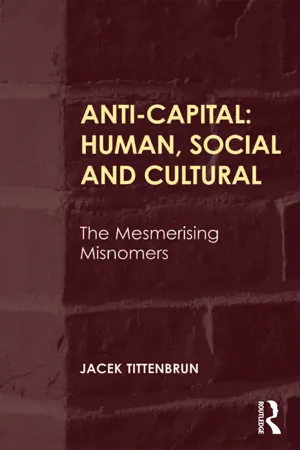
The notion of capital has enjoyed a rich career in the social sciences, its use across a range of subjects and in diverse academic and professional contexts having served to establish its conceptual status as 'given'. With particular attention to human and social capital - including cultural capital - this book traces the roots of this theoretical and conceptual trend to economics, revealing the proliferation of various forms of capital to be based upon an encroachment of the conceptual apparatus of economics into other social sciences. Offering an in-depth, critical analysis of the concepts of human and social capital, as well as their surrounding theories, Anti-Capital: Human, Social and Cultural proposes an alternative theoretical framework, whilst better explaining the realities that they mask in economic terms. A rigorous exploration of the most popular forms of 'capital' in the contemporary social sciences, this book will be of interest to scholars and students of sociology, political and social theory, demography and economics.
Information
HUMAN CAPITAL
Chapter 1
Background
The importance of the standard concept of human capital, in contrast to social and cultural capital, is fully accepted by mainstream economists. Whilst the concept did not catch on until 50 years ago or so the very idea of human capital is far older. “Economists who considered human beings or their skills as capital include such well-known names in the history of economic thought as Petty, Smith, Say, Senior, List, von Thunen, Roscher, Bagehot, Ernst Engel, Sidgwick, Walras, and Fisher” (Kiker 1966: 481). For instance, the founder of modern economics Adam Smith introduced the notion of humans as capital in his classic Wealth of Nations (1776/1937). Others, such as Alfred Marshall (1890/1930) and Irvin Fisher (1906), kept the idea alive (Walsh, 1935). Notwithstanding its long history, the theory of humans as capital remained relatively undeveloped well into the 20th century.
Specifically, Smith referred to:
The acquired and useful abilities of all the inhabitants or members of the society. The acquisition of such talents, by the maintenance of the acquirer during his education, study, or apprenticeship, always costs a real expense, which is a capital fixed and realised, as it were, in his person. Those talents, as they make a part of his fortune, so do they likewise of that of the society to which he belongs. The improved dexterity of a workman may be considered in the same light as a machine or instrument of trade which facilitates and abridges labour, and which, though it costs a certain expense, repays that expense with a profit. (1776 Book II, chapter 1)
The above passage has been cited not only for its own sake, but also because of the following commentary: “As clearly demonstrated by the above quote, the idea that part of economic activities might not be devoted to immediate production or consumption, but might rather be diverted to education, study, or apprenticeships, is well entrenched in the history of economic thought” (Coulombe, Tremblay 2009).
What is striking in the above argument is that the authors treat education as an economic activity, presumably on the grounds that education forms one’s labour power which subsequently is used in the process of economic activity. And there’s the rub; education may be a form of economic activity inasmuch as it is provided by some profit-seeking ventures, is organised on the private property basis. Otherwise, it is a process that can certainly have some impact on the economy, while being at the same time dependent on the latter (for schooling premises, equipment, and indirectly through taxes paid by the various economic establishments), but essentially it belongs to what, in terms of our socio-economic structuralism, is termed the ideational structure of society.1 What this case clearly shows is the imperialistic – in an economic sense – nature of human capital theory.
Be that as it may, for much of the ensuing 200 years (after the publication of Wealth of Nations) economic thought largely ignored Smith’s insights, and focused instead on the role of land, capital stock, and hours of labour as the crucial ingredients in economic growth (Hornbeck and Salamon, 1991: 3).
Walsh (1935) noted that prior to the mid-1900s, discussions about humans as capital were carried on “chiefly in general terms; references being made to all men [sic!] as capital, and to all kinds of expenses in rearing and training as [investment]” (p. 255).
In the literature several reasons are given for the delay in formulating a theory of humans as capital, and these are interesting as they introduce us into the heart of some of key controversies connected with the concept in question.
One is the difference of opinion among early theorists regarding the relationship between humans, labour, capital, and earnings. Three camps seem to have emerged. The first (represented by John Stuart Mill and Alfred Marshall) distinguished between the acquired capacities (skills and knowledge) of human beings, which are classed as capital, and human beings themselves. On the base of their profound moral and philosophical commitment to human freedom and dignity, this group of thinkers rejected the notion in question, finding the mere thought of humans as capital rather offensive. To them, humans were the purpose for which wealth and capital existed: the end to be served by economic endeavour. Marshall, for instance, argued that although it is quite possible and ethical for people to sell their labour, there ought not to be a market in human beings (Baptiste 2009: 187).
A couple of comments are in order here. The object of exchange between the worker and his or her employer is not labour itself, but labour power. Firstly, this kind of transaction would amount to selling something that does not yet exists at the moment (the worker will have an opportunity to perform his or her concrete work only upon signing the relevant contract and being assigned to the specific means of work). Secondly, the very idea of selling an activity, human action, seems odd, if not outright irrational. What constitutes the object of exchange in this case is the worker’s potential labour, or labour power. Thirdly, from our theoretical point of view, the worker does not sell, but, rather, leases out his or her labour power. Why this is so? When one purchases a consumer product, one acquires full property rights to it, including its use and abuse. Nothing of the sort takes place in the relationship between the worker and her so-called employer; the latter has no right whatsoever to use the worker as he wishes; quite the contrary, he is limited to only one direction of applying his or her labour power. In addition, the owner of his or her labour power can either move to another employer or, staying at the current firm, withdraw one’s labour power, for example, by means of strike action. This suggests that the relationship is rather more one of land lease wherein the farmer also leases the allotment of land in the specific end, and does not hold absolute property rights in it.
Fourthly, moral condemnation or protest against economic, i.e. capitalistic realities, is futile; historically (and even today – in its underdeveloped form) capitalism proved to be perfectly compatible with the slave mode of production, and whilst morally controversial, to say the least, markets in human organs flourish nowadays in a quite considerable number of countries.
Perhaps due to this divergence between lofty moral convictions and mundane realities (despite his aforementioned objection) Marshall’s (1890/1930) Principles of Economics includes in an appendix a methodology for calculating the private returns on investment in education that, according to Marginson (1993: 33–4), would later become the core of the theory (Schultz, 1961).
A second camp (represented by Adam Smith, Irving Fisher, and the Chicago School) argued that human beings are themselves capital, that the notion of humans as capital is not incompatible with freedom and dignity, and that on the contrary, by investing in themselves, people enlarge the range of choices available to them and so enhance rather than limit their freedom (Schultz, 1961). This group tied earnings to educational expense (capital investment), not just to productivity. Adam Smith (1776/1937), for instance, argued that “a man educated at the expense of much labour…may be compared to one…expensive machine… .The work which he learns to perform…over and above the wages of common labour will replace the whole expense of his education” (p. 101). To Smith, then, variations in educational investments (human capital) explained and justified variations in earnings.
The third position is epitomised by Karl Marx. On the one hand, he agreed with Smith (1776/1937) that greater productivity alone does not account for the higher earnings of educated workers but that the cost of education (investment in the parlance of human capital theory) also enters into the equation as part of costs of production of a given labour power in conjunction with the costs of reproduction forming the value of labour power (Marx, 1867/1976). On the other hand, Marx also concurred with Mill (1859/1956), that workers sell their capacities to labour (their “labour power”) rather than themselves. However, and here is the rub, Marx conceived of the above-mentioned capacity to labour not as a form of capital but reckoned that a worker’s labour power becomes capital only when it is used in the process of production (Marx, 1867/1976, 1894/1981). Crucially, this variable capital, as Marx termed it, was couched in terms of the capitalist’s expenses on his or her workers’ labour power which constitutes a U-turn compared to those who treat the worker herself as making those capital investments. Thus, it is rather easy to agree with Marginson (1993: 34) that Marxist economics substantially diverged from what was to become human capital theory.
According to the commentators there is another reason for the delay in developing a theory of humans as capital which is the widespread use of the Keynesian definition of consumption and investment. According to Blaug (1970) Keynes viewed consumption and investment as mutually exclusive categories: expenditures of two different sectors of the economy, households and businesses, respectively. Keynes regarded education as largely a household expenditure and therefore treated it as pure consumption with no investment component. Consequently, as long as Keynesian economics reigned, the so-called investment aspect of education remained hidden from view (Blaug, 1970: 16–22).
The above passage also needs some comment. While the differentiation between consumption and investment is sound, it is a fallacy to treat both these activities as part of the economy. A commonplace error is committed here (whose another case has been identified above): the circumstance that X influences A, does not mean that X becomes an integral part of A. Consumer demand undoubtedly influences the allocation of capital and other processes within the economic structure, but it does not follow that it itself is a component of the economy. Such social processes could be termed economically relevant, as opposed to those which are economically conditioned. By the way, consumption, of course, is also in the latter category, and only on non-dialectical grounds one may argue that the simultaneous membership in both categories is impossible.
A third reason given for the delay is the nature of economic production prior to World War I. According to Briggs (1987), for example, prior to World War II agricultural and industrial economies did not require large numbers of highly skilled workers, and as such, there was little need for a theory of human capital. But, Briggs argued, the high-technology economies that emerged in the post-World War II era required massive doses of highly skilled workers. And this technological advancement, he believed, created some sort of demand for building a theory of human capital (Briggs, 1987: 1201–10).
To continue the present story of prehistory and history of what is often called no less than “the Human Capital Revolution” (Baptiste 2009), the articulation of a formal theory of human capital is said to begin in the mid-20th century with what has been dubbed the Chicago School (Ali, 1985; Psacharopoulos, 1988; Sobel, 1978; Walters and Rubinson, 1983).
Chicago was, of course, a centre of free-market fundamentalism and neo-liberalism which fact is not irrelevant to the shape of the theory under consideration. No one other than Milton Friedman (1962) “signaled the interest of the Chicago school economists in a human capital theory approach” (Marginson, 1993: 36). What Friedman (1962) planted, Theodore Schultz, as Baptiste (2009) puts it, watered. In his presidential address at the Seventy-Third Annual Meeting of the American Economic Association on December 28, 1960, Schultz (1961) delivered what is generally considered the inauguration of “the human investment revolution in economic thought” (Sobel, 1978: 268, footnote 2). In that address Schultz (1961) argued that much of what is commonly labelled consumption is really human capital investment. This investment, he stated, includes direct expenditure on education, health, and internal migration; earnings foregone by mature students attending school and by workers acquiring on-the-job training; the use of leisure to improve skills and knowledge; and so on – all of which constitute measures aimed at improving the quality of human effort and, ultimately, workers’ productivity. Schultz (1961) wrote, “Although it is obvious that people acquire useful skills and knowledge, it is not so obvious that these skills and knowledge are a form of capital, [or] that this capital is in substantial part a product of deliberate investment” (p. 1). He called the body of knowledge that sought to describe, explain, and validate this phenomenon “human capital theory” (Schultz, 1989: 219).
Let us immediately note that the concept of investment with reference to the process of acquisition of what is called human capital is largely a misnomer; Human capital is not built within formal educational institutions and frameworks alone, or even predominantly. “[…] Occupational skills are learnt on the job, implicitly as well as consciously” (Schuller 2001: 22).
Confronted with the fictitious, the vulgar economists outdo each other in propagating the trite and the banal: To derive a justification for the existence of ground-rent from its sale and purchase means in general to justify its existence by its existence. Through spotlighting such tautologies, Marx traces a decline from the peaks of classical political economy to the flatland of marginal-utility calculators: The insanity of the capitalist mode of conception reaches its climax here, for instead of explaining the expansion of capital on the basis of the exploitation of labour-power, the matter is reversed and the productivity of labour is explained by attributing this mystical quality of interest-bearing capital to labour-power itself. (McQuinn 2011)
The above suggests that there is a relationship between the concepts of human capital and labour power. Topel (2000) defines human capital as “the intangible stock of skills that are embodied in people”. There are many cognate definitions, such as: “…managerial ability or human capital” (Coles et al. 2010), “human capital or more colloquially, people” (Bukowitz et al. 2004). Finally, in no uncertain terms Brown and Lauder (2002: 224) state that according to human capital theory “Workers are expected to invest in their ‘employability’ regardless of whether they are in employment or looking for work”. The notion of “employability” refers, of course, to one’s capacity to work, i.e. labour power.
And one can couch human capital in terms of labour power not only at the broadest, but also more specific levels; the following claim refers to what within our socio-economic structuralism is termed operationally particularistic labour power – the author fails to distinguish such work processes in which communication forms an inalienable and essential part of work especially, but not exclusively, in services: “Communication and teamwork skills are two of the most universally acknowledged competences for a modern economy” (see e.g. Levy and Murnane 1999). “These can be interpreted at a basic practical level, where productive efficiency requires good communication between workgroup members. […] Human capital can certainly be understood to encompass social as well as technical skills” (Schuller 2001: 16–17).
1 More on the composition of society at large in Tittenbrun (2012).
Chapter 2
Theory and Reality
To put it in a nutshell, “the basic idea of human-capital theory is that workers invest in their own skills in order to earn higher wages, much as persons invest in financial or physical assets to earn income” (Sullivan, Sheffrin 2003). Apart from the economists already mentioned above, the main contributors to modern human-capital research are Jacob Mincer, and Gary Becker. Their ideas, focusing on investments in and returns to education and training, have provided the theoretical and empirical basis for decades of ensuing research.
The revival of interest in the human capital idea occurred at the end of the 1950s and in the early 1960s, following the growth accounting approach put forward by Solow (1957), that a substantial proportion of US economic growth was not accounted for by such traditionally conceived of as playing that role the increases in the stock of physical capital (machinery and equipment, and structures) and labour (number of people employed). It was then suggested that precisely human capital might be a good candidate for accounting for the so-called Solow residual.
The human capital concept developed, however, separately from the economic growth literature with the influential works of Mincer (1958) and Becker (1962, 1964). Mincer attempted to explain the differences in the personal income (wage) distribution by the investment in human capital. He analysed how rational agents freely determine the time they allocate to studying (or training) or working. The cost of studying is the direct cost of education (tuition fees) plus forgone labour earnings, while the return to studying comes from higher future earnings. Initially, because the return to extra years of education is decreasing, the value of future earnings exceeds the cost of studying and the individual continues to invest in education. In equilibrium, the benefit of an extra year of schooling equals its costs. This analysis – based, as it does, on marginalism – is generally regarded as the theoretical foundation of empirical labour economics (Coulombe, Tremblay 2009).
Workers invest in productivity-increasing skills through formal education and on-the-job training. Moreover, in long-run competitive equilibrium, firms hire additional labour until workers’ marginal productivity coincides with their wage rate. This allows us to infer the effects of worker characteristics on productivity, which are not directly observable, from their effects on predicted wages, which can be estimated from cross-sectional data. We use such wage function estimates to value additional years of education, experience, and other forms of human capital. Applying these value estimates to the changing distributions of human capital indicators yields estimates of the growth in average worker quality.
The critical assumption underlying our approach is that workers’ wage rates are equal to their marginal productivity, a basic implication of the competitive model of labour markets. (Aaronson, Sullivan 2001)
There are, of course, models of the labour (strictly speaking, as argued above, labour power) market in which wages are not equal to marginal products. For example, if firms discriminate against women or minority groups or if unions or firms exercise market power,1 wage rates may differ from productivity. Milgrom and Oster (1987) develop a model which implies lower returns to human-capital investments for disadvantaged workers (e.g., “invisibles”) as employers receive rents and conceal the ability of disadvantaged workers from potential outside employers. This concealment permits the current employer to pay high ability invisibles less than their marginal product.
In addition, Spence (1973) argues that firms use education and other observable human capital variables as a signal of unobservable worker ability. This can lead workers to invest in education even when it provides no actual increase in productivity. Finally, implicit contract models of the type studied by Lazear (1979) suggest that in order to induce higher effort and investment in skills, firms defer a portion of workers’ compensation until later in their careers. This leads to wages being below productivity early in workers’ careers and above productivity in later years (Aaronson, Sullivan 2001).
In basic economic theory, under perfect competition, to ensure efficiency and maximisation of output, one needs to ensure that the workers’ remuneration or real wage rate should be equal to its marginal productivity.
However,...
Table of contents
- Cover Page
- Title Page
- Copyright Page
- Contents
- Introduction
- PART I: HUMAN CAPITAL
- PART II: SOCIAL CAPITAL
- PART III: CULTURAL CAPITAL
- Bibliography
- Index
Trusted by 375,005 students
Access to over 1.5 million titles for a fair monthly price.
Study more efficiently using our study tools.
Frequently asked questions
Yes, you can cancel anytime from the Subscription tab in your account settings on the Perlego website. Your subscription will stay active until the end of your current billing period. Learn how to cancel your subscription
No, books cannot be downloaded as external files, such as PDFs, for use outside of Perlego. However, you can download books within the Perlego app for offline reading on mobile or tablet. Learn how to download books offline
Perlego offers two plans: Essential and Complete
- Essential is ideal for learners and professionals who enjoy exploring a wide range of subjects. Access the Essential Library with 800,000+ trusted titles and best-sellers across business, personal growth, and the humanities. Includes unlimited reading time and Standard Read Aloud voice.
- Complete: Perfect for advanced learners and researchers needing full, unrestricted access. Unlock 1.5M+ books across hundreds of subjects, including academic and specialized titles. The Complete Plan also includes advanced features like Premium Read Aloud and Research Assistant.
We are an online textbook subscription service, where you can get access to an entire online library for less than the price of a single book per month. With over 1.5 million books across 990+ topics, we’ve got you covered! Learn about our mission
Look out for the read-aloud symbol on your next book to see if you can listen to it. The read-aloud tool reads text aloud for you, highlighting the text as it is being read. You can pause it, speed it up and slow it down. Learn more about Read Aloud
Yes! You can use the Perlego app on both iOS and Android devices to read anytime, anywhere — even offline. Perfect for commutes or when you’re on the go.
Please note we cannot support devices running on iOS 13 and Android 7 or earlier. Learn more about using the app
Please note we cannot support devices running on iOS 13 and Android 7 or earlier. Learn more about using the app
Yes, you can access Anti-Capital: Human, Social and Cultural by Jacek Tittenbrun in PDF and/or ePUB format, as well as other popular books in Social Sciences & Sociology. We have over 1.5 million books available in our catalogue for you to explore.