- 238 pages
- English
- ePUB (mobile friendly)
- Available on iOS & Android
eBook - ePub
About this book
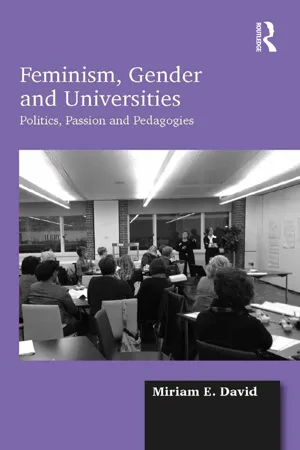
Feminism, Gender and Universities demonstrates the positive and robust impacts that feminism has had on higher education, through the eyes and in the words of the participants in changing political and social processes. Drawing on the 'collective biography' of leading feminist scholars from around the world and current evidence relating to gender equality in education, this book employs methods including biographies, life histories, and narratives to show how the feminist project to transform women's lives in the direction of gender and social equality became an educational and pedagogical one. Through careful attention to the ways in which feminism has transformed feminist academic women's lives, the author explores the importance of education in changing socio-political contexts, raising questions about further changes that are necessary. Delving into the deeper and more 'hidden' echelons of education, the book examines the contested nature of current managerial or business approaches to university and education, revealing these to be incompatible with feminist thought. A plea for more careful attention to education and the ways in which the processes of knowledge-making influence (and are influenced by) gender and sexual relations, Feminism, Gender and Universities will appeal to scholars across the social sciences with interests in gender, pedagogy and modern academic life.
Information
Chapter 1
Feminism as an Education Project to Transform Women’s Lives
Introduction
This book is about the feminist project to transform women’s lives towards gender and social equality over the last 50 years. This is fundamentally an educational and pedagogical project: to understand how the current gender, sexual and social structures have come about and to develop knowledge and wisdom to further that understanding and transform such relations in the direction of what has become known, in the twenty-first century, as gender and social justice. It has been a project increasingly in universities, as higher education (HE) has expanded, with changing socio-economic and political systems globally.
The origins of this feminist project lie with the social and political movements for change in the post-Second World War period: movements for civil and human rights across the now so-called ‘global north’, in North America, Europe and parts of Australasia. Many of the early participants in the women’s liberation movement (WLM), which is what has become known as ‘second-wave feminism’, had been or were students in these expanding systems. Book titles such as The Second Sex (Beauvoir, 1949, 1953 in English); The Feminine Mystique (Friedan, 1963); Women: The Longest Revolution (Mitchell, 1966); Patriarchal Attitudes (Figes, 1970); The Dialectic of Sex (Firestone, 1970); The Female Eunuch (Greer, 1970); Sexual Politics (Millett, 1970); Women, Resistance and Revolution (Rowbotham, 1973) Of Woman Born: Motherhood as Experience and Institution (Rich, 1976) are key examples of the books that ‘inaugurated’ the women’s movement, between 50 and 60 years ago. They were variously written by Simone de Beauvoir, the French intellectual and existentialist; Betty Friedan, the American Jewish feminist writer, socialist campaigner and founder of the National Organization of Women (NOW); Juliet Mitchell, the New Zealand-born socialist-feminist academic, later psychoanalyst; Eva Figes, the German Jewish refugee to England becoming a novelist; Shulamith Firestone, the Canadian orthodox Jewess who sought refuge in New York; Germaine Greer, the Australian émigré academic to England; Kate Millett, the American artist who wrote this as part of her doctorate; Sheila Rowbotham, the English feminist historian, and Adrienne Rich, the American lesbian feminist poet and essayist. These writers were all passionate about changing women’s lives: in the family as daughters, sisters, wives and mothers, as sexual beings, and in education, paid and unpaid work or employment. How could women’s lives be transformed and made more equal with men’s lives in both public and private? How could patriarchy and sexual oppression be overcome?
Just how successful has this project been? What has been accomplished over the last 50 years, in terms of feminist knowledge and wisdom and what remains to be done? What changes have been made that need to be undone in the changing global contexts towards neo-liberalism? How successful has the feminist project been in educating women and girls across the globe about their rights in both their public and private lives? How has the education system itself been transformed? Just what do feminist academic activists, like me, think of the changes that we have achieved over the last 50 years? To what extent have our own transformed lives led to wider and global educational and political transformations? What are the educational and political obstacles still to be overcome, especially in an era of near global neo-liberalism? What precisely is the legacy for future generations within and outside of global universities?
Whilst there have been innumerable studies of feminism and the women’s movement, changing politics and policies, there is relatively less about how feminism has become a part of academe, developing feminist knowledge, contributing to critiques of the traditional academic subjects, and as a subject in its own right, as, for instance, women’s studies. Many of the women who wrote the initial books and pamphlets of ‘second-wave feminism’ were, indeed, women who had been college students, as the American women in Friedan’s (1963) study of housewives and mothers and their dissatisfaction with ‘the problem that has no name’ had been, but just how did feminism continue to impact upon HE itself (Stambach and David, 2005)? How did feminist knowledge emerge, and become a vital part of the transformations of HE? What did the feminists who, perhaps surprisingly at first, became academics think and feel about this project, and just how did they engage with it? Looking back how do they now feel, and what are their views of the prospects for the future?
Clearly socio-economic and socio-political transformations over the last 50 years are such that education, and HE, is now a key part of the global economy. We now refer to this as the knowledge economy or ‘academic capitalism’, a term coined by the American feminist Sheila Slaughter, with her colleagues Larry Leslie and Gary Rhoades (1997; 2004). Whilst there are many ways to describe and theorize these manifold and global transformations, a key part has been played by changing forms of education, especially in relation to information and computer technologies (ICT), and these are often now known to comprise the knowledge industries as important forms of networking.
Questions of gender and sexual relations, and violence against women or sexual harassment and child sexual abuse, are now more overtly in the public eye (David, 2013). For instance, it was a young woman paramedical student whose murder through a brutal gang rape in India dominated the global news headlines over the New Year period (2012–2013). Similarly, the Taliban’s general political violence in that region of the Indian sub-continent, Afghanistan and Pakistan, has been perpetrated on young women fighting for girls’ education, such as Malala Yousafzai – who was shot in the face by a Taliban gunman for campaigning for girls’ education in Pakistan in October 2012. Miraculously she survived the gun attack and was brought to the UK for treatment. Given her recovery in the Birmingham hospital she is now being educated in the UK, was nominated for the Nobel peace prize, and celebrated her 16th birthday giving a pleading speech at the UN on 12 July 2013 about education for all and universal girls’ education. She has also written her story (Yousafzai with Lamb, 2013). In South Africa, Reeva Steenkamp, the girlfriend of Oscar Pistorius, the Paralympic gold medallist, whom he shot, was described as a law graduate and model who was about to deliver a Valentine’s day talk to schoolgirls on sexual abuse. These are some stark examples of the violence and sexual harassment of women and girls that also occur closer to home.
In the UK there has been a recent furore over a BBC celebrity, Jimmy Savile, whose sexual harassment and rape of young women, over a 50 year period only came to light publicly recently and after his death two years ago. It is only now that questions of sexual abuse and gender-related violence are being discussed in public arenas. Such violence against women is not confined to the developing regions of the world, although it is clear that it remains a serious problem for the implementation of education for all. Even in the developed regions of the world such as the UK and the USA gender-related violence remains rife. But the roots of such gender-related violence are not adequately tackled and remain sidelined in political discourse. We must continue to argue for a more appropriate form of education for all that tackles issues of gender, gender-based sexual abuse as part of child sexual abuse, and all violence against women as integral to a proper education for all.
Why are these questions of gender and sexual relations now so visible when they were not on public agendas 50 years ago? Is the way in which they are publicly debated a result of feminist activism or is the question more complex than simply that? Is it more to do with transformations in culture, social media and communications, contributing to new forms of capitalism and commercialization of gender and sexuality as new forms of sexualization? Has this become a toxic mix of globalization and changing gender and social relations? What has really changed to make these questions of such intense media debate and will the resolution of some of the issues bode well for a more women- and feminist-friendly future? Or is it the case that the ‘cycle of domination of top roles by men’ [in universities], as Louise Morley (2012) argued in the Times Higher Education, will continue to hold sway? What needs to be done to break out of that vicious cycle to make education, higher education especially, and society more broadly, more feminist-friendly and less misogynistic? And, can education be used to try to transform wider social and sexual relations and reduce, if not eliminate, male violence against women?
Looking back on my own life as a feminist academic, I remember that Savile was launching his career as a DJ on the public stage when I was becoming an undergraduate student of sociology at the University of Leeds. Among my friends and acquaintances in Leeds were young women who did encounter him – and around the same time other women friends were beginning groups as part of the early stirrings of the women’s liberation movement (WLM) that was later to become known as feminism. It was in these consciousness-raising (CR) groups that women began to talk personally about intimate sexual relations, but in the relative safety of the privacy of groups of like-minded women, reaching out towards some understanding of sexual power relations, and how they were not only individual but also political. Yet they were certainly hidden from the public gaze.
The phrase ‘the personal is political’ was then coined, leading into discussions about the sexual division of labour, women’s rights and women’s work, and, more importantly, the rise of intellectual curiosity about how these structured gender relations had come about (David, 2003). Through the women’s movement, based, as it tended to be, around young women as students or new graduates, feminists began to develop new ‘knowledge’ and new approaches, including feminist pedagogies grounded in personal experience. At the same time, HE was expanding and opportunities for women not only as students but also as researchers and academics were opening up: women, including feminists, quickly were afforded opportunities to enter academia. In the UK, for example, the policy to expand HE was initiated through the Robbins Report, published in autumn 1963 (Robbins Report, Cmnd 2154, 1963). At that time, very few of the age cohort went to university, and of that tiny proportion, only a fifth were women. Over the last 50 years, this pace of change has speeded up such that women now comprise over 50 per cent of the undergraduate students in HE across most countries, especially the ‘global north’, although these percentages do not translate into academe and nor do they transform gender relations (UNESCO, 2012). The differences here are stark as I shall show.
Women’s Learning Lives as a Background
This book began life as a project reflecting on the global transformations in HE as they impacted upon women’s lives and education across the life course. Tentatively called Women’s Learning Lives I particularly wanted to capture the vitality of the changes for women through education, school and universities. As a feminist social scientist, I had always been passionately interested in the relations between social and political changes, family, work and education and had written extensively about these issues in an academic activist vein, including an intellectual biography (David, 2003). I now wanted to devote my time and attention to providing an overview of the changes for women through universities and the question of changing forms of pedagogy, especially feminist pedagogy, for the practices of HE. Although I had touched upon these questions in my more recent studies on social diversity and widening access to and participation within HE in the twenty-first century I had not had the liberty to concentrate solely on these, given the changing nature of universities moving towards a performative, managerialist culture (David, 2009a). In an inaugural professorial lecture at the University of London’s Institute of Education, which was also a valedictory, entitled Transforming Global Higher Education: a feminist perspective I began to address some of my passionate interests, questioning how feminist perspectives had been incorporated into the global academy without their critical and radical edge (David, 2009b).
My aim remains focused on my own feminist passions and politics as a woman educator and intellectual: different from what has become, in an era of neo-liberal accountability and ‘metrics’, academic research assessable and accountable only to university peers. As Morley (2011) has argued so passionately the moves towards creating new ‘metrics’ and ‘the numbers game’ in assessing gender equity or parity amongst students in HE is a form of ‘misogyny posing as measurement’. She also suggests that it is important for feminist academics today to consider how to change ‘the rules of the [patriarchal] game’ (Morley, 2013) so as to have a more gender-friendly future for universities. What precisely should this entail, given our experiences as feminist academics in neo-liberal universities?
The term pedagogy may appear abstruse but it has come to have meaning amongst educators as a perspective on knowledge and ways of learning through committed and critical forms of teaching about ideas: an intellectual approach (McLean, 2006). It is also about a commitment to social and gender justice. Yet, as HE has expanded, and more women have participated, it has become increasingly difficult to attend to questions of women or even gender alone, with social and political commentators arguing that gender equality has been accomplished with the advent of mass HE globally (e.g. Bekhradnia, 2009; Altbach, 2010; Willetts, 2010). This is what has been called the ‘feminisation crisis debate’ (Morley, 2011; Leathwood and Read, 2008). I have also become fascinated by the contested nature of these global changes and how gender equality in education has become emasculated, or certainly not feminized, by its incorporation into neo-liberal global universities.
This idea of gender equality or the more lukewarm notion of gender equity has been one of the key international policy changes in the last 25 years, and certainly in the first decade of the twenty-first century in an era of near global neo-liberalism. Starting as an academic sociological concept to distinguish different forms of sexual relations or sexual divisions and the social relations surrounding sex, it had entered the political lexicon by the end of the twentieth century. Most countries of the ‘global north’ have developed policies for gender equity in the public sphere and education especially; and many countries of the ‘global south’ also have developed frameworks for gender equity in public life (Morley, 2011). In 2010 in the UK, for example, the ‘gender equality duty’ was renamed and strengthened in law as part of the ‘public sector equality duty’ and yet three years later the Coalition government has decided to review it with a view to repeal (Government Equalities Office, 2013a and b).
Such is the extensive usage of the term, it now has also become a major vehicle for social research, particularly and interestingly in the Nordic countries for instance, with research centres of excellence on the topic, funded by government in Sweden and Norway, and with devoted research funds for gender and women’s studies in Finland. There remains a huge disparity in what is meant by gender equity, and even more so by gender equality, under different political regimes, despite all the recent moves towards austerity cultures. Perhaps the most notable exposition is that expressed at the world congress on Education For All in the 1990s, and through UNESCO’s (March 2012) publication of the World Atlas on Gender Equality in Education that I will elaborate in Chapter 2.
Using feminist methodologies of biographies, life histories and narratives, I construct a collective memoir to reflect on what has been accomplished over the last 50 years, and what the problems are with gender equity in HE today. I had originally intended to survey women’s education and learning through the transformations in the economy, linked to socio-cultural and political systems, but this proved to be too vast to be able to illustrate all the nuanced transformations. I have therefore opted for an account as seen through the eyes and in the words of the participants in these changing processes. By concentrating on how a select group of academic women’s lives have been transformed through HE I am able to demonstrate how important education has been in these changing contexts, and what further changes are necessary. I have woven a tapestry of their values and voices to create a collective life history and biography.
Women’s learning lives as a double entendre had escaped me, but when my U3A group in north London pointed it out to me approvingly as I discussed it with them in the spring of 2011, it seemed most apposite. Women’s learning does live on in both formal and informal universities. The vast majority of students and participants in U3A, as in universities, are women: here usually over the formal or ‘official’ age of retirement. Of course, women also outnumber men in their life expectancy in older age, although there are class and cultural differences, but what was particularly important was how these women seemed particularly thirsty for discussions, talks and learning more broadly; less hidebound by the old strictures of age than their male counterparts. This is indeed a testimony to how alive women are to continual learning and development across their lives. It may also be because women were traditionally denied opportunities for learning and work at younger ages and stages. This passionate and spirited engagement in lifelong learning has indeed developed apace as higher and adult education has grown and the notion of lifelong learning has been given credence and become a policy mantra. As I have argued ‘a particular transformation, I would contend, that is often occluded in the dominant strands of the literature is that of women’s learning and involvement in aspects of HE’ (David 2012).
Initially seen as being ‘the university of life’, adult, continuing, extra-mural or extension education from universities in the UK also developed alongside workers’ education, especially through the Workers’ Educational Association (WEA), including the independent Ruskin College in Oxford, founded as a working men’s college at the turn of the twentieth century. Ruskin was home to the first-ever British women’s liberation movement (WLM) conference in 1970 and we shall hear about how influential it was in the stories of some British feminists. The extra-mural departments of universities and community education were often the beginnings of women’s studies, and seen as safer places and spaces than the more overtly political consciousness-raising (CR) groups and where feminist work could blossom before it was allowed formal entry into university curricula. These were the courses that we, in the Bristol Women’s Studies Group (BWSG), comprised of budding academic scholars and activists, for example, set up outside of universities in the early 1970s (BWSG 1979). There has recently been an attempt in London, at the Feminist Library, to recreate what is called Women’s Studies Without Walls (WSWW) (20–21 January 2013). For those adults in later life it grew into what, in the UK, became the U3A 30 years ago.
Nevertheless, despite women’s activism in courses and teaching for adults in community education, U3A was said to be founded by three male uni...
Table of contents
- Cover Page
- Dedication
- Title Page
- Copyright Page
- Contents
- List of Tables and Figures
- Preface and Acknowledgements
- List of Abbreviations, Acronyms and Names: A Glossary
- 1 Feminism as an Education Project to Transform Women’s Lives
- 2 Gender Equality in Global Higher Education: The Misogynistic Numbers Game?
- 3 A Life History of Academic Feminism
- 4 A Collective Biography of Academic Feminism: University Pioneers?
- 5 Second-Wave Feminism Breaks on the Shores of Academe
- 6 The Ripple Effects of Feminism Moving into Academe
- 7 The Crest of the Wave of Academic Feminism?
- 8 Academic Feminism Today: Towards a Feminized Future in Global Academe
- Appendix 1: Questions for Discussion and Possible Online Replies
- Appendix 2: International Participants in the Three Generation Cohorts
- References and Select Bibliography
- Index
Trusted by 375,005 students
Access to over 1.5 million titles for a fair monthly price.
Study more efficiently using our study tools.
Frequently asked questions
Yes, you can cancel anytime from the Subscription tab in your account settings on the Perlego website. Your subscription will stay active until the end of your current billing period. Learn how to cancel your subscription
No, books cannot be downloaded as external files, such as PDFs, for use outside of Perlego. However, you can download books within the Perlego app for offline reading on mobile or tablet. Learn how to download books offline
Perlego offers two plans: Essential and Complete
- Essential is ideal for learners and professionals who enjoy exploring a wide range of subjects. Access the Essential Library with 800,000+ trusted titles and best-sellers across business, personal growth, and the humanities. Includes unlimited reading time and Standard Read Aloud voice.
- Complete: Perfect for advanced learners and researchers needing full, unrestricted access. Unlock 1.5M+ books across hundreds of subjects, including academic and specialized titles. The Complete Plan also includes advanced features like Premium Read Aloud and Research Assistant.
We are an online textbook subscription service, where you can get access to an entire online library for less than the price of a single book per month. With over 1.5 million books across 990+ topics, we’ve got you covered! Learn about our mission
Look out for the read-aloud symbol on your next book to see if you can listen to it. The read-aloud tool reads text aloud for you, highlighting the text as it is being read. You can pause it, speed it up and slow it down. Learn more about Read Aloud
Yes! You can use the Perlego app on both iOS and Android devices to read anytime, anywhere — even offline. Perfect for commutes or when you’re on the go.
Please note we cannot support devices running on iOS 13 and Android 7 or earlier. Learn more about using the app
Please note we cannot support devices running on iOS 13 and Android 7 or earlier. Learn more about using the app
Yes, you can access Feminism, Gender and Universities by Miriam E. David in PDF and/or ePUB format, as well as other popular books in Social Sciences & Labour Economics. We have over 1.5 million books available in our catalogue for you to explore.