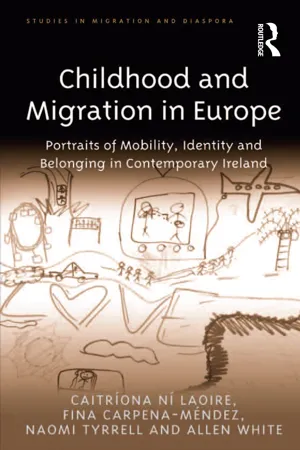
eBook - ePub
Childhood and Migration in Europe
Portraits of Mobility, Identity and Belonging in Contemporary Ireland
- 212 pages
- English
- ePUB (mobile friendly)
- Available on iOS & Android
eBook - ePub
Childhood and Migration in Europe
Portraits of Mobility, Identity and Belonging in Contemporary Ireland
About this book
Childhood and Migration in Europe explores the under-researched and often misunderstood worlds of migrant children and young people, drawing on extensive empirical research with children and young people from diverse migrant backgrounds living in a rapidly changing European society. Through in-depth exploration and analysis of the experiences of children who moved to Ireland in the first decade of the 21st century, it addresses the tendency of migration research and policy to overlook the presence of children in migratory flows. Challenging dominant adult-centric perspectives on contemporary global migration flows and presenting understandings of the lives of migrant children and young people from their own experiences, this book presents a detailed exploration of children's lives in four different migrant populations in Ireland. With a unique comparative perspective, Childhood and Migration in Europe advances upon current conceptualisations of migration and integration by interrogating accepted views of migrant children and focusing on children's own voices and experiences. It challenges the prevailing assimilationist discourses underlying much existing research and policy, which often construct migrant children as deficient in different ways and in need of 'being integrated'.
Information
Acknowledgements
The authors would like to sincerely thank the following for their support and assistance at all stages of the research and writing of this book: all of the children, young people, parents and others who participated in the research, the EU Commission Sixth Framework Programme (Marie Curie Actions) for funding this research, all those who helped us in accessing participants (whom we do not name here for reasons of confidentiality), the members of the Migrant Children Project Advisory Panel and our colleagues in Geography, Migration Studies, the Research Office and across campus in University College Cork. We are grateful to Stanley Brandes, Denis Linehan and Piaras Mac Éinrí for their valuable advice and feedback on earlier drafts, to Neil Jordan of Ashgate for his patience, and finally, to our families for their support at all times.
1 Introduction: Childhood and Migration
DOI: 10.4324/9781315571485-1
In this book, we seek to explore the under-researched and often misunderstood worlds of migrant children and young people. We draw on extensive empirical research with children and young people from diverse backgrounds who have moved to, or within, contemporary Europe as part of transnational migration flows. We challenge dominant adult-centric perspectives on contemporary global migration flows, and begin to reveal partial understandings of the mobilities, identities and belongings of migrant children and young people from their own perspectives, through an in-depth exploration and analysis of the experiences of children and young people who have moved to Ireland in the first decade of the 21st century.
Over the last decade researchers from a range of disciplines have explored the experiences of child migrants in a variety of contexts, recognising the importance of these children's futures in Europe and beyond. Indeed, as Melia (2004) states, understanding the factors that shape mobile children's lives is key to understanding processes of integration in European societies. However, the lack of comparable national data on child migration (UNICEF 2009), with migration statistics often not including children, has resulted in fragmented knowledge about the situations of child migrants. While it is certainly not accurate to claim that child migration has been completely overlooked in research and policy, we argue that the ways in which it is approached tend to be characterised by a number of selectivities and invisibilities (see also White et al. 2011). These selectivities reflect deep-rooted western assumptions about migrant childhoods that ‘the normal state of child life is stability, and that children are naturally innocent and dependent’ (Fass, 2005: 937).
Firstly, reflecting dominant constructions of migrant children as vulnerable victims of migration, there is a tendency to emphasise their neediness and difference, which means that their agency and subjectivities are frequently effaced. This is reflected in the predominance of research and policy on particularly vulnerable groups such as refugee, asylum-seeker, trafficked or separated children (see Spicer 2008, Terrio 2008, Gozdziak 2008), and that which is focused on the needs of these children in host society contexts (see Kohli 2006, Rutter 2003, 2006). Children who move as part of migrant-worker or return migrant families, and/or who disrupt accepted concepts of child vulnerability, are much less frequently the subject of concern. Secondly, often there is a focus on the objectively defined ‘integration’ (or lack of) of migrant children and young people in host society contexts, rather than on their subjective experiences of belonging as transnational migrants moving between different worlds. This is reflected in a paucity of research which focuses on first generation migrant children, that is, children who experience migration themselves, as opposed to second or third generation migrant children. It also creates a tendency to focus on migrant children's futures as adults, rather than their everyday lives and experiences as children who migrate in the here and now. In this introductory chapter, we discuss some of the main elements of recent debates on childhood and migration in Europe and we outline the contribution that this book makes to the current state of knowledge, suggesting that there is a need to incorporate children-centred approaches and to recognise the complex nature of migrant children's belongings and identities. We then go on to discuss the aims and methodological approach of the research on which the book is based before introducing the overarching structure of the remaining chapters.
Migrant Children in European Contexts
Migrant Children as Vulnerable
Research highlights the situations of (often extreme) hardship faced by many migrant children in European contexts, for example as a result of detentions and deportations associated with clandestine border-crossings (Fekete 2007, Watters 2008) or experiences of trafficking (Gozdziak and McDonnell 2007). Young people who migrate alone or as unaccompanied minors are frequently the subjects of research which highlights their vulnerabilities in relation to factors such as exposure to violence, disruption and loss (Hodes 2000) as well as in their encounters with adult-centric asylum and immigration systems (Crawley 2009, Giner 2007). For example, research in France has found that unaccompanied and irregular migrant children are denied basic social services and are disproportionately subject to prosecution (Terrio 2008). Crawley (2006) argues that European immigration regimes contribute to migrant children's vulnerabilities by treating them as migrants first and children second.
Researchers have highlighted the lack of attention paid to children's rights in immigration policies, processes and legal frameworks. According to Bhabha (2008), there are three broad legal approaches to the international migration of children: a punitive and criminalizing approach which constructs the child migrant as victim, a regulatory approach which constructs migrant children as family dependents lacking agency, and a human rights approach which has begun to tackle questions of the rights of migrant children. Similarly, research has pointed to the dominance of two polarised constructions of refugee children: as vulnerable victims in need of care, or as threats to the integrity of the nation-state (Terrio 2008, Doná and Veale 2011). As a result of this duality, refugee children often find themselves the targets of contradictory national policies which attempt to ‘police’ them as untrustworthy immigrants yet also care for them as vulnerable children (Watters 2008). Thus, studies frequently focus on the problems that asylum-seeker, refugee or unaccompanied children experience in their interactions with immigration systems of European host societies (Crawley 2009), and on the effectiveness of systems of care and education which seek to meet their needs (Christie 2002, 2003, Kohli 2006, Watters 2008). A large number of studies have highlighted refugee children's vulnerability to psychological distress (Hodes 2000, Eastmond and Ascher 2011), a trend which some relate to a dominant and highly problematic ‘trauma’ discourse which labels and pathologises a diverse group of young people (Rutter 2006, Watters 2008). In some instances, the children's rights agenda has been mobilised to reinforce constructions of vulnerability in order to argue for more humanitarian immigration regimes for refugee children (Eastmond and Ascher 2011).
This discourse of vulnerability has been challenged by an emerging discourse which emphasises migrant children's resilience in the face of extreme hardship, and points to the need for a shift away from constructions of migrant children and young people as passive, and towards recognition of their agency and competence (Gozdziak 2008, Hess and Shandy 2008, Maegusuku-Hewett et al. 2007, Mai 2011, Watters 2008). This is related, in part, to the influence of the children's rights agenda on child migration research, which argues for the recognition of children's rights in migration policy as well as the acknowledgement of migrant children's agency and voice.
Migrant Children as Passive
Ackers and Stalford (2004) have explored the construction of migrant children as family dependents lacking agency in the European context in particular. They point out that the emphasis (within the EU) on labour migration has contributed to improved family reunification, welfare and education provisions in member states to accommodate labour migrants and their families. However, they argue that it has also resulted in a tendency to subsume children's interests within the interests of the family unit as a whole, often constructing children as barriers to mobility. This view recurs in some family migration literature, in which the role of children is seen to be significant mainly in terms of their presence within families who migrate (Allen 2008), the timing of childbirth events (Cooke 2008) and as motivations for female migration (Horton 2008). In short, having children (or not) is recognised as influential in adult migration decisions and experiences but children's migration within families is not often a topic of interest in its own right. As a result, there is a tendency to construct children who migrate within families as passive dependents (Bushin 2009). As Orellana et al. (2001: 578) argue, children have been portrayed as ‘burdens weighing down on otherwise mobile adults’, as a form of ‘luggage’ in family migration. This denies children's agency and overlooks the diverse roles played by children in family migration processes. Research shows that children can also be active in family migration decision-making processes (Ackers 2000, Ackers and Stalford 2003, Bushin 2009) and can be cultural mediators between adult family members and host societies (de Block and Buckingham 2007, Orellana 2001).
Migrant Children's Rights
One approach to child migration, identified by Bhabha (2008), is the human rights approach which relies on a body of international standards, including the UN Convention on the Rights of the Child, to protect migrant children. While the protection of rights contributes to an emphasis on children's vulnerability, there are also provisions regarding the principle of children's agency or voice. However, in reality, it has proven difficult to protect the rights of migrant children in varying circumstances. For example, in relation to family reunification rights in the EU context, Drywood (2007: 2) argues that ‘there appears to be an over emphasis upon the restrictive provisions of the ECHR1 at the expense of a bold approach to children's rights’. Bhabha (2009) also highlights the predicament of a particular subgroup of migrant children, that is, those who are in effect ‘stateless’ for various reasons and as a result of which whose rights are unenforceable in practice.
The principle of children's ‘voice’ also is central to current directions in sociological research on children's lives, which emphasise the importance of adopting children-centred perspectives and allowing children's own voices to be heard in the research process (James and Prout 1990). There is a growing interest in migrant children's experiences of migrating to, and living in, European contexts, which recognises their agency and subjectivity. Research within the tradition of what has been termed the ‘new social studies of childhood’ acknowledges children's own voices and reveals the multiple ways in which migrant children, sometimes in particularly vulnerable situations, exert agency and construct narratives of their own lives (Adams 2009, Sirriyeh 2010, Sporton, Valentine and Bang-Nielsen 2006, Valentine, Sporton and Bang-Nielsen 2009). Research that acknowledges migrant children's agency and subjectivity in this way is beginning to challenge dominant views of migrant children as vulnerable, needy and powerless. Hess and Shandy (2008) introduce a note of caution however, arguing that migrant children's agency emerges from the gaps and fissures in state policy, reflecting the overwhelming power of the state to objectify children and exert control in their lives.
Second Generation Migrant Children and Integration
While a wealth of research exists on the situations, experiences and identities of the children of immigrants living in Europe, much of this focuses on the experiences of second and subsequent migrant generations, that is, children who were born in the ‘host’ or ‘receiving’ country to immigrant parents. This emphasis reflects the characteristics of migrant populations in most established European immigrant societies which now include substantial second generation populations. Some of this research has employed large-scale survey or multi-method research on the situations of second generation young adults, comparing different ethnic groups in various western European contexts (for example, Crul and Vermeulen 2003, 2004, Penn and Lambert 2009). The main concern of many of these studies is the success or failure of the ‘integration’ or ‘incorporation’ of the children of immigrants in socio-economic, educational and legal terms.
Often these studies of migrant children, second and subsequent generations, focus on children's educational attainment and/or progressions into a country's workforce. European databases that allow comparisons between migrant children's educational attainment in different countries have been utilised (for example, PISA data) and research has explored the situation of migrant children's education in some countries in-depth (OECD 2009, UNICEF 2009). Some of these studies compare the educational and/or employment outcomes for migrant children with those of the ‘indigenous’ population. While a general pattern of social mobility among the second generation has been identified (Crul and Vermeulen 2003), some groups display distinct patterns of socioeconomic disadvantage in comparison to their peers (Aparicio 2007, Marqués, Valente and Martins 2007, Thomson and Crul 2007, UNICEF 2009). Comparative studies of some European countries suggest that children in migrant families perform less well in the education system than children in native-born families, which analysts explain with reference to socioeconomic differences, geographical segregation and the persistence of stereotyping and discrimination (UNICEF 2009). Researchers also point out, however, that this pattern varies by national context and by ethnic group, highlighting the difficulties inherent in making cross-national generalisations (Fibbi et al. 2007, Thomson and Crul 2007).
The education of migrant children is arguably the area that has received most attention in Europe, and in some national contexts this is because of the immediacy of trying to ensure adequate schooling for all children (as is the case in Ireland and other ‘new’ immigration countries). Research has explored the effects of different approaches to the education of children of immigrants (for example, Ackers and Stalford 2003). Youdell's (2006) in-depth research demonstrates how dominant constructions of difference along class, race, gender and ethnic lines in the education system marginalises and defines children, producing particular children as educational outcasts. Similarly, other research suggests that educational policies regarding the promotion of multiculturalist or ethno-national forms of citizenship actually contribute to the ways in which second generation youth form their identities and belongings (Faas 2010, Schmitt 2010). However, much research focuses primarily on educational attainment in academic terms. Entorf and Lauk's (2008) research in the German and Austrian contexts finds that school systems with early streaming or tracking of children reinforce inequalities between those with a low parental socio-economic migration background and those from more privileged families. Crul and Vermeulen's (2004) comparison of four western European countries shows the importance of institutional arrangements in education in determining educational outcomes for second generation Turks (such as starting age, amount of school contact hours in primary school, early or late selection in secondary education and degree of additional support for children of migrant background).
Some of the existing research which focuses on educational atta...
Table of contents
- Cover
- Half Title Page
- Series Page
- Title Page
- Copyright Page
- Table of Contents
- List of Figures
- Notes on Authors
- Series Editor’s Preface
- Acknowledgements
- Bibliography
- Index
Trusted by 375,005 students
Access to over 1.5 million titles for a fair monthly price.
Study more efficiently using our study tools.
Frequently asked questions
Yes, you can cancel anytime from the Subscription tab in your account settings on the Perlego website. Your subscription will stay active until the end of your current billing period. Learn how to cancel your subscription
No, books cannot be downloaded as external files, such as PDFs, for use outside of Perlego. However, you can download books within the Perlego app for offline reading on mobile or tablet. Learn how to download books offline
Perlego offers two plans: Essential and Complete
- Essential is ideal for learners and professionals who enjoy exploring a wide range of subjects. Access the Essential Library with 800,000+ trusted titles and best-sellers across business, personal growth, and the humanities. Includes unlimited reading time and Standard Read Aloud voice.
- Complete: Perfect for advanced learners and researchers needing full, unrestricted access. Unlock 1.5M+ books across hundreds of subjects, including academic and specialized titles. The Complete Plan also includes advanced features like Premium Read Aloud and Research Assistant.
We are an online textbook subscription service, where you can get access to an entire online library for less than the price of a single book per month. With over 1.5 million books across 990+ topics, we’ve got you covered! Learn about our mission
Look out for the read-aloud symbol on your next book to see if you can listen to it. The read-aloud tool reads text aloud for you, highlighting the text as it is being read. You can pause it, speed it up and slow it down. Learn more about Read Aloud
Yes! You can use the Perlego app on both iOS and Android devices to read anytime, anywhere — even offline. Perfect for commutes or when you’re on the go.
Please note we cannot support devices running on iOS 13 and Android 7 or earlier. Learn more about using the app
Please note we cannot support devices running on iOS 13 and Android 7 or earlier. Learn more about using the app
Yes, you can access Childhood and Migration in Europe by Caitríona Ní Laoire,Fina Carpena-Méndez,Allen White,Naomi Tyrrell in PDF and/or ePUB format, as well as other popular books in Social Sciences & Emigration & Immigration. We have over 1.5 million books available in our catalogue for you to explore.