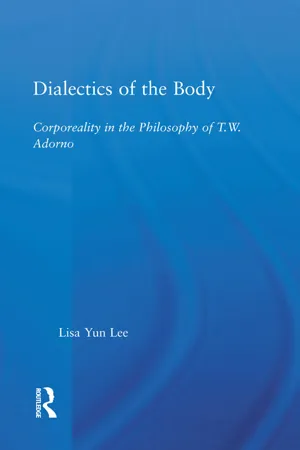
The study of Theodor Adorno has largely ignored or dismissed the enigmatic and provocative moments in his writing on the body. Dialectics of the Body corrects this gap by arguing that Adorno's analysis of reified society emanates and returns to the body and that hope and desire are present throughout Adorno's philosophy.
- 206 pages
- English
- ePUB (mobile friendly)
- Available on iOS & Android
eBook - ePub
About this book
Information
Chapter One
Repressing the Body
Hope clings to the transfigured body.
—Theodor Adorno
In a remarkable section of the appended texts to the Dialectic of Enlightenment1, Adorno and Horkheimer reflect on western civilization’s love/hate relationship with the body, which they describe as an intimate affair that has turned the sensuous body into a corpse. The first passage of the section, entitled “The Importance of the Body,” opens with the statement, “Europe has two histories: a well-known, written history and an underground history. The latter consists in the fate of the human instincts and passions which are displaced and distorted by civilization.”2 Adorno and Horkheimer go on to suggest that the sadistic impulses of society result from the repression of the libidinal body; “The compulsive urge to cruelty and destruction springs from the organic displacement of the relationship between the mind and body.”3 Using language that recalls both Nietzsche and Sade, Adorno and Horkheimer suggest that by dismantling the myth of “history as progress,” it is possible to uncover a subterranean history that reveals a darker side of the Enlightenment. This other history, which has been repressed, is one of instincts, desire, pleasure and suffering—in short, a history of the body.
This particular section of Dialectic of Enlightenment—a work that Jürgen Habermas has described as the “blackest, most nihilistic” of Frankfurt School texts—is remarkable because it highlights its author’s insistence on sensual pleasure, corporeal gratification and desire for happiness. There is, granted, an ascetic aura to the Dialectic of Enlightenment, emanating from Adorno and Horkheimer’s aggressive critique of Enlightenment reason and their relentless negation of, and skepticism towards, the existing order. It would be wrong, however, to reify negativity in their thought, which is most often the case in current post-modern appropriations of Adorno and Horkheimer. It is important to keep in mind that negativity—like dialectics—was, according to Adorno, the ontology of “the wrong state of things;” accompanying the negative in Adorno’s dialectical meditations, is always the promise of “the right state of things.”4
This hope in the “promise of happiness” underlies Adorno’s understanding of Utopia, which for him is not a “brave new world” of carefree abandon, instant gratification, and complacent contentment. Adorno makes this clear in an essay on Alduous Huxley, in which he describes how closely a socially engineered system based upon guaranteed happiness and fulfilled needs resembles the “totally administered society” of the modern state. In this essay, Adorno examines how the master raisonneur of Huxley’s world, Mustapha Mond—operating under the same libidinal economy as the rationalized mechanisms of the culture industry—manipulates desires and encourages people to forget suffering. In contrast, Adorno stresses that suffering is the condition of truth. One of the most compelling statements in Adorno’s oeuvre is the opening to Negative Dialectics, in which he writes, “The need to lend a voice to suffering is the condition of all truth.”5 The truth content of Utopia is precisely this ability to give suffering a voice. This imperative to express and not repress suffering is one of the fundamental conditions of Adorno’s philosophy and thought.
In the following chapter, I will examine the linkage between repression, the body and Utopia in Adorno’s thought. I will focus on Adorno’s major work of social theory, the Dialectic of Enlightenment, because it is the work in which the concept of repression is best articulated. In this text, the body emerges as the Utopian site from which Adorno launches his critique of the failures and absences of reified society. It is necessary for my discussion to take a step back and trace one of the more enigmatic intellectual forces that shaped the early Frankfurt School—Freud and the emerging discourse of psycho-analysis. I will therefore begin with an examination of Adorno’s engagement with Freudian theory and his strategic appropriation of Freud’s libidinal understanding of society. This discussion of repression will be useful as a site from which to begin thinking in corporeal terms and for my larger project of describing the centrality of the body in Adorno’s philosophy and thought.
REPRESSION AND MEDIATION
Repression is a crucial word in Adorno’s critical lexicon. It provides an important clue to answering the perplexing question that occupied Adorno for his entire intellectual life: How do individuals become accomplices to their own subjugation? In Adorno’s meditations, repression is the mechanism that allows for the internalization of the external forms of domination and oppression. In other words, repression acts as a form of mediation. Adorno’s insistence on the importance of mediation is a hallmark of his thought. Mediation (Vermittlung) is a difficult concept in his philosophy because it has several different meanings. At times it is used quite simply in the traditional sense to mean that a third term is required to make a connection between two ideas. At other times, the concept of mediation is used to suggest a level of self-refiexivity to the epistemological process, or what Adorno often referred to as “thought thinking thought” or “thought to the second degree.” In other words, a sort of suspicion toward the way human beings perceive the world around us. A third, and more complex, meaning of Vermittlung—the one that is most relevant for the concept of repression—must be understood in relation to the concept of reification.
Adorno first encountered the notion of reification in Georg Lukács’ The Theory of the Novel, which he read and studied early in his intellectual life. Lukacs wrote this work in 1914–15 during a period when he was more concerned by aesthetic concerns (Kierkegaard, Dilthey and Hegelian idealism) than political revolution (Marx). Unlike his later masterwork History and Class Consciousness, which interprets history as the irresistible objective movement of proletarian consciousness—a premise that Adorno vehemently opposed—the focus of The Theory of the Novel is on the relationship between form and history, namely the idea that literary form is not an abstract, atemporal principal, but is itself an objective content and a reflection of historical conditions. It is in this work that Lukacs first uses the concept of reification to describe the negative influence of concrete historical conditions on works of art; only later, in History and Class Consciousness, does Lukacs develop and extend his understanding of reification to include human beings. Though Adorno’s relationship with Lukacs soured later on with the infamous debates concerning aesthetics and politics,6 he consistently expressed the seminal importance of Lukacs’ concept of reification to the development of his thought.
Although it is not possible to give a complete account of Lukacs here, I will briefly outline some of the significant elements of his arguments in regards to reification in order to show how repression functions as a form of mediation. Lukacs begins his explication of reification by showing how one ideology manifests itself in various ways in different strata of social life by establishing correspondences between the “economic forms of society” and its “cultural forms” and “forms of expression.” This approach towards understanding ideology and its various manifestations became a standard methodology for examining politics, literature and philosophy for many of the Frankfurt School thinkers, namely Leo Lowenthal, Walter Benjamin, Max Horkheimer and Adorno. In his discussion, Lukacs uses the concept of reification to describe the structural process whereby the commodity form permeates life in capitalist society in other words, when exchange value replaces use-value. Drawing on Marx’s description of this process in terms of the commodity, whereby the social character of human labor is transformed from a relation between people to a relation between the products of that labor, Lukács demonstrates how the “organic” relationship between producer and product has been usurped and the human being has been made into an object of consumption. The relation between human beings is no longer based on qualitative values, but merely quantitative, commercial exchange. In the process, human beings are transformed from sentient beings into commodities, things and reified objects. The commodity form transforms the immediate relation between human beings into, to borrow a phrase from Marx, “the fantastic form of a relation between things.”7 The most insidious effect of reification is the inability of human beings to recognize their own exploitation. In the midst of such alienating reification, the existing state of affairs takes on a “ghostly objectivity.” Lukács explains the effects as follows:
For that very reason the reified mind has come to regard [this situation] as the true representatives of his societal existence. The commodity character of the commodity, the abstract, quantitative mode of calculability shows itself here in its purest form: the reified mind necessarily sees it as a form in which its own authentic immediacy becomes manifest and— as reified consciousness—does not even attempt to transcend it.8
Lukács concludes that it is therefore important to move beyond “false immediacy” and the reflection of immediate reality, which is merely the illusory reflection of a reified condition.
Adorno extends Lukács’ understanding of reification and mediation to his critique of philosophy in his work on Edmund Husserl, Against Epistemology- a Metacritique: Studies in Husserl and the Phenomenological Antinomies. Adorno began this work while he was studying in London, and intended to become promoviert with it. He started by trying to reconcile Husserl’s phenomenological project with his own endeavor to construct a dialectical materialism, and it is obvious in the study that Adorno is sympathetic to Husserl, particularly his attention to the sensuous nature of the lived-body and to his key insight that the relationship between the body and things is not identical to that between physical things.9 Ultimately, however, Adorno’s insistence on mediation propelled a critique and rejection of Husserl, and he left the work unfinished until 1956.
Though Husserl’s project starts as a struggle against idealism—a sentiment with which Adorno agreed entirely—Adorno denounced it in the end because it develops into a search for a prima philosophia, or a first principle from which philosophy may proceed. This misguided search for an origin, or arche, to thought dominates western philosophy beginning with Descartes. According to Adorno, all forms of idealism stem from this search, which assigns primacy to an original principle, whether it is located in the epistemic subject or primordial Being.10 Adorno draws attention to the traces of idealism in Husserl’s efforts by demonstrating the “ghostliness of all phenomenological concretion.”11 In other words, he points out the spurious nature of Husserl’s phenomenological project, which seeks to reveal “the order of the objects themselves” apart from “the schema of order imposed on objects by human consciousness.”12 Adorno argues that Husserl fails to reflect critically on his own epistemological method because he accords objects of his method the status of unmediated phenomena.
Adorno mobilizes two arguments against the notion of such an origin. For one, he suggests that “the first and immediate is always, as a concept, mediated and thus not the first,”13 by which he means that it is impossible to separate thought from a constructed philosophy. We must think “mortal and not immortal thoughts”—anything we take to be original is always already derivative and secondary. We cannot step out of our epistemological skins. Adorno’s second argument against an original principle develops from a Marxist understanding of history, and his commitment to a “historico-philosophical analysis” (geschichtsphilosophischen Analyse) of the surrounding world and our selves. In Adorno’s methodology, every principle that is elevated above appearances is inescapably historical. The “original principle” is in fact generated from on-going philosophical debates (which are historical) and are in turn generated by the social conflicts surrounding them (which are also historical).
Virtually all the problems Adorno finds with Husserl’s project stem from the philosophical weight that Adorno accords to mediation. From Lukács’ understanding of reification and his critique of Husserl, Adorno begins to formulate a critique of the end of human sensuousness, vitality and authentic experience and the inability of human beings to understand their own domination. It is at this point that I will turn to Adorno’s interest in Freud, who develops a concept of repression that mediates the psyche and somatic and explains the process by which socio-historical institutions and practices become sedimented and rigidified into our psychic structures.
FREUD AND THE FRANKFURT SCHOOL
When Horkheimer was asked by Leo Lowenthal to describe the significance of Freud for the Institute of Social Research, he responded as follows: “We really are deeply indebted to Freud and his first collaborators. His thought is one of the Bildungsmächte without which our own philosophy would not be what it is.”14 The Frankfurt School’s intrepid attempts to treat Freud on par with canonical German thinkers such as Kant, Hegel, and Nietzsche were unprecedented. It is difficult today to appreciate the audacity of the Frankfurt School’s reception of Freud and their efforts to introduce psychoanalysis into neo Marxist Critical Theory in the 1920’s and early 1930’s, and therefore meaningful to sketch out some of the historical circumstances that shaped the tenuous relationship between Freud and Marxist thinkers of this period.
During this time, Freud’s controversial (and, as popular reception at the time held, contradictory) thought had been all but replaced by the new orthodoxy and transparency of Pavlovian behaviorism. Stalin, who was an enthusiastic supporter of Pavlov, gave Pavlov his own research institute in 1930. As a result, it is not difficult to unearth traces of Pavlov’s influence on Marxist thinkers of this period—most notable in Germany. Bertolt Brecht’s depiction of human nature and his central notion of “re-functioning” (Umfunktionierung)—especially in a work such as Man Equals Man—owes much to the revolutionary notion that human beings can be reconstructed and retrained to think and perform as easily as it is to make a dog salivate when the proper stimulus is provided. In contrast, Freud’s pessimism about the possibilities for social change, most apparent in texts such as Civilization and its Discontents, was considered incompatible with revolutionary hopes. These factors, which helped lead to Freud’s demise in other Marxist circles, seemed to be tailor-made for the thinkers at the Institute of Social Research. As we shall see, Horkheimer and Adorno preserve and recognize the antinomies of Freud’s thought as a form of dialectical reason. Most importantly, it was...
Table of contents
- Cover
- Title Page
- Copyright Page
- Table of Contents
- Acknowledgments
- Introduction
- Chapter One Repressing the Body
- Feminist Interlude I Avoiding the Sirens: Women in the Dialectic of Enlightenment
- Chapter Two Interrogating Philosophy: The Bared Breasts Incident
- Feminist Interlude II Entanglement: Remembering Gretel Karplus Adorno
- Chapter Three “The Most Forgotten Alien Land”: Adorno’s Essay on Kafka
- Feminist Interlude III Reading the Body: Kafka’s “In the Penal Colony”
- Chapter Four Feminist Negative Dialectics: Dialectical Materialism and the “Transfigured Body”
- Conclusion
- Notes
- Bibliography
- Index
Trusted by 375,005 students
Access to over 1.5 million titles for a fair monthly price.
Study more efficiently using our study tools.
Frequently asked questions
Yes, you can cancel anytime from the Subscription tab in your account settings on the Perlego website. Your subscription will stay active until the end of your current billing period. Learn how to cancel your subscription
No, books cannot be downloaded as external files, such as PDFs, for use outside of Perlego. However, you can download books within the Perlego app for offline reading on mobile or tablet. Learn how to download books offline
Perlego offers two plans: Essential and Complete
- Essential is ideal for learners and professionals who enjoy exploring a wide range of subjects. Access the Essential Library with 800,000+ trusted titles and best-sellers across business, personal growth, and the humanities. Includes unlimited reading time and Standard Read Aloud voice.
- Complete: Perfect for advanced learners and researchers needing full, unrestricted access. Unlock 1.5M+ books across hundreds of subjects, including academic and specialized titles. The Complete Plan also includes advanced features like Premium Read Aloud and Research Assistant.
We are an online textbook subscription service, where you can get access to an entire online library for less than the price of a single book per month. With over 1.5 million books across 990+ topics, we’ve got you covered! Learn about our mission
Look out for the read-aloud symbol on your next book to see if you can listen to it. The read-aloud tool reads text aloud for you, highlighting the text as it is being read. You can pause it, speed it up and slow it down. Learn more about Read Aloud
Yes! You can use the Perlego app on both iOS and Android devices to read anytime, anywhere — even offline. Perfect for commutes or when you’re on the go.
Please note we cannot support devices running on iOS 13 and Android 7 or earlier. Learn more about using the app
Please note we cannot support devices running on iOS 13 and Android 7 or earlier. Learn more about using the app
Yes, you can access Dialectics of the Body by Lisa Yun Lee in PDF and/or ePUB format, as well as other popular books in Philosophy & Mind & Body in Philosophy. We have over 1.5 million books available in our catalogue for you to explore.