eBook - ePub
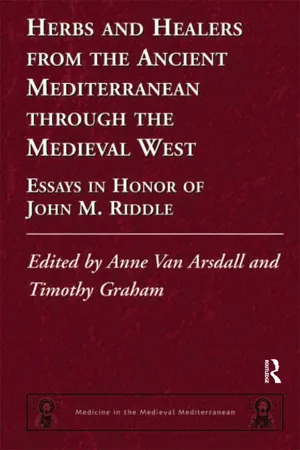
Herbs and Healers from the Ancient Mediterranean through the Medieval West
Essays in Honor of John M. Riddle
- 394 pages
- English
- ePUB (mobile friendly)
- Available on iOS & Android
eBook - ePub
Herbs and Healers from the Ancient Mediterranean through the Medieval West
Essays in Honor of John M. Riddle
About this book
Herbs and Healers from the Ancient Mediterranean through the Medieval West brings together eleven papers by leading scholars in ancient and medieval medicine and pharmacy. Fittingly, the volume honors Professor John M. Riddle, one of today's most respected medieval historians, whose career has been devoted to decoding the complexities of early medicine and pharmacy. "Herbs" in the title generally connotes drugs in ancient and medieval times; the essays here discuss interesting aspects of the challenges scholars face as they translate and interpret texts in several older languages. Some of the healers in the volume are named, such as Philotas of Amphissa, Gariopontus, and Constantine the African; many are anonymous and known only from their treatises on drugs and/or medicine. The volume's scope demonstrates the breadth of current research being undertaken in the field, examining both practical medical arts and medical theory from the ancient world into early modern times. It also includes a paper about a cutting-edge Internet-based system for ongoing academic collaboration. The essays in this volume reveal insightful research approaches and highlight new discoveries that will be of interest to the international academic community of classicists, medievalists, and early-modernists because of the scarcity of publications objectively evaluating long-lived traditions that have their origin in the world of the ancient Mediterranean.
Information
Chapter 1
Pharmacology and Toxicology at the Court of Cleopatra VII: Traces of Three Physicians
In a tattered papyrus, recovered from the charred scrolls in the Villa dei Papiri in Herculaneum, is a scorched remnant in eight columns of a Latin poem, Carmen de Bello Actiaco (The Battle of Actium). With some difficulty regarding orthography, since its original unrolling in 1805, scholars gradually have deciphered, edited, and translated this priceless bit of almost contemporary history.1 The full epic most likely focused on the actions and participants in the naval battle at Actium (31 BC), in which Octavian emerged victorious over Antony and Cleopatra, and the poet—who remains anonymous, although Rabirius seems favored among classical scholars—details characteristic behaviors of the protagonists; two of the eight surviving columns describe, with bloodthirsty relish, Cleopatra’s “experiments” with methods of murder on living human beings:
... and the place assigned, where the crowd of criminals would collect and provide sad spectacles of their own deaths. Just as, for an army and fleet on the point of attack, weapons, flags, and trumpets are readied this is what the place looked like, as the cruel instruments of death were collected, brought together in varying stages of readiness. Thus, every kind of ugly death, every kind of ugly fear, was gathered there on the field. One man lies cut down by the sword; another is swollen with poison, or with an asp hanging on his throat he slips into sleep, led on by his lust for death; another a small basilisk strikes with his hisses alone, without a bite; or a tiny bit of poison smeared in a small wound does away with him more quickly; others are forced by tight nooses to pour forth their last breath through compressed passages; and others had their throats closed when they were immersed in water. In the midst of this slaughter she descended from her throne and in the midst of ...2
Similarly, Plutarch gives purported details of Cleopatra’s heartless trials on slaves and criminals, seeking means of rapid demise through poisons3—probably tales based on Alexandrian traditions, also reflected in Galen’s version of the famous suicide.4 Many scholars have questioned the standard account of that suicide,5 and it is clear the bite of an Egyptian cobra would not guarantee an instant and painless death.6 Cleopatra herself had a fairly well-founded expertise in the lore of drugs and poisons,7 poisonous snakes, and other presumably harmful creatures native to Egypt, even though she bequeathed in her often-quoted works—assumed by authorities in Roman antiquity to be genuine—a respected proficiency in the arts of cosmetics,8 as contrasted to the more ominous reputation (in company with Mithridates VI of Pontus and Attalus III of Pergamon) of being a royal toxicologist.9
Plutarch mentions that an important source for his account of Cleopatra’s death was a physician named Olympus, who apparently was present when the queen committed suicide.10 If Olympus was the author of any medical writings, he has left us with no actual tracts, nor do later authorities mention any of his works.11 Jacoby simply records the Greek text in Plutarch, with his blunt commentary that scholars who have attempted connections with Octavian/Augustus are sadly misled, quoting the renowned line from Plutarch, “nobody knows the truth.”12 We cannot, therefore, determine if Olympus had any influence on the queen’s learning in pharmaceuticals, but he certainly represents the continual presence of a “royal physician” attending to her requirements. It is also probable that Olympus’ “journal” had some limited circulation, and it seems reasonable to suppose that Galen’s often-expressed disgust at Alexandrian mores (which included the supposedly humane methods of execution by means of cobra bites)13 may have surfaced, in part, from such eyewitness accounts, perhaps available through the book trade.
Firmer testimony on the circle of physicians who ministered to the medical needs of Antony, Cleopatra, and others of this late Ptolemaic court14 offers details of the pharmacology involved in the practice of medicine among royalty, as well as some anecdotal evidence on how a doctor functioned in the milieu of one of the most famous imperial entourages in classical antiquity. Connections are secure in the texts for two other physicians, Philotas of Amphissa (c. 55 BC–AD 30) and Dioscorides “Phacas” (fl. c. 80–45 BC), but links to the Ptolemaic court during the reign of Cleopatra VII of four more doctors then resident in Alexandria (Sostratus, Apollonius “the Mouse” [Mys], Ammonius, and Philoxenus)15 are woolly at best and generally conjectured alone on simple chronology and locale.
Philotas of Amphissa was one of the young medical attendants serving Marcus Antonius Antyllus, Marc Antony’s elder son by Fulvia (born probably in late 47 or 46 BC).16 In the early 30s BC, Philotas returned to Amphissa after completing his medical studies at Alexandria. At the age of about 75,17 Delphi honored Philotas with an inscription for his numerous years of service.18 Plutarch’s grandfather, Lamprias, listened with unbridled fascination to the stories of the then-elderly and quite garrulous Philotas, tales that included the luxurious culinary habits of Antony and Cleopatra: according to the oral narratives, as reported by Plutarch, Antony and Cleopatra insisted that eight boars should be in separate stages of roasting, so that when the royal couple called for their meal, the meat would be done to perfection.19 Oral sources were quite important to Plutarch,20 and he provides a valuable characterization of his grandfather’s particular style of storytelling, and why a little wine went a long way: Lamprias was “his most eloquent and resourcefully clever self while imbibing, saying that since frankincense becomes vaporous fumes from heat, thus he was made so by wine.”21
Philotas acquired some of the usual medical theories while he was a student in Alexandria, most likely attending lectures given by noted medical philosophers of the day, who perhaps espoused a common version of “Hippocratic” or Aristotelian notions of opposites as they existed in the wider universe and in the physiologies of animals and humans. Another third-hand report from the mouth of Lamprias suggests a “social application” of medical theory in debates and conversations some time in the 40s and 30s BC. During an evening meal with Marcus Antonius Antyllus and his cronies and attendants, the youthful Philotas challenged an apparently annoying older physician in his cups with a blunt analysis of how a doctor might treat fevers: “To someone who is slightly feverish, one must administer something cold; and anyone who displays a fever is slightly feverish; therefore everyone who is feverish should be given cold [water].”22
Mirrored in the fragments of Philotas’ writings, pharmacology was an important aspect of medical instruction in Alexandria, and one can surmise that he applied such knowledge in the context of the Ptolemaic court. Perhaps Philotas’ pharmaceutical formulas and recipes were very useful indeed for soldiers and gladiators, since his kephalikon among the rhaptousi (compound drugs, normally prepared as plasters, which “sewed up” or “sealed” a wound) would have been immediately applicable in instances of skull fractures and broken bones.23 Philotas’ kephalikon includes expected ingredients (beeswax, myrrh and frankincense, the agglutinative Eretrian earth combined with vinegar, four kinds of copper flakes as well as copper rust [verdigris], the gummy exudates of birthwort [Aristolochia spp.], raw alum, oil of roses, and olive oil), but also, most unusually, 25 drachmai of ichthyokolla, “fish glue” derived from the natural gelatin made from the sounds or swimming bladders of large freshwater fish, usually sturgeons.24 Galen notes that Philotas’ compound, with its large quantity of fish glue, is also good for inveterate wounds, that is those of “long standing” (ta chronia), and for those injuries difficult to treat and heal (kai dysalthē), especially “promoting the setting of broken bones and the formation of a callus.” Once applied, fish glue dries glass-hard and transparent, and its employment for skull fractures and hard-to-seal wounds continued well into the twentieth century.25 The Ptolemaic pharmacist first pounded the fish glue in a glass vessel, adding slowly the vinegar, then the copper flakes, and the Greek text concludes by saying that one fashions the compound into pastilles (trochiskoi), which then could be used as small plasters as required. Given the fairly large amount of fish glue and other ingredients (50 drachmai of the copper flakes/scales, 100 drachmai of the Eretrian earth, the 25 drachmai of the fish glue, 12 kotylai of vinegar), it appears that the compound was made in bulk and applied to the wounds and fractures presumably of soldiers and gladiators over a period of time. Philotas’ inclusion of ichthyokolla...
Table of contents
- Cover
- Title Page
- Copyright Page
- Table of Contents
- List of Figures
- List of Tables and Boxes
- List of Contributors
- Introduction
- 1 Pharmacology and Toxicology at the Court of Cleopatra VII: Traces of Three Physicians
- 2 Quid pro Quo : Revisiting the Practice of Substitution in Ancient Pharmacy
- 3 Speaking in Tongues: Medical Wisdom and Glossing Practices in and around Salerno, c. 1040–1200
- 4 The Ghost in the Articella: A Twelfth-century Commentary on the Constantinian Liber Graduum
- 5 “I will add what the Arab once taught”: Constantine the African in Northern European Medical Verse
- 6 A Problematic Plant Name: elehtre. A Reconsideration
- 7 Herbs and Herbal Healing Satirized in Middle English Texts
- 8 “Kurze versuochte dinge.” Ein mährisch-schlesisches wundärztliches Rezeptar des 15. Jahrhunderts
- 9 Saint John’s Wort (Hypericum perforatum L.) in the Age of Paracelsus and the Great Herbals: Assessing the Historical Claims for a Traditional Remedy
- 10 Revisiting Eve’s Herbs: Reflections on Therapeutic Uncertainties
- 11 Modding Medievalists: Designing a Web-based Portal for the Medieval Plant Survey/Portal der Pflanzen des Mittelalters (MPS/PPM)
- The Publications of John M. Riddle, 1964–2010
- Index of Manuscripts
- General Index
Trusted by 375,005 students
Access to over 1.5 million titles for a fair monthly price.
Study more efficiently using our study tools.
Frequently asked questions
Yes, you can cancel anytime from the Subscription tab in your account settings on the Perlego website. Your subscription will stay active until the end of your current billing period. Learn how to cancel your subscription
No, books cannot be downloaded as external files, such as PDFs, for use outside of Perlego. However, you can download books within the Perlego app for offline reading on mobile or tablet. Learn how to download books offline
Perlego offers two plans: Essential and Complete
- Essential is ideal for learners and professionals who enjoy exploring a wide range of subjects. Access the Essential Library with 800,000+ trusted titles and best-sellers across business, personal growth, and the humanities. Includes unlimited reading time and Standard Read Aloud voice.
- Complete: Perfect for advanced learners and researchers needing full, unrestricted access. Unlock 1.5M+ books across hundreds of subjects, including academic and specialized titles. The Complete Plan also includes advanced features like Premium Read Aloud and Research Assistant.
We are an online textbook subscription service, where you can get access to an entire online library for less than the price of a single book per month. With over 1.5 million books across 990+ topics, we’ve got you covered! Learn about our mission
Look out for the read-aloud symbol on your next book to see if you can listen to it. The read-aloud tool reads text aloud for you, highlighting the text as it is being read. You can pause it, speed it up and slow it down. Learn more about Read Aloud
Yes! You can use the Perlego app on both iOS and Android devices to read anytime, anywhere — even offline. Perfect for commutes or when you’re on the go.
Please note we cannot support devices running on iOS 13 and Android 7 or earlier. Learn more about using the app
Please note we cannot support devices running on iOS 13 and Android 7 or earlier. Learn more about using the app
Yes, you can access Herbs and Healers from the Ancient Mediterranean through the Medieval West by Anne Van Arsdall, Timothy Graham, Anne Van Arsdall,Timothy Graham in PDF and/or ePUB format, as well as other popular books in Medicine & World History. We have over 1.5 million books available in our catalogue for you to explore.