- 222 pages
- English
- ePUB (mobile friendly)
- Available on iOS & Android
eBook - ePub
About this book
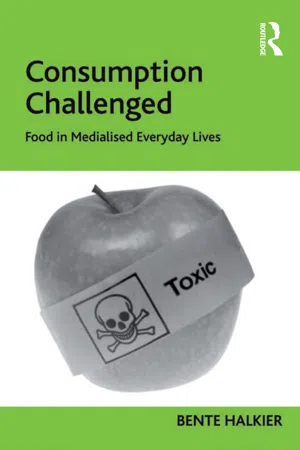
In public debates, communication campaigns and public policies, it is increasingly common to attribute to consumers and their agency an ability to help solve a broad array of societal problems. This tendency is particularly clear in the field of food consumption, owing to the fact that food is both materially and symbolically central for consumers in everyday life as well as for large scale institutionalized dynamics. In order to shed light on the challenges facing food consumption, this volume takes an innovative theoretical approach, presenting four empirical Danish case studies which are compared with other analyses drawn from the wider international context. Consumption Challenged will appeal not only to sociologists of consumption, risk and the environment, but also to policy makers and researchers in the fields of geography, communication, media, governance and social psychology.
Information
Chapter 1 A Field of Challenged Consumption
DOI: 10.4324/9781315573755-1
Challenging Consumption
But I am also tired of the media in the way that ... they bring something up, right, and then I sit and work myself all up about it and saying that it’s too bloody bad ... but my possibilities for doing ANYTHING about it are not really there, are they? You know ... the fish doesn’t get better from them making such a television show, right? I’ve just got yet another problem thrown into my face, right? (Danish food consumer)
Most of us living in modern globalised and medialised large-scale societies will probably be able to recognise the type of experience expressed above by this Danish food consumer. He talks about what he can do when television suddenly represents fish as potentially dangerous to eat because of its content of mercury or dioxin, whereas fish has otherwise typically been represented as healthy to eat. What are we as consumers going to do about all the different kinds of knowledge and opinions about what we eat and how we eat that we get from the media discussions about food? Do we as consumers have a responsibility for helping to solve societal problems such as the quality of food, the climate crisis, or the obesity epidemic? We cannot entirely escape discussions in the media that question our consumption routines, but how do we react to this constant questioning on a daily basis? The primary purpose of this book is to show the variety in consumer reactions in everyday life to such questioning of food consumption routines.
One of the assumptions made in this book is that everyday consumption activities become contested because we live in a thoroughly medialised society (Thompson, 1995). That society is medialised means that most of us use and relate to insights from media as an integrated part of many of our daily activities. We cannot directly experience everything we need to know or get to know what we need to know through sharing the experiences of people we know personally. Significant parts of our understandings are based upon representations in media of knowledges, experiences and discourses. Such representations are called medialised knowledges, medialised experiences and medialised discourses.
The quote at the beginning of the chapter, in which the male consumer is talking about a television programme on the quality of fish, refers to discourses in the media that question the consumer’s fish consumption and suggest that he should change his eating habits in relation to fish. The same type of discourse in the media can be seen in relation to a number of societal food issues: environmental problems, health problems, food safety problems, ethical problems, problems related to cooking skills, and problems of social inequality. The primary message in such media discourses and communication campaigns is that we, as food consumers, ought to change our routines of shopping, cooking and eating in order to act as morally good consumers, who help to solve collective problems in society. We can react in many different ways to the suggestions in this type of media discourse and communication campaigns. We can, for example, comment upon, reflect upon, ignore, discuss, and/or act upon such suggestions for changing our food consumption routines. When we as consumers react in these various ways, we are already interacting with the discourses that contest our food consumption.
Ordinary routinised, unnoticeable consumption activities become normatively1 challenged as a result of such media discourses (Adams and Raisborough, 2008: 1178; Clarke et al., 2007; Ehn and Löfgren, 2009: 106; Sulkunen, 2009: 8). The whole point of the majority of the media discourses on consumer responsibility is that a large amount of consumption activities ought to be noticed, reflected upon and changed – e.g. into more sustainable, healthy, ethical and safe patterns. The discourses of communication campaigns (Windahl et al., 1992) are meant to make consumers mindful of their unnoticed routines in consumption, although such reflexivity has been shown on many occasions to be both demanding and difficult (Wilk, 2009: 146).
This book aims to show similarities and differences in consumers’ handling of such normative challenging of their consumption activities across four specific issues where food habits are being contested through media discourses: the environmental issue, the issue of food safety, the issue of cooking from scratch, and the issue of nutrition.
During the last twenty years, there has been an increased ascription of societal responsibility and agency to ordinary citizens in their capacities as private individual consumers.2 Expectations as to what ordinary consumers themselves can do to solve societal problems have risen significantly. In public debates, communication campaigns and public policies, consumers are being called upon to help solving a broad array of societal problems. The UN Brundtland Report in 1987 and the following Rio Conference in 1992 framed individual ordinary consumers as co-responsible for solving environmental problems (Christensen et al., 2007: 94–95). Max Haavelaar introduced the first Fairtrade labeeling scheme in 1988, presenting ordinary consumers in supermarkets with the choice of ethical consumption (Nicholls and Opal, 2005: 10). The institutional changes in food safety policies in the wake of Europe’s hitherto largest food scandal, the BSE crisis, beginning in 1996, led to attempts to involve ordinary consumers in the societal regulation of food risks (Holm and Halkier, 2009). The global so-called obesity epidemic at the beginning of the twenty-first century led to media products confronting ever-younger consumers with discourses about healthy eating practices (Kline, 2005).
The development of ascribing societal responsibility to individual consumers and thereby challenging everyday consumption practices is reflected in the social scientific field. In recent years, a number of international journals publishing about consumers and consumption have devoted special issues to the theme of challenging consumption. The International Journal of Consumer Studies published a special issue on political consumerism in 2006, the Journal of Consumer Culture ran an issue on ethical consumption in 2007, the Journal of Business Research published an issue on anti-consumption in 2009, and Anthropology of Food published one on sustainable consumption in 2009.
In the sociology of consumption and studies of consumer culture, this tendency can be observed, for example, in the discussions about the agency of consumers. In 1995, a much-quoted book by Yiannis Gabriel and Tim Lang, called The Unmanageable Consumer, discussed different conceptualisations of consumers. The aim of their book was on the one hand to give theoretical importance to an understanding of the concept of the consumer across the various research traditions that tried to make it their own, and on the other hand, to signal something about the unpredictability of processes of consumption (Gabriel and Lang, 1995: 4).
In a recent article, Gabriel and Lang reflect upon this category of the unmanageable consumer and conclude:
The consumer, then, is unmanageable, both as a concept, since no-one can pin it down to one specific conceptualization at the expense of all others, and as an entity, since attempts to control and manage the consumer result in mutations from a stable consumer concept to an unstable one. (Gabriel and Lang, 2007: 333)
However, they also highlight that in spite of the unmanageability of consumers, concrete consumption activities and patterns are constantly attempted, influenced, managed, controlled, and changed, and they mention environmental problems and demographic problems as legitimate grounds for challenging consumption (ibid.: 335). This type of argumentation brings Gabriel and Lang in line with several other contributions to the field which debate how consumption is a complicated and even ambivalent social phenomenon that cannot be held apart from societal moralisations (Adams and Raisborough, 2008: 1170–71; Wilk, 2001: 253) but needs to be discussed in relation to agency and citizenship (e.g. Boström and Klintman, 2008; Soper and Trentmann, 2008).
In communication and media research, consumers are also seen as communication users, and the main debate has focused on an expansion of the concept of citizenship into a more culturally based understanding (e.g. Dahlgren, 2006; Dodds et al., 2008; Keum et al., 2004), probably because consumption typically is seen as cultural consumption in communication and media research (Storey, 1999; Hermes, 2005). Dahlgren argues that the boundaries between the traditionally differently conceived spheres of society such as the public and the private are fluid, and that understandings of current, more culturally based citizenship must include the everyday life experiences of ordinary communication users: ‘In short, to understand the origins of civic competence, we need to look beyond the public sphere itself into the terrain of the private – or expressed alternatively, into the experiential domain of everyday life or civil society’ (Dahlgren, 2006: 276). Contributions that express more scepticism in relation to the agency potential of ordinary communication users and consumers point to the conditions under which it is assumed that such a culturally broader civic engagement is supposed to be carried out (e.g. Phillips, 2000). But it seems to be a shared assumption across the more optimistic and the more sceptical approaches that the development towards expansion of citizenship via consumption and other ordinary life activities is taking place as a kind of social conditioning in itself.
In business studies and marketing, the topic of challenging consumption has been discussed as an additional symbolic dimension of consumer choice (e.g. Aspers, 2008; Belk et al., 2005; Hanpää, 2007; Sandikci and Ekici, 2009), in which the symbolic gratifications and identifications can be grounded for ordinary consumers. The contributions to this discussion have not necessarily involved the potential element of changes of consumer choice. Another type of discussion in business and marketing (overlapping with parts of communication research) has focused more on the element of change. This is the debate about the potentials and pitfalls of social marketing as a strategy for behavioural change (e.g. McKenzie-Mohr, 2000; Peattie and Peattie, 2003; Pechmann and Slater, 2005). Social marketing is the use of marketing methods to change consumer behaviour in relation to a social goal and not a business goal. Reflecting one of the issues of this debate Pechmann and Slater conclude: ‘In sum, social marketers should not assume that any message is better than no message. At minimum, messages should be quantitatively pretested prior to airing using methods that are sensitive to adverse effects’ (Pechmann and Slater, 2005: 202). In other words, social marketing can also unintendedly push consumers away from an issue.
Finally, the ascription of societal agency to individual consumers has also become part of political science and policy studies. There are more general conceptual discussions about whether and how activities of individual consumers can be understood as political participation (e.g. Bang and Sørensen, 2001; Micheletti, 2003). There are also a number of contributions where empirical case studies are seen as examples of the politicisation of consumption in as different areas as, for example, public health services, biotechnology and animal welfare (Newman and Kuhlmann, 2007; Schibecci and Harwood, 2007; Wahlström and Peterson, 2006). Furthermore, consumption activities now form part of standard batteries of questions in surveys about political participation and civil audits (e.g. Goul Andersen and Tobiassen, 2004; Pattie et al., 2003), reflecting that the ascription of political agency to individual consumers is taken for granted on a par with citizens voting and becoming members of organisations.
Why Food?
This book focuses on food as an area of challenged consumption and thus as an example of the development of the discourse. It is necessary to focus on one type of consumption, since consumption is an aspect of nearly all of our activities in modern, medialised, large-...
Table of contents
- Cover Page
- Half Title Page
- Title Page
- Copyright Page
- Table of Contents
- List of Tables
- Preface
- 1 A Field of Challenged Consumption
- 2 Analysing Challenged Consumption from a Practice Theoretical Perspective
- 3 Dealing with Environmental Challenges
- 4 Dealing with Food Risk Challenges
- 5 Dealing with Challenges of Cooking from Scratch
- 6 Dealing with Nutritional Challenges
- 7 Concluding Consumption Challenged
- References
- Index
Trusted by 375,005 students
Access to over 1.5 million titles for a fair monthly price.
Study more efficiently using our study tools.
Frequently asked questions
Yes, you can cancel anytime from the Subscription tab in your account settings on the Perlego website. Your subscription will stay active until the end of your current billing period. Learn how to cancel your subscription
No, books cannot be downloaded as external files, such as PDFs, for use outside of Perlego. However, you can download books within the Perlego app for offline reading on mobile or tablet. Learn how to download books offline
We are an online textbook subscription service, where you can get access to an entire online library for less than the price of a single book per month. With over 1.5 million books across 990+ topics, we’ve got you covered! Learn about our mission
Look out for the read-aloud symbol on your next book to see if you can listen to it. The read-aloud tool reads text aloud for you, highlighting the text as it is being read. You can pause it, speed it up and slow it down. Learn more about Read Aloud
Yes! You can use the Perlego app on both iOS and Android devices to read anytime, anywhere — even offline. Perfect for commutes or when you’re on the go.
Please note we cannot support devices running on iOS 13 and Android 7 or earlier. Learn more about using the app
Please note we cannot support devices running on iOS 13 and Android 7 or earlier. Learn more about using the app
Yes, you can access Consumption Challenged by Bente Halkier in PDF and/or ePUB format, as well as other popular books in Social Sciences & Anthropology. We have over 1.5 million books available in our catalogue for you to explore.