The year 2008 marks the 40th anniversary of Mabada Plains Project archaeological research in the Hashemite Kingdom of Jordan. The Madaba Plains Project is one of the longest-lived, continuously running archaeological excavation projects in the Middle East. Spanning four decades, the project, with its beginnings at Tall Hisban in the late sixties, has engaged 1,500 participants, produced scores of publications and spawned a dozen other projects. Its legacy includes being one of the first major Near Eastern archaeology projects to adopt a multi-millennial, regional approach; to incorporate ethnoarchaeology and environmental studies; to construct data around a food-systems' approach; and to computerize procedures for archaeological data acquisition and analysis, thus helping advance both the theoretical underpinnings and the field methods of archaeology in the southern Levant and beyond. Madaba Plains Project directors, wishing to celebrate this major scientific and historical milestone, have produced this anniversary volume which: highlights the value of ongoing collaborative research across the region of central Jordan, attempting to explain life and survival from the Bronze ages through the Islamic and early modern periods and features the latest results from ongoing research; enlivens the discussion by hearing from major scholars in the field who, in the process of assessing the contributions of the project to the archaeology of the southern Levant, broaden the discussion in the context of ancient Near Eastern archaeological research; and, expands the horizons of the project's research by presenting the ever enlarging number and extent of projects conducted by dig directors once on staff with the Madaba Plains Project, thereby taking readers all over Jordan and beyond.
eBook - ePub
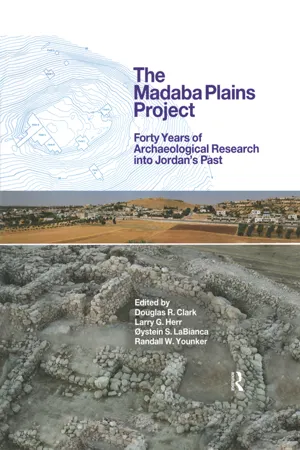
The Madaba Plains Project
Forty Years of Archaeological Research into Jordan's Past
- 305 pages
- English
- ePUB (mobile friendly)
- Available on iOS & Android
eBook - ePub
The Madaba Plains Project
Forty Years of Archaeological Research into Jordan's Past
About this book
Information
Madaba Plains Project Research after 40 Yeears
1
The Madaba Plains Project
A Personal 40-year Retrospective, 1967–2007
Before there was a Madaba Plains Project (MPP) there was its predecessor, the Andrews University Heshbon Expedition, conceived in 1966–1967, and directed initially by Siegfried H. Horn (1967–1973), and sponsored by Andrews University in Berrien Springs, Michigan, where he was Professor of Archaeology & the History of Antiquity. As his master’s degree student from 1962–1965 and then his choice to succeed him at Andrews (for which, at his recommendation, I prepared by completing my Ph.D. at Harvard University between 1966 and 1972), I was involved with the work at Heshbon (Hisban) from the beginning, first as a Square Supervisor, then Area (Field) Supervisor, and finally the Director who succeeded him in 1973 when he became Dean of the Seminary at Andrews.
After getting into archaeology relatively late in his career (Horn was 60 years old when the Heshbon Expedition began), other than some brief digging as a guest at Nineveh, Ugarit, and Ramat Rahel, he gained his field experience as a supervisor with G. Ernest Wright at Tell Balatah (Shechem) in the early 1960s. He soon began dreaming of conducting “his own dig.” After consulting with W. F. Albright, M. Noth, R. DeVaux, G. E. Wright, K. Kenyon, and others, and after securing the commitment of $20,000 from a private foundation along with approval from the Andrews University Board of Trustees and the American Schools of Oriental Research (ASOR), he decided on Hisban in Jordan.
Something of Horn’s motivation can be gleaned from the account of his visit to Hisban found in his diary for July 31, 1966 (all spellings in quotes are Horn’s):
At Na‘ur we left the Amman road on the recently paved Madeba road and after 10 km reached the village of Hesban, built against the slopes of Tell Hesban, the site of the Amorite city taken by Moses, the capital of King Sihon. We found the Mukhtar Daoud Abdulhadi, a very friendly man, on the threshing floor. He led us, but then left us to return in his Mukhtar garb riding on a fine spirited horse. He told us that his village would welcome us to excavate, that they provide all the labor and housing we want and get us also the necessary water. He showed us the parts of the tell which are government-owned and they are the major portion, so that we will hardly need to rent or buy private property.
Although the first season of work at Hisban was scheduled to begin on June 5, 1967, that had to be postponed until the following summer due to the disruption of the Six Day War which commenced on that very day. The Hisban camp had been dismantled a few days before and, with the equipment which had been rented from the American School in Amman, Horn returned to Jerusalem. By December of 1967 Horn had again secured ASOR and Jordan Department of Antiquities support, this time to begin the project the following summer. Because the dig equipment was now in Jerusalem and thus not available to projects within the newly drawn borders of Jordan, ASOR president G. Ernest Wright promised $5,000 to Horn for new excavation equipment to then be available to other ASOR projects in Jordan. And because several key staff members (notably, Roger Boraas who became the excavation’s Chief Archaeologist) were already committed to other archaeological projects at the beginning of the summer of 1968, work did not begin at Hisban until July 15, 1968. That allowed me to get some experience as a volunteer at Tel Gezer (with Philip King as my Square Supervisor) in the earlier part of the summer of 1968 before moving across the Jordan River to help Hisban get under way.
It is interesting to read from Horn’s diary his own description of how he felt at the end of his first successful day of digging (July 15, 1968):
A hectic and full day. So far it does not show up in my health or vitality, but I do not know whether it is good to carry on like this in my age of three-score years. This was the day we had planned for a long time and which was supposed to have come a year ago, but which did not come on account of a war. Some years ago I would never have dreamed that I would run up and down a Biblical site as the recognized director of an archaeological expedition of no mean proportion, having a staff of over 40 men and women. Anyway this day of days, July 15, came today and passed according to schedule. The Heshbon excavations began today and only the Lord knows when they will end, though the terminal date of the first campaign is envisioned to be August 29 or 30. It is a fascinating event to be involved in the uncovering of a city’s history, of which the remains have slumbered for centuries, and whose ruin mound has never before been touched by an archaeologist. Well, this was today’s experience of this humble recorder, and I could not help to think about it as I looked over the mound and seeing there some 150 people (including the staff) busy working like ants.
Horn proved to be very impatient with the time it took to excavate the latest (Islamic) strata. He had chosen the site because of its presumed biblical connections and he was very anxious to find evidence for Sihon and thus help to date the Israelite exodus from Egypt. This is illustrated by the following entry in his diary for August 23, 1968:
Today was a red-letter day inasmuch as we found a practically certain LB sherd in Area B in a level slightly underneath the kiln. This is the first swallow of the coming spring and makes the Sihon story possible raising above the level of fiction. The sherd in question comes from a neck, is bichrome and has a zigzag-design, typical of the LB pottery.” [This sherd was undoubtedly what we now know to be a late Iron 11/Persian jug with typical Ammonite painted pattern—eds.]
My work at Gezer in 1968 and 1969 (when I was a Square Supervisor) put me in touch with some personnel and perspectives which then became important for Hisban. For instance, while at Gezer, I met James Sauer who was working with his father at Tell Ta‘anak, and talked him into joining us at Hisban. Beginning in 1971, his careful stratigraphic work in Hisban’s Area B together with his study of our pottery turned into his doctoral thesis at Harvard (Sauer 1973). About that, his advisor, G. Ernest Wright said, “This is the first publication of well-stratified, tightly controlled strata, dealing with archaeologists’ greatest dark age—the post-New Testament era. For pottery sequences from Roman to the Crusader periods, with this publication Heshbon becomes the type-site for all archaeologists” (King 1983: 204).
Another thing I observed and experienced at Gezer was Dever’s and Lance’s use of Geologist Reuben Bullard. As a supervisor, I found him to be a significant resource when I had questions about soil and rocks. While we were never able to get Bullard to Hisban during a digging season, he did meet Horn at Hisban, shared his geological insights on several unanswered questions, and produced a useful geology report on the region. This impetus together with the presence on our team and influence of Øystein LaBianca (an Andrews undergraduate student of Robert Little, the Heshbon Expedition’s first “bone man”), starting in 1971, brought about the inclusion of many specialists in our work—something that was not characteristic of most digs at the time, but something Hisban helped pioneer for Jordan.
Once begun, the plan was to dig every other year, it being important to Horn that a full preliminary report of the season be in press before the next one started. After a successful beginning season in 1968, the second season, planned for 1970, had to be postponed until 1971 because of political turmoil in Jordan. After the third season in 1973, Horn assumed the Seminary deanship at Andrews University and felt he could not continue as Director, so I was asked to take over and prepare for the fourth season in 1974 to try and “get back on track” in terms of our digging schedule. In some ways, Horn had also lost some interest in the project because it had not met his expectations of finding evidence for the Late Bronze Age Amorites. The rest of us who stayed involved with the project were also definitely interested in biblical connections but had broader interests and were quite willing to accept the evidence suggested by the data discovered. By the fifth season in 1976 we were pretty well down to bedrock in most of our original squares and felt that most of our goals had been achieved. So the first phase of excavations at Hisban concluded then, except for a smaller team that returned in 1978 to complete the excavation of the “North [Byzantine] Church” under the direction of John Lawlor with the assistance of Larry Herr. While they worked on that project, I did some “clean up” work at the Area B Iron Age reservoir, uncovering further Ammonite ostraca.
Looking back at the accomplishments of this project, Philip King, in his 75th anniversary history of the American Schools of Oriental Research (1983: 193–194), observed the following:
The Hesban project has been a model of interdisciplinary research. Its inquiry into the occupational history and the environmental setting of central Transjordan has led to an understanding of the cultural development of the region starting with the Iron Age.
The archaeology of Jordan owes an extraordinary debt of gratitude to the Hesban expedition, especially for its pioneering efforts in many areas of archaeological research. The following list of Hesban accomplishments is only a suggestion of their long-term implications for the scientific development of archaeology in the land east of the Jordan River. Hesban was the first truly interdisciplinary undertaking in Jordan on a large scale. The comprehensive environmental studies at Hesban included work on the climate, geology, soil, hydrology, phytogeography (the biogeography of plants), and zoogeography. At the same time, the Hesban dig has pioneered methods and procedures for processing large quantities of animal remains; the accumulation of what is probably the most comprehensive assemblage of animal bones from any site in Palestine has resulted.
This expedition was the first in Jordan to introduce ethnoarchaeology, the ethnographic study of material and social life in the present for the purpose of aiding integration of evidence from the past. Starting in 1971, Hesban may have been the first ASOR-related field project to use the computer in a systematic way. The Hesban archaeologists deserve special recognition for having published a full preliminary report each season before returning to the field for the next season.
Through its field school Hesban has touched almost every dig in Jordan by serving as the training ground for scores of graduate students, several of whom now direct their own projects. That a number of native Jordanian archaeologists received their initial field training at Tell Hesban is noteworthy. In all these achievements the Hesban project has admirably fulfilled the objectives of ASOR as set down in ASOR’s original statement of purpose and its later revision.
During the long-term excavation of Tell Hesban Roger S. Boraas of Upsala College served as the chief archaeologist. The field manual which he developed for the Tell Hesban dig has become the standard text used in nearly all American digs in Jordan, as well as those sponsored by the Department of Antiquities of Jordan.
With the final publication volumes for Hisban well under way and surrounded by eager, capable graduate students, Larry Herr and I decided to take advantage of our available human resources and launch another project in Jordan. While we considered moving to a completely new area, we decided there were advantages to staying in the region with which we were familiar and which we knew best. The largest and most impressive tell in the Madaba region was Jalul, a site we had carefully surveyed as part of our Hesban Regional Survey effort, directed by Douglas Waterhouse and Robert Ibach (Ibach 1987). It appeared to have an occupational history that went back into the Bronze Age, something that to Horn’s great disappointment, Hisban did not do. So we decided we wanted to dig there, extending our knowledge of the history and life of Jordan back into the Bronze Age, calling our new endeavor “The Madaba Plains Project,” anticipating long-term research into the occupational history of the region between Madaba to the south and the Ammonite hill country to the north, bordered by the desert on the east and the rapidly descending terrain between the plains/hill country and the Jordan River valley on the west. We applied for and got a permit for the summer of 1982, only to have it revoked due to some political concerns that were never fully disclosed to us.
Because of the uncertainties connected with Jalul, we looked around for another dig site within the Madaba Plains where results of excavation would help respond to our objectives, and settled on Tall al-‘Umayri—a little known site that had been “rediscovered” by our Hisban regional survey team (Ibach 1987: 31). Since it was off the beaten track, it had been neglected but actually seemed to be a very promising candidate for excavation. It guarded one of the key entrances into the Ammonite hill country as soon became evident when the new highway to Queen Alia International Airport swept right by the foot of the tell. This also made access for our team much easier. We were delighted to find that a major portion of the tell was owned by the family of Raouf Abujaber, a major Amman businessman and scholar of Jordan’s history. As fortune would have it, he was also the current president of the Friends of Archaeology in Amman! When approached, he enthusiastically agreed to make the tell available for excavation and even stored our excavation equipment at his Yaduda estate.
With everything in readiness, we launched our new MPP at ‘Umayri in the summer of 1984. At first I directed the project with Larry Herr as Chief Archaeologist. Øystein LaBianca and Douglas Clark were also key from the beginning—all of us having worked together at Hisban. In 1985 I moved from Andrews University to Atlantic Union College in South Lancast...
Table of contents
- Cover
- Half Title
- Title
- Copyright
- Dedication
- Contents
- Prefaces
- Acknowledgments
- List of Contributors
- Part I MADABA PLAINS PROJECT RESEARCH AFTER 40 YEEARS
- Part II ASSESSMENT OF THE CONTRIBUTIONS OF THE MADABA PLAINS PROJECT TO THE ARCHAEOLOGY OF THE SOUTHERN LEVANT
- Part III LEGACY OF THE MADABA PLAINS PROJECT THROUGHOUT JORDAN
- Appendix A Madaba Plains Project History of Institutional Consortium and Affiliation Relationships
- Appendix B Madaba Plains Project: Hisban Participants 1968–1976 (Phase I) and 1997–2007 (Phase II)
- Appendix C Madaba Plains Project: ‘Umayri Participants 1984–2008
- Appendix D Madaba Plains Project: Jalul Participants 1992–2008
- Appendix E Madaba Plains Project Consortium Publications
- Appendix F Publications—Tall Hisban
- Appendix G Publications—Tall al–‘Umayri
- Appendix H Publications—Jalul
- Index of Subjects
- Index of Authors
Trusted by 375,005 students
Access to over 1.5 million titles for a fair monthly price.
Study more efficiently using our study tools.
Frequently asked questions
Yes, you can cancel anytime from the Subscription tab in your account settings on the Perlego website. Your subscription will stay active until the end of your current billing period. Learn how to cancel your subscription
No, books cannot be downloaded as external files, such as PDFs, for use outside of Perlego. However, you can download books within the Perlego app for offline reading on mobile or tablet. Learn how to download books offline
Perlego offers two plans: Essential and Complete
- Essential is ideal for learners and professionals who enjoy exploring a wide range of subjects. Access the Essential Library with 800,000+ trusted titles and best-sellers across business, personal growth, and the humanities. Includes unlimited reading time and Standard Read Aloud voice.
- Complete: Perfect for advanced learners and researchers needing full, unrestricted access. Unlock 1.5M+ books across hundreds of subjects, including academic and specialized titles. The Complete Plan also includes advanced features like Premium Read Aloud and Research Assistant.
We are an online textbook subscription service, where you can get access to an entire online library for less than the price of a single book per month. With over 1.5 million books across 990+ topics, we’ve got you covered! Learn about our mission
Look out for the read-aloud symbol on your next book to see if you can listen to it. The read-aloud tool reads text aloud for you, highlighting the text as it is being read. You can pause it, speed it up and slow it down. Learn more about Read Aloud
Yes! You can use the Perlego app on both iOS and Android devices to read anytime, anywhere — even offline. Perfect for commutes or when you’re on the go.
Please note we cannot support devices running on iOS 13 and Android 7 or earlier. Learn more about using the app
Please note we cannot support devices running on iOS 13 and Android 7 or earlier. Learn more about using the app
Yes, you can access The Madaba Plains Project by Douglas R. Clark, Larry G. Herr, Øystein S. LaBianca, Randall W. Younker, Douglas R. Clark,Larry G. Herr,Øystein S. LaBianca,Randall W. Younker in PDF and/or ePUB format, as well as other popular books in Social Sciences & Archaeology. We have over 1.5 million books available in our catalogue for you to explore.