- 264 pages
- English
- ePUB (mobile friendly)
- Available on iOS & Android
eBook - ePub
About this book
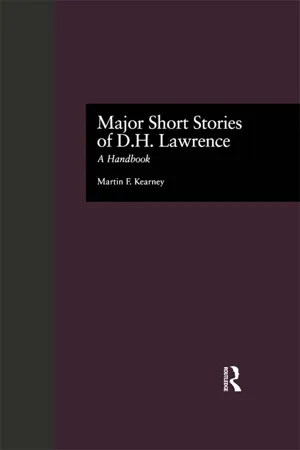
First published in 1998. This reference guide is designed for those who would be knowledge able readers of major short stories by D.H. Lawrence when the store of scholarship, investigation, and appraisal is far too vast for all but the expert. An inclusive examination of what has been written about these short stories, each chapter deals with a different short story and consists of five distinct sections: (1) the complete publication history, including all revisions and variants; (2) a thorough examination of recognized and hitherto unrecognized sources, as well as the influences at work on Lawrence in the creation of the story; (3) the story's relationship to Lawrence's other writings; (4) acknowledgement and summary of all extant critical studies; and (5) a bibliography of works cited. This study concentrates on six short stories culled from Lawrence's more than fifty works of short fiction.
Information
I
"Odour of Chrysanthemums"
Publication History
Lawrence first came into print in 1907 as the winner of a Christmas story contest held by the Nottinghamshire Guardian. He submitted three tales: "The White Stocking," "A Fragment of Stained Glass," and "The Prelude," which took the prize. (After extensive revision, the first two would appear in 1914 in Lawrence's first collection of short fiction, The Prussian Officer and Other Stories.) A year and a half later, Lawrence's good friend Jessie Chambers copied out several of his poems and sent them to Ford Madox Hueffer (the surname became "Ford" when the First World War fostered anti-German sentiment), the editor of the distinguished English Review. Accepted immediately and published that November, these poems presaged Lawrence's future success.
On December 9, 1909, Lawrence himself sent to Hueffer two recently completed short stories. He had co-written one of the tales, "Goose Fair," with his future fiancee, Louisa (Louie) Burrows; the other was an early version of his masterpiece "Odour of Chrysanthemums." Hueffer accepted both for publication.
In a testimony since questioned, Ford Madox Ford later took credit for recognizing Lawrence's genius in the very first paragraph of this early version of "Odour of Chrysanthemums." He said he saw therein a writer with character, courage of conviction, and a keen observational mastery. Lawrence could obviously be trusted, Ford recalled, as was witnessed by his use of rhythm in the opening sentence to capture a reader's attention, his ability to forge a flawless paragraph, and his knowledge of the life about which he wrote, set in a region effectively revealed by means of an arresting word here and there (Ford 1937, 74).
On March 9, 1910, Lawrence received from the English Review a 27-page set of proofs dated March 3, which he corrected with black ink on the proof-set pages themselves. These galley pages, before Lawrence's revision, embodied the tale in its earliest form. The major difference between this and later versions lay in the ending. In the initial version, Elizabeth Bates took comfort in her husband's death. She apparently preferred him home dead to home dead drunk. This first rendition much later appeared in Renaissance and Modern Studies 13 (1969) (Boulton, "Odour," 1969, 4–48).
Having been led to expect a May publication date, Lawrence wrote a friend on June 1 that he was rapidly losing faith in the writing profession and wondered if the journal's new editor, Austin Harrison, had forgotten or mislaid his story (Boulton 1979, 162). The proofs, however, came back again in July with instructions to cut the tale by five pages. Lawrence spent part of the summer of 1910 making this revision, but as he mentioned to Louie Burrows in a July 24 letter, it was "a devilish business" (Boulton 1979, 172). Still dissatisfied, Harrison further asked that Lawrence shorten the first part of the story: much of the Bates children's playing should be cut to accelerate to the climax (Boulton 1979, 252). In late March and early April of 1911, Lawrence revised these same proofs accordingly, but he also rewrote the ending by means of "delving ... into cause and effect"(Boulton 1979, 250), which improved the story, but lengthened it by eight pages. In this version, focus shifted from Elizabeth as mother and emphasized her role as wife. No longer pleased that her husband is dead, Elizabeth now sees herself as a lady whose knight has returned to her, exquisite and pure, from a base existence precipitated by alcohol abuse. She feels that she has reclaimed the essence of his former innocence.
Lawrence sent this manuscript to Louie Burrows on April 2, 1911, with a request that she make a fair copy, leaving out all that he had struck. He subsequently sent the clean thirty-nine-page fair copy to the English Review before the end of April, and "Odour of Chrysanthemums" appeared on pages 115–33 of the June 8, 1911 issue. Some of Lawrence's latest revisions, however—especially those in the tale's first half—failed to appear at this time. The printers, it seems, used much of the standing type from the 1910 page proofs as the primary text (Worthen 1983, li). For his story, the English Review paid Lawrence ten pounds, rather more than he had anticipated.
At the time, the English Review, which would ultimately print more of Lawrence's short fiction than any other magazine, enjoyed a circulation of approximately 10,000. Since he knew he might make more money from periodicals with larger circulations, it is to Lawrence's credit that he recognized this magazine's dedication to literary merit and experimentation. He knew, too, that his fiction would find greater appeal and understanding among subscribers to such an avant-garde publication as the English Review (Van Spanckeren 1986, 296–97).
As Ford Madox Ford later recounted, editors during the early years of the century were eager to find "authentic projections" of working-class life that had yet to be voiced (Ford 1937, 74). "Odour of Chrysanthemums" was just such an expression, for it portrayed life as Lawrence knew it from his earliest memories in Eastwood, the Nottinghamshire colliery village where he was raised, and it offered an objective glimpse of working-class life, wherein humanity was presented universally (Leavis [1956] 1979, 308). Having found "a market," therefore, Lawrence began to receive solicitations for his stories from other magazines.
In July of 1914, Lawrence extensively revised the 1911 English Review text of "Odour of Chrysanthemums," rewriting the ending again and dividing the story into two numbered sections. With a letter dated July 14, 1914, he sent this manuscript to his mentor/agent Edward Garnett, of Duckworth Publishers, accompanied by others also revised for a short-story collection.
Another thorough revision of "Odour of Chrysanthemums" occurred when Lawrence worked over the Duckworth proofs dated October 6, 1914. In this draft, he reworked for the final time the passage into the well-known ending wherein Elizabeth Bates recognizes the shared responsibility for the failure of the marriage. This version shifted the weight of emotion of the earlier versions away from the mother's attempt to reclaim her child, as well as the wife's endeavor to claim Walter as though he were also a child (Black, 1986, 208).
When the collection of tales Garnett entitled The Prussian Officer and Other Stories was published on November 26, 1914, by Duckworth, "Odour of Chrysanthemums" appeared last in the volume, presumably so as to conclude the book with a particularly forceful work. This tale would not appear in America in its final form until 1916, at which time B.W. Huebsch published The Prussian Officer and Other Stories in New York (McDonald, 1925, 34—6).
A later and somewhat controversial text of this story appeared in 1983 in the Cambridge University Press edition of The Prussian Officer and Other Stories (Worthen 1983, 181–201). The editor of this volume, John Worthen, a preeminent Lawrence scholar, examined all of the existing manuscripts of all the included tales so as to emend any textual corruptions, his goal being to present the tales in a final form Lawrence's might approve were he alive. Although the textual changes in this edition were slight, some scholars have criticized Worthen's well-intentioned work on the grounds that Lawrence was not, in fact, alive either to condone or condemn the so-derived text.
Also, appearing in this Cambridge edition of The Prussian Officer and Other Stories is a fragment of "Odour of Chrysanthemums" that seems to have been a working draft with an ending much briefer than in any of the other variants (Worthen 1983, 201–07).
Circumstances of Composition, Sources, and Influences
In the latter part of 1909, when D.H. Lawrence first composed "Odour of Chrysanthemums," he was teaching at the Davidson Road School in Croydon, a suburb of London. He lodged at 12 Colworth Road, the home of Mr. and Mrs. John Jones, and he would work there on his fiction after his tiring days in the classroom. During vacations, Lawrence stayed with his parents at Lynn Croft, Eastwood, Nottinghamshire.
This living arrangement continued through 1910. In the summer, as we have seen, Lawrence revised the March 3 proofs of the tale for the English Review. Then, owing to his mother's illness in late August and her death from cancer on December 9, Lawrence took increasingly more time off from teaching. During the year-end term break, he found it too painful to return to his family home, now empty, and stayed at the Quorn in Leicestershire with the family of Louie Burrows, who had become his fiancée on December 3.
Lawrence made an April, 1911, revision of "Chrysanthemums" before its June publication in the English Review, then began his new career as a full-time writer. He had broken his informal engagement with Jessie Chambers the previous November, and his mother's death the following month had severed his strongest tie with his birthplace. The attractions of being a teacher with a secure and a stable domestic life were giving way to his fascination with the adventure and self-development that he associated with the writing profession. By 1911, he had completely immersed himself in the literary world (Boulton 1979, 15).
The publication that year of The White Peacock, his generally well-received first novel, and the appearance of "The Odour of Chrysanthemums" in the English Review that June had attracted the flattering interest of editors Martin Seeker, Austin Harrison, and Edward Garnett. Letters from the latter part of 1911 to his fiancée, Louie Burrows, with whom he would soon break up, expressed his discontent with teaching and his desire to become a full-time writer. Garnett's encouragement played a major role in his decision to indulge that desire.
He was welcome at Garnett's Kent home, the Cearne, which soon replaced the Quorn, Louie Burrows' home, as the axis of his new career. He was heartened by the popular success of The White Peacock, but his health finally sealed the matter of his future occupation. In November of 1911, Lawrence caught a chill while working with Garnett in the Cearne's garden; the severe pneumonia that followed forced him to resign the teaching post at Croydon, and he never taught in a classroom again (Boulton 1979, 15–17). He recovered from his pneumonia, and in the three years before "Odour of Chrysanthemums" appeared in The Prussian Officer and Other Stories, he ended his engagement with Louie Burrows on February 4, 1912, and took up residence in Italy with a married woman, Frieda Von Richthofen Weekley, whom he married in July, 1914, following her long-pending divorce.
Lawrence and Frieda returned to England in June of 1914, and during the July revision of "Chrysanthemums" and other tales for the short story collection, they resided at Selwood Terrace, South Kensing ton, London. He returned briefly that month to the English Midlands for a four-day visit to Ripley, where his sister Ada lived. Then, during the October revisions of the book proofs, the Lawrences stayed near Chesham, at a residence called The Triangle.
Growing up in a colliery town where the deprivations outnumbered the festivals, Lawrence remained keenly sensitive to "daily sensory experience," and he infused in all of his early work the pulse of nature's rhythms—bliss and suffering, birth and dissolution, creation and disintegration—which drive and permeate class conflict (Freeman 1955, 18.) Lawrence had to look no further than his own family to find a principal source for "Chrysanthemums." He was seven when he first heard his Aunt Polly tell how in 1880 her husband, Lawrence's Uncle James, had been killed in a mining accident at Brinsley Colliery (Boulton 1979 199). As was the case with the fictional collier Bates, a common name around Brinsley in the 1870's, Lawrence's uncle bore no marks of violence or suffering (Worthen 1983, 272). The Bateses' cottage, too, may well be based on Aunt Polly's lodge in Brinsley (Delavenay 1972, 107); thus, by extrapolation some critics assume Elizabeth Bates to have been modeled on this aunt (Moore 1974, 18).
Later critics, like Keith Cushman, however, argued convincingly that the Bates family more closely resembles Lawrence's own. Walter and Elizabeth Bates do seem very much like Lawrence's own parents, which makes the narrator's detachment all the more remarkable. Feuding parents similar to Walter and Gertrude Morel of Sons and Lovers, Walter and Elizabeth Bates may well reflect Lawrence's own home life (1978a, 48–9).
Lydia Lawrence, like Elizabeth Bates, experienced a social degradation of sorts in assuming her station among the working class, and she appears to have transferred to her children her desperate desire to regain the middle class again where she might develop her mind and spiritual nature. This longing both resulted from and contributed to her disaffection for her husband, Arthur, whose own family came to resent him and treat him as though he were a stranger at his own hearth (Delavenay 1972, 6).
One can have little doubt that Walter Bates and Walter Morel of Sons and Lovers took after Arthur Lawrence. In fact, as L.D. Clark has noted, the Bates' cottage may not be based upon the aunt and uncle's house at all, but rather on father Arthur's birthplace, a small house in a quarry hollow very near the level-crossing at Brinsley (Clark 1980, 350).
One result of a childhood spent in this tense and hostile household was Lawrence's major preoccupation revealed early in "Chrysanthemums": the indifference of his parents' sexual relationship, and the powers women hold over men (Holbrook 1992, 78). As Janice Harris observed, "Odour of Chrysanthemums" mines a vein of familial recollections that influenced all of his work, although an acute awareness of his own sexuality exerted another strong influence (1984, 36).
Over the years when "Chrysanthemums" took shape (1909–14), Elizabeth and Walter Bates, then, became an amalgamation of Lawrence's parents and his aunt and uncle. Nora Stovel (1983) argued convincingly that Polly and James Lawrence were sufficiently distant from their nephew to inspire objectivity in his portrayal of their conflicts. The years that had passed between James's death and Lawrence's first version of his story also encouraged an unprejudiced portrait. Following his mother's death in December of 1910, however, the variants of the tale—especially the final version—became infused with Lawrence's new sense of the utter separation death imposes, as depicted in Elizabeth's sense of "intense alienation" as she washed her husband's corpse. From his mother's death, Lawrence came to understand this sense of separation implicit in the later versions of "Chrysanthemums" (60–73).
Moreover, one must always account for the influence Lawrence's wife, Frieda, had on his personal and artistic growth between 1912 and November, 1914, when "Odour of Chrysanthemums" came out in The Prussian Officer and Other Stories. Critic J.F.C. Littlewood examined the various conclusions and decided that the later revisions must have been written during or after 1913, when Lawrence began his first version of The Rainbow. Littlewood sustained his position by comparing the later variants with the final version and with passages in the second and third version of The Rainbow composed in 1914, passages that revealed a new insight into "otherness" in the sense that Lawrence made his characters respond in concert with their essential selves. This artistic development resolved a personal integration problem present in earlier versions. Littlewood attributed this development both to the several drafts of The Rainbow and to Lawrence having "come through" his often tumultuous relationship with Frieda (Littlewood 1966, 112–24).
The final 1914 text of "Odour of Chrysanthemums" contained a dual vision: man's being seen as it relates to the eternal rhythms of the cosmos, and this vision of radiance emerging from the prosaic base of the workaday world. This dual vision reflects the deep personal fulfillment Lawrence found with Frieda and a relationship that freed him from the difficulties of early manhood (Cushman 1978, 44).
Scholars like Keith Cushman and Janice Harris who investigate the young Lawrence's reading interests find still more influences upon his growing conceptions of art and artistry. Cushman saw Lawrence in the early variants of "Odour of Chrysanthemums" employing formulas peculiar to the symbolic realism of th...
Table of contents
- Cover
- Half Title
- Title
- Copyright
- Dedication
- Contents
- Acknowledgments
- Introduction
- Chapter I: “Odour of Chrysanthemums”
- Chapter II: “The Shadow in the Rose Garden”
- Chapter III: “Daughters of the Vicar”
- Chapter IV: "The Prussian Officer"
- Chapter V: "The Horse Dealer's Daughter"
- Chapter VI: "The Rocking-Horse Winner"
- Index
Trusted by 375,005 students
Access to over 1.5 million titles for a fair monthly price.
Study more efficiently using our study tools.
Frequently asked questions
Yes, you can cancel anytime from the Subscription tab in your account settings on the Perlego website. Your subscription will stay active until the end of your current billing period. Learn how to cancel your subscription
No, books cannot be downloaded as external files, such as PDFs, for use outside of Perlego. However, you can download books within the Perlego app for offline reading on mobile or tablet. Learn how to download books offline
Perlego offers two plans: Essential and Complete
- Essential is ideal for learners and professionals who enjoy exploring a wide range of subjects. Access the Essential Library with 800,000+ trusted titles and best-sellers across business, personal growth, and the humanities. Includes unlimited reading time and Standard Read Aloud voice.
- Complete: Perfect for advanced learners and researchers needing full, unrestricted access. Unlock 1.5M+ books across hundreds of subjects, including academic and specialized titles. The Complete Plan also includes advanced features like Premium Read Aloud and Research Assistant.
We are an online textbook subscription service, where you can get access to an entire online library for less than the price of a single book per month. With over 1.5 million books across 990+ topics, we’ve got you covered! Learn about our mission
Look out for the read-aloud symbol on your next book to see if you can listen to it. The read-aloud tool reads text aloud for you, highlighting the text as it is being read. You can pause it, speed it up and slow it down. Learn more about Read Aloud
Yes! You can use the Perlego app on both iOS and Android devices to read anytime, anywhere — even offline. Perfect for commutes or when you’re on the go.
Please note we cannot support devices running on iOS 13 and Android 7 or earlier. Learn more about using the app
Please note we cannot support devices running on iOS 13 and Android 7 or earlier. Learn more about using the app
Yes, you can access Major Short Stories of D.H. Lawrence by Martin F. Kearney in PDF and/or ePUB format, as well as other popular books in Literature & Literary Criticism. We have over 1.5 million books available in our catalogue for you to explore.