eBook - ePub
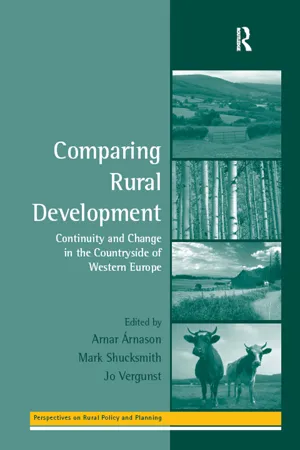
Comparing Rural Development
Continuity and Change in the Countryside of Western Europe
- 212 pages
- English
- ePUB (mobile friendly)
- Available on iOS & Android
eBook - ePub
Comparing Rural Development
Continuity and Change in the Countryside of Western Europe
About this book
At a time when there is major reorientation of rural economies in Europe, and the emergence of new possibilities both for governance and for conflict, this book brings together a group of leading academics in the fields of geography, sociology and anthropology to examine how such changes are taking place in the west of Europe. It describes, analyses and theorises the role of networks and social capital in rural development in six countries: Finland, Ireland, Italy, Norway, Scotland and Sweden, and addresses the tension between studying 'local' rural development and the 'globalized' nature of modern economies and societies. An approach to networks and social capital is used as a way of drawing attention to the non-economic dimensions of rural development and society. The book stresses that the links between society and economics are of key importance.
Chapter 1
Introduction
This book describes and compares case studies in rural development in six European countries: Finland, Ireland, Italy, Norway, Scotland and Sweden.1 Our starting points are many: a old limestone quarry, a new marketing network, and an ongoing debate about public and private service provision, amongst others. We use these to tell the stories of continuity and change in the countryside as the people in case study areas told them to us. We shift between a close-grained description of the thoughts and actions of the people involved and an analytical mode that brings a broader understanding of how rural development has been taking place on the ground. There is one clear lesson: that development happens through social processes, and in particular social networks, that come before and, in some form or other, will last longer than any discrete development project. Understanding development requires a recognition that the dynamic of social continuity and change is key.
But there is limited value in presenting simply another set of discrete cases, and our goal is more ambitious. For it is in the careful comparison of cases that broader and deeper understanding emerges. Each of the stories we were told has its resonances in other areas and other contexts and through following these resonances, certain themes emerge which have relevance wider than the immediate localities. What is presented in this book, therefore, are not the isolated case studies which leave the reader to attempt a comparison between them, but a set of thematic studies which draw on the same core material but explore it in different ways, comparing the cases as they go along. The contributors have been able to do this as a result of close collaboration over three years involving fieldwork and analysis shared between research teams. More will be explained of our methodology within the chapters themselves, but it will be useful at this stage to outline the key themes of our comparison in a straightforward manner.
Networks in development projects (Chapter 1 – ‘Networks for Local Development: Aiming for Visibility, Products and Success’ by Lehto and Oksa). We start with a comparison of the various networks instigated for rural development studied in the six areas. This theme provides an introduction to the local issues in rural development that the subsequent themes investigate, and makes the case that the particular characteristics of the networks are very relevant to the form of development that results. In flourishing regions, networks are able to reorganise themselves around their success stories and enable a sense of continuity through development.
The provision of public goods and public services (Chapter 3 – ‘The Process of Building Social Capital in Rural Areas: Public Goods and Public Services’ by Cecchi). This theme looks at social capital from an economic perspective, drawing links between social capital, public goods and public services. It explores how different state structures offering varying levels of services and engagement locally can produce different forms and levels of social capital. Where no strong local dynamic exists for rural development, as in our Italian case, the state can take the lead in providing a model for collective action.
Gender, civil society and labour (Chapter 4 – ‘Gendered Social Capital: Exploring the Relation between Civil Society and the Labour Market’ by Stenbacka and Mattsson). Drawing initially from the Swedish case study, this theme offers evidence to problematise the Putnamian conception of social capital as belonging equally to a ‘whole community’. The authors discuss different modes of engagement with voluntary work and the varying production of and access to social capital that can be seen to result, and gender dimensions are particularly significant here.
Cultural identities in rural development (Chapter 5 – ‘Identity-building in Regional Initiatives for Rural Development: Comparing Ireland’s Lake District and Norway’s Mountain Region’ by Meistad and Chapter 6 – ‘The Role of Identity in Contemporary Rural Development Processes’ by Meistad, Hannon and Curtin). Many varieties of social identity exist in the different case study areas and this theme charts their impact upon both specific development projects (Chapter 5) and the overall course of rural development (Chapter 6). How people claim and attribute identities as ‘local’ or ‘expert’, for example, influence social relations within development, while the senses of belonging that occur within particular environmental or cultural settings are likely to affect how development processes are understood within a locality. Meistad (Chapter 5) applies this discussion to two projects in Ireland and Norway involving the construction of new regional identities which have very different stories to tell. The central purpose of the theme to problematise the easy association of region, culture and identity that are often made within both development practice and academic commentary.
Networks in environment and landscape (Chapter 7 – ‘Using Environmental Resources: Networks in Food and Landscape’ by Vergunst, Árnason, Macintyre and Nightingale) This theme focuses on new uses of resources in the environment in the case study areas, the networks involved, and one frequent outcome: new ways of branding rural Europe. Referring to local food development on Skye, the re-use of a quarry in Sweden and a number of other cases, the theme highlights some challenges of branding and also adds to the questioning of the notion of post-productivism as a characterisation of rural Europe. A concern of many people in the case studies is to maintain the productivity of their land, but sometimes in unexpected and non-traditional ways.
The book ends with a set of reflections and conclusions drawn from across these themes. We show that social processes, through networks, are fundamental to development. Our idea of positive rural development, then, entails overcoming the rather staid dichotomies of endogenous versus exogenous development, or infrastructure versus community development. We look to a plurality of cultural identities, a mixing of spatial scales – where a place can be at once local and part of the international economy, and, as we practice here, to the telling and re-telling of narratives of development.
Rural Development in the European Union
The decline in farming as an activity and as a determinant of land use is well known in rural Europe and is the main context for our research on rural, rather than just agricultural, development. Simultaneously, new demands are being made on rural space. In brief, as the post-war consensus came to an end in the 1970s, governments began to look for ways to cut spending, and the Common Agricultural Policy, as the largest expenditure of the EU, was seen to be in line for cutbacks. Agricultural production had outstripped demand, while at the same time many rural areas were suffering continued population loss, lack of services, economic underperformance and environmental degradation. Southern enlargement of the EU put pressure for CAP reform and pushed new ideas of territorial development and ‘rural’, as opposed to ‘agricultural’ policy, onto the agenda. The recent eastern expansion of the EU has heightened concerns over spending on farm subsidies. A succession of EU policy documents, starting with ‘The Future of Rural Society’ (European Commission 1988) have been designed to implement a territorial approach to rural development, which can also be seen as an attempt to move from a ‘sectoral’ towards an ‘integrated’ rural development strategy (Shucksmith et al. 2005).
Alongside such political and economic changes, there are a set of social and cultural factors that have been influencing how environments are used in rural Europe. Marsden (1998, 15) noted, for example, that ‘new demands, for “quality” food production, public amenity space, positional residential property, areas of environmental protection, and for the experience of different types of rural idyll or urban antithesis are now much more entrenched in rural space’. These demands have arisen not just as a result of population movement from urban to rural areas, although this counter-urbanisation has for some time been important dynamic in many rural areas (Fielding 1982), but from a broader, European-wide rethinking of the uses of rural areas. Food scares, such as BSE, have drawn attention to the quality rather than just the quantity of food produced in rural Europe. Mass-membership environmental movements in Europe also signify a concern over damage to the natural environment, and this has been translated into a number of EU policies, including the Birds Directive of 1979 and the Habitats Directive 1994. Finally, ‘endogenous’ rural development strategies have become widespread, whereby people in rural areas themselves attempt to identify and utilise local resources for local benefits (Shucksmith 2000).
The changes in rural Europe from an agricultural to a broader social and economic base have for some time been theorised as the ‘post-productivist transition’ (Ilbery 1998). According to this, consumption is becoming more important in rural areas. The rise of tourism, different forms of land-use competition, and concerns over the environment are held to be linked together as part of a new type of post-productivist rurality. Debate continues as to how applicable this model is across Europe (Hoggart and Paniagua 2001; Marsden 2003; Ward et al. 2008). But if there is something in the argument, we need to consider both what is happening to European rural space and how it is happening.
Agency in Rural Development: Communities, Individuals and Networks
We now need to be clear about how we conceptualise development itself. We are using the term in a broad sense to refer to processes of social change and continuity, encompassing both planned social change, such as ‘development projects’, and the everyday ways of life that people attempt to continue and improve by their own efforts. The research presented in this book tracks the means by which these often rather different processes play out in particular case study contexts. We often return to the themes of continuity and change, looking at, for example, the ways that development projects are often relatively short-term affairs and sometimes contrast with other efforts simply to continue valued ways of life. The constant search for newness and innovation in rural development projects – where finance is available for business expansion but not maintenance, for example – marks out a distinctive discourse of development related to the ideals of progress that have been subject to the broader critique of modernist development (Escobar 1995; Gardner and Lewis 1996; Abram and Waldren 1998).
Kovách and Kucerova have suggested that rural development in Eastern Europe is increasingly subject to ‘projectification’ (Kovách and Kucerova 2006). They suggest that rural development elites may be increasingly pursuing development agendas that reflect their own intellectual and economic interests, partly as a result of decentralisation of budgets to rural and regional levels. The contributors to this book similarly find it useful to maintain a critical approach to development. From our perspective we could disagree with the idea that decentralisation is the problem, since in many of our case study areas, such as Scotland, we have seen a tendency towards the loss of autonomy over budgets and thus economic development decisions within localities, suggesting that the entrepreneurial ethos is in fact perpetuated at larger scales. The specific trends of Eastern European rural development are not within the scope of this book, and our research took place before the A8 accession. But Kovách and Kucerova usefully distinguish development outcomes between on one hand the revitalising of civil society and on the other the instrumental use of funds for limited interests. This certainly chimes with our research in rural Western Europe, as we find some success stories and some – while not necessarily finished – that are not characterised thus by participants in them. It also indicates that EU regional funding may in some ways mirror the ‘Third Way’ approaches of other liberalised democracies (Kendall 2000; MacKenzie 2004), where policy spaces are created in which ‘policy entrepreneurs’ can operate. In this book we take on board these critiques of development and keep a broad view in our case study areas. We want to open the relationship between formal development projects and ongoing social life to critical evaluation.
The next conceptual issue, once we accept the importance of understanding the agency of development professionals, is in how best to attribute agency to other kinds of people – such as individual residents in our case study areas – or to ‘communities’ within studies of rural development. We meet the problem of whether it is better to conceive of the ‘individual’ or the ‘community’ as the key actor in development processes, and this is relevant both methodologically and analytically. This leads us into some of the key themes for the book.
The question of individual and community roles has been important in studies of both formal development projects and of local social life more generally. Shucksmith raised the issue in 2000, as part of an evaluation of LEADER in the west of Scotland. In some attempts at endogenous development (i.e. development that emerges and uses resources from within a place, broadly speaking) easy assumptions are often made about ‘the community’, and unequal power relations within the group and differential participation in development processes are often ignored (Shucksmith 2000, 209–10). ‘Community development’ runs the risk of reifying traditional notions of rural society as homogenous and bounded, despite prolonged social science attention towards rural class structure and other internal differentials (e.g. Newby 1979; Milbourne 1997). ‘Community’ is often equated with ‘territory’, with the result that these questions of internal social differentiation may not be asked. If regional territorial identity is becoming more significant in European rural development (Ray 1999), there is the possibility that symbols of collective identity paper over more specific issues and hide inequalities in power, wealth and access. As Shucksmith put it, from the point of view of people within these communities, ‘their (individual) capacity to act will be diminished by such approaches to (collective) capacity building, and it is unclear prima facie whether this will increase or decrease inequalities in society’ (Shucksmith 2000, 10). This is a critique of the concept of community from the point of view of the individual, whereby attempts to build the capacity of the collective in determining the course of development can end up excluding or disempowering certain individuals from it.
The idea of community therefore appears as a symbol that is available for manipulation and use through discourse and action. Cohen (1985; 1987) explores the ‘symbolic boundaries’ of community in detail, showing how common distinctions between ‘us’ and ‘others’ are maintained through small acts of speech, narrative and everyday action. Having long since lost its status as an inviolable empirical fact (Bell and Newby 1971), community-as-symbol alerts us to the production of the commonalities of a social group and territory on the one hand, and the production of difference to others on the other. In academic terms, if not always in lay discourse, ‘community’ has long since lost any veneer of neutrality. In recognising ‘community’ in this way we destabilise it and call into question those regional development initiatives that place it at the centre of rural policy. It is important to scrutinise the political processes through which ‘communities’ are constituted and social capital attributed to them, as well as the contexts within which notions of community and of individuals belonging to a collective are formed.
It is notable, however, that the idea of the individual is rarely subjected to similar critical scrutiny. If we need to be careful about how we use the term community, because of its symbolic construction, what should we make of the ‘individuals’ to whom it is often opposed? On principle it seems unrealistic to identify one half of a dichotomy as being constructed and thus problematic, while accepting the other as natural. To be fair, Bourdieu’s concepts of social capital and symbolic violence, used by Shucksmith (2000) to critique the concept of community, must be understood as part of his broader theory of practice in which individuals are viewed as internalising the social field through their habitus. Bourdieu is highly critical of rational action theory. But in development studies we often unpack one side of the dichotomy without paying so much attention to the other. In practice this means we have focused on the problem of community without making similar efforts to uncover the symbols or other insinuations that result from analytically constructing people as ‘individuals’.
Individuals are the unit and subject of much social science research. Often, we as researchers then build up the ‘social’ dimension by collating responses of individuals: reading off the collective attitude or activity from the aggregated units. The dichotomy of individual and society (or community) then emerges through this process of building up from the former to the latter. On the other hand, critiques of the notion of community often carry out the same process in reverse, pointing out the inadequacies of referring to the collective when individuals are overlooked as a result. The question of how to attribute social capital to communities or individuals faces this problem. While there are many subtle analytical critiques of community (such as Cohen’s), there is a need to apply the same rigour to concepts of the individual. Discussions of social capital could be enlivened by understanding how the actions of people, including those amongst whom we carry out research, are inherently social and performed, being continually placed within networks of social relations, as has begun to happen (Murdoch 2000). Our goal then is not to switch between the analysis of a separated, rationally-minded individual and a super-organic or aggregated collective but to investigate the ways in which the attitudes and actions of people are meaningful in themselves, acting out the sociality (the social process) which is often sought at the level of the community. Reconsidering of the terms of the question – what we actually mean by ‘individuals’ and ‘communities’ – should allow more nuanced reflections on the quality of social life in the case study areas. We study networks in this book to track how people come together and move on from particular social groupings.
Researching Rural Development in a Multidisciplinary and International Framework
Our research encompasses ideas about rural development, networks and social capital that often hinge on the issues of individual and community analysis outlined here. Like the other concepts, how social capital is conceived of depends on one’s grounding in the social sciences. One way of distinguishing between concepts of social capital is to contrast an approach inspired by Emile Durkheim, focusing on the social solidarity that produces the ‘glue’ to bind members of a society (e.g. Putnam 1993), with a Weberian approach that examines the divisions within society, and particularly the mechanisms by whic...
Table of contents
- Cover
- Half Title
- Title Page
- Copyright Page
- Table of Contents
- List of Figures, Map and Tables
- Notes on Contributors
- Preface and Acknowledgements
- 1 Introduction
- 2 Networks for Local Development: Aiming for Visibility, Products and Success
- 3 Social Capital in Rural Areas: Public Goods and Public Services
- 4 Gendered Social Capital: Exploring the Relations between Civil Society and the Labour Market
- 5 Identity-building in Regional Initiatives for Rural Development: Comparing Ireland’s Lake District and Norway’s Mountain Region
- 6 The Role of Identity in Contemporary Rural Development Processes
- 7 Using Environmental Resources: Networks in Food and Landscape
- 8 Conclusions: Comparing Rural Development
- References
- Index
Trusted by 375,005 students
Access to over 1.5 million titles for a fair monthly price.
Study more efficiently using our study tools.
Frequently asked questions
Yes, you can cancel anytime from the Subscription tab in your account settings on the Perlego website. Your subscription will stay active until the end of your current billing period. Learn how to cancel your subscription
No, books cannot be downloaded as external files, such as PDFs, for use outside of Perlego. However, you can download books within the Perlego app for offline reading on mobile or tablet. Learn how to download books offline
Perlego offers two plans: Essential and Complete
- Essential is ideal for learners and professionals who enjoy exploring a wide range of subjects. Access the Essential Library with 800,000+ trusted titles and best-sellers across business, personal growth, and the humanities. Includes unlimited reading time and Standard Read Aloud voice.
- Complete: Perfect for advanced learners and researchers needing full, unrestricted access. Unlock 1.5M+ books across hundreds of subjects, including academic and specialized titles. The Complete Plan also includes advanced features like Premium Read Aloud and Research Assistant.
We are an online textbook subscription service, where you can get access to an entire online library for less than the price of a single book per month. With over 1.5 million books across 990+ topics, we’ve got you covered! Learn about our mission
Look out for the read-aloud symbol on your next book to see if you can listen to it. The read-aloud tool reads text aloud for you, highlighting the text as it is being read. You can pause it, speed it up and slow it down. Learn more about Read Aloud
Yes! You can use the Perlego app on both iOS and Android devices to read anytime, anywhere — even offline. Perfect for commutes or when you’re on the go.
Please note we cannot support devices running on iOS 13 and Android 7 or earlier. Learn more about using the app
Please note we cannot support devices running on iOS 13 and Android 7 or earlier. Learn more about using the app
Yes, you can access Comparing Rural Development by Arnar Árnason,Mark Shucksmith in PDF and/or ePUB format, as well as other popular books in Physical Sciences & Geography. We have over 1.5 million books available in our catalogue for you to explore.