eBook - ePub
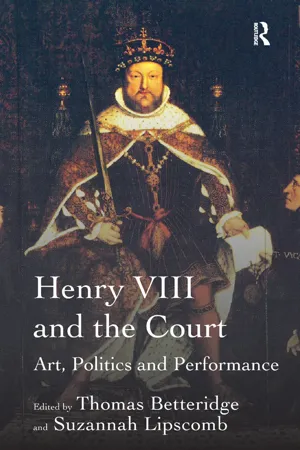
Henry VIII and the Court
Art, Politics and Performance
- 372 pages
- English
- ePUB (mobile friendly)
- Available on iOS & Android
eBook - ePub
About this book
After 500 years Henry VIII still retains a public fascination unmatched by any monarch before or since. Whilst his popular image is firmly associated with his appetites - sexual and gastronomic - scholars have long recognized that his reign also ushered in profound changes to English society and culture, the legacy of which endure to this day. To help take stock of such a multifaceted and contested history, this volume presents a collection of 17 essays that showcase the very latest thinking and research on Henry and his court. Divided into seven parts, the book highlights how the political, religious and cultural aspects of Henry's reign came together to create a one of the most significant and transformative periods of English history. The volume is genuinely interdisciplinary, drawing on literature, art history, architecture and drama to enrich our knowledge. The first part is a powerful and personal account by Professor George W. Bernard of his experience of writing about Henry and his reign. The next parts - Material Culture and Images - reflect a historical concern with non-documentary evidence, exploring how objects, collections, paintings and buildings can provide unrivalled insight into the world of the Tudor court. The parts on Court Culture and Performance explore the literary and theatrical world and the performative aspects of court life, looking at how the Tudor court attempted to present itself to the world, as well as how it was represented by others. The part on Reactions focuses upon the political and religious currents stirred up by Henry's policies, and how they in turn came to influence his actions. Through this wide-ranging, yet thematically coherent approach, a fascinating window is opened into the world of Henry VIII and his court. In particular, building on research undertaken over the last ten years, a number of contributors focus on topics that have been neglected by traditional historical writing, for example gender, graffiti and clothing. With contributions from many of the leading scholars of Tudor England, the collection offers not only a snapshot of the latest historical thinking, but also provides a starting point for future research into the world of this colourful, but often misrepresented monarch.
PART I: WRITING ABOUT HENRY VIII
1
Reflecting on the King’s Reformation
What was remarkable about Henry VIII was his evident personal charm. He had a Tony Blair-like ability to make those who spoke to him feel that he sympathized with them. The most extraordinary example was at Christmastide 1536 when Henry invited Robert Aske, the leader of the Pilgrims of Grace, to spend ten days at court. In October a huge rebellion had arisen in the north of England, with some 30,000 men assembling not just in October but again at the beginning of December, protesting not, I maintain, against taxation or for other economic grievances, but rather against the king’s religious policies, especially the dissolution of the smaller monasteries. Outnumbered, the king’s lieutenants, Thomas Howard, third duke of Norfolk, and George Talbot, fourth earl of Shrewsbury, made a deal on 6 December with those whom he saw as rebels. The insurgents would receive free pardons for the offences they had committed in assembling illegally, a parliament would meet in the north, and until that parliament met, abbeys would stand. At that point the Pilgrims must have thought they had won: why else would a parliament be called except to repeal recent legislation that they detested, especially the act dissolving the smaller monasteries?1 Henry then invited Robert Aske, the one-eyed lawyer who had emerged as the leader of the Pilgrims in Yorkshire, to spend Christmastide at court. In correspondence to his military commanders Henry had fiercely denounced Aske. But now he treated him as his honoured guest. Aske was invited to declare how he had come to be involved in the disturbances.2 More strikingly still, Henry clearly succeeded in giving Aske the impression that he would honour the promise that the duke of Norfolk had made that a parliament would be held in the north. Henry, we know from the instructions he would send the duke of Norfolk, had not the slightest intention of honouring those concessions.3 But astonishingly Aske returned to the north in January full of confidence that Henry would do so.4 Nor was Aske the only rebel leader to be deceived.5 When some of the northern commons began to suspect that Henry did not mean what he had said, Aske and others who had led the rising now stood firm against the new disturbances.6 By dividing the rebels, Henry was then able to summon Aske and other leaders to London again – but this time to send them to the Tower.7 It was a remarkable achievement by the king. If only we had some description of those Christmastide feasts that Aske enjoyed in Henry’s company.
Henry was quite ready to allow those with whom he talked to believe that they had got the better of him. Eustace Chapuys, the imperial ambassador, repeatedly informed his master, Charles V, of how he had won an argument with Henry over the details of diplomacy or the fine points of Henry’s justifications for his divorce. But what Chapuys did not realize, I suspect, was that Henry was playing him along.8
Henry as king was skilled at allowing his leading ministers to shoulder the responsibility for unpopular policies, at maintaining his ‘deniability’. Nowhere was that more evident than over the Amicable Grant of 1525. That was a huge financial demand, not sanctioned by parliament. It ran into refusals and outright resistance, not least because it came hard on other exactions, a great loan in 1522–23, and parliamentary taxation granted in 1523 on the basis of fresh valuations of wealth and income made in 1522. According to a famous story told by Edward Hall, the lawyer who wrote a Chronicle published in 1548, Henry, on hearing of the troubles, summoned his councillors, and demanded to know who was responsible for the demand. Wolsey stepped forward. But Hall did not intend us to take that at face value. And the chance discovery of the instructions sent to the commissioners for the Amicable Grant in Gloucestershire has revealed that Henry was intimately involved, assembling the commissioners at court, and telling them ‘by his own mouth’ why he needed the money. Not the least of the function of leading ministers was to serve as lightning conductors for kings: a practice Henry shrewdly exploited.9
Much of Henry’s personal charm was surely genuine. He was hailed as a model renaissance prince at his accession, and his talents were real. He was a skilled jouster, he spoke several languages, he wrote music and sang, he manifestly appreciated architecture and painting, and his education had been rigorous, to judge by the theological knowledge he would display.10 Judging from accounts of what he said on public occasions, as in the example from 1525, he had a flair with words and an instinctive judgement of what should be said.
But as my examples of Henry’s charm show, there was a ruthless and cynical streak in the man. We do not know whether Henry read Nicolo Machiavelli and especially Machiavelli’s rather cynical analysis of what rulers must do. But if Henry had not read Machiavelli, the truth is that he did not need to. There is an intriguing letter he sent to his ambassadors at the court of Francis I, the king of France, in July 1531. Henry was ready, he wrote, to do what he could for the French king without overmuch detriment to himself. But, he continued, benefits to be done and hoped for are much more effectual in preserving goodwill than those already received, which men lightly pass over and which are then forgotten. Therefore Henry thought it better to put the French king in hope of his request being granted, but not so firmly that he no longer doubted it. Rather than suddenly giving Francis a determinate and certain answer, they should leave such an impression that Francis neither despaired of the king’s answer, nor conceived such hope that he would have just cause to complain if only part is granted.11 That betrays a shrewd and deep-seated cynicism.
Most remarkable about Henry’s reign, indeed unparalleled, is how many of those who at some point were close to him and served him well suddenly found themselves not just out of favour but on trial for their lives and condemned to death.12 Blood stains the pages of any history of Henry VIII. On his accession to the throne, two of his father’s ministers, Edmund Dudley and Richard Empson, associated with Henry VIII’s financial exactions, were sent to the Tower and tried and executed for treason. The chronicler Polydore Vergil, usually swift to understand politics in terms of faction, here presents Henry as taking the initiative, consulting with his councillors on his wish to have them tried as savage extortioners: ‘everyone was grateful to the monarch for the punishment of the evil pair’.13 In 1513, just before he embarked on his invasion of France, Edmund de la Pole, son of a sister of Edward IV, a prisoner in the Tower since 1506, was summarily executed, not for anything he had recently done, but simply as a precaution: there is nothing to prove the king’s direct involvement but it does seem highly likely.14 In 1521 Edward Stafford, third duke of Buckingham, was executed for treason when disaffected members of his household revealed that he had listened to a monk who had prophesied that he would one day be king. That Henry was closely involved is suggested by the despatch of Sir William Compton, Henry’s closest body servant, as the messenger who was to summon Buckingham to court and then to the Tower. And Henry was involved in the interrogation of witnesses. A monarch other than Henry might well have fined Buckingham for his unwise behaviour: Henry had him executed.15 Thomas Wolsey, Henry’s devoted minister for many years, was not only dismissed as Lord Chancellor on absurd charges of breaking the statute of praemunire in 1529 but had he not died on the way to London in 1530 he would undoubtedly have been tried and executed too.16 In 1535 Thomas More, long Henry’s secretary, and Wolsey’s successor as Lord Chancellor, and someone who was as close to a friend as a king could have – Henry would ‘for the pleasure he took in his company’ sometimes unexpectedly come to More’s house in Chelsea ‘to be merry with him’, even after dinner walking with him in his garden for an hour ‘holding his arm about his neck’ – was executed when he refused to swear the oath of succession and was tricked into revealing what he thought about the king’s new supremacy.17 In 1536 Anne Boleyn, Henry’s second wife, was executed for treason: I shall return to this. In 1540 Thomas Cromwell, Henry’s leading minister in the 1530s, was executed for treason.18 In 1542 Catherine Howard, Henry’s fifth wife, was executed after she was found to have been committing adultery.19
At the very end of the reign, Thomas Howard, third duke of Norfolk, who had so skilfully resisted and ultimately defeated the Pilgrimage of Grace,20 and his son, Henry Howard, earl of Surrey, were arrested and convicted of treason after Surrey had unwisely quartered his arms with those of the king.21 Surrey was duly executed. Norfolk was due to be executed a few days later. But Henry died the night before. Norfolk’s life was then spared: he spent the reign of Edward VI in the Tower. That Norfolk’s life was spared after Henry died strongly suggests to me that it was indeed Henry who was responsible for the shedding of all that blood. If the Howards had been brought down by some political faction, as many historians have claimed, then why was Norfolk not executed too? There might have been some legal complications arising from Henry’s death, but it is hard to see why they could not have been overcome if the will were there.
It would be impossible to compile a similar catalogue of executed queens, noblemen and councillors for any other reign: and it is important to emphasize that none of these convicted and attainted traitors had actually raised their swords against the king.
Yet Henry is often – wrongly, as I shall maintain – thought to have been lazy, quickly bored with business, not very intelligent, easily manipulated. Geoffrey Elton, the most influential historian of Tudor England in the twentieth century, notoriously presented Thomas Cromwell, Henry’s minister in the 1530s, as a great revolutionary. If, as Elton once remarked, ‘Cromwell, not Henry VIII, was really the government’,22 that significantly diminished the part played by Henry, whom Elton memorably characterized as ‘a bit of a booby and a bit of a baby’.23
And when Elton examined the fall of Cromwell in 1540, he explained it in terms of faction: Cromwell was brought down by his supposed long-standing rivals, Thomas Howard, duke of Norfolk, and Stephen Gardiner, bishop of Winchester.24 Elton’s factional interpretation of Cromwell’s fall was followed in the 1970s by complex elaborations by Eric Ives and David Starkey. Starkey, a pupil of Elton, studied Henry VIII’s privy chamber, that part of the royal household responsible for the private life of the king. And the young David Starkey built up his reputation by arguing that Henry was the plaything of factions. In 1985 he declared that his study of The Reign of Henry VIII: Personalities and Politics ‘presents a new view of the King and the most important event of the reign: the Reformation. Henry was not the archetypal strong king. He was not weak either, but he was manipulable.’ And the Reformation ‘was not simply a great popular movement; it was also the work of court faction’. It was Thomas Cromwell whom Starkey then presented as the ‘architect of the reformation’.25 Very m...
Table of contents
- Cover
- Half Title
- Title Page
- Copyright Page
- Table of Contents
- List of Plates
- List of Abbreviations
- Notes on Contributors
- Acknowledgements
- Introduction
- Part I: Writing about Henry VIII
- Part II: Material Culture
- Part III: Images
- Part IV: Court Culture
- Part V: Reactions
- Part VI: Performance
- Part VII: Afterword
- Index
Trusted by 375,005 students
Access to over 1.5 million titles for a fair monthly price.
Study more efficiently using our study tools.
Frequently asked questions
Yes, you can cancel anytime from the Subscription tab in your account settings on the Perlego website. Your subscription will stay active until the end of your current billing period. Learn how to cancel your subscription
No, books cannot be downloaded as external files, such as PDFs, for use outside of Perlego. However, you can download books within the Perlego app for offline reading on mobile or tablet. Learn how to download books offline
Perlego offers two plans: Essential and Complete
- Essential is ideal for learners and professionals who enjoy exploring a wide range of subjects. Access the Essential Library with 800,000+ trusted titles and best-sellers across business, personal growth, and the humanities. Includes unlimited reading time and Standard Read Aloud voice.
- Complete: Perfect for advanced learners and researchers needing full, unrestricted access. Unlock 1.5M+ books across hundreds of subjects, including academic and specialized titles. The Complete Plan also includes advanced features like Premium Read Aloud and Research Assistant.
We are an online textbook subscription service, where you can get access to an entire online library for less than the price of a single book per month. With over 1.5 million books across 990+ topics, we’ve got you covered! Learn about our mission
Look out for the read-aloud symbol on your next book to see if you can listen to it. The read-aloud tool reads text aloud for you, highlighting the text as it is being read. You can pause it, speed it up and slow it down. Learn more about Read Aloud
Yes! You can use the Perlego app on both iOS and Android devices to read anytime, anywhere — even offline. Perfect for commutes or when you’re on the go.
Please note we cannot support devices running on iOS 13 and Android 7 or earlier. Learn more about using the app
Please note we cannot support devices running on iOS 13 and Android 7 or earlier. Learn more about using the app
Yes, you can access Henry VIII and the Court by Suzannah Lipscomb, Thomas Betteridge in PDF and/or ePUB format, as well as other popular books in History & Early Modern History. We have over 1.5 million books available in our catalogue for you to explore.