- 304 pages
- English
- ePUB (mobile friendly)
- Available on iOS & Android
eBook - ePub
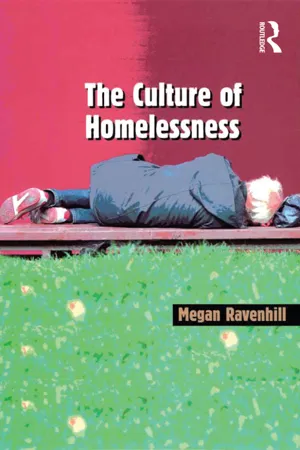
The Culture of Homelessness
About this book
Despite an extensive literature on homelessness there is surprisingly little work that investigates the roots of homelessness by tracking homeless people over time. In this fascinating and much-needed ethnographic study, Megan Ravenhill presents the results of ten years' research on the streets and in the hostels and day-centres of the UK, incorporating intensive interviews with 150 homeless and formerly homeless people as well as policy makers and professionals working with homeless people. Ravenhill discusses the biographical, structural and behavioural factors that lead to homelessness. Amongst the important and unique features of the study are: the use of life-route maps showing the circumstances and decisions that lead to homelessness, a systematic study of the timescales involved, and a survey of people's exit routes from homelessness. Ravenhill also identifies factors that predict those most vulnerable to homelessness and factors that prevent or considerably delay the onset of homelessness.
Information
Chapter 1
Introduction
This is an ethnographic study providing a unique insight into homelessness. This book explores why it is that despite the fact that previous research appears to have established the causes of homelessness and formulated solutions to it, which have been implemented, homelessness still persists. The book will look anew at the causes or triggers of homelessness, discussing the life events and processes that often trigger, protect against and predict the likelihood of someone becoming homeless (or roofless). This includes a close look at the process of becoming homeless, the existence of homeless subcultures and their impact on long-term homelessness, plus the process of leaving homelessness and reintegration into housed society.
A detailed examination of the synergical and complex nature of homelessness will explore the interaction of this complexity with the structures in place within society that are designed to prevent or alleviate rooflessness. Unique evidence is drawn from a group of people who have experienced rooflessness. Uniquely, this is counterbalanced with evidence from people who experienced similar triggers but never actually became homeless. The complex, multi-faceted routes into rooflessness will be demonstrated in terms of biographical, structural and behavioural factors. It will be shown that this complexity increases with the age of the individual and the duration of their rooflessness.
Unique in British homeless literature is the ethnographic exploration of homeless culture, its nature and impact – a culture that developed and exists to serve specific needs that mainstream society has historically proved unwilling or unable to provide for. The research highlights the intensity, vibrancy and attraction of homeless culture in the context of individuals’ need to belong, to be respected and to be able to feel ontologically secure. There is unique insight into the process of becoming homeless, fitting into the culture and the allure of the culture. This includes the strong, intense friendships developed, the inverse hierarchies and a glimpse into the violent side of the culture, as well as the fun side.
It will be shown that much of the current system for tackling homelessness evolved by default and can itself be a cause of homelessness. It is a system that inadvertently discourages and prevents people from leaving homelessness and fully reintegrating back into housed society. There is a tension between creating a system that is so easy that it encourages rooflessness, and a system so harsh that it discourages resettlement. This tension appears to paralyse policy-makers and providers, preventing them from moving to a point of equilibrium and creating an effective homeless prevention and resettlement programme for all homeless people. This suggests that radical changes are needed in the way rooflessness is perceived and tackled.
The reader will be taken systematically through the theoretical and policy backdrop, before being led sequentially through the experiences of the people interviewed for the study. The book begins by discussing the definition of home and interpreting the various definitions of British homelessness in terms of home (Chapter 2). This includes the impact of such definitions on knowledge and the construction of homelessness as a social policy issue. Unique to this book, the notion of a homeless industry set up to tackle homelessness will be introduced. This will include an exploration of the co-dependence of the homeless and homeless industry on each other. Uniquely, Chapter 2 goes on to examine the relationship between this co-dependence and public policy, plus the interaction between homeless industry, policy generation, funding, stereotypes of homeless people and the generation of public opinion.
In addition to the traditional theoretical perspectives associated with homelessness, this book discusses unique theories implicit within the literature but not formally discussed elsewhere; for example deviancy, symbolic interaction, normalization, agency, structuration and risk society (Chapter 3). The overall conclusion drawn from this discussion is that no one theoretical stance is adequate to fully explain homelessness, although structuration perhaps comes the closest. Instead, a combination of a number of theories needs to be used to fully capture the complexity of homelessness.
The pervading theoretical perspectives at various points in time have historically driven welfare and homeless policy (Chapter 4). The book examines the evolution of current homeless policy in the light of the overall housing policy, employment and economic structures within the welfare state and Britain in general. Concluding that much of the current homeless policy has evolved by default, this creates the absence of any alternative cohesive policy that prevents or at least creates an adequate safety net against homelessness.
There are powerful accounts of people’s ‘homeless’ experiences – before, during and after rooflessness. Chapter 6 explores the origins of people’s routes into rooflessness, establishing a number of clearly identifiable factors that increased people’s vulnerability to rooflessness. It will be established that it is not the triggers of homelessness themselves that result in rooflessness, but the accumulation of triggers – especially if they were experienced in quick succession. In fact, rooflessness appears to be predominantly a solution to existing problems rather than the problem. On average, 7–9 years elapse between triggers commencing and rooflessness occurring. Furthermore, there was an average of 1–2 years in precarious housing, episodic homelessness (not rooflessness) and continuous vulnerability to rooflessness before rooflessness occurred, despite, in many cases, determined attempts to avoid it.
There is a unique insight into the childhoods of roofless people, showing that the majority of people’s routes into rooflessness began in childhood. Experiences during childhood began a series of experiences, decisions and gradual disaffection or alienation from society, the family and home. The family, relationships within the family and home environment were the strongest factors that either triggered or protected people against homelessness. Life events are depicted using route-maps that outline these processes and demonstrate the accumulation of triggers over time. The age at which a person first experiences rooflessness is linked to the number of episodes and duration of homelessness. Similarly, the age an individual first leaves home is shown to have a direct impact on the degree and duration of rooflessness, with those leaving home early or experiencing rooflessness at a young age far more likely to go on to become roofless long term. There is also a unique look at the class of origin of the roofless. The book offers evidence to suggest that the social class of origin is much higher than most commentators assume (social class II and IIIa, rather than IV or V).
Chapter 7 offers a unique insight into British homeless culture. This is briefly contrasted with American and Dutch homeless culture. The homeless culture is a counterculture created through people being pushed out of mainstream society. The culture’s attractions, mechanisms for inclusion and acceptance, the fun and the heartache are all explored in this chapter. What happened to people in the past creates the nature of the homeless culture. Furthermore, any serious attempt at resettling long-term rough sleepers needs to consider what it is that the homeless culture offers and whether or how this can be replicated within housed society. There are immense multidimensional difficulties to be faced by those exiting the homeless culture and rooflessness. These difficulties arise from complex structural, behavioural and emotional factors that are inextricably entwined within people’s lives and, at times, negate positive influences or exacerbate existing problems.
Chapter 8 demonstrates the enormity of the task faced by roofless people trying to resettle into mainstream society. The book will show that the resettlement process at present appears to be an assault course, with obstacles designed to prove the individuals’ desperation, rather than the intended gradual rehabilitation through preparation, support and assistance. This assault course has developed by default over a significant period of time, the obstacles being a combination of practical, structural, ideological and behavioural factors. This makes the current system counterproductive, actually discouraging people from trying to resettle, or locking them into dependency on the homeless culture for survival. There is a unique insight into the pervasive, deep, long-lasting impact of current resettlement practices and conditions homeless people are expected to accept as part of that resettlement.
This is contrasted with a number of factors identified as influencing successful reintegration into housed society and the struggle to prevent people from becoming locked into the homeless culture. Points are identified along the continuum of social exclusion and inclusion that highlight how excluded people from mainstream society become included in the homeless culture, then have to exclude themselves from that culture in an attempt to be included within the society that rejected them. This often has to be done without a safety net of support in the interim.
The book concludes that although long-term rooflessness is triggered and sustained by many complex, interlinked problems and circumstances, people can and do manage to avoid rooflessness or, once roofless, to leave and lead settled lives. Many factors that prevent people from doing so are identified. If there is to be a serious attempt at ending rooflessness, then there needs to be a number of changes that enable people to seek and receive assistance, both before, during and after rooflessness has occurred. This assistance needs to be easily available to people regardless of their geographical location or ability to ask for and/or receive that help. The fact that rooflessness is so complex means that solutions need to be client-centred, flexible and layered or administered in stages that reflect the individuals’ changing needs. Historically the current system has proved unable to stem the tide of new homeless people and tackle entrenched rooflessness. An ideological shift is needed. Without adequate alternatives to rooflessness being created, along with transparent access routes to those alternatives, rooflessness will remain.
Chapter 2
Defining Homelessness
The importance of defining homelessness should not be underestimated. In this chapter, particular emphasis is placed on the definition of ‘homelessness’. Homelessness is an emotive word that conjures up in people’s minds pictures of the tramp walking the street, smelly, dirty and hungry, or the alcoholic, obnoxious, loud and drunk. To view all homeless people in terms of these two stereotypes is to do many an injustice. It can also act as an obstacle to tackling a serious problem.
There is no consensus on the definition of homelessness in the literature. The definition used often relates directly to the objectives and ethos of the body or organization defining it. Thus all definitions become relative and prone to variation. In spite of this, definitions have shaped and formed public policy, moulded and manipulated public opinion, identified causes and defined solutions. For example:
Statutory definitions
Include families in precarious housing or temporary accommodation, but exclude most single male rough sleepers.
Voluntary organization promotional literature
Most literature promoting individual organizations define homelessness in terms of causal factors that evoke public sympathy (e.g. ‘84 per cent of young people arriving at Centrepoint are forced to leave home’ – Centrepoint 1997).
The lack of a comprehensive definition that is acceptable to all prevents cohesive action on tackling homelessness, both as a phenomenon and before it occurs. Carter (Burrows et al. 1997) suggests this is because social policy itself has become so ‘embroiled’ in finding complex explanations that it has created ‘individualistic discourses’, which deny or obscure any ability to recognize real need even when confronted with rough sleepers. For example, homelessness is often analysed according to the two poles on a wide spectrum of attitudes, namely structural factors or psychological (individual pathological) factors (Watson and Austerberry 1986). Structural factors are arguments about, for example, the high demand for housing, unemployment, rising rents and house prices. Psychological factors focus on the individual and the way they fit into society. Caplow uses the second pole, defining homelessness as:
a condition of detachment from society characterised by the absence or attenuation of the affiliative bonds that link settled persons to a network of interconnected social structures. (Caplow in Bahr 1973)
For Caplow, homelessness is a form of alienation from the rest of society, caused by the loss of an ‘affiliative bond’ (work, family or home) that links or connects the individual with society. The lack of an affiliative bond effectively excludes them from society. For Watson and Austerberry (1986), however, Caplow’s psychological emphasis implies a need for institutional provision, psychiatric treatment or social work intervention.1 The truth probably lies somewhere between the two. For some, the ‘affiliative bond’ can only be re-established through some form of psychiatric/social work intervention; whereas others simply need the security and stability associated with well-being and ‘home’.
There are currently five main types of definition of homelessness:
1. Statutory or Legal Definitions
These definitions are used by national and local governments and are enshrined in the legal framework via legislation. The British statutory definition defines families with dependent children and without access to accommodation as homeless and those accepted as in ‘priority need’ on the grounds of ‘vulnerability’ (i.e. aged over 60, pregnant, suffering from mental ill-health, young people in danger of exploitation). This excludes the vast majority of single homeless people, especially men.
Statutory definitions place the onus on the individual to prove that they are homeless and that they deserve help. Those single people identified as undeserving (i.e. not old, not pregnant, mentally healthy) are not entitled to be housed under the law. The UK’s statutory definition of homelessness does not include roofless people. They are identified as rough sleepers, not ‘homeless’ (e.g. Crisis 1998). They are not counted in the Government’s homeless statistics.
2. Continuum Definitions
Some authors use a continuum of definitions that incorporates all possible types of homelessness, from the roofless to those housed but who would rather live elsewhere (Meert et al. 2004; Bramley 1988). These definitions are based predominantly on the individual’s relation to housing, their housing need and/or the type of tenure they have. Although this is the most versatile way of defining homelessness, it may be criticized for defining everyone as homeless apart from those who own their home outright and are happy with where they live.
Chamberlain et al. (2000) supports a move away from continuum towards a three-tiered definition of homelessness. Arguing, that by acknowledging degrees of homelessness in three simple levels,2 statistics can be more precise creating a clearer picture of the extent of the problem.
3. Statistical Definitions
Statistical definitions identify an issue as a social problem then measure the magnitude of that problem. Such definitions are not discussed in the literature as a separate category; they are incorporated into other categories. Yet they play an important role in shaping the general public’s attitudes, fundraising campaigns and political agendas. Statistics on homelessness are derived from literally counting people identified as homeless.3 Thus, the definition used determines the number of people that are counted and in turn the size of the problem. For example, in 1993 the homeless figure in Britain ranged from 140,000 households to 8,600 individuals (Shelter 1993). The former figure refers to those ‘households’ accepted as statutorily homeless in England and Wales; the latter refers to the estimate of how many people slept rough each night. Statistical definitions tell more about the organization collecting them than about the actual phenomena they are designed to measure (Hutson and Liddiard 1994).
Homeless people are a transient population; they move in and out of various forms of accommodation and spend time on the streets. Statistical definitions require precise categories of clearly identifiable groups of people. However, people’s lives rarely fit neatly into just one category. Countries such as Denmark (Stax 2003), Hungary (Győri 2004) and The Netherlands (Doorn 2003) have found that the more you try to impose definitions suitable for statistical categories, the more complex defining becomes and the vaguer the concept of homelessness becomes. Smith’s (2003) paper on defining British homelessness demonstrates this problem beautifully with a plethora of different categories – resulting in another continuum of definitions.
Rossi (1989) dismisses homeless statistics as irrelevant, as counting the uncountable, merely providing a representative snapshot of the problem, but with no way of identifying how representative that snapshot is. However, based on this unrepresentative snapshot, the general public’s attitudes, fundraising campaigns and political agendas are shaped.
4. Housing Shortage Definitions
These are the most common definitions. They reduce all other factors or problems that may cause homelessness to the lack of accommodation (rooflessness) or its unsuitability. Thus homelessness is caused by a shortage of suitable affordable accommodation in the housing market (Avramov 1995; Shelter 1997; Baker 1997). Hostels are full because there is no suitable ‘move-on’ accommodation (Spaull and Rowe 1992). Little regard is given to individual autonomy or capability to cope in accommodation, sustain a t...
Table of contents
- Cover Page
- Dedication
- Title Page
- Copyright Page
- Contents
- List of Illustrations
- List of Diagrams
- List of Photographs
- List of Route-maps
- List of Tables
- Preface
- Acknowledgements
- List of Abbreviations
- 1 Introduction
- 2 Defining Homelessness
- 3 Homelessness: Theoretical Perspectives
- 4 Homelessness: British Policy Overview
- 5 Research Framework
- 6 Routes into Homelessness
- 7 Homeless Culture
- 8 Exit Routes from Homelessness
- 9 Conclusions and Recommendations: Prevention and Intervention
- Appendix
- Bibliography
- Index
Trusted by 375,005 students
Access to over 1.5 million titles for a fair monthly price.
Study more efficiently using our study tools.
Frequently asked questions
Yes, you can cancel anytime from the Subscription tab in your account settings on the Perlego website. Your subscription will stay active until the end of your current billing period. Learn how to cancel your subscription
No, books cannot be downloaded as external files, such as PDFs, for use outside of Perlego. However, you can download books within the Perlego app for offline reading on mobile or tablet. Learn how to download books offline
Perlego offers two plans: Essential and Complete
- Essential is ideal for learners and professionals who enjoy exploring a wide range of subjects. Access the Essential Library with 800,000+ trusted titles and best-sellers across business, personal growth, and the humanities. Includes unlimited reading time and Standard Read Aloud voice.
- Complete: Perfect for advanced learners and researchers needing full, unrestricted access. Unlock 1.5M+ books across hundreds of subjects, including academic and specialized titles. The Complete Plan also includes advanced features like Premium Read Aloud and Research Assistant.
We are an online textbook subscription service, where you can get access to an entire online library for less than the price of a single book per month. With over 1.5 million books across 990+ topics, we’ve got you covered! Learn about our mission
Look out for the read-aloud symbol on your next book to see if you can listen to it. The read-aloud tool reads text aloud for you, highlighting the text as it is being read. You can pause it, speed it up and slow it down. Learn more about Read Aloud
Yes! You can use the Perlego app on both iOS and Android devices to read anytime, anywhere — even offline. Perfect for commutes or when you’re on the go.
Please note we cannot support devices running on iOS 13 and Android 7 or earlier. Learn more about using the app
Please note we cannot support devices running on iOS 13 and Android 7 or earlier. Learn more about using the app
Yes, you can access The Culture of Homelessness by Megan Ravenhill in PDF and/or ePUB format, as well as other popular books in Politics & International Relations & Social Policy. We have over 1.5 million books available in our catalogue for you to explore.