- 408 pages
- English
- ePUB (mobile friendly)
- Available on iOS & Android
eBook - ePub
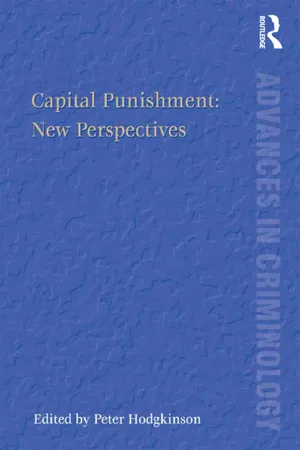
Capital Punishment: New Perspectives
About this book
This collection asks questions about the received wisdom of the debate about capital punishment. Woven through the book, questions are asked of, and remedies proposed for, a raft of issues identified as having been overlooked in the traditional discourse. It provides a long overdue review of the disparate groups and strategies that lay claim to abolitionism. The authors argue that capital litigators should use their skills challenging the abuses not just of process, but of the conditions in which the condemned await their fate, namely prison conditions, education, leisure, visits, medical services, etc. In the aftermath of successful constitutional challenges it is the beneficiaries (arguably those who are considered successes, having been 'saved' from the death penalty and now serving living death penalties of one sort or another) who are suffering the cruel and inhumane alternative. Part I of the book offers a selection of diverse, nuanced examinations of death penalty phenomena, scrutinizing complexities frequently omitted from the narrative of academics and activists. It offers a challenging and comprehensive analysis of issues critical to the abolition debate. Part II offers examinations of countries usually absent from academic analysis to provide an understanding of the status of the debate locally, with opportunities for wider application.
Information
New Perspectives and Challenging Questions
Chapter 1
A Critique of Litigation and Abolition Strategies: A Glass Half Empty
Kerry Ann Akers and Peter Hodgkinson
Introduction
In this chapter, we challenge the received wisdom of abolition strategies from the standpoint of two experienced and uncompromising foes of capital punishment who are struggling to reconcile claims of ‘success’ made by abolitionists and the experience of the countries in which we have worked in the aftermath of abolition. Many of the issues we discuss have thus far escaped the scrutiny of career academics. Strategies which conventionally target discreet aspects of capital punishment’s implementation fail as a consequence to appreciate or address the macro-context of capital punishment. In our view, the claims of abolitionists are somewhat exaggerated and the achievements [reducing its scope and repealing executions] are diminished if not accompanied by root and branch reform of the fundamental flaws that characterize its implementation. Regrettably, the view of too many in the abolitionist movement is that by the single measure of outlawing executions, abolition of capital punishment is accomplished – this is both short-sighted and obscures the implementation of essential infrastructure improvements. Questions need too to be asked about the profligate costs expended on the abolitionist industry, especially when the actions they stage, such as national and international conferences, are of questionable value. These are resources we believe could be more effectively spent developing and supporting the infrastructure changes essential to the transition to lasting abolition marked by fundamental improvements to the socio-legal and socio-political landscape.
Abolitionists seem too ready to accept the inevitable, if unintended, negative consequences of their ‘victories’, exemplified in particular by litigation strategies and the issue of alternatives to the death sentence. Repeal of execution statutes in and of itself does not bring about the wholesale civilizing of and access to justice claimed by most abolitionists. Our experience is that very little, if any, attention is given to countries in the aftermath of abolition. For a host of reasons, from funding pressure to convenience to self-aggrandizement to vanity, many abolitionists are reducing abolition to its most rudimentary terms, ignoring country-specific nuances, disregarding negative repercussions and often entrenching bad law for the sake of expedience.
The American experience has been the staple diet of capital punishment research and activism and continues to shape the debate even when it is frequently not appropriate to the analysis globally. Difficult though it might be to unearth country- and topic-specific research, we have, where possible, drawn on non-US experiences to inform our analysis. This chapter will analyse abolition in the light of its repercussions and the generic approaches employed by civil society, lawyers and states illustrated by accounts of regional developments and country-specific examples. We want to explore whether lessons have been learnt from flawed strategies. The analysis provided throughout this chapter posits that isolationism and competition within the abolition sector proves an obstacle to comprehensive development of penal policy.
Whilst the focus of this chapter is to scrutinize abolitionism, questioning its received wisdom, we recognize the need to examine the position held by those who support the death penalty, especially as the abolition movement devotes few resources to including death penalty supporters in its strategies. With this in mind, a summary of the pro-death penalty movement is included in the Introduction to this book.
Strategies for Abolition: Acts and Actors
The actions of many ‘abolitionists’ focus on saving the life of an individual, a friend, a family member, and subscribe to anti-capital punishment beliefs to provide structure and support for their journey when in fact they only want to abolish the death penalty for their friend. The annals of activism are replete with examples of the fight for individual personalities,1 in the course of which all concerned become ‘famous’ or attract notoriety. Clearly, not all ‘personality’ activities fall under this heading as there are examples – too many – that exploit individuals to justify and give life to abolitionism. Campaigning is central to the strategy of abolition, but not all campaigns are motivated by abolition.
Before embarking on the principal targets of this analysis – litigation strategies and alternatives to the death sentence and the links between them – we will review the variety of actions, actors and issues that characterize the confusion that is the abolition industry. Crucial, too, to this analysis is to identify the particulars of what it is we want to abolish and to what extent there are universally accepted criteria. On the one hand, there are those who oppose capital punishment based on the offence, and others based on the characteristics of the defendant or on the death penalty process itself. Some individuals and countries restrict their support for capital punishment to murder, others for crimes including rape, child sexual abuse, drug trafficking, kidnapping, bribery, corruption, adultery, apostasy and arson. There is neither clarity nor agreement nor consistency worldwide about which crimes ‘deserve’ the death sentence, or what elements of a particular crime distinguish it as deserving of death. ‘Heinous’ as a descriptor is part of the lexicon of justification. ‘Abolitionists’ influenced by this approach usually remain so only until the ‘unacceptable’ crimes have been removed from the purview of capital punishment. Further opposition to capital punishment is based on specific characteristics of the defendant: for example, they oppose sentencing to death those under the age of 18 at the time of the offence, those with mental impairment or mental illness, women, pregnant women, or those over a certain age. Some oppose its mandatory imposition, the possibility of wrongful convictions, the mode of execution, or policies with their roots in religious beliefs (Hodgkinson, Kandelia and Gyllensten, 2008).
Group activism is prevalent in the USA, with all states having at least one group opposed to capital punishment, even in those states which no longer retain the penalty, where campaigning seeks to resist reinstatement. Having been close to the activism in the USA for a couple of decades, Hodgkinson’s overall impression is that whilst ‘abolition of the death penalty’ is a shared objective amongst these disparate groups, that is where the commonality ends, with as many approaches, strategies, ‘beliefs’, targets and remedies as there are groups. To compound this rather haphazard approach, there is no tradition of evaluating the effectiveness of their activities or of learning from others or from the fruits of authoritative research. For some, like religion, it is a belief to be accepted without question. The failure to subject strategies and outcomes to rigorous evaluation is universal to the abolition industry. We mention this because we believe that abolition activities could improve immeasurably through a process of self- or external assessment coupled with a clearer vision of the full purpose of abolition.
Abolition’s Multinationals
Amnesty International (AI) is no longer considered to be the pre-eminent organization campaigning against capital punishment, with some believing that it has lost its edge, its reputation and therefore its authority. However, it remains the international non-governmental organization (INGO) of preference for the United Nations (UN) and governments globally, and the recognized source of data about implementation, whilst accepting that in many instances the data is either incomplete or inaccurate. AI’s abolition strategy is essentially to provide information about and to retentionist countries, coupled with its mantra about the futility of the death penalty and the damage it causes. Here again it is nigh impossible to judge the effect, as to our knowledge no systematic evaluation has ever been done, nor is there evidence that AI’s strategy has evolved over time. It remains worryingly silent on such important issues as alternatives, public sentiment and the families of homicide victims.
Nonetheless, one cannot fault it for having been the catalyst for the exponential rise of a variety of multinationals, many of which are dedicated solely to abolition of the death penalty, and others like Human Rights Watch (HRW)2 and Penal Reform International (PRI)3 for which capital punishment is part of a broader focus on human rights violations.
Others derive their origins from government initiatives on abolition largely within Europe, Italy taking an early lead with a near-zealous pursuit of abolition domestically and internationally with its roots in the Italian Radical Party and spawning two major non-governmental organizations (NGOs) – Hands Off Cain (founded in 1993),4 which combines information collection and distribution with extensive political activism whose principal target is the periodic UN General Assembly and the moratoria resolutions, whereas the Comunità di Sant’Egidio (founded in 1968) delivers its abolition message symbolically, characterized by the lighting up of the Coliseum and capital cities to mark abolition events. Both are driven by an emotional commitment to abolition. France, too, has a prominent position in pursuit of abolition, supporting a number of initiatives including Ensemble Contre la Peine de Mort (ECPM, founded in 2000) and the World Coalition against the Death Penalty (founded in 2002). The Fédération Internationale des Ligues des Droits de L’homme (FIDH, founded in 1901) has compiled several important country reviews which provide an important source of evidence-led information about the status of capital punishment globally. The Spanish government recently established two initiatives: the International Commission against the Death Penalty (ICDP, founded in 2010)5 and the International Academic Network Against the Death Penalty (founded in 2010).6 Whilst it is still early days, they too, have resorted to staging seminars, and elites’ meetings, which to date have addressed the usual tired and dated topics. Disappointing given the innovation and freshness shown at the founding meeting in Madrid.
Space doesn’t allow us to reproduce individual statements of aims, though we would learn little that distinguishes one from the other. Whatever the claims of their mission statements, they all collect and disseminate information; even though the information they collect and the means of dissemination may differ, this is the common denominator. Also, given that they all stage seminars, publish data, lobby governments and compete for scarce resources, there is inevitably duplication and therefore waste. Another characteristic they all share is the ‘expertise’ promulgated by a core of the usual suspects to be found at capital punishment events worldwide, the substance of whose presentations is entirely predictable and rarely progress the debate. In our opinion, there are a number of weaknesses common to all such abolition activities, in particular (1) an absence of any systematic evaluation of the effectiveness of their strategies, and (2) a decision – and it must be a deliberate decision – to exclude supporters of capital punishment from their guest lists. Whose opinions are they trying to influence at such huge expense?
It may not make headlines or court publicity characteristic of its European Union ‘competitors’, but the British government, too, is committed to global abolition of capital punishment. This commitment has its formal beginnings in 1997, when the then Foreign Secretary, the Rt Hon. Robin Cook MP, established the Human Rights Policy Department (HRPD), one branch of which was the Death Penalty Panel. Hodgkinson is a founding member of this group, the role of which is to advise the Foreign and Commonwealth Office (FCO) on a range of issues relating to capital punishment. In contrast to its neighbours, which focus on staging high-profile information and awareness-raising events, the thrust of the UK’s strategy is to fund scoping visits to retentionist states judged to be priorities, to fund the legal representation of British citizens facing capital charges abroad, to fund litigation strategies to repeal the mandatory death penalty, to reduce the scope of capital crimes, and to support a variety of abolition activities in ‘soft’ targets, namely states judged to be susceptible to abolition. Over the years, Hodgkinson has represented the FCO on numerous such country missions, frequently questioning their purpose, but not their commitment. Abolition of capital punishment is awash with opinions, so the British Government and Panel members also have their own ‘beliefs’ about what works and what the priorities should be. A paradox in their strategy is that whilst bounty hunting the repeal of the mandatory death penalty worldwide, it continues to impose legislation in England and Wales which increases the range of mandatory sentencing, building on the mandatory sentence of life imprisonment as the alternative to the death sentence in 1965.7
Here, too, we have evidence of a failure to evaluate and to commit to initiatives thus increasing the risk of leaving half-finished or abandoned projects. In a paper written at the invitation of the FCO’s Strategic Project Fund, Hodgkinson comments:
A fresh approach to improving the delivery and quality of its effectiveness is overdue and could be achieved by focussing on improving the support offered by British Embassies and High Commissions for country actions and developing stronger collaborations with the EC, the EU, the UN and the London Missions of target countries and sympathetic countries.
Significant savings can be made by strictly limiting overseas missions, which in my experience have led to only modest and fleeting benefits rarely meeting capacity building or sustainability targets. The potential for both soon dissipates due to embassy commitments and other demanding portfolios overtaking the capital punishment agenda. Furthermore, I wonder whether a permanent and accessible record of the actions and the actors exists– the last of my 4 visits to S. Korea revisited many important issues and raised even more questions, which despite the genuine resolve of all involved to continue working on the issues activity soon evaporated – much better had we been able to build on the previous visits. Embassy staff should be given more support to ensure sustainability. Four visits over as many years addressing the same issues from the same starting point is not an efficient use of resources.8
‘Communities of nations’ – such as the United Nations (UN), the Council of Europe (CoE), the Organization for Security and Co-operation in Europe (OSCE) and the European Union (EU) – all oppose capital punishment, and because they collectively represent the views of all nations, the strategies they adopt are important, some would say crucial. All claim a mandate to abolish capital punishment, though none can claim to reflect or represent the citizens of their member states; none the less, they all adopt robust anti-death penalty positions. Other ‘communities of nations’, including the Arab League, the African Union, Caricom, the Association of Southeast Asian Natio...
Table of contents
- Cover Page
- Title Page
- Copyright Page
- Dedication
- Contents
- List of Figures and Tables
- Notes on Contributors
- Introduction
- PART I NEW PERSPECTIVES AND CHALLENGING QUESTIONS
- 1 A Critique of Litigation and Abolition Strategies: A Glass Half Empty
- 2 Juvenile Death Penalty in Islamic Countries: The Road to Abolition is Paved with Paradox
- 3 Talking to Each Other in the Dark: The American Abolition Movement and the Christian Opportunity
- 4 Non-refoulement Obligations Under International Law in the Context of the Death Penalty
- 5 Victims: Transforming the Death Penalty Debate
- 6 The Greater Stigma? Family Visits to the Condemned
- 7 Children of Parents Sentenced to Death
- 8 Death Penalty Internships in the American South
- PART II COUNTRY PERSPECTIVES
- 9 Reconciling Human Rights and the Application of the Death Penalty in Malawi: The Unfulfilled Promise of Kafantayeni v. Attorney General
- 10 Taiwan: Cutting the Gordian Knot – Applying Article 16 of the ICCPR to End Capital Punishment
- 11 Transnational Networks and Norm Compliance: Stopping Executions in Belarus
- 12 Afghanistan: Death Penalty at the Crossroads
- 13 The Death Penalty in Canada: Ethnicity, Abolition and the Current Debate
- 14 Successful Capital Litigation in Uganda: A Counterintuitive Approach?
- 15 The End of the End: Understanding the Paradox of Capital Sentencing in Liberia
- 16 The Political Use of Capital Punishment in Communist Romania between 1969 and 1989
- 17 Capital Punishment in Vietnam: Status and Perspective
- Index
Trusted by 375,005 students
Access to over 1.5 million titles for a fair monthly price.
Study more efficiently using our study tools.
Frequently asked questions
Yes, you can cancel anytime from the Subscription tab in your account settings on the Perlego website. Your subscription will stay active until the end of your current billing period. Learn how to cancel your subscription
No, books cannot be downloaded as external files, such as PDFs, for use outside of Perlego. However, you can download books within the Perlego app for offline reading on mobile or tablet. Learn how to download books offline
Perlego offers two plans: Essential and Complete
- Essential is ideal for learners and professionals who enjoy exploring a wide range of subjects. Access the Essential Library with 800,000+ trusted titles and best-sellers across business, personal growth, and the humanities. Includes unlimited reading time and Standard Read Aloud voice.
- Complete: Perfect for advanced learners and researchers needing full, unrestricted access. Unlock 1.5M+ books across hundreds of subjects, including academic and specialized titles. The Complete Plan also includes advanced features like Premium Read Aloud and Research Assistant.
We are an online textbook subscription service, where you can get access to an entire online library for less than the price of a single book per month. With over 1.5 million books across 990+ topics, we’ve got you covered! Learn about our mission
Look out for the read-aloud symbol on your next book to see if you can listen to it. The read-aloud tool reads text aloud for you, highlighting the text as it is being read. You can pause it, speed it up and slow it down. Learn more about Read Aloud
Yes! You can use the Perlego app on both iOS and Android devices to read anytime, anywhere — even offline. Perfect for commutes or when you’re on the go.
Please note we cannot support devices running on iOS 13 and Android 7 or earlier. Learn more about using the app
Please note we cannot support devices running on iOS 13 and Android 7 or earlier. Learn more about using the app
Yes, you can access Capital Punishment: New Perspectives by Peter Hodgkinson in PDF and/or ePUB format, as well as other popular books in Social Sciences & Law Theory & Practice. We have over 1.5 million books available in our catalogue for you to explore.