eBook - ePub
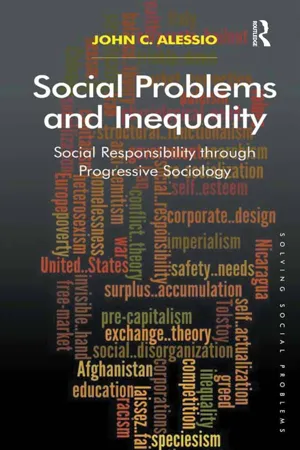
Social Problems and Inequality
Social Responsibility through Progressive Sociology
- 302 pages
- English
- ePUB (mobile friendly)
- Available on iOS & Android
eBook - ePub
About this book
Social Problems and Inequality explores integrated and root-cause-based explanations of complex social problems. Written in clear and understandable language, allowing it to be used for classroom purposes, it addresses the most fundamental principles of how humans, acting through social units, create, and eventually can remedy, social problems. With a central focus on the problem of inequality and the manner in which this is manifested in crime, social class and stratification, this book examines the key theoretical perspectives relevant to the study and solution of social problems, whilst drawing upon rich illustrations and case studies from the US and Europe to offer a thorough examination of the nature, common root causes and social remedies of social problems. Providing discussions of both theoretical approaches and concrete applications, Social Problems and Inequality investigates the sources of various prejudices and attitudes that contribute to social problems and the associated issues of globalization, economic greed and imperialism. Accessible in style and comprehensive in its coverage, this book will appeal to students and scholars of social problems across the social sciences.
Information
Chapter 1
The Systematic Study of Social Problems
Personal Troubles vs. Public Issues
Perhaps the most often cited work when defining the concept “social problems” is that of C. Wright Mills’ “The Sociological Imagination,” originally published in 1959. In “The Sociological Imagination,” among other goals, Mills endeavored to draw a distinction between personal troubles and public issues. Some social problems authors have used Mills’ arguments and examples to make the point that social problems are not to be confused with personal troubles. Others have used Mills’ writings to emphasize the idea that personal troubles and social problems are inextricably connected. Indeed, when we look at “The Sociological Imagination,” we find evidence to support both positions. Support for the former position can be seen in the following quote:
Troubles occur within the character of the individual and within the range of his immediate relations with others; they have to do with his self and with those limited areas of social life of which he is directly and personally aware …
Issues have to do with matters that transcend these local environments of the individual and the range of his inner life. They have to do with the organization of many such milieu [sic] into the institutions of an historical society as a whole, with the ways in which various milieu [sic] overlap and interpenetrate to form the larger structure of social and historical life. (Mills 1993: 51)
As an example of a personal trouble, Mills identifies one person in a city of 100,000 being unemployed. Under these circumstances we are permitted to examine the person’s character and skills for possible explanations of their unemployment. As an example of a public issue, he identifies 15 million people being unemployed out of a population of 50 million. Here we are permitted to examine the political and economic institutions of society for the sources of unemployment.
Support for the latter interpretation of Mills, i.e., that the personal and public are inextricably connected, can be seen in the next quote.
What we experience in various and specific milieu [sic], I have noted, is often caused by structural changes. Accordingly, to understand the changes of many personal milieu [sic] we are required to look beyond them. (Mills 1993: 52)
The above quote is preceded by examples of large numbers of individuals experiencing hardships because of broader social structural problems. Regardless of which interpretation one chooses to give Mills’ work, it seems clear that a purported fundamental distinction between personal troubles and public issues is the number of people involved. The importance of having a lot of people involved to constitute a public issue continues to be reflected in many of the text book definitions of social problems. Some examples are as follows:
A social problem exists when an influential group asserts that a certain social condition affecting a large number of people is a problem … (Zastrow 1996: 3)
Social Problems can be defined as situations, policies, or trends that are (1) distressing or threatening to large numbers of people … (Glynn et al. 1996: 3)
A social problem is a condition affecting a significant number of people in ways considered undesirable … (Horton et al. 1997: 2)
Sociologically, a social problem is a phenomenon regarded as bad or undesirable by a significant number of people or a number of significant people who mobilize to remedy it. (Heiner 2010: 5)
And most recently:
… an alleged situation that is incompatible with the values of a significant number of people who agree that action is needed to alter the situation. (Rubington and Weinberg 2011: 3)
A version of Heiner’s approach is the definition offered by Joel Best: “That is, the study of social problems should focus on how and why particular conditions come to be constructed as social problems” (2008: 14). A constructionist approach presumes a public awareness of a problem, which implies someone with a claim goes through a process of making others see reality in the same manner as the claim-maker. According to these definitions there are no true external benchmarks for social problems analysts to study—only the process by which events come to be seen as social problems. Under this approach there are no social problems until there is a certain level of social consciousness of a problem, which can only emerge through an effective social construction of that problem.
One could, however, work backward from Best’s model to discuss what the common events are that provoke individuals to engage in the process of making a claim, or what conditions prevent a claim from being effectively made when serious harm is being done to someone or some group of people. Indeed, from a social constructionist point of view, the more relevant question might be how social reality is effectively controlled to publicly deny the “existence” of social problems. Therein lie the serious social problems, and that is the focus of the definition of a social problem in this book.
A Definition of Social Problem
If there are conditions and circumstances under which individuals cannot be held responsible for their negative predicament, however undesirable or seemingly isolated that predicament, it would seem to be important to recognize such predicaments as part of what constitute a social problem. We look to causal sequences of events to understand how the individual’s behavior or negative situation is part of a broader social fabric and not simply the outcome of a personal decision. A definition of “Social Problem” should reflect the important issues discussed in the middle chapters of this book. The definition I use may have been influenced by a combination of definitions I have encountered over the years. If it is influenced by an existing particular definition, I am unaware of the source:
A social problem is a condition that involves harm to one or more individuals and/or one or more social entities, has at least one social cause and/or at least one social effect, and consequently has one or more social remedies.
The actual reason for the importance placed on large numbers by some authors is not clear. While on the surface, as sociologists, it makes intuitive sense that we would be dealing with large numbers of people, Mills’ seems to fall short of a logical explanation. Others tend not to address the matter. Since I raised this issue in a paper I presented at a conference a few years before writing this book, I have noticed some changes in the definitions of a social problem. It seems there is a movement toward greater inclusion, but texts still fall short of a clear explanation of why a single individual cannot experience a social problem. Leon-Guerrero (2009) is somewhat of an exception and comes close to seeing social problems in the same manner as presented in this text.
Framework of the Definition
On the one hand Mills indicated that personal troubles are a function of characteristics in the individual or local milieu. On the other hand he allowed public issues to consist of aggregated personal troubles. The argument seems to be that when a lot of people have a particular negative experience, it is a function of something happening in society. When few people have the same experience, it is a function of something wrong with the individual or the individual’s immediate circumstances.
Understanding blaming the victim
From the above discussion we are cast into an interesting and challenging debate surrounding the concept of “blaming the victim.” As stated by Ryan, “Blaming the victim is an ideological process, which is to say that it is a set of ideas and concepts deriving from systematically motivated, but unintended, distortions of reality” (1996: 61). The blaming the victim ideology (BVI), in its least harmful form, essentially identifies people who are different from mainstream normative standards, and asks the question, “how can we fix these individuals so they can be like everyone else?” That question implies two assumptions: 1) that the difference is intrinsically undesirable or problematic; and 2) that the difference is a result of something that is wrong with the individual. Ryan’s formulation of the BVI does not include identification of genetic or innate qualities. He suggests that belief in the importance of “innate” qualities is from an earlier conservative era. His original work on this issue was in 1976. I would argue that BVI today includes the belief in genetic and innate qualities as determinants of an individual’s behavioral and corresponding social characteristics.
The “bell curve” research is perhaps one of the most evident examples of attributing social status to genetically based qualities. The bell curve research refers to scientifically flawed research that was conducted and published to demonstrate the superior intelligence of some social groups and the inferior intelligence of others. This type of research is conducted and published every few years to assert White superiority over most other racial and ethnic groups.
Whose intelligence?
Suppose you want to be the most intelligent person in the world. What can you do to accomplish that goal? Your first thought might be that you could read and study everyday all day long until the day you die. Would you be successful? What would you choose to read? What would you choose to study? Could you possibly even come close to covering everything there is to know? Then how would you know if you covered the right topics that qualify as intelligent subject matter? Who would you ask?
There is a much easier way to achieve the status of most intelligent being on the planet. Sit down for a couple hours, with a refreshing beverage of your choice if you like, and write up a test that measures intelligence. If you are serious about your goal, you will be sure to ask only questions you can answer. If it is a good test, it will contain many questions that Research Methodologists call highly discriminating questions. That is, questions that most other people will not know how to answer because they are not you and consequently have not had the exact same experiences you have had. You may want to label this test “The Final IQ Exam” in order to maintain your preeminence as the most intelligent person in the world.
As you administer your IQ test to others, which people are most likely to do well and which people are most likely to do poorly? If you have done your job, as instructed above, the people most like yourself are the people who will tend to do the best on the exam. These are the people who grew up in your hometown, went to your schools, participated in the same activities, read the same books, traveled to the same places, and so on. As you continue to administer the test, and the population circle using the exam widens to include greater numbers of people from backgrounds increasingly more different than yours, your test will successfully ferret out the truly dumb people—that is, those people who happened to grow up in an extremely different social and physical environment.
Not a universally testable phenomenon The primary point being made should be pretty obvious by now. Intelligence is measured with tests. Tests measure what the test-makers believe is important, which just happens to be what the test-makers know. The information contained in any single IQ test is a very small amount of possible knowledge about the universe. A completely different test could be constructed about subject matter totally foreign to the IQ test-makers, which would evaluate them as lacking in intelligence. Even the notion of testing itself, especially as it is done in a timed written form, is a culturally biased phenomenon. That basically means that some peoples’ backgrounds and socio-physical environments are more conducive to the activity of IQ test-taking than are the backgrounds of others.
People who do exceptionally well on IQ tests are mostly people who come from backgrounds similar to the people who constructed the tests. This does not mean that there cannot be exceptions. There are exceptions to most circumstances in life. With the proper training a person can now learn how to more effectively take IQ tests. There are practice IQ tests which, if taken often enough, give one a good idea of what kinds of questions to expect. Other similar achievement tests serve the same purpose. Educated people in some cultures quite different from the West where IQ tests were developed, learn the material covered on IQ tests almost in a caricature form. That is, they have focused their educational system predominantly on the areas covered by western IQ tests, and may have ignored valuable knowledge related to their own culture.
So how do we get from scores on culturally and regionally biased tests to genetic inferiority or superiority? We don’t in any sensible manner. Even the best argument for attempting to do so is flawed. It is quite likely that people do have genetically different neurological systems that respond differently to various kinds of stimuli. On the basis of this point, one might argue that such differences in neurological systems are the basis for developing higher and lower levels of intelligence. We have seen, however, that decisions about which types of stimuli are most important represent a bias critical to the invalidation of IQ tests. One neurological system might be more responsive to one type of stimuli and another neurological system more responsive to another type of stimuli. The value placed on those two types of stimuli is socially determined by who controls that particular definition of reality. Furthermore, there is no evidence that there are more neurological differences between socially defined groups of people than there are within socially defined groups of people.
What about when there are neurological differences? For example, non-human animals have different neurological systems from humans and often do not respond to stimuli in the same manner as humans. On the basis of these different behavioral responses humans typically assume that animals are less intelligent than they are. Such an assumption might reflect a shortcoming in human intelligence more so than a short coming in non-human intelligence. We do not have a sufficiently common set of criteria for judging the intelligence of non-humans. Similarly, our IQ tests are insufficient for measuring intelligence in people who are from backgrounds different from the IQ exam content source.
Genetics agenda
Presumably, if we can attribute “undesirable” behavioral tendencies to genetic characteristics, we open the door to implement our powerful new genome research technology to “correct” those behavioral tendencies. A long-term underlying assumption here is that if we genetically alter fetuses to make everyone behave in a certain way our social problems will disappear: no more crime and so on. There are too many ethical and philosophical problems related to this line of thinking to be able to address genetic manipulation effectively in this chapter. There are many moral and practical reasons for humans to avoid manipulating one another’s genetic makeup.
As will be discussed in Chapter 9, as long as there are human differences and laws there will continue to be people defined as criminals. The economic function of human differences will also be discussed later in this book. Under an economic system focused on short term profit maximization, the demand for low cost labor will always require the social construction of human group differences. In other words, the macro-economic function of identifying some people as inferior and some people as superior might curb tendencies toward trying to genetically shaped people into having the same mental and physical characteristics. In order for people to not be channeled into superior and inferior groups under the current socio-economic norms of behavior, humans would have to be perfect clones of one another. Until that happens, and let us hope it never does, some people will find ways of defining others into particular social categories for their own purposes.
How many victims does it take?
Ryan tells us that BVI is responsible for explanations that attribute conditions, such as unemployment, to characteristics and/or the decision making of the individuals experiencing those conditions. Ryan does not, however, tell us under what circumstances, if any, conditions such as unemployment, may actually be the responsibility of the individual. Mills, and numerous social problems texts following Mills’ lead, tell us that the answer is somehow related to the number of people experiencing a particular condition, but most social problems scholars avoid indicating how large or small that number should be. Hence, the question that begs an answer from the available social problems literature is, “How many ‘victims’ does it take to make a social problem?” Note the reference to “victims” now instead of people. It could be argued that in a complex world such as ours we are all victims of some sort or another, and even perpetrators suffer. Notwithstanding, some circumstances are far more serious than others. How do we know if we have enough victims to constitute a circumstance serious enough to be considered a social problem?
Rubington and Weinberg (2011) ask this same question regarding the number of people it takes to make a social problem, but address it from the standpoint of how many people it takes to get an issue recognized as a social problem. The answer then becomes based on how much social power people have who want to identify something as a social problem. Most critical sociologists do not accept the notion that social problems have to be publicly recognized as such in order to be considered social problems. Hence, sociologists are not bound to accept, as given, social problems proclaimed by those who have the power to do so. The question remains unanswered: how many victims does it take to make a social problem? If sociologists cannot answer this question in a meaningful way, how can we claim that a social problem requires “large numbers of people?” I take a different approach. I propose the answer to the above question is that a social problem can involve any number of people—even one.
When the Cause is the Problem
While sociologists who take the “large numbers” approach do not typically ignore causation, they tend to be focused on the effects of social problems. Rather...
Table of contents
- Cover
- Title Page
- Copyright Page
- Contents
- List of Figures
- Foreword
- Preface
- Dedication and Acknowledgements
- 1 The Systematic Study of Social Problems
- 2 Macro Sociological Theory and Analyzing Social Problems
- 3 Micro Sociological Analysis of Social Problems
- 4 Probable Roots and Current Manifestations of Inequality
- 5 Inequality and Social Disorganization
- 6 Social Class and Stratification
- 7 Gender, Race, Ethnicity, and the Isms
- 8 Inequality and the Social Construction of Reality
- 9 Criminology and Criminal Justice
- 10 Corporations, Nation-States, and Economic Globalization: Impact on Inequality
- 11 Political Economy and Social Change
- 12 Micro and Macro Solutions to Global Problems
- References
- Index
Trusted by 375,005 students
Access to over 1.5 million titles for a fair monthly price.
Study more efficiently using our study tools.
Frequently asked questions
Yes, you can cancel anytime from the Subscription tab in your account settings on the Perlego website. Your subscription will stay active until the end of your current billing period. Learn how to cancel your subscription
No, books cannot be downloaded as external files, such as PDFs, for use outside of Perlego. However, you can download books within the Perlego app for offline reading on mobile or tablet. Learn how to download books offline
Perlego offers two plans: Essential and Complete
- Essential is ideal for learners and professionals who enjoy exploring a wide range of subjects. Access the Essential Library with 800,000+ trusted titles and best-sellers across business, personal growth, and the humanities. Includes unlimited reading time and Standard Read Aloud voice.
- Complete: Perfect for advanced learners and researchers needing full, unrestricted access. Unlock 1.5M+ books across hundreds of subjects, including academic and specialized titles. The Complete Plan also includes advanced features like Premium Read Aloud and Research Assistant.
We are an online textbook subscription service, where you can get access to an entire online library for less than the price of a single book per month. With over 1.5 million books across 990+ topics, we’ve got you covered! Learn about our mission
Look out for the read-aloud symbol on your next book to see if you can listen to it. The read-aloud tool reads text aloud for you, highlighting the text as it is being read. You can pause it, speed it up and slow it down. Learn more about Read Aloud
Yes! You can use the Perlego app on both iOS and Android devices to read anytime, anywhere — even offline. Perfect for commutes or when you’re on the go.
Please note we cannot support devices running on iOS 13 and Android 7 or earlier. Learn more about using the app
Please note we cannot support devices running on iOS 13 and Android 7 or earlier. Learn more about using the app
Yes, you can access Social Problems and Inequality by John Alessio in PDF and/or ePUB format, as well as other popular books in Social Sciences & Social Classes & Economic Disparity. We have over 1.5 million books available in our catalogue for you to explore.