- 358 pages
- English
- ePUB (mobile friendly)
- Available on iOS & Android
eBook - ePub
About this book
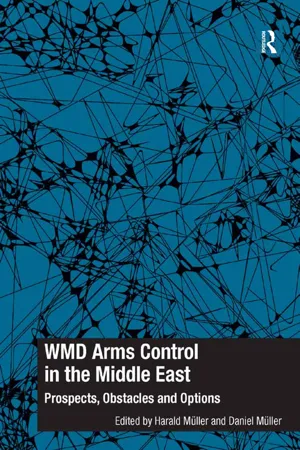
The Middle East is a hot spot of proliferation. It contains one state assumed to possess nuclear weapons, several states that tried and failed to develop a military nuclear capability, one state under suspicion of trying to do so, and it is the world region that witnessed the most frequent and severe employment of chemical weapons since the end of World War I. Notwithstanding, not a single arms control regime concerning weapons of mass destruction (WMD) covers the region as a whole. Instead we have seen several proliferation-related military operations which have rather contributed to destabilization than served non-proliferation. This volume, written under the auspices of the EU Consortium for Non-Proliferation and Disarmament determines the current state of diplomatic efforts to establish a WMD free zone in the Middle East. In doing so, it provides insights into central actors' conflicting political positions, thereby explaining the stalemate of efforts to negotiate a WMD-free zone. Chapters written by renowned experts from academia and policy-oriented think tanks, as well as by next-generation Middle East and arms control experts, introduce the subject to the reader, give background information about arms control initiatives, provide technical expertise, and endeavour to make proposals for arms control measures in support of the creation of a Middle East WMD-free zone.
Information
PART I
Setting the Stage
Chapter 1
The Regional Security Environment and Basic Principles for the Relations of the Members of the Zone
Nabil Fahmy1
The 1995 Review and Extension Conference of the Treaty on the Non-Proliferation of Nuclear Weapons (NPT) was able to adopt its decision to indefinitely extend the treaty without a vote only because it also adopted a parallel resolution on the Middle East region calling for, inter alia, ‘practical steps in appropriate forums aimed at making progress towards, inter alia, the establishment of an effectively verifiable Middle East zone free of weapons of mass destruction, nuclear, chemical and biological’ (NPT, 1995). Consequently, one should not forget or ignore the salience of this resolution, which was sponsored by the three depositaries of the NPT: The United States, Russia, and the United Kingdom. Equally significant is that the Middle East was the only region in the world on which a resolution was adopted, which was testimony to the concern of the NPT state parties over nuclear proliferation developments in the region.
None of this is coincidental. The issue of non-proliferation of nuclear weapons has been a topic of great consequence in the Middle East since the 1950s. Several countries, including Egypt, Israel and Iran, have unilaterally planned or have run nuclear weapons programs. When the NPT was opened for signature in 1968, Israel declined to sign the treaty and Egypt signed but conditioned its ratification upon Israel’s full adherence to the treaty. Several other Arab countries did the same. Over the years, every state in the Middle East, except for Israel, ratified its adherence to the NPT but, nevertheless, concerns over nuclear non-proliferation and nuclear weapons in the Middle East remain paramount. Reports have emerged in the past about the non-compliance of Iraq and Iran with their non-proliferation obligations and of a rather bizarre attempt at producing weapons of mass destruction in Libya, over and above what may or may not have happened in Syria. While, in addition, it appears that Israel has continued to expand its nuclear weapons arsenal despite Egypt and Jordan signing a peace agreement with Israel, as well as the destruction of Iraq’s military infrastructure, both of which have negated any serious potential for a full-fledged Arab–Israeli war or existential threat. Israel, the country reported to have the largest nuclear arsenal in the region, still remains outside the NPT. Over the last few decades, while the number of adherents to the NPT has increased in the Middle East, the tensions caused by military asymmetries and regional conflicts have placed the commitments made by NPT members to their treaty obligations under considerable stress. This is particularly true given that the security concerns of Middle Eastern NPT parties have not been adequately addressed in the nuclear domain.
The proposal to free the Middle East from nuclear weapons was first introduced by Iran and Egypt at the 1974 United Nations General Assembly. Thirty-eight years have passed since the adoption of that proposal, which has frequently received the unanimous support of the international community, irrespective of some less than nuanced caveats about when it could enter into force. This foundational proposal was complemented but not replaced by another Egyptian proposal in 1990: to create a weapons of mass destruction-free zone (WMDFZ) in the Middle East (MEWMDFZ). The longevity of these proposals indicates, I believe, that the international community overwhelmingly supports their objectives and is seriously concerned about the deterioration of non-proliferation efforts in the Middle East. The 2010 NPT Review Conference decision, which called upon the three depositaries and the Secretary-General of the United Nations to convene a conference by 2012 to discuss implementation of its 1995 resolution, constitutes a call for action if we, as a community, are truly interested in safeguarding the Middle East and the international community from the dangers of the proliferation of these weapons in the region. It also presents a valuable opportunity to address these core challenges to Middle Eastern security. Further procrastination in dealing with these issues will bring into question the credibility of the NPT itself.
It is rather ironic that, today, some argue for a delay in the process because of the political transformations occurring, most notably in the Arab Middle East. Many of the same protagonists of this opinion have, at one point, argued that they could not deal with this issue as long as existential threats existed – threats that were removed by the Egyptian and Jordanian peace agreements with Israel – or the existence of authoritarian regimes, which raised questions about the commitment of the peoples of the region to these international obligations. Yet now, they continue to object to even the beginning of a process that, while urgent, will most likely conclude well after stabilization of the domestic political situations in the Arab Middle East. Even if that is not the case, the example of the Tlatelolco Treaty in Latin America, which was negotiated between states with different degrees of democratic development and which entered into force gradually as members of the region found it in their interests to do so, clearly demonstrates that a diplomatic path towards nuclear non-proliferation exists, despite domestic uncertainties.
For all these reasons and many more, I see no merit whatsoever in postponing further the commencement of a process of negotiations to free the Middle East from nuclear weapons and other weapons of mass destruction. Ultimately, states in the region, based on their appraisal of the political and security environment, will have to agree on the Entry into Force clauses when and if they decide to join the proposed treaty. Needless to say, however, these decisions will not even be considered if the actual content of the treaty has not been determined. This is yet another reason not to delay the commencement of a serious process of negotiations or, perhaps even more importantly, not to disrupt it at any point due to changing political circumstances. In fact, the negotiating process is in itself a vital confidence-building measure between states in the region. And I strongly caution that not embarking on it would, in fact, have negative ramifications on any attempt to generate confidence between the regional parties.
In light of the above, I will focus on what principles should serve as guidelines for states in the region now and, when the zone is established, on what the conference ‘on the establishment of a Middle East zone free of nuclear weapons and all other weapons of mass destruction’ as scheduled by the consensus document of the 2010 NPT Review Conference to be held in 2012 should conclude with, and will furthermore suggest different kinds of confidence-building measures that can be adopted by states in the region before, during, and after the conference.
Principles and Parameters
The question of principle and moral responsibility is one that often seems secondary in the fraught realpolitik of international relations. It is empty rhetoric, put there only to cushion the harder practicalities of negotiated compromise. However, the moral principle of an international agreement must, in fact, be its defining characteristic. If any security agreement aspires to lasting success it must hold states to a clear ideal and it must ensure that the states themselves fully and honestly subscribe to that ideal. In the context of the Middle East and the creation of a nuclear-weapon-free zone (NWFZ) there, such adherence to a clear set of principles regarding arms control and collective security is doubly important to the project’s success. Any state that is party to a NWFZ must take to heart the mandate to ‘maintain international peace and security’ through ‘effective collective measures’ enumerated in the first article of the Charter of the United Nations (UN, 1945). Similarly, all presumptive states should unwaveringly commit themselves to refrain from the acquisition, transfer, and use of nuclear weapons enshrined in the preamble and the opening articles of the NPT. No NWFZ, or a zone restricting weapons of mass destruction (WMD), can function on a basis falling short of this fundamental commitment.
Today, the international community focuses most on Iran’s suspect nuclear program, while the non-compliance of countries such as Iraq, Libya, and Syria with international arms control regimes has been similarly emphasized over the last few decades. Such non-compliance with treaty obligations cannot and should not be accepted. However, we must not forget the burden placed on any regional arms control effort by Israel’s alleged nuclear arsenal, its refusal to submit to the NPT, and its insistence on quantitative and qualitative military superiority over its neighbours. In any non-proliferation agreement, whether it be the NPT, the Chemical Weapons Convention (CWC), the Biological Weapons Convention (BWC), etc. the clear objective is to prohibit and prevent use and acquisition of these weapons. If a country wants to be a part of the international community, then it must take action towards these provisions, even if it is not a member state of one or all of the agreements. In other words, we cannot hope to achieve any WMD-free zone in the Middle East if one or more of the vital partners are in moral or actual violation of the already existing concepts and principles that guide non-proliferation and arms control and today constitute basic international norms recognized in this region.
Consequently, the basic set of foundational commitments for the negotiating process towards the creation of a Middle East nuclear-weapon-free zone (MENWFZ) or a MEWMDFZ should, inter alia, include, first, a commitment to the pursuit of security through collective security measures and, second, a commitment to equal security for all states of the region. Through these commitments, the states should be tacitly agreeing to the overarching objectives of a conference: increased security for the nations of the region and the assumption that security can only be achieved through peaceful relations, dialogue, and political arrangements; the logic of discarding the current imbalance for the establishment of a qualitative and quantitative balance between the military capabilities of regional players; and the conclusion of agreements on arms reduction and disarmament with effective monitoring measures enshrining equal rights and responsibilities between all party nations is imperative.
The long-term objectives suggested here must also be accompanied by the recognition of a set of short-term priority objectives. These are the banishment of all weapons of mass destruction from the Middle East, the prevention of an intensive arms race in the region, and achieving a high degree of military transparency in all weapons systems, particularly those utilizing advanced or devastating technologies.
Furthermore, for the negotiating process itself to have any potential for success, the parties should openly commit, a priori, as part of a NWFZ or WMDFZ to promise, at minimum, to:
1. Renouncing the acquisition, transfer, and use of nuclear weapons and other weapons of mass destruction
2. Ensuring that the regional and provisional agreements would be consistent with the relevant international disarmament agreements, but complementing them when necessary
3. Ensuring that the arrangements for ridding the region of these weapons would be achieved with the agreement of the respective states of the region.
Objectives of a Middle East Conference on Creating a MENWFZ
With this in mind, the first objective of a Middle East Conference should be to produce an unequivocal declaration in support of a MENWFZ without caveats or condition. The second objective should be to bolster rhetoric with the commencement of a negotiation process that is completely inclusive and leaves nothing that is directly relevant off the table, in terms of either topics or members. The conference, however, should remain focused on nuclear weapons for two reasons. The nuclear issue is the most pertinent and divisive topic in regional arms control, one which presents an urgent, and potentially devastating, threat to Middle Eastern security as a whole. Progress on a MENWFZ should, as a logical consequence, kick-start negotiating processes on the further regulation of chemical, biological, and other weapons of mass destruction. Many of the issues that stymie progress on these weapons touch on the same grievances that have blocked progress on a MENWFZ for nearly fifty years – for example, Egypt refuses to ratify the CWC until Israel ratifies the NPT – and, if those issues can be addressed by the nuclear process, then that should stimulate progress on the WMD front. It has also been argued that, since conventional weapons constitute the bulk of the weapons systems available in the Middle East, they should be dealt with first. However, it is for that very reason that it is unreasonable to expect any progress in the arms limitation process if conventional weapons are given priority because, as long as the Arab–Israeli conflict remains unresolved, neither side is likely to consider real change in such arsenals. Weapons of mass destruction on the other hand, especially nuclear weapons, pose a direct and imminent threat to regional security. For that reason, they must be our immediate concern at the upcoming conference.
Scope of Prohibition, Geographic Scope, a Verification System and the Relationship with International Systems
The conference should create something of a roadmap for the nuclear zone, and lay the groundwork for the requisite WMD treaties and arrangements. There are six questions in particular for which the conference will need to provide some clarity or create a process for clarity to be worked out afterwards. They can be best addressed through the establishment of parallel negotiating working groups to commence at, or immediately after, each respective Middle East Conference.
First, clear guidelines for the scope of prohibition within the zone should be set. For instance, some suggest that the NWFZ should include prohibitions against peaceful nuclear testing, others do not. Another question is whether the treaty will cover research an...
Table of contents
- Cover
- Half Title
- Title Page
- Copyright Page
- Table of Contents
- List of Tables
- Contributors
- Foreword
- Preface
- Acknowledgments
- Abbreviations and Acronyms
- Introduction
- Part I Setting the Stage
- Part II Arms Control Approaches in the Middle East: Taking Stock
- Part III Assessing Regional Capabilities, Challenges and Opportunities
- Part IV Arms Control and Regional Security Matters
- Part V In Lieu of Conclusion
- Index
Trusted by 375,005 students
Access to over 1.5 million titles for a fair monthly price.
Study more efficiently using our study tools.
Frequently asked questions
Yes, you can cancel anytime from the Subscription tab in your account settings on the Perlego website. Your subscription will stay active until the end of your current billing period. Learn how to cancel your subscription
No, books cannot be downloaded as external files, such as PDFs, for use outside of Perlego. However, you can download books within the Perlego app for offline reading on mobile or tablet. Learn how to download books offline
Perlego offers two plans: Essential and Complete
- Essential is ideal for learners and professionals who enjoy exploring a wide range of subjects. Access the Essential Library with 800,000+ trusted titles and best-sellers across business, personal growth, and the humanities. Includes unlimited reading time and Standard Read Aloud voice.
- Complete: Perfect for advanced learners and researchers needing full, unrestricted access. Unlock 1.5M+ books across hundreds of subjects, including academic and specialized titles. The Complete Plan also includes advanced features like Premium Read Aloud and Research Assistant.
We are an online textbook subscription service, where you can get access to an entire online library for less than the price of a single book per month. With over 1.5 million books across 990+ topics, we’ve got you covered! Learn about our mission
Look out for the read-aloud symbol on your next book to see if you can listen to it. The read-aloud tool reads text aloud for you, highlighting the text as it is being read. You can pause it, speed it up and slow it down. Learn more about Read Aloud
Yes! You can use the Perlego app on both iOS and Android devices to read anytime, anywhere — even offline. Perfect for commutes or when you’re on the go.
Please note we cannot support devices running on iOS 13 and Android 7 or earlier. Learn more about using the app
Please note we cannot support devices running on iOS 13 and Android 7 or earlier. Learn more about using the app
Yes, you can access WMD Arms Control in the Middle East by Harald Müller in PDF and/or ePUB format, as well as other popular books in Politics & International Relations & International Relations. We have over 1.5 million books available in our catalogue for you to explore.