- 208 pages
- English
- ePUB (mobile friendly)
- Available on iOS & Android
eBook - ePub
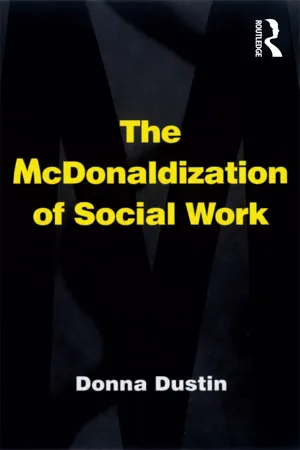
The McDonaldization of Social Work
About this book
Based upon George Ritzer's McDonaldization of Society thesis and incorporating aspects of social theory, this book examines the introduction of care management to social work practice. Donna Dustin analyzes care management as an example of the managerial application of efficiency, calculability, predictability and control to social work practice. These principles, put to good use in organizations that produce tangible outputs at a profit, are being increasingly applied in non-profit public sector organizations where the outcomes require intangibles such as professional relationships. The author examines whether the McDonaldization process heightens dilemmas such as cost versus rights for professionals working in the social services. Using social theory to frame her research with care managers and their managers in the UK, the author examines the day-to-day implications of care management for social work practice and questions whether the construction of service users as customers contributes to empowering practice. The book's in-depth analysis of the policy background, implementation and practice of care management will resonate with social workers in other national contexts, such as the US, where the care management model has been introduced.
Information
PART I THE MACRO PERSPECTIVE
Understanding the Introduction of Care Management – Theory and Context
Introduction to Part I – Chapters 1 and 2
A social theory ‘macro’ perspective is adopted in Part I to examine the phenomenon of ‘care management’, as it is referred to in Britain, or what is called ‘case management’ in the US. Chapter 1 presents a social theory/social policy framework for understanding the social and political changes associated with the introduction of care management. Globalization implies that we live in a diverse, postmodern world. Yet measures such as care management are modern, rational ways to measure input and output in service delivery systems and contain cost. Management itself is analysed in terms of perspectives within management theory because management has become central to the operation of care management.
An analysis of care management using social theory is part of an effort to develop a ‘synthetic analysis of contemporary social developments’ (Seidman 1992, 72) by employing a number of theoretical frameworks to examine the large scale social trends that have led to their development. This perspective takes into account the way in which history, culture, social policy, monetarist economics, neo-liberal politics and NMP principles intersected, leading to the imposition of care management on social work practice in Social Services Departments (SSDs) in England, initially in work with adults, but increasingly in work with children. This ‘macro’ analysis is balanced against the results of ‘micro’ qualitative research, discussed in Part II, which was carried out to assess the day to day impact on social workers who practice as care managers.
In Chapter 2, care management is placed in an international perspective. Care management originated in the Unites States and has been introduced in a range of English-speaking countries. The implications of the care management model of service delivery for social workers in the UK are considered. Its introduction in the national structures of UK local government social services systems has had far reaching implications.
Chapter 1 Theorizing Social Change
DOI: 10.4324/9781315555676-3
Introduction
In this chapter, theoretical perspectives on the broad social changes that have led to care management are explored. The influence of wider social changes on the organizations that deliver social welfare services both in the UK and elsewhere begins with a discussion of social theory per se. These changes, including the rise of New Right politics, the quasi-market state and New Public Management (NPM) have contributed to the creation of the care-management role, which has had a direct impact on social work practice in local government organizations, which are called local authority Social Services Departments (SSDs) in the UK. It is argued that with the escalation of capitalist pressures and the globalization of culture (Kellner 2007), the introduction of care management to social work practice will spread and its influence on social work practice will extend beyond the US and the UK (George 1998, 28).
Consistent with this definition of social theory, a ‘multiperspectivist’ approach (Kellner 1999, 186) is employed to analyse how care management as social policy and a model of welfare provision emerged, how it came to take the forms it has and the relationships between policies and programmes in the UK (O'Brien and Penna 1998, 6). The perspectives employed to study the implementation and the practice of care management include the history of social welfare provision and aspects of social policy, social theory and management theory. Social policy refers to ‘principles and practices of state activity … relating to redistribution in pursuit of welfare’ (Miller 1999, 14). Social theory studies the way that social change affects our everyday lives (Miles 2001, 2) so it is an active process, a means to an end, and a way of theorizing what is happening around us (Miles 2001, 163). Like Miles (2001, 2), I do not consider myself a social theorist. However, I believe that concepts from social theory can illuminate social work issues. Social theory should inform social work and social work should inform social theory (Lovelock et al., 2004, 16). Social theory contributes to the analysis of care management, and conversely, a study of the application of care management to social work practice offers insights for social theory.
The relevance of social theory to social work is discussed first. The characteristics of modern and postmodern discourses are explored. The concept of a discourse, defined as ‘a set of ideas, practices and beliefs which coalesce to produce an overarching picture of reality’ (Symonds and Kelly 1998, 8) is useful because it conveys the idea that social reality can be constructed in different ways at different historical points in time. It is argued that there is a relationship between postmodernity as late capitalism and New Right politics. The relationship between managerialism inherent in care-management models of service delivery and professionalism is discussed. At the level of the organization, the parallel concepts of Fordism/post-Fordism will be applied to SSD organizations. Two contrasting management theories, Theory X and Theory Y, will be defined and explored in relation to understanding the management of care managers. It will be argued that the concept of McDonaldization contributes to an understanding of the changes in SSDs because it postulates that modern Fordist management methods developed in the industrial sector have been applied to non-industrial sectors to enhance efficiency, predictability, calculability and control of service provision (Ritzer 1996).
The Relevance of Social Theory to Social Work
The value of social theory, from a social work perspective, is that it is applied. Social work is an applied activity which draws on sociology. However, some find classical sociological theories difficult to apply to social work practice. These theories seem ‘distant from everyday reality and appear to exist on an abstract and remote plane where the ability to theorize appears to be more important than the relevance of the theory itself’ and where ‘theorists appear to belong to a club from which the rest of us mere mortals are barred’ (Miles 2001, 2). Social theory is concerned with issues such as globalization and postmodernity, which were not, by definition, concerns of classical sociological theorists such as Durkheim, Marx, Parsons and Weber. Social theory is current, grounded and relevant and can therefore make a contribution to understanding the context of their work current changes.
Social theory refers to the use of complex theoretical frameworks to analyse macro social structures. It is interdisciplinary and can include economics, history and philosophy. It examines and interprets the meaning of large scale trends. It focuses on social forces in society. Social theory is therefore relevant to an analysis of care management because the introduction of care management as a model of social services delivery has arisen out a complex combination of historical influences, globalization and political thinking. Social theory is linked to the concept of the sociological imagination that interprets the meaning of social facts (Mills 1959). Current social theorists such as Jameson and Ritzer draw upon and apply insights from classical sociologists such as Marx and Weber to make current social developments understandable to those not trained in classical sociology.
Ritzer (1996) has applied Weber's theory regarding the ‘iron cage’ of bureaucracy to an analysis of service industries, introducing the term ‘McDonaldization’ to describe the growing tendency to apply rational bureaucratic measures to businesses that provide tangible services in the areas of food, health, leisure and travel. The ‘McDonaldization’ concept will be applied to an analysis of the rise of care management as an intensification of Weber's bureaucratic principles applied to organizations that provide social care services.
Ritzer's thesis is used in this book to analyse the impact of care management as a model of service delivery on social work practice with further implications for the profession itself. The relationship between current social work practice and McDonaldization has been observed by social work authors (James 2004, Parton 2004, 36–37). The McDonaldization thesis will be applied to an analysis of care management as ‘part of a historical tradition in which social theory is used to critique society and thereby provide the base for its betterment’ (Ritzer 1993, xiii in Kellner 1999, 203).
Issues of ethics and social justice are an accepted part of social theory, in contrast to classical sociology, which is intended to be ‘scientific’ and ‘rational’. Sociologists can never be completely objective because they are part of the social phenomenon they are studying, unlike physicists or geologists. Social theorists accept bias, but are aware of its effects, which is more realistic than a claim to objectivity. The application of social theory, as exemplified by Ritzer with his McDonaldization thesis, allows the non-sociologists to apply social theory.
The benefit of social theory lies in its potential for shedding light upon circumstances that are often taken for granted (Miles 2001, 163). It makes insights drawn from classical sociology immediately useful to those experiencing social change. It is hoped that the application of social theory to an analysis of care management will provoke debate about issues that otherwise might be taken for granted and thus contribute to reflective practice among practitioners in social care settings and managers of these services.
Modernity and Postmodernity
Although the terms ‘modern’ and ‘postmodern’ are now commonplace in contemporary social science, the meaning of these concepts is contested (O'Brien and Penna 1998, 186). Most writers link the emergence of modernity to the rejection of magic, traditional or religion as forms of social authority characteristic of pre-modern or traditional societies (Katz 1996). Modernity was marked by the growth of scientific enquiry and a valorization of rationality as the organizing principle for social life in the 1700s with the Age of Enlightenment (Rosenau 1992, 5; Taylor-Gooby 1989, 389; Howe 1994, 513). The main features of modernity are a belief that history has a direction and purpose or teleology, an attempt to develop universal categories of experience, representation and explanation through theory or metanarratives, a valuing of reason as the basis of all activity, and a belief that the nation state has a role to play in improving society (Parton 1994, 27).
Modernity has been characterized by a search for truth, that is, universally valid foundations for human knowledge and action based on rationality and science, referred to as positivism or empiricism. A contrasting postmodern position is that truth and meaning are context-dependent and predictable from a particular horizon or point of view, referred to as interpretivism. The belief that knowledge can be applied to achieve social progress is central to modernity (Sheppard 2006, 61). The problem with modernity is that it has not been able to deliver on its promise to improve society or make the world a better place. ‘The modern project has not so much been abandoned or forsaken by the tide of history … as substantially devalued and discredited by the very development of modernity itself. The erosion of confidence, of trust and faith, in its core assumptions and objectives has been a direct consequence of modern practices and their uneven effects’ (Smart 2000, 457). The ‘postmodern’ is associated with the perspective that modernity has not brought the progress it promised. The myth that knowledge would bring emancipation is no longer believed (Lyotard 1984; xxiv in Seidman 1992, 345). Instead modernity has brought with it the efficiency of the killing in the Holocaust (Bauman 1989, 13), the degradation of the environment.
The postmodern can be divided into the intellectual postmodern and the material postmodern (Wilson 1998). The intellectual postmodern is referred to as ‘postmodernism’ and refers to changes in ways of thinking about or understanding the world. Postmodernism is ‘a particular shift in theory and analysis, which is itself part of the condition’ (Williams 1992, 204–5), most importantly, a challenge to the possibility of absolute knowledge in the area of the social ‘sciences’. Social work has drawn upon the social sciences and therefore postmodernism is relevant to social work knowledge. In the modern era, social work knowledge was drawn eclectically from a range of metanarratives, both sociological and psychological or psychiatric, all of which are now subject to challenge. In care-management practice, issues of theory and ‘knowing’ have been challenged by the practical necessity to purchase services at the lowest price within the quasi-markets of care.
The material postmodern is referred to as postmodernity and encompasses current conditions and changes that are taking place such as globalization, the information technology revolution and the triumph of market capitalism, fragmentation and superficiality. It is synonymous with Jamison's (1984) ‘culture of late capitalism’. The term postmodernity refers to the political and economic condition in which social work is currently practised (Fawcett and Featherstone 1998, 68; Penna and O'Brien 1996; O'Brien and Penna 1998, 136; Ginsburg 1998, 26).
Material postmodernity, that is, ‘a condition – a set of changes, transitions and processes perceived to be taking place at the social, political, economic and cultural level’ (Williams 1992, 204–5) is the most relevant concept to use when analysing care management because it encompasses the material changes that have occurred at the level of the organization of social welfare services. Some reference will be made to elements of postmodernism because postmodernism, which implies different ways of thinking, has contributed to changes in t...
Table of contents
- Cover Page
- Half Title Page
- Title Page
- Copyright Page
- Table of Contents
- Acknowledgements
- Glossary of Terms
- Introduction
- Part I The Macro Perspective: Understanding the Introduction of Care Management – Theory and Context
- Part II The Micro Perspective: Social Workers’ Perceptions of their Care Management Role – Findings from Research
- Part III Considering the Macro and the Micro: Looking Back – Looking Forward
- Bibliography
- Index
Trusted by 375,005 students
Access to over 1.5 million titles for a fair monthly price.
Study more efficiently using our study tools.
Frequently asked questions
Yes, you can cancel anytime from the Subscription tab in your account settings on the Perlego website. Your subscription will stay active until the end of your current billing period. Learn how to cancel your subscription
No, books cannot be downloaded as external files, such as PDFs, for use outside of Perlego. However, you can download books within the Perlego app for offline reading on mobile or tablet. Learn how to download books offline
Perlego offers two plans: Essential and Complete
- Essential is ideal for learners and professionals who enjoy exploring a wide range of subjects. Access the Essential Library with 800,000+ trusted titles and best-sellers across business, personal growth, and the humanities. Includes unlimited reading time and Standard Read Aloud voice.
- Complete: Perfect for advanced learners and researchers needing full, unrestricted access. Unlock 1.5M+ books across hundreds of subjects, including academic and specialized titles. The Complete Plan also includes advanced features like Premium Read Aloud and Research Assistant.
We are an online textbook subscription service, where you can get access to an entire online library for less than the price of a single book per month. With over 1.5 million books across 990+ topics, we’ve got you covered! Learn about our mission
Look out for the read-aloud symbol on your next book to see if you can listen to it. The read-aloud tool reads text aloud for you, highlighting the text as it is being read. You can pause it, speed it up and slow it down. Learn more about Read Aloud
Yes! You can use the Perlego app on both iOS and Android devices to read anytime, anywhere — even offline. Perfect for commutes or when you’re on the go.
Please note we cannot support devices running on iOS 13 and Android 7 or earlier. Learn more about using the app
Please note we cannot support devices running on iOS 13 and Android 7 or earlier. Learn more about using the app
Yes, you can access The McDonaldization of Social Work by Donna Dustin in PDF and/or ePUB format, as well as other popular books in Social Sciences & Sociology. We have over 1.5 million books available in our catalogue for you to explore.