- 184 pages
- English
- ePUB (mobile friendly)
- Available on iOS & Android
eBook - ePub
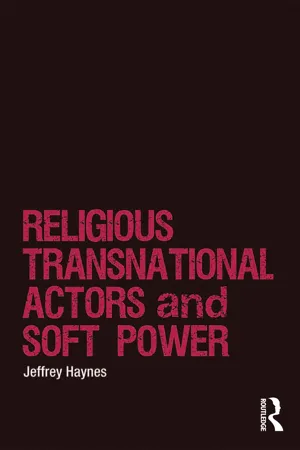
Religious Transnational Actors and Soft Power
About this book
Haynes looks at religious transnational actors in the context of international relations, with a focus on both security and order. With renewed scholarly interest in the involvement of religion in international relations, many observers and scholars have found this move unexpected because it challenges conventional wisdom about the nature and long-term historical impact of secularisation. The 'return' of religion to international relations necessarily involves deprivatisation. Recent challenges to international security and order emanate from various entities, notably 'extremists', people often said to be 'excluded' from the benefits of globalisation for reasons of culture, history and geography. This study looks at the dynamics of this new religious pluralism as it influences the global political landscape. Several specific transnational religious actors are examined in the chapters including: American Evangelical Protestants, Roman Catholics, the Organisation of the Islamic Conference, Sunni extremist groups (al Qaeda and Lashkar-e-Taiba), and Shia transnational networks. While varying widely in what they seek to achieve, they also share an important characteristic: each seeks to use religious soft power to advance their interests. In sum, these religious transnational actors all wish to see the spread and development of certain values and norms, which impact on international security and order.
Information
Chapter 1
Religious Transnational Actors and Soft Power
The aim of this book is to examine selected religious transnational actors (RTAs) in international relations, with a focus on both security and order.
Our starting point is renewed scholarly and policy interest in religion in international relations, focusing on both state and non-state actors. More generally, religion’s renewed political significance is notable among many cultures and religious faiths in countries with various levels of economic development and political system. For many observers and scholars this development was unexpected. Religious deprivatisation – that is, the generalised ‘return’ of religion to the public realm – challenged conventional wisdom about the nature and long-term historical impact of secularisation, calling into question a core presumption of Western social science. It was long assumed that, as societies modernise, they invariably secularise, with consequential effects for religion, which becomes publicly marginalised – or, ‘privatised’ – and excluded from the public realm.
Domestically, the return of religion to the public realm implies a renewed political voice for religion, with profound impacts on political outcomes in a number of countries, including Iran, Poland, the USA and India. Internationally, the ‘return’ of religion to international relations has had major – and continuing – implications for international security and order, clearly illustrated by the notorious September 11, 2001, (‘9/11’) attacks on the USA. Many such challenges to international security and order emanated from Islamic ‘extremists’, people often said to be ‘excluded’ from the benefits of globalisation for reasons of culture, history and geography. Certainly, over the last decade or so, Islamic extremist pathologies have presented themselves in various order-challenging forms, including not only the 9/11 assault on the USA, masterminded by al Qaeda which led to nearly 3,000 deaths, but also, inter alia, the November 2008 atrocity in Mumbai, perpetrated by Pakistan-based Lashkar-e-Taiba, which killed 170 people in the attack on and siege of the Taj Hotel.
More generally, scholarly, popular and policy interest in the involvement of religion1 in international relations has increased in recent years. Contemporary globalisation is a key factor encouraging religious transnational actors of various kinds – both benign and malign – to involve themselves in cross-border issues (Thomas 2005; Haynes 2007). On the one hand, some people involved in religious transnational networks – such as al Qaeda and those influenced by the organisation’s radical ideas – are said to be ‘excluded’ from the benefits of globalisation for reasons of culture, history and geography. More generally, globalisation facilitates increased links between many kinds of state and non-state actors, both religious and secular. Geographical distance or international borders are no longer insuperable barriers to communication. As Peter Beyer (1994: 1) noted nearly 20 years ago: ‘We now live in “a globalizing social reality”, one in which previously effective barriers to communication no longer exist’. For all religious transnational actors, globalisation theoretically increases their ability to spread their messages and to link up with like-minded groups across international borders. In addition, over the past two decades or so, global migration patterns have also helped spawn more active religious transnational communities (Cesari 2010). The overall result is that cross-border links between various religious actors have recently multiplied, and, in many cases, so have their international and transnational concerns (Rudolph and Piscatori 1997; Haynes 2001, 2009; Fox and Sandler 2004; Thomas 2005). In short, according to Banchoff (2008), globalisation leads to more active religious transnational communities, creating a powerful force in international relations.
Such issues are contextualised by the recent international focus on democratisation and democracy; which ultimately seeks to extend cooperation and reduce conflict. The Roman Catholic Church was especially noteworthy in this context in the 1980s and 1980s. The Church – or more accurately, its organisational and diplomatic head, the Vatican – encouraged authoritarian regimes to democratise in parts of the world where the Catholic Church had considerable influence, including many Latin American countries, parts of Central and Eastern Europe, especially Poland, and several African countries, including Benin, Togo and Zaire (now Democratic Republic of Congo).
On the other hand, the actions of jihadi transnational organisations, such as al Qaeda and Lashkar-e-Taiba, author of the November 2008 atrocities in Mumbai, are based squarely on a conflictual view of the world. Jihadi transnational organisations, unlike Islamist-nationalist groups such as Hamas, see even local and regional conflicts, such as the ongoing insurgencies in Yemen and Somalia, as aspects of a wider international conflict whose goal is to establish an Islamic state (khalifah), although for practical reasons it would probably be sub-divided regionally.2 Jihadi transnational organisations, such as al Qaeda, explicitly reject and seek to undermine foundational norms, values, institutions and rules that underpin international order and its key institutions, such as the United Nations and leading states, such as the United States (Haynes 2005). As a result, they offer a competing logic to the sovereignty-based state system and seek to undermine and eventually replace (Sunni) Muslims’ national allegiances (Rudolph and Piscatori 1997: 12). Jihadi transnational organisations’ capacity for destabilisation was highlighted in the 2005 Human Security Report, which noted that ‘[i]nternational terrorism is the only form of political violence that appears to be getting worse. Some datasets have shown an overall decline in international terrorist incidents of all types since the early 1980s, but the most recent statistics suggest a dramatic increase in the number of high-casualty attacks since the September 11 attacks on the US’.
Jihadi transnational organisations rarely control territory for long – although the Taliban government in Afghanistan (1996–2001) did allow Osama bin Laden and al Qaeda considerable freedom of movement in the country until overthrow by the US-led bombardment and subsequent invasion. More generally, ‘failed’ states, such as Somalia, and ‘failing’ states, such as Pakistan, facilitate formation and development of jihadi transnational organisations because the state is too weak to prevent it. This allows such organisations increased freedom of action, including Lashkar-e-Taiba in Pakistan. The overall point is that jihadi transnational organisations seek to exploit the circumstances of failed and failing states in order to try to achieve their objectives. Their success or failure is not linked to their ability to command significant military resources; as they do not have them in any meaningful sense. Instead, their ability to advance their cause and achieve the khalifah is largely dependent on their ability to convince putative followers of the appropriateness of their goals. To do this, they need to increase and utilise their resulting soft power.
Various transnational religious actors – including the Roman Catholic Church, al Qaeda and Shia networks in the Middle East – are of importance in current international relations.3 Some transnational religious actors affect international order and security, especially networks of Islamic extremists and terrorists. Extremist pathologies present themselves in various order-challenging forms, including the 9/11 outrages in the USA, the 7 July 2005 (‘7/7’) bombings in London and the deadly assault on the Taj Hotel in Mumbai, India, undertaken by Lashkare-Taiba in November 2008. Note, however, that this is certainly not to imply that all Islamic transnational actors have ambitions to challenge international security or that they are all extremists.
The recent rise of Islamic extremism has helped to stimulate, more generally, a focus on religious transnational actors, their political demands and order-challenging potential and propensities. The 9/11 and Mumbai attacks helped to reignite the long-running debate on the ‘clash of civilisations’ controversy, yet at the same time tended to obscure the contours and characteristics of a new religious transnational landscape marked by polarisation: on the one hand, intercivilisational conflict, and, on the other, interreligious cooperation, with a focus on human rights and improved development.
Increased religious transnational activities are stimulated by globalisation and especially the accompanying communications revolution. This is a key factor in encouraging the current dynamic growth and development of religious transnational networks. In addition, global migration patterns over the past two decades or so have also helped spawn more active religious transnational communities. The overall result of these developments – religious deprivatisation, globalisation and more active religious transnational religious networks – is a new religious pluralism that impacts upon international relations in two key ways. First, it has led to ‘global religious identities’, whereby people feel themselves part of religious transnational communities in new and important ways which may lead to increasing interreligious dialogues, involving greater religious engagement around various issues, including international development, conflict resolution and transitional justice. On the other hand, this globalising environment also provides an opportunity to encourage increased interreligious competition which often takes on political connotations.
This introductory chapter has several objectives. First, it examines the nature and characteristics of religious transnational actors. Second, it looks at the concept of religious transnational soft power. Third, it discusses how religious transnational soft power can influence international outcomes. Overall, this introductory chapter provides a summary of and entry into the issues examined in the subsequent chapters. The main claim and argument of this book is that the dynamics of the new religious pluralism influence the global political landscape by encouraging the activities of various kinds of religious transnational activities, often with significant impacts upon international security and order. To provide evidence for the claim that: (1) religious transnational actors are increasingly influential in international relations, and (2) what they do is often important for international security and order, several specific religious transnational actors are examined in the following chapters, including American Evangelical Protestants, the Roman Catholic Church, the Organisation of the Islamic Conference,4 Sunni extremist groups (al Qaeda and Lashkar-e-Taiba) and Shia transnational networks in the Middle East, including Iran and Iraq.
While varying widely in what they seek to achieve, they also share an important characteristic: each seeks to use what I call ‘religious soft power’ to advance their interests. For example, American Evangelical Protestants are often said to be the ‘new internationalists’ who, during the presidency of George W. Bush (2001–2009), championed and pursued an international agenda which focused on improving development, health and religious freedom, especially in the developing world. Earlier, during the 1980s and 1990s, the Roman Catholic Church also increased its transnational influence, notably by encouraging numerous authoritarian governments in various parts of the world – including Latin America, Africa and Eastern Europe – both to democratise and improve human rights, including religious freedom. Transnational Sunni extremist groups, such as al Qaeda and Lashkar-e-Taiba, collectively provide a third example: extremist organisations which have sought to extend their cross-border influence among (Sunni) Muslims by controversial, yet sometimes shrewd, appeals to supposedly universal ‘Islamic values’. Shia transnational groups, on the other hand, do something different: they seek to extend and deepen interlinked religious, social and political objectives in the context of a Middle East region dominated by a jockeying for influence and status between Iran and Saudi Arabia. Although seeking different goals, each of these religious transnational actors lacks conventional power attributes – such as conventional military capacity – and instead relies upon the ability to wield religious soft power in order to help achieve objectives. In sum, these religious transnational actors all wish to see the spread and development of certain values and norms, which impact on international security and order.
Religious transnational concerns illustrate how domestic and international political issues can feed off each other to present significant challenges to international order and security, with religious values and norms of central concern. In addition, the focus on jihadi transnational organisations5 and other Islamist extremist entities has served to reignite the ‘clash of civilisations’ controversy, while serving partially to obscure the wider issue of what transnational religious actors actually seek to achieve. The current struggle between the USA and its allies and transnational jihadism is not a simple clash of Islam versus the West. Instead, it is a competition within Islam between a tiny minority of extremists and a much larger mainstream of moderates. But the USA cannot triumph in the ‘war against terror’ unless the Muslim moderates are victorious. The US needs to use its hard power – especially military capacity – against the hard core extremists, such as al Qaeda: no amount of soft power – non-coercive persuasion and encouragement – alone will do the job. On the other hand, soft power is essential to attract the mainstream and curtail support for the extremists. The US needs to show both cooperation with moderate Muslims and conflict with the extremists. This is also the situation more generally with such religious transnational actors. Observers note that this can be characterised by its dualism, with some religious transnational actors seeking conflict and others, cooperation in order to achieve better outcomes in, for example, human rights and development issues (Haynes 2007). The transnational pursuit of cooperation and conflict is a key factor in encouraging dynamic growth of religious actors’ transnational networks. The overall result is a new religious pluralism that has impacted upon transnational and international relations in two key ways. First, there is said to be the emergence of ‘global religious identities’ that may lead to increasing interreligious dialogues, involving greater religious engagement around various issues, including international development, conflict resolution and transitional justice. On the other hand, this globalising environment can also encourage greater, often more intense, interreligious competition between members of various religious faiths and traditions (Haynes 2007).
Religion’s renewed transnational significance is observable among many cultures and religious faiths and in countries at various levels of economic development. For many observers and scholars, this was unexpected because it challenged conventional wisdom about the nature and long-term historical impact of secularisation, calling into question a core presumption of Western social science: as societies modernise, they invariably secularise, with consequential effects for religion, which is both marginalised and ‘privatised’, excluded from the public realm. Fox (2008) notes, however, that what is actually happening is less clear-cut: secularisation in some areas and sacralisation in others.
What religious transnational actors principally represent is the capacity to influence international relations by their ability to disseminate ideas and values. Such actors are not sui generis; they are not a product of the current phase of globalisation alone. Historically, influential transnational ideas, both religious and secular, have emerged in response to changing domestic and international circumstances. Over the last century or so, we have seen the impact of a range of diverse transnational ideas on international relations, including national self-determination from the second half of the nineteenth century; revolutionary communism following the Bolshevik Revolution in Russia in 1917; Zionism in the first half of the twentieth century leading to the creation of Israel in 1948; anti-colonialism and its close corollary, anti-imperialism, which emerged in Africa and Asia after World War II; anti-racism, building on the civil rights movement in the USA in the 1960s and the anti-apartheid movement in and about South Africa; pan-Africanism, led by Kwame Nkrumah of Ghana until his overthrow by a military coup d’état in 1966; pan-Arabism, briefly significant but which collapsed following the victory of Israel in the 1967 Six-Day War against the Arabs; ‘Afro-Asian solidarity’, which led to the creation of the non-aligned movement in Belgrade in 1961; and, most recently, the development of transnational environmentalism in the wake of climate change controversies, reflected in the cross-border influence of organisations like Greenpeace International (Florini 2000).
Diverse though these transnational ideas are, what they have in common is the capacity to stimulate large numbers people, often across state boundaries, to pursue shared goals. That is, when transnational ideas appeal to large numbers of people around the world then, by virtue of their collective effort, they can influence outcomes significantly. Such ideas’ success or failure does not necessarily depend on their ability to link up with state power. As Thomas (1999: 30) notes, ‘[t]ransnational actors represent – or are seen to represent by individuals and groups in the international community – ideas whose time has come, ideas which increasingly shape the values and norms of the international system’. Note that this does not necessarily imply that such values or norms are necessarily normatively progressive or regressive. They are applicable to a wide range of actors with various motives for action, some of which are widely commended while others are not. What is clear, however, is that transnational actors and the ideas they represent, for good or ill, help to set, mould and influence international agendas and outcomes in various ways (James 2011; Snyder 2011). They do this primarily by adding to the lexicon and vocabulary of debate, providing sources of soft power in international relations, which inform the ideas and development of transnational civil society.
Taken together, the thousands of extant non-state transnational actors – both secular and religious – are collectively conceptualised in international relations as comprising ‘transnational’ or ‘global’ civil society (Glasius, Kaldor and Anheier 2006).6 The concept has three main components. First, like domestic civil society, transnational civil society (TCS) encompasses various, principally non-state, groups with social and/or political goals; groups overtly connected to the state, as well as profit-seeking private entities, such as transnational corporations, are conceptually excluded. Second, such groups interact with each other across state boundaries and are not overtly manipulated by governments, although they might have links. Third, TCS takes a variety of forms; many are secular in orientation, for example an international non-governmental organisation with constituent groups in a number of countries, such as Amnesty International or Human Rights Watch, or an organisation with a presence in various countries, such as the National Democratic Institute or the National Endowment for Democracy (Gagnon 2002: 215–16; Adamson 2002: 191–2). Others are specifically concerned with religious issues, for example the Roman Catholic lay organisation, Opus Dei.
Transnational civil society forms an important aspect of the globalisation t...
Table of contents
- Cover Page
- Title Page
- Copyright Page
- Contents
- List of Tables
- 1 Religious Transnational Actors and Soft Power
- PART 1: TRANSNATIONAL RELIGIOUS ACTORS AND INTERNATIONAL RELATIONS IN AN ERA OF GLOBALISATION
- PART 2: RELIGION, SECURITY AND NATIONALISM
- PART 3: RELIGIOUS SOFT POWER AND FOREIGN POLICY
- Bibliography
- Index
Trusted by 375,005 students
Access to over 1.5 million titles for a fair monthly price.
Study more efficiently using our study tools.
Frequently asked questions
Yes, you can cancel anytime from the Subscription tab in your account settings on the Perlego website. Your subscription will stay active until the end of your current billing period. Learn how to cancel your subscription
No, books cannot be downloaded as external files, such as PDFs, for use outside of Perlego. However, you can download books within the Perlego app for offline reading on mobile or tablet. Learn how to download books offline
Perlego offers two plans: Essential and Complete
- Essential is ideal for learners and professionals who enjoy exploring a wide range of subjects. Access the Essential Library with 800,000+ trusted titles and best-sellers across business, personal growth, and the humanities. Includes unlimited reading time and Standard Read Aloud voice.
- Complete: Perfect for advanced learners and researchers needing full, unrestricted access. Unlock 1.5M+ books across hundreds of subjects, including academic and specialized titles. The Complete Plan also includes advanced features like Premium Read Aloud and Research Assistant.
We are an online textbook subscription service, where you can get access to an entire online library for less than the price of a single book per month. With over 1.5 million books across 990+ topics, we’ve got you covered! Learn about our mission
Look out for the read-aloud symbol on your next book to see if you can listen to it. The read-aloud tool reads text aloud for you, highlighting the text as it is being read. You can pause it, speed it up and slow it down. Learn more about Read Aloud
Yes! You can use the Perlego app on both iOS and Android devices to read anytime, anywhere — even offline. Perfect for commutes or when you’re on the go.
Please note we cannot support devices running on iOS 13 and Android 7 or earlier. Learn more about using the app
Please note we cannot support devices running on iOS 13 and Android 7 or earlier. Learn more about using the app
Yes, you can access Religious Transnational Actors and Soft Power by Jeffrey Haynes in PDF and/or ePUB format, as well as other popular books in Theology & Religion & Politics. We have over 1.5 million books available in our catalogue for you to explore.