eBook - ePub
Careful Eating: Bodies, Food and Care
- 244 pages
- English
- ePUB (mobile friendly)
- Available on iOS & Android
eBook - ePub
Careful Eating: Bodies, Food and Care
About this book
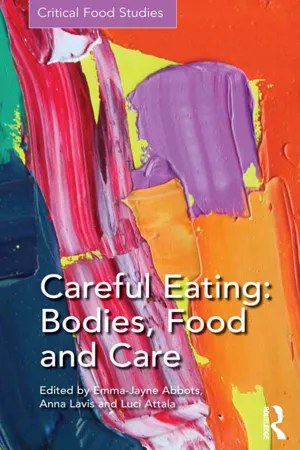
Critically reflecting on the interplays between food and care, this multidisciplinary volume asks 'why do individuals, institutions and agencies care about what other people eat?' It explores how acts of caring about food and eating shape and intervene in individual bodies as well as being enacted in and through those bodies. In so doing, the volume extends current critical debates regarding food and care as political mechanisms through which social hierarchies are constructed and both self and 'other' (re)produced. Addressing the ways in which eating and caring interact on multiple scales and sites - from public health and clinical settings to the market, the home and online communities - Careful Eating asks what 'eating' and 'caring' are, what relationships they create and rupture, and how their interplay is experienced in myriad spaces of everyday life. Taking account of this two-directional flow of engagement between eating and caring, the chapters are organized into three central theoretical dimensions: how eating practices mobilize discourses and forms of care; how discourses and practices of care (look to) shape particular forms of eating and food preferences; and how it is often in the bodies of individual consumers that eating and care encounter one another.
Part I Eating to Care: Proximities and Productions
This opening part explores ways in which the act of eating produces, mobilizes and ruptures dynamics of care. Extending explorations of how individuals care for themselves and Others through their food choices, this part begins the volume’s narrative arc by asking what relationships, discourses and imaginings of care are embedded not only in individuals’ eating practices, but also in the ways they articulate their food preferences vis-à-vis other individuals and social groups. These processes are examined through the diverse contexts of culinary tours, social media debates, and celebrations of traditional food. As such, the central argument that care is a slippery concept that takes multiple forms and guises – and that this slipperiness enables caring to be politically deployed – starts to emerge. The chapters in this part all demonstrate that eating is an act inherently productive of, as well as entangled in, social relations – whether these are between ethnic groups, social classes or just individuals with conflicting views on what comprises ‘good’ food. All elucidate how these relations dynamically take shape through everyday engagement and proximity with Others. In so doing, each points to the ways that eating, eating the Other, and caring about the eating of Others demonstrate and enact relationships of care. In turn, careless eating – that is not eating in preferred manners and adopting foods considered less desirable – is shown to be constructed as a problematic practice that requires intervention and interference in the forms of, for example, health fairs, education and the instigation of online debates. Collectively, then, this part draws attention to the ways in which individuals ingesting careful foods are constituted as more caring than those who do not. In short, to eat (certain foods) is to care (for and about particular people and issues).
By tracing the often fraught and tension-filled nature of these processes, the chapters in this part further examine ways that subjective knowledges of proper eating are overlaid onto particular individuals or segments of society including, for example, ethnic women in the form of hostesses or members of the peasantry. They thereby indicate how particular social groups are expected to eat carefully, and the ways in which this intersects with ethnicity, gender, class, and body size. They further examine how these expectations are both upheld and challenged through social interactions. This part consequently highlights the political dynamics of care, the (moral) authority of the carer, and the eater as carer.
Chapter 1 Multiculturalism as Work: The Emotional Labour of Ethnic Food Tour Guides
DOI: 10.4324/9781315570877-2
Introduction
In this chapter, we examine the complex gendered and racialized politics of caring work performed by guides on Taste Tours, a food-tourism social enterprise. The tours are organized by The Benevolent Society, Australia’s oldest not-for-profit organization and run in southwestern Sydney. They are ‘designed to show the very best of southwest Sydney’s amazing multicultural food traditions’ as a means ‘to bridge cultural divides and build community pride, generate income for local businesses, and create training and employment opportunities’ (The Benevolent Society 2011). Southwestern Sydney has a large migrant population and has long been represented in racist ways in the media and public imaginary (Poynting et al. 2004; White 2004). The tours are presented as attempts at countering such ‘negative perceptions’, thus creating a more ‘caring’ and ‘careful’ image of the region and its people through food.
A diverse organization with approximately 850 staff and 600 volunteers, The Benevolent Society provides a range of services focused on children, older people and women’s health (Michaux 2010). It was established in 1813, only 30 years after the British First Fleet invaded Australia, to ‘promote missionary work and the ‘sacred duties of religion’ (Clarke 2013: np). Originally called the NSW Society for Promoting Christian Knowledge and Benevolence, in 1818 it was renamed The Benevolent Society of NSW, and became a non-religious organization with the remit of providing ‘relief of the poor, the distressed, the aged, and the infirm, and for other benevolent purposes’ (ibid.: np). Since that time the society has extended its service provision to maternity services, home care, child protection, community development and more recently social enterprise activity. It derives most of its funding from government grants, and donors and recently income from social enterprises.
Against this backdrop, Taste Tours has been running for three years as a social enterprise. In essence, this means that the tours are organized as a business with a social purpose. Fee-income is reinvested back into the business and the community. Although somewhat contested, social enterprises are often imagined as more ‘caring’ organizational forms than those which are for-profit (Haugh 2005: 5). Taste Tours is described as ‘designed to give something back to the local community’ (The Benevolent Society 2011).
Failed Multiculturalism
In order to understand the aims of Taste Tours, it is important to know that there has been a longstanding economic and cultural marginalization of southwestern Sydney (Poynting et al. 2004). It has large numbers of migrants and refugees from southern and eastern Europe, Vietnam, the Middle East and Africa; is relatively poor; and is the target of racist and Islamaphobic media and political constructions about ‘ethnic’ violent crime, the ‘criminalized Arab,’ and ethnic young men’s ‘gangs’, such that some major suburbs are portrayed as ‘no-go’ enclaves for Anglo-Celtic Australians (Collins 2009; Dreher 2003; Noble 2009). As a result, there has been a repeated demonization of categories such as the ‘Arab’, ‘Muslim’, ‘Middle Eastern’ and ‘Lebanese’ in the reporting of events in the region and racial discrimination and violence towards men and women from these backgrounds. Because of this context of ‘Othering’ Vietnamese, Arab and Muslim Australians, southwestern Sydney is constructed as Australian multiculturalism ‘gone wrong’ (Dreher 2003). It is these negative ‘Othering’ perceptions of crime and danger, and the effects of these on small ethnic businesses, that Taste Tours seeks to ‘rewrite’ through ethnic neighbourhood tourism and the work of the guides.
Eating the Other
Ethnic culinary tourism is one of a number of concerted efforts to construct ‘ethnic’ food as a medium through which people learn about other cultures and as a sign that they, their cities and regions are more ‘tolerant’ of difference, more caring of the Other (Duruz 2010; Flowers and Swan 2012, 2015; Hage 1997; Probyn 2000; Sheridan 2000). Thus in Australia, ethnic food has ‘long been the acceptable face of multiculturalism’ (Gunew 1993: 41). There has been much debate on the ethics, politics and effects of such culinary tourism. The term ‘eating the Other’, taken from bell hooks’ (1992) critique of the commodification and consumption of racial difference by white people, has been taken up in food studies to characterize the way that white middle-class people consume ethnic food as a form of cultural capital production. For hooks, dominant white cultures visually or metaphorically eat racialized bodies to spice up the blandness of mainstream white culture (Sheller 2003). Through commodification, the Other’s histories of racism and imperialism are decontextualized in a process of ‘commodity fetishism’ (hooks 1992). Hence, writers suggest that white people learn an attenuated idea of Others’ cultures and the historical, political, colonial contexts of their lives and foods (Hage 1997; Heldke 2003; hooks 1992).
At the centre of the critique is the idea that the Other is simply used as an object for a white project of narcissist self-development and status enhancement: one might say the consumer is careless and self-centred through their food. For writers such as Ghassan Hage (1997) and Lisa Heldke (2003), the greed of the eater for parading their cultural competence gets in the way of any care for the workers in ethnic restaurants, or the socio-cultural histories of their food and journeys as migrants or refugees. For Hage, it is a detached intellectual project lacking any sensory relationship to the materiality of food or actual engagement with local people (1997: 86). Eating the Other is thus a form of self-care, learning more about the self, with the desire to be oneself by getting closer to and incorporating the stranger. Eating the Other is more about appetite than generosity, and narcissism than altruism (Ahmed 2002).
A question arising from this debate is whether the Other can be eaten in a more caring and careful way. In one school of thought, Heldke sets out an anti-colonial project of eating the Other in which careful eating entails ‘self-reflective eating’ (2003: 117), learning how colonialism structures experiences of eating ethnic food and developing a more ongoing relationship with ethnic food producers – a more attentive sociality. In another school of thought, careful eating of the Other happens through ‘everyday multiculturalism’ (Wise and Velayutham 2009: 1): the ways multi-ethnic people have prosaic encounters and ongoing interactions in neighbourhood and everyday settings such as schools, buses, shops, community gardens, and sports fields. These interactions, so the argument goes, produce a more caring relation to the Other than a version of multiculturalism which relies on celebrations and festivals (Jakubowicz and Ho 2014; Wise 2010; Wise and Velayutham 2009). A third school of thought suggests that the sensory and embodied aspects of ethnic food encounters produce a visceral connection to the Other in positive ways (Highmore 2008; Johnston and Longhurst 2012; Molz 2007). In this view, eating the Other in tourist encounters displays a physical as well as an intellectual stance of openness toward consuming difference, with tourists voluntarily seeking out a sense of risk and curiosity through ethnic food, and alienation which can result from eating unfamiliar food (Molz 2007: 82-5). These produce what Amanda Wise calls ‘hopeful intercultural encounters’ producing new ways of thinking and doing (2005: 172. See also Johnston and Longhurst 2012).
For Hage (1997) and Uma Narayan (1997), the focus needs to be on the agency of the Other in producing food-multiculturalism. Thus, Hage writes of the ethical importance of researching the Other as subject: what he calls the ‘feeder, not just the white cosmopolitan ‘eater’. With these ideas in mind, in this chapter, we examine the caring work of the migrant women guides on Taste Tours. Over a 12-month period in 2012 and 2013 we undertook participant observation research on five tours, conducted a focus-group interview with five guides, plus one-on-one interviews. We participated in the tours, walking, eating, drinking and conversing with the guides, tourists and shopkeepers, undertaking what has been called ‘tourist-ethnography’ (Jack and Phipps 2005). We audio-taped and transcribed the focus groups and interviews. From this participant observation we produced data in the form of photographs and fieldnotes. Using a loosely grounded theory (Charmaz 2014) approach, we followed a coding process augmented by memo-writing. We drew on literature on guiding work and emotional labour for our analysis and from the outset we were clear that we would use etic categories informed by critical race and feminist theories and thus positioning us closer to ‘critical’ ethnography than traditional ethnography.
Taste Tours: Ethnic Neighbourhood and Benevolent Tourism
The Taste Tours program began in 2010 with a half-day walking tour in the suburb of Bankstown. It continues to expand with tours now being offered in seven other suburbs of southwestern Sydney. Names of tours include Babylonian Delights, South American Food Trail, Shanghai to Saigon, and World Explorer and typically participants to these tours will get to shop for and taste foods originating from various language groups and countries in the Middle East, Southeast Asia and South America. It should be noted that they are all multi-ethnic food tours.
Their website describes the tours as follows:
All tours are led by local guides and hosted by businesses that share their stories of food and culture. We reveal the best places to eat and shop, all while you enjoy a feast for the senses. You’ll also get a sample bag to fill to bursting point with goodies collected along the way. Taste is far from your typical food tour. Let local guides share their secrets on the best places to eat and shop for aut...
Table of contents
- Cover Page
- Half-Title Page
- Series Page
- Title Page
- Copyright Page
- Table Of Contents
- Notes on Editors and Contributors
- Acknowledgements
- Introduction: Reflecting on the Embodied Intersections of Eating and Caring
- PART I EATING TO CARE: PROXIMITIES AND PRODUCTIONS
- PART II EMBODIED ENCOUNTERS BETWEEN EATING AND CARING
- PART III CARING TO EAT: DISTANCES AND (DIS)CONNECTS
- Index
Trusted by 375,005 students
Access to over 1.5 million titles for a fair monthly price.
Study more efficiently using our study tools.
Frequently asked questions
Yes, you can cancel anytime from the Subscription tab in your account settings on the Perlego website. Your subscription will stay active until the end of your current billing period. Learn how to cancel your subscription
No, books cannot be downloaded as external files, such as PDFs, for use outside of Perlego. However, you can download books within the Perlego app for offline reading on mobile or tablet. Learn how to download books offline
Perlego offers two plans: Essential and Complete
- Essential is ideal for learners and professionals who enjoy exploring a wide range of subjects. Access the Essential Library with 800,000+ trusted titles and best-sellers across business, personal growth, and the humanities. Includes unlimited reading time and Standard Read Aloud voice.
- Complete: Perfect for advanced learners and researchers needing full, unrestricted access. Unlock 1.5M+ books across hundreds of subjects, including academic and specialized titles. The Complete Plan also includes advanced features like Premium Read Aloud and Research Assistant.
We are an online textbook subscription service, where you can get access to an entire online library for less than the price of a single book per month. With over 1.5 million books across 990+ topics, we’ve got you covered! Learn about our mission
Look out for the read-aloud symbol on your next book to see if you can listen to it. The read-aloud tool reads text aloud for you, highlighting the text as it is being read. You can pause it, speed it up and slow it down. Learn more about Read Aloud
Yes! You can use the Perlego app on both iOS and Android devices to read anytime, anywhere — even offline. Perfect for commutes or when you’re on the go.
Please note we cannot support devices running on iOS 13 and Android 7 or earlier. Learn more about using the app
Please note we cannot support devices running on iOS 13 and Android 7 or earlier. Learn more about using the app
Yes, you can access Careful Eating: Bodies, Food and Care by Emma-Jayne Abbots, Anna Lavis, Luci Attala, Emma-Jayne Abbots,Anna Lavis,Luci Attala in PDF and/or ePUB format, as well as other popular books in Physical Sciences & Geography. We have over 1.5 million books available in our catalogue for you to explore.