eBook - ePub
Buddhism, Christianity and the Question of Creation
Karmic or Divine?
- 200 pages
- English
- ePUB (mobile friendly)
- Available on iOS & Android
eBook - ePub
About this book
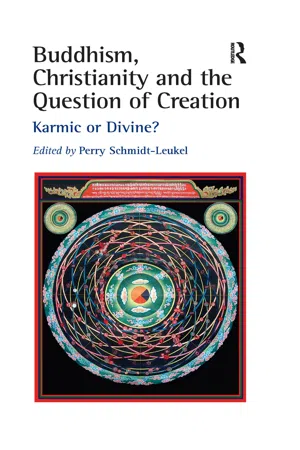
Is the world created by a divine creator? Or is it the constant product of karmic forces? The issue of creation was at the heart of the classic controversies between Buddhism and Hindu Theism. In modern times it can be found at the centre of many polemical debates between Buddhism and Christianity. Is this the principal barrier that separates Buddhism from Christianity and other theistic religions? The contributions to Part One explore the various aspects of traditional and contemporary Buddhist objections against the idea of a divine creator as well as Christian possibilities to meet the Buddhist critique. Part Two asks for the potential truth on both sides and suggests a surprising way that the barrier might be overcome. This opens a new round of philosophical and theological dialogue between these two major traditions with challenging insights for both. Contributors: José I. Cabezón, John P. Keenan, Armin Kreiner, Aasulv Lande, John D'Arcy May, Eva K. Neumaier, Perry Schmidt-Leukel, Ernst Steinkellner.
Information
PART 1
Buddhist and Christian Perspectives on the Issue of Creation
1
Hindu Doctrines of Creation and Their Buddhist Critiques
Some Preliminary Considerations
At the very beginning of this chapter, a short note of apology seems to be appropriate. When the editor confirmed my positive answer to the invitation to write this contribution, I felt flattered by his words ‘I am glad that you approach the area of Buddhist philosophy not only with a philological and historical interest, but also with a philosophical one – this, after all, makes it really interesting.’ I felt flattered, because in my youth philosophy appeared to me to be the peak of human activities. Throughout my working life, I nonetheless never even came near these high ranges, and while facing the task of preparing this paper I had to admit to myself that my philosophical interest is actually quite minimal by now, and more and more my hopes focus rather on philology strictly speaking, especially when the questions to be addressed are within the framework of ‘Buddhist–Christian Dialogue’. For ‘philology’, as I would like to understand it, is an area of exercise in the never-ending social process of understanding information which originates from human sources with the intention to be understood by another human being, thus providing a basis for a dialogue which aims at mutual understanding rather than at preparing for non-verbal application of sticks or bombs.
The inter-linguistic and inter-cultural difficulties and impediments that are met with are well known.1 Projects like the present one, however, testify to the fact that a possibility to overcome these difficulties in a meaningful way is still to be hoped for, and is certainly preferable to the alternatives of cultural solipsism and military monism which result from intellectual attitudes such as those of the recently fashionable hermeneutical despair.
Intra-culturally, we are confronted with similar difficulties. Debates between different strands of Indian societies, too, are held in the same language and use roughly the same logical forms, and yet they often tend to end in irreconcilable differences. Precise conceptual clarity and neatness is therefore required in order to discover the – mostly – silent presuppositions brought into such debates based on backgrounds of different social conditions, motivations, and aims.
In my following attempt to fulfil the task requested in the title of my paper, I shall naturally stay within the borders of the Indian culture. And, in order not to be possibly misread in an inter-cultural discourse, I will try, as closely as possible, to identify the key concepts by their function in context. In addition, in order to do justice to those key concepts also within intra-cultural debates, we must take into account both the starting point and the direction of these debates. For, as a rule, a specific polemical argument tends to be selective and limitative from the beginning: it chooses targets and prepares them for easier destruction through weapons wielded in the owner’s factory. Consequently, the theories and concepts of the party under polemical attack are always broader and more meaningful in their natural and homogeneous conceptual environment than when put up as isolated targets in polemics.
I shall therefore structure my paper in the following way: before looking at the various arguments developed by Buddhist traditions and philosophers, I will introduce some examples of ‘creation’ concepts from the early brahmanical and Hindu context which the Buddhists respond to in their critiques. This should reveal at least the more important reasons for their polemical efforts and identify the specific types of their targets. Since the Buddhists were quite selective, targeting not even all the main Indian doctrines of creation, this survey will really be no more than a typological one, with no comprehensiveness intended. Subsequently, I will summarize the historical development of the Buddhist arguments, attempt to identify the Buddhists’ reasons for their critical enterprise, and finally, I shall present in more detail, but again only as an example, a particular argument which was elaborated by one of the most influential and differentiating Buddhist philosophers, Dharmakīrti.
It will remain to be seen whether any of these arguments can be transferred meaningfully to the Christian–Buddhist dialogue, and whether any objective can be seen in such an enterprise. Nineteenth- and early twentieth-century Buddhists tried to use their traditional polemical lore to confront Christian ideas in much the same way as it had been used against the concepts developed by Indian theistic traditions. This, however, is not my topic, and will be dealt with in a later chapter.2
Creator and Creation in Traditional Hindu Thought
‘Creation’ together with its various explanations in India is an answer to the question of ‘Why are we, here and now?’ The question is searching for a first cause. By the time of the Buddha’s appearance, many answers had already been given. Starting from the later parts of the Ṛgveda to the earlier Upaniṣads, mythic notions of beginnings within a pre-existing set-up of the Vedic gods prevailed.3 Some cosmogonic hymns of the Ṛgveda speak of a personal creator-god, Viśvakarman (‘Whose acting is the universe’), who as a priest carries out creation as a sacrifice, and who works with pre-existing unformed material in the manner of a craftsman. In the hymn to puruṣa (‘man’) (Ṛgveda 10.90), we find the idea of an emanation of the universe, including the macro cosmos and our worldly surrounding with its social institutions, from a single entity, the puruṣa, as causa materialis. This is a clearly monistic tradition, identifying the cause as ‘the One’ (tad ekam), but naming it by the names of the great Vedic gods Indra, Varuṇa, or Agni.4 The early Upaniṣads identified this Vedic ‘One’ with bráhman, the truth of the Vedic word and reality of everything existent, the source and substance of the world in matter and consciousness, and finally identified this impersonal principle with the conscious core in living beings, the ‘Self’ (ātman). Vedic polytheism thus gave way to Upaniṣadic monism, and the Vedic gods were relegated to the realm of the finite with their tasks. The absolute bráhman does not necessarily require a creator of the universe. The created world could be seen as being only phenomenal, an illusion, and a falsely imagined transformation of the ultimate reality. Such ideas do not, however, exclude the assumption of a temporarily active creator-god as long as the impersonality of the absolute bráhman is not associated with a function. Materialistic monism is known as well, in which creation is seen as an ‘outflow’ (sṛṣṭi), or in a dualistic garb, in which an active undifferentiated primal matter (prakṛti) creates by transforming itself for the purpose of inactive but observing units of consciousness (puruṣa).
Along with these atheistic ideas of creation we also find personalistic-theistic concepts developing from late-Vedic monism. The Vedic ‘One’ was assumed to exist, have a wish to create and a consciousness to know what is to be created in all its details. Such a wishful and conscious ‘One’, however, can hardly be a neutral principle, but must be a personal one. The alternative to an unfathomable bráhman without form and qualities (nirguṇa) is thus a personal God with qualities (saguṇa), an agent of creation of the world, as well as its upkeep and destruction, the masculine god brahmán (nom. brahmā) with only a shift of the accent. He is not known in the Veda, but Vedic and early Upaniṣadic mythic notions, for example, the ‘lord of creatures’ (prajāpati) or the ‘golden (that is, eternal) germ’ (hiraṇyagarbha) were seen as ‘the One’ that has subsequently taken form as a personal God, the Lord of creation, Prajāpati or Puruṣa in the Veda, later Bhagavān and Īśvara, who designs the elements and laws of nature, and starts the process of creating all living beings beginning with the various gods. Theories of rebirth and a cyclic conception of the cosmos were also developed in this period and completed the notion of a highest personal God: at the end of a world-period, this God takes both the world and its creatures back into himself. Formless neuter bráhman before creation, that is, the moment when the ‘golden germ’ is born, is god Brahman (brahmán) as long as the world, space, time and creatures exist. Therefore, a relationship between the eternal creator and creatures is possible, and no alternative is left to this monotheistic option: he creates and supports, he is omniscient, omnipotent and eternal. The Vedic gods have now become part of the circle of finite existences, even if long-lasting. This highest personal and eternal God is subsequently identified by historically and socially different groups, the representatives of the developing Hindu religions, under the various names praised, loved and feared, for example by Vaiṣṇava believers as Viṣṇu, Kṛṣṇa, Rāma, or by Śaiva believers as Śiva.5
These early theistic tendencies, becoming monotheistic traditions and finally Hindu religions properly speaking, incorporate the inherited basic structure of identity or difference between transcendent and immanent aspects of the ultimate being in different ways. Roughly, it can be said that the Supreme Being bráhman is personalized in the sense that a creative aspect is attributed to it: it is assumed to be responsible for the origin and order of the cosmos. The idea of a transcendent, all-pervading, inactive and impersonal principle, the late-Vedic bráhman, remains alive, however, for in many of the mythic accounts of the creation that are available, for example, in the Manu Smṛti or in various Purāṇas, the actual creation of the world lies in the hands of a demiurge. Often, the god Brahman is given this special task, but the demiurge may also be seen as the creative power (māyā, śakti) or a manifestation (vyūha) of the ultimate reality. What these general myths and later theologies then present are elaborate variations on the answers to two main questions: How did God create the world? And why did God create the world?
The general scarcity of written sources for centuries of oral tradition allows only for a hypothetical history of these developments: they begin already in the last parts of the Ṛgveda, and become stronger around the time of the Buddha’s activity, the fifth to fourth centuries BCE, during the first North Indian empire of the Nandas, and the time of the Maurya dynasty. With the development of the classical Indian philosophical traditions from the last centuries BCE onwards, we can assume that the theistic conceptions, which so far were only asserted in the form of mythic accounts, finally begin to receive theoretical justifications.
I cannot touch upon the question of why God created the world, and the direction of this chapter does not allow for a comprehensive survey of the variations in the manner of his creation.6 I would offer, rather, a typology of concepts of creation, and exemplify the two types proposed respectively. Their main difference seems to consist in whether an all-pervading or only a limited function of God is assumed to be the cause of the world. For God may be seen as being both, the material and the instrumental or efficient cause of the world, or only its instrumental cause.
The first type of creation theory can perhaps be characterized as evolutionary. It aims at harmonizing a monotheistic position with the ancient idea of an original transcendent unity of impersonal being. An example is the creation theory of the viṣṇuitic Pāñcarātra tradition.7 Here, two main stages of creation are distinguished, a higher or pure one (śuddhasarga), and a lower or gross one. Viṣṇu, the ultimatėmī, being, wakens Lakṣmī, his Śakti (‘Power’). Why remains a mystery, for even ‘diversion’ (līlā) given as an answer is not satisfying in the case of a perfect being. Viṣṇu’s ‘Power’ is twofold as action and becoming, that is, as the instrumental and material cause of the world. This ‘Power’, which is nothing but Viṣṇu’s will to create, is symbolized by God’s discus-weapon (Sudarśana), and is understood to be the principle that supports and orders the world. ‘Manifestations’ (vyūha) and ‘appearances’ (avatāra) of Viṣṇu as part of this pure creation enrich the possibilities of special k...
Table of contents
- Cover Page
- Title Page
- Copyright Page
- Table of Contents
- Buddhism, Christianity and the Question of Creation
- List of Contributors
- Acknowledgements
- Introduction
- PART 1 Buddhist and Christian Perspectives on the Issue of Creation
- PART 2 The Unbridgeable Gulf? Towards a Buddhist-Christian Theology of Creation
- Index
Trusted by 375,005 students
Access to over 1.5 million titles for a fair monthly price.
Study more efficiently using our study tools.
Frequently asked questions
Yes, you can cancel anytime from the Subscription tab in your account settings on the Perlego website. Your subscription will stay active until the end of your current billing period. Learn how to cancel your subscription
No, books cannot be downloaded as external files, such as PDFs, for use outside of Perlego. However, you can download books within the Perlego app for offline reading on mobile or tablet. Learn how to download books offline
Perlego offers two plans: Essential and Complete
- Essential is ideal for learners and professionals who enjoy exploring a wide range of subjects. Access the Essential Library with 800,000+ trusted titles and best-sellers across business, personal growth, and the humanities. Includes unlimited reading time and Standard Read Aloud voice.
- Complete: Perfect for advanced learners and researchers needing full, unrestricted access. Unlock 1.5M+ books across hundreds of subjects, including academic and specialized titles. The Complete Plan also includes advanced features like Premium Read Aloud and Research Assistant.
We are an online textbook subscription service, where you can get access to an entire online library for less than the price of a single book per month. With over 1.5 million books across 990+ topics, we’ve got you covered! Learn about our mission
Look out for the read-aloud symbol on your next book to see if you can listen to it. The read-aloud tool reads text aloud for you, highlighting the text as it is being read. You can pause it, speed it up and slow it down. Learn more about Read Aloud
Yes! You can use the Perlego app on both iOS and Android devices to read anytime, anywhere — even offline. Perfect for commutes or when you’re on the go.
Please note we cannot support devices running on iOS 13 and Android 7 or earlier. Learn more about using the app
Please note we cannot support devices running on iOS 13 and Android 7 or earlier. Learn more about using the app
Yes, you can access Buddhism, Christianity and the Question of Creation by Perry Schmidt-Leukel in PDF and/or ePUB format, as well as other popular books in Theology & Religion & Religion. We have over 1.5 million books available in our catalogue for you to explore.