eBook - ePub
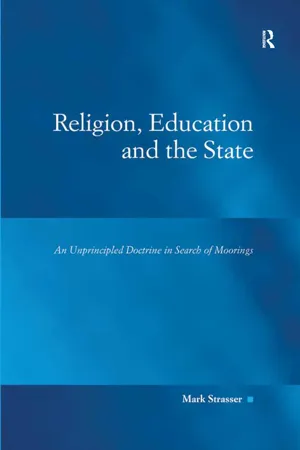
Religion, Education and the State
An Unprincipled Doctrine in Search of Moorings
- 214 pages
- English
- ePUB (mobile friendly)
- Available on iOS & Android
eBook - ePub
About this book
In the context of education, Church and State issues are of growing importance and appear to be increasingly divisive. This volume critically examines the developing jurisprudence relating to religion in the schools beginning with Everson v. Board of Education, where the US Supreme Court discussed the wall of separation between Church and State. The study traces both how the Court's views have evolved during this period and how, through recharacterizations of past opinions and the facts underlying them, the Court has appeared to interpret Establishment Clause guarantees in light of the past jurisprudence when in reality that jurisprudence has been turned on its head. The Court not only offers an unstable jurisprudence that is more likely to promote than avoid the problems that the Establishment Clause was designed to prevent, but approaches Establishment Clause issues in a way that decreases the likelihood that an acceptable compromise on these important issues can be reached. The study focuses on the situation in the US but the important issue of religion, education and the state has great relevance in many jurisdictions.
Information
Chapter 1
Everson and Aid to Private Schools
Ever since deciding Everson v. Board of Education,1 the Court has wrestled with the proper way to characterize the Establishment Clause limitations on the states. Many of the cases have involved the extent to which a state can provide aid to parents of children attending primary and secondary sectarian schools. While the Court’s understanding of the constitutional limits imposed on such aid has changed markedly over the past several decades, accurately characterizing that evolution is difficult for two distinct reasons. First, the Court usually does not fully and clearly articulate its position when issuing opinions, so the Court’s rationale is often somewhat opaque. Second, perhaps even more in this area than in others, the Court often recasts past opinions as a way of retroactively modifying their legal import. For these reasons, it is often unclear exactly where and when particular changes in the jurisprudence occurred. Nonetheless, what is clear is that the jurisprudence has undergone a radical transformation over the relevant period.
At first, the Court suggested that the constitutionality of state aid to sectarian schools depended upon whether that aid was being used to promote health and safety rather than education. Then, the Court modified the criterion, instead saying that the Constitution permitted states to provide funding to private schools as long as the aid was supporting secular rather than religious education. That position was modified yet again so that the focus was on whether the state was offering nonsectarian benefits to the religious and nonreligious alike, even if those nonsectarian benefits in fact promoted religious education. Finally, the Court adopted yet another approach in which the constitutionality of state aid to sectarian schools would depend upon whether what was admittedly support of religious teaching could reasonably be imputed to the state. While the changes in the jurisprudence were often not dramatic, they have cumulatively resulted in a position that is hard to reconcile with either the spirit or the holding of Everson, even when Everson is understood to be much more accommodationist than is commonly supposed.
Support for Safety and Health
Contemporary Establishment Clause jurisprudence can hardly be called transparent if only because it has changed markedly over the past several decades. That said, the jurisprudence with respect to the conditions under which the state is permitted to provide aid benefiting primary and secondary sectarian institutions has not always been as difficult to fathom as is sometimes claimed. While the Court has never articulated a principle clearly demarcating the line between permissible and impermissible kinds of aid, a rough rule emerged permitting aid as long as certain conditions had been met. This understanding governed the Court’s holdings in this area at least through the 1970s, although the dicta in some of the Court’s decisions during this period provided the basis for the stark changes that subsequently occurred.
Everson v. Board of Education is the seminal case in contemporary Establishment Clause jurisprudence. It is important both because of its holding that Establishment Clause guarantees constrain not only the federal government but state and local governments as well, and because it attempts to set out some of the parameters regarding the conditions under which state aid can be offered to sectarian schools without offending constitutional guarantees. The decision itself sent rather mixed messages, however, because its very robust language regarding the required degree of separation between church and state seemed incompatible with the Court’s decision to uphold the statute at issue.
The disparity between the tone and the holding of the opinion has led some commentators to suggest that the Court was simply being inconsistent. Other commentators suggest that the decision is unproblematic in reasoning and result, although perhaps incorporating some overly exuberant rhetorical flourishes. In any event, Everson demands close attention, both because it was the first case in modern Establishment Clause jurisprudence and because it foreshadows many of the competing considerations that continue to play a role when the Court seeks to draw a line between permissible and impermissible state aid to sectarian schools.
At issue in Everson was the following statute:
Whenever in any district there are children living remote from any schoolhouse, the board of education of the district may make rules and contracts for the transportation of such children to and from school, including the transportation of school children to and from school other than a public school, except such school as is operated for profit in whole or in part.
When any school district provides any transportation for public school children to and from school, transportation from any point in such established school route to any other point in such established school route shall be supplied to school children residing in such school district in going to and from school other than a public school, except such school as is operated for profit in whole or in part.2
The statute performed two functions: (1) it authorized school boards to provide transportation for children attending public and private nonprofit schools, and (2) it required school districts providing transportation to public school students to provide transportation to children attending private, nonprofit schools, as long as the private school was along the established school route. Arguably, (2) would require no extra expenditure of funds beyond the de minimis expenditure involved in stopping along the route to pick up and drop off the children at the bus stops near their homes. In contrast, (1) permitted but did not require additional expenditures, since the local boards were authorized to provide transportation for children who were going to a private school that was not located along an established school route.
A New Jersey taxpayer challenged the right of the school board to authorize reimbursement of transportation expenses incurred by children using public buses to go to and from parochial school, arguing that the authorizing statute violated state and federal constitutional guarantees. The New Jersey Supreme Court upheld the constitutionality of the statute, and the case was appealed to the United States Supreme Court.
After making clear that the constraints imposed by the Establishment Clause on the federal government also apply to the states, the Everson Court tried to explain the limitations imposed by that clause. States are precluded from “set[ting] up a church” or from passing “laws which aid one religion, aid all religions, or prefer one religion over another.”3 Indeed, the Court suggested that “the clause against establishment of religion by law was intended to erect a wall of separation between church and State,”4 thereby implying that the Constitution requires church and state to be in completely non-overlapping spheres.
While speaking in rather absolute terms, the Everson Court nonetheless found that the reimbursement at issue did not violate constitutional guarantees. The Court explained that the Constitution’s prohibiting the use of public funds for the support of religion was not meant to preclude every use of public funds that might in some way benefit religion. Such a broad interpretation of the rule would prohibit states from extending any kind of aid, including police and fire services, which would make states hostile to religion. An interpretation making each state an adversary of religion misrepresents the constitutional guarantee, since state power “is no more to be used so as to handicap religions, than it is to favor them.”5 Instead, the prohibition on state aid is narrower in scope, so that some kinds of aid, but not others, are permissible.
When upholding the state reimbursement of parents for transportation costs, the Court emphasized that this aid was “so separate and so indisputably marked off from the religious function”6 that the state could not plausibly be thought to be directly supporting religious activities or teaching. By focusing on the function that the aid was to perform, the Court implied that sectarian aid could not be offered to support religious functions, but could be offered to support nonreligious functions.
One complicating factor in Everson not emphasized by the Court was that the township resolution at issue only authorized reimbursement for parents of children attending public and Catholic schools. While there was no evidence that any child attending a private, nonprofit, non-Catholic school had been denied travel reimbursement or even that there was a child who would have attended such a school if only transportation reimbursement had been provided, the resolution nonetheless facially discriminated among religions. Had the resolution’s constitutionality been analyzed in light of its expressly distinguishing among religions, the statute would likely have been struck down. As Justice Robert Jackson pointed out in his dissent, if the Court were examining the permissibility of reimbursing children attending Catholic, but not other private, nonprofit schools, then the police/fire services analogy would have cut the other way—the question would have been whether it would be permissible for the state to afford fire services to Catholic establishments but permit other religious establishments to burn.7
Yet, it could be that the Court did not focus on the benefit accorded to Catholic schools for a different reason. As Marci Hamilton notes, the curriculum in the public schools historically favored a Protestant perspective, which was one of the reasons that Catholics started parochial schools.8 It may be that the Court viewed the provision at issue not as a way of favoring Catholics but as a way of reducing the burden placed on them.
The Everson Court did not analyze the constitutionality of state reimbursement for transportation costs to and from Catholic schools in particular but, instead, whether the state’s paying for the transportation costs of children attending religious schools violated the Establishment Clause. The Court offered a quick history of the Establishment Clause, observing that “dissenters were compelled to pay tithes and taxes to support government-sponsored churches whose ministers preached inflammatory sermons designed to strengthen and consolidate the established faith by generating a burning hatred against dissenters.”9 After noting that practices burdening dissenters “became so commonplace as to shock the freedom-loving colonials into a feeling of abhorrence,” the Court explained that the people of Virginia, “as elsewhere, reached the conviction that individual religious liberty could be achieved best under a government which was stripped of all power to tax, to support, or otherwise to assist any or all religions, or to interfere with the beliefs of any religious individual or group.”10 Here, too, a broad reading of the Court’s language in Everson suggests strict separation between church and state.
Yet, the Court’s language regarding the taxing power might be given a much narrower interpretation. Just as the Court denied that a state was precluded from offering fire protection services to a religious school, the Court would also deny that a state was precluded from spending public funds to extinguish a fire in a chapel, even though that would mean that public support (in the use of public equipment, the payment ...
Table of contents
- Cover Page
- Dedication
- Title Page
- Copyright Page
- Contents
- Acknowledgments
- Introduction
- 1 Everson and Aid to Private Schools
- 2 Religion in Public Schools
- 3 Public Funding of Sectarian Higher Education
- 4 Religious Groups at Public Colleges and Universities
- 5 The Pledge of Allegiance in the Schools
- 6 The Ten Commandments in the Schools
- Bibliography
- Index
Trusted by 375,005 students
Access to over 1.5 million titles for a fair monthly price.
Study more efficiently using our study tools.
Frequently asked questions
Yes, you can cancel anytime from the Subscription tab in your account settings on the Perlego website. Your subscription will stay active until the end of your current billing period. Learn how to cancel your subscription
No, books cannot be downloaded as external files, such as PDFs, for use outside of Perlego. However, you can download books within the Perlego app for offline reading on mobile or tablet. Learn how to download books offline
Perlego offers two plans: Essential and Complete
- Essential is ideal for learners and professionals who enjoy exploring a wide range of subjects. Access the Essential Library with 800,000+ trusted titles and best-sellers across business, personal growth, and the humanities. Includes unlimited reading time and Standard Read Aloud voice.
- Complete: Perfect for advanced learners and researchers needing full, unrestricted access. Unlock 1.5M+ books across hundreds of subjects, including academic and specialized titles. The Complete Plan also includes advanced features like Premium Read Aloud and Research Assistant.
We are an online textbook subscription service, where you can get access to an entire online library for less than the price of a single book per month. With over 1.5 million books across 990+ topics, we’ve got you covered! Learn about our mission
Look out for the read-aloud symbol on your next book to see if you can listen to it. The read-aloud tool reads text aloud for you, highlighting the text as it is being read. You can pause it, speed it up and slow it down. Learn more about Read Aloud
Yes! You can use the Perlego app on both iOS and Android devices to read anytime, anywhere — even offline. Perfect for commutes or when you’re on the go.
Please note we cannot support devices running on iOS 13 and Android 7 or earlier. Learn more about using the app
Please note we cannot support devices running on iOS 13 and Android 7 or earlier. Learn more about using the app
Yes, you can access Religion, Education and the State by Mark Strasser in PDF and/or ePUB format, as well as other popular books in Theology & Religion & Law Theory & Practice. We have over 1.5 million books available in our catalogue for you to explore.