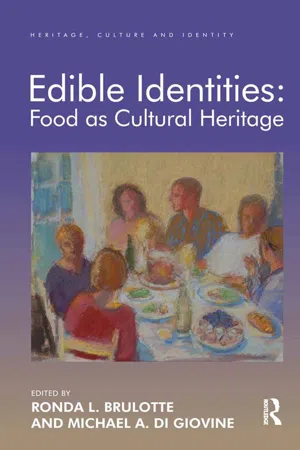
eBook - ePub
Edible Identities: Food as Cultural Heritage
- 252 pages
- English
- ePUB (mobile friendly)
- Available on iOS & Android
eBook - ePub
Edible Identities: Food as Cultural Heritage
About this book
Food - its cultivation, preparation and communal consumption - has long been considered a form of cultural heritage. A dynamic, living product, food creates social bonds as it simultaneously marks off and maintains cultural difference. In bringing together anthropologists, historians and other scholars of food and heritage, this volume closely examines the ways in which the cultivation, preparation, and consumption of food is used to create identity claims of 'cultural heritage' on local, regional, national and international scales. Contributors explore a range of themes, including how food is used to mark insiders and outsiders within an ethnic group; how the same food's meanings change within a particular society based on class, gender or taste; and how traditions are 'invented' for the revitalization of a community during periods of cultural pressure. Featuring case studies from Europe, Asia and the Americas, this timely volume also addresses the complex processes of classifying, designating, and valorizing food as 'terroir,' 'slow food,' or as intangible cultural heritage through UNESCO. By effectively analyzing food and foodways through the perspectives of critical heritage studies, this collection productively brings two overlapping but frequently separate theoretical frameworks into conversation.
1 Re-Inventing a Tradition of Invention: Entrepreneurialism as Heritage in American Artisan Cheesemaking
DOI: 10.4324/9781315578781-1
In his 2006 book, The United States of Arugula, David Kamp credits Laura Chenel with almost singlehandedly introducing goat cheese to America by becoming its first domestic commercial producer (2006: 171–2). Chenel’s story, in his telling, contains two iconic features. First, to perfect her craft, Chenel traveled to France, the quintessentially cultured epicenter of “real” cheese. Second, she got her commercial break in 1980 when she drove a batch of fresh cheeses from her Sonoma County goat farm to Berkeley and walked into Chez Panisse restaurant. Alice Waters put the chèvre in a salad, named Chenel on the menu, and the rest is … invented tradition? Today the story of Laura Chenel’s chèvre is often told to establish the beginning of a current “renaissance” in American artisan cheesemaking. A handful of Americans involved in the back-to-the-land movement, including Chenel, began making cheese by hand for commercial sale in the early 1980s; since 2000, the number of domestic artisan producers has more than doubled. The heroine of the chèvre’s story embodies characteristics that could describe the American artisan industry as a whole: it is innovative, it is entrepreneurial and it borrows unapologetically from European tastes and savoir-faire.
Drawing on several years of ethnographic research among artisan cheesemakers, retailers and boosters in the United States, I suggest that a tradition of artisanal cheesemaking—a tradition that is consciously cultivated as newly emergent—locates its distinctively American heritage neither in the taste of a food nor in customary practice of cheese fabrication, but instead in an entrepreneurial sensibility. At talks given at annual meetings of the American Cheese Society and in a raft of recent popular cheese books, American artisanal cheesemaking is collectively characterized by shared cultural commitment to innovation as a source of value and integrity—even artisanal authenticity. What makes an American cheese distinctively American (in this formulation) is that it presents itself as new, different, unique—despite the fact that, as acknowledged in Laura Chenel’s story of pilgrimage to France, it remains inescapably indebted to European histories of practice and taste-making. Often obscured in this formulation is how today’s innovators are also indebted to American histories of practice and taste-making that have unfolded in New England, Wisconsin, central California, and elsewhere across the States (Paxson 2010).
To frame my argument about American invented traditions of artisanal cheesemaking innovation, I will first briefly characterize the foil against which claims to American exceptionalism are made: namely, invented traditions of European continuity. Just as the appearance of continuity in European food traditions relies on changing methods of fabrication and marketing, I will demonstrate through the example of the oldest continuously operating artisan cheese factory in the United States how an emphasis on change relies on continuity “in order to demonstrate its effect” (Strathern 1992: 3).
French Cheese and the Invention of Tradition
In the course of my research among American cheesemakers, I lost count of how many times I heard repeated General Charles De Gaulle’s complaint, “How can you govern a country which has 246 varieties of cheese?” (Mignon 1962) (The number of cheeses changed with each recitation.) De Gaulle’s quip tells us something about the role of food, and of cheese in particular, in helping to establish a collective sense of regional affiliation. Cheese, an ancient, domestic means of preserving that most perishable agrarian product, milk, would seem ready-made to embody cultural heritage. De Gaulle’s 246 (or so) varieties of cheese work as a symbol of national unruliness only if we imagine each of those cheeses as emerging from a politically entrenched patchwork of customarily distinct regions. De Gaulle’s task was to unify a people loyally committed not to the excellence of “French” cheese but to 246 regionally distinctive cheeses and the cultural heritage for which they stand.
One of France’s most elaborate and successful cheese traditions concerns Camembert, said to have originated when a Norman farmwoman named Marie Harel followed a “secret” recipe for Brie using a smaller Livarot mold (practicing the sort of improvisational tinkering I have found among American cheesemakers) and trained her children and grandchildren to carry on making the cheese as family patrimony. As Pierre Boisard (2003) details in Camembert: A National Myth, the cheese’s story begins to transcend Norman regionalism and to take on the significance of a national myth because the tale is set in the early years of the French Revolution (1791) and because the secret Brie recipe is said to have been given to Madame Harel by a priest (who stands in the story as a representative of the Ancien Régime) seeking refuge with the Harel family while fleeing persecution by the revolutionaries. Thanks to Madame Harel’s entrepreneurial industry, writes Boisard, “a bit of old France, of pre-Revolutionary France, will survive” into the future in a new form (2003: 10).
The myth of Camembert fits neatly Eric Hobsbawm’s formula for “invented traditions,” which he describes as “responses to novel situations which take the form of reference to old situations, or which establish their own past by quasi-obligatory repetition” (1983: 2). No surprise, then, to learn that Marie Harel’s mythological fame does not, in fact, date back to the Revolution. Instead, 130 years went by before the American Joseph Knirim turned up in the town of Camembert (pop. 300) to venerate the memory of Madame Harel and her “veritable Norman Camembert” by erecting a statue in her honor. Knirim, a physician, adulated Marie Harel’s cheese not for its taste and sumptuousness, but for its “digestibility.” In a letter to the townspeople of Camembert, Knirim explained: “Years ago, I suffered for several months from indigestion, and Camembert was practically the sole nourishment that my stomach and intestines were able to tolerate. Since then, I have sung the praises of Camembert, I have introduced it to thousands of gourmets, and I myself eat it two or three times a day” (Boisard 2003: 3). Only once the visiting American had erected her statue did Marie Harel’s name begin to stand for the essential contribution that peasant agriculture has made to the strength of the French nation. Camembert’s iconic Frenchness seems little tarnished by having become one of the nation’s most industrialized cheeses. Long seeded with laboratory-isolated strains of Penicillium candidum to produce a pure-white coat of mold, and now most often made from pasteurized milk, Camembert’s materiality today is only a shadow of what once cured Knirim’s indigestion. In hopes of recuperating at least a hint of that past, Norman dairy farmers and cheesemakers have secured Appellation d’Origine Contrôlée (A.O.C.) status not for Camembert per se, but for Camembert de Normandie. For a cheese to qualify for the site-specific name, production must occur within geographically limited areas and comply with a voluminous set of regulatory standards (Rogers 2008). Norman Camembert and French Camembert now vie for consumer sentiment and market position. Throughout Europe, what heritage food will look like in the future is a contentious matter of politics and policy to be worked out through the legal instruments of geographical indications (on cheese, see: Boisard 1991, 2003, Grasseni 2003, 2009, Rogers 2008, on wine, see Ulin 2002, Guy 2003, Demossier 2011).
Such well-cultured cheeses as Camembert, Comté, and Taleggio are usefully analyzed as embodying and reproducing the “invented traditions” of country idylls populated by an immemorial peasantry (Boisard 2003, Rogers 2008, Trubek and Bowen 2008, Grasseni 2009). When a new wave of American cheesemakers travels to France to learn how to make “real” cheese, they reinforce European inventions of culinary tradition as authentic and gastronomically superior. Without doubt, many excellent cheeses are made in France and throughout Europe—but so, too, are boring supermarket cheeses. It is a testament to the success of France’s invented cheese traditions and to the branding of French cheeses as fundamentally authentic and traditional—even when most Camembert today is, in fact, made from pasteurized milk and ladled by robots—that foil-wrapped, processed wedges of Laughing Cow (La Vache Qui’rit, in its native tongue) are never metonymically dubbed “French cheese” (Boisard 1991). As Hobsbawm writes, “It is the contrast between the constant change and innovation of the modern world and the attempt to structure at least some parts of social life within it as unchanging and invariant, that makes the ‘invention of tradition’ so interesting for historians of the past two centuries” (1983: 2). In Europe, where “the traditional” and “the modern” continue to be potent, mutually constitutive tropes through which people stake moral claims of belonging, authenticity, and progress, “invention of tradition” is a particularly useful analytic (cf. Terrio 2000). But in the United States, where progress is valued over patrimony, what is invented as tradition—what is enshrined as a matter of cultural heritage—is continual change and innovation, not continuity. In the United States, continuity in practice, in know-how, in form, risks being labeled old-fashioned or, worse, boring, and so continuity is often obscured in narratives of innovation. Americans, ever impatient for a brighter tomorrow, are continuously remaking and marketing their traditions as new, fresh, and exciting.
American Cheese and a (Continuously Re-invented) Tradition of Invention
In 1865, with Lincoln in the White House and the Civil War just coming to an end, the Marin French Cheese Company began making cheese (originally the Thompson Brothers Cheese Co.) after Jefferson Thompson, a dairy farmer, recognized an emergent market niche in the port town of San Francisco. Compare to the above story of Camembert that of Marin French, the oldest continuously operating cheese factory in the United States, located in Petaluma, California. In a 2008 interview, the late Jim Boyce, who in 1998 purchased the company from Thompson’s descendents, told me the story as he learned it from an employee who had just retired after 60 years with the company.
During the California Gold Rush (1849–1855), the story goes, European stevedores (deckhands) who sailed into Yerba Buena harbor (later, San Francisco Bay) delivering goods to support the mining enterprises got “caught up in the fever” and abandoned ship to seek their own fortune in the mines. After the gold rush went bust, workers returned to the bay to make a living at the dockyards. Boyce said to me:
Now, in any workman’s bar or inn … you work hard, you get dehydrated, you go to the bar for hydration and energy—most typically that’s given to you by beer so you can quickly restabilize yourself. … The beer gives them hydration and carbohydrate but no protein. And most typically in a workman’s bar there’s a jar of pickled eggs or something like that, pig knuckles, sausage. [But here] there weren’t any eggs; no chickens— nothing had been developed. … Well, Jefferson Thompson, the dairyman on this farm [the site of the present-day factory] says to himself in a moment of marketing brilliance, ‘I wonder if they’d eat cheese, instead?’ So he starts making these little cheeses, three-ounce cheeses, more or less. And he hauls them off to the docks, and they put them on the table in a bowl, and they were an immediate hit! Why? Because these are European stevedores: they knew cheese. They ate it breakfast, lunch, and dinner. And that was the origin of the company.
Whereas Europe’s invented food traditions mean to legitimate present practices by claiming continuity with the past (even if shaped in a new form), American origin stories mark decisive breaks with the past. The story of Laura Chenel chèvre exemplifies individual passion and entrepreneurial opportunism; Marin French’s Breakfast Cheese celebrates the creation of new markets.
A tradition of invention is enshrined in the American Cheese Society (ACS) designation of American Originals as a classificatory category for its annual judging and competition. American Originals designate cheeses invented on American soil: Colby and Brick, invented by first-generation immigrants in nineteenth-century Wisconsin; Teleme and Jack, invented in twentieth-century California. In recent years, the American Cheese Society has added “original recipe” subcategories of American Originals; 2011 award winners included Mt. Tam, Cocoa Cardona and Flagsheep. The theme of the 22nd Annual Meeting of the ACS held in Louisville, Kentucky, in 2005—Creating Tradition—did not so much offer a self-conscious look at how American cheese traditions had been invented as it set out to create tradition anew from this point onward, into the future. The call for Americans to create a cheesemaking tradition arises from a feeling among newer artisans, those getting their start since Laura Chenel’s goat cheese hit Berkeley, that they have been largely on their own, starting from scratch.
Allison Hooper, co-founder of the 25-year-old Vermont Butter & Cheese Company, writes in her Foreword to Roberts’ Atlas of American Artisan Cheese , “Without the burden of tradition we are free to be innovative, take risks,” suggesting that a lack of tradition in regional cheese types and fabrication method is a virtue rather than a deficit because it opens up possibilities for experimentation (2007: xiii). Dancing Cow’s Sarabande, a cow’s milk cheese with a washed rind, is molded in a truncated pyramid form, the kind used in France for Valençay, a charcoal-dusted goat’s milk cheese from the province of Berry (legend has it that the cheese was once a made in a perfect pyramid until Napoleon, passing through Valençay town following a failed military campaign in Egypt, was so enraged by the cheese’s taunting shape that he lopped off the top with his sword, leaving the form that survives today). In a presentation at the 2007 American Cheese Society meetings, Steve Getz, co-owner and operator of Dancing Cow (which has since gone out of business), delighted in announcing that it had been recently declared illegal in France to make a cow’s milk cheese in a truncated pyramid form (the shape is reserved for goat’s milk cheese)....
Table of contents
- Cover
- Halftitle Page
- Series Page
- Title Page
- Copyright Page
- Contents
- List of Figures
- Notes on Contributors
- Introduction: Food and Foodways as Cultural Heritage
- 1 Re-Inventing a Tradition of Invention: Entrepreneurialism as Heritage in American Artisan Cheesemaking
- 2 Terroir in D.C.? Inventing Food Traditions for the Nation’s Capital
- 3 Of Cheese and Ecomuseums: Food as Cultural Heritage in the Northern Italian Alps
- 4 Edible Authenticities: Heirloom Vegetables and Culinary Heritage in Kyoto, Japan
- 5 The Everyday as Extraordinary: Revitalization, Religion, and the Elevation of Cucina Casareccia to Heritage Cuisine in Pietrelcina, Italy
- 6 Take the Chicken Out of the Box: Demystifying the Sameness of African American Culinary Heritage in the U.S.
- 7 Caldo De Piedra and Claiming Pre-Hispanic Cuisine as Cultural Heritage
- 8 Hallucinating the Slovenian Way: The Myth of Salamander Brandy, an Indigenous Slovenian Psychedelic Drug
- 9 Haute Traditional Cuisines: How UNESCO’s List of Intangible Heritage Links the Cosmopolitan to the Local
- 10 Reinventing Edible Identities: Catalan Cuisine and Barcelona’s Market Halls
- 11 French Chocolate as Intangible Cultural Heritage
- 12 Daily Bread, Global Distinction? The German Bakers’ Craft and Cultural Value-Enhancement Regimes
- 13 The Mexican and Transnational Lives of Corn: Technological, Political, Edible Object
- 14 Cultural Heritage in Food Activism: Local and Global Tensions
- Index
Trusted by 375,005 students
Access to over 1.5 million titles for a fair monthly price.
Study more efficiently using our study tools.
Frequently asked questions
Yes, you can cancel anytime from the Subscription tab in your account settings on the Perlego website. Your subscription will stay active until the end of your current billing period. Learn how to cancel your subscription
No, books cannot be downloaded as external files, such as PDFs, for use outside of Perlego. However, you can download books within the Perlego app for offline reading on mobile or tablet. Learn how to download books offline
Perlego offers two plans: Essential and Complete
- Essential is ideal for learners and professionals who enjoy exploring a wide range of subjects. Access the Essential Library with 800,000+ trusted titles and best-sellers across business, personal growth, and the humanities. Includes unlimited reading time and Standard Read Aloud voice.
- Complete: Perfect for advanced learners and researchers needing full, unrestricted access. Unlock 1.5M+ books across hundreds of subjects, including academic and specialized titles. The Complete Plan also includes advanced features like Premium Read Aloud and Research Assistant.
We are an online textbook subscription service, where you can get access to an entire online library for less than the price of a single book per month. With over 1.5 million books across 990+ topics, we’ve got you covered! Learn about our mission
Look out for the read-aloud symbol on your next book to see if you can listen to it. The read-aloud tool reads text aloud for you, highlighting the text as it is being read. You can pause it, speed it up and slow it down. Learn more about Read Aloud
Yes! You can use the Perlego app on both iOS and Android devices to read anytime, anywhere — even offline. Perfect for commutes or when you’re on the go.
Please note we cannot support devices running on iOS 13 and Android 7 or earlier. Learn more about using the app
Please note we cannot support devices running on iOS 13 and Android 7 or earlier. Learn more about using the app
Yes, you can access Edible Identities: Food as Cultural Heritage by Ronda L. Brulotte, Ronda L. Brulotte,Michael A. Di Giovine, Ronda L. Brulotte, Michael A. Di Giovine in PDF and/or ePUB format, as well as other popular books in Social Sciences & Geography. We have over 1.5 million books available in our catalogue for you to explore.