- 252 pages
- English
- ePUB (mobile friendly)
- Available on iOS & Android
eBook - ePub
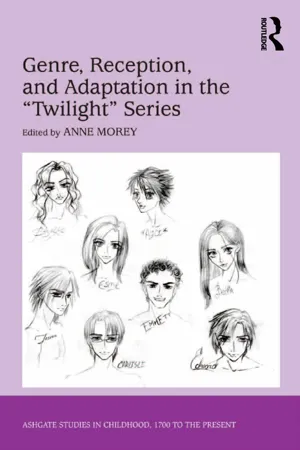
Genre, Reception, and Adaptation in the 'Twilight' Series
About this book
Much of the criticism on Stephenie Meyer's immensely popular 'Twilight' novels has underrated or even disparaged the books while belittling the questionable taste of an audience that many believe is being inculcated with anti-feminist values. Avoiding a repetition of such reductive critiques of the series's purported shortcomings with respect to literary merit and political correctness, this volume adopts a cultural studies framework to explore the range of scholarly concerns awakened by the 'Twilight novels and their filmic adaptations. Contributors examine 'Twilight's debts to its predecessors in young adult, vampire, and romance literature; the problems of cinematic adaptation; issues in fan and critical reception in the United States and Korea; and the relationship between the series and contemporary conceptualizations of feminism, particularly girl culture. Placing the series within a broad tradition of literary history, reception studies, and filmic adaptation, the collection offers scholars the opportunity to engage with the books' importance for studies of popular culture, gender, and young adult literature.
Information
Chapter 1
“Famine for Food, Expectation for Content”: Jane Eyre as Intertext for the “Twilight” Saga
Anne Morey
This chapter argues that the nuances of the gender politics of the “Twilight” series can be usefully articulated and examined by exploring Charlotte Brontë’s Jane Eyre as an unacknowledged or displaced intertext. Jane Eyre is one of the forebears of the contemporary romance just as it is of the paranoid woman’s film, also an important precursor of the “Twilight” series.1 Despite Stephenie Meyer’s lifelong devotion to Jane Eyre, which she first read at the age of nine (Valby), the series fails to mention the novel, explicitly offering instead Wuthering Heights and Romeo and Juliet as being among Bella’s preferred reading. Nonetheless, the similarities between Jane Eyre and the “Twilight” saga are both more numerous and more profound than those to be found in the avowed intertexts. The heroines of both texts are, in Jane’s words, both “plain Quakeress[es]” in dress and general affect who morph into figures capable of exciting erotically a more powerful man; each heroine must engage in acts of investigation to discover both the threat that the lover represents and the depth and constancy of his feeling, revealed after a painful separation; each prefers the dangerous man to a more socially acceptable but ultimately less sexually exciting suitor; each is menaced by a powerful woman who represents loss of control of some appetite (Bertha Mason is, of course, famously described as a vampire, while Bella is stalked by Victoria); each is saved by the disembodied voice of her lover; each dreams of a child who must be protected and who represents a great responsibility. Meyer even continues the temperature trope used to characterize the male rivals (Rochester hot, Rivers cold), although she reverses Bella’s preferences.
The most significant difference, of course, is that the “Twilight” saga makes central the supernatural phenomena that are only latent in Jane Eyre. Yet the series also continues what one might call the theological imperatives of the original, in which the heroine gives herself to the man for whom she is irreplaceable as guide and encourager. Bella, not Edward, hopes that the Volturi may be defeated by both community and individual powers, and indeed concludes the series as Edward’s spiritual guide, having saved him from self-destructive despair. Both novels conclude with their respective Edwards seeing, or seeing again, the true form of their beloved: Rochester as he gradually recovers his sight, and Cullen as he is finally permitted access to Bella’s mind, there to find all her memories of her love for him in a concluding erotic striptease. Like her original in Jane Eyre, Bella and her lover represent a somewhat unorthodox working out of salvation, in which conventional Christianity appears to come second to the divinity of perfect concord between husband and wife (a denouement that both Wuthering Heights and Romeo and Juliet eschew in favor of unfulfilled passion). Again unlike both Wuthering Heights and Romeo and Juliet, both narratives conclude not merely with an account of the expected marriage of the couple but also with a discussion of their progeny (in admittedly different proportions). In both narratives, the heroine rises from misprized child to powerful woman, tracing an arc of Bildung that may be one of their shared attractions for both girls and women.
Jane Eyre has already been used as the yardstick against which Bella has been measured and found wanting as a feminist heroine. Leaving aside the question of whether such assessments are overly hasty, examining the “Twilight” series in the context of Jane Eyre allows a comparison of the ways in which both texts attempt to deal with such aspects of gender politics as sexual difference, access to power, physical threats to femininity, and feelings of pain and rage that arise from the condition of being a woman. Specifically, I argue that Meyer uses the resources of fantasy, those elements of the plot and characters that are not mimetic of the world as we know it, to first heighten and then eliminate the sexual disparities between Bella and Edward, a process that Jane Eyre performs without recourse to fantasy. In invoking the resources of fantasy, Meyer may be signaling the difficulty of imagining an empowered young woman even in the context of the present, and certainly within the context of the romance.
Indeed, in keeping with the difficulty of fixing the gender politics of the romance, part of the problem with assessing “Twilight”’s gender politics appears to be that even its model’s feminist bona fides are themselves periodically suspect. As Chris Vanden Bossche argues, critics have not resolved the question of whether Jane Eyre is retrograde or radical along any of the obvious axes: sexual, economic, ethnic.2 He proposes that the most useful way to examine Brontë’s novel is essentially as a process rather than a product (where even the question of whether Jane has completed her Bildung by novel’s end is up for grabs [58]), and one that is best approached by understanding that ideology does not precede artistic artifact but is in fact activated, even created, by it. In other words, Vanden Bossche suggests that there is no preexisting ideological subject addressed by the novel but rather a set of overlapping discursivities with “no single cause and therefore no single set of effects,” a circumstance that creates potentially numerous, and even opposed, ideological subjects among its readers (49). What follows, then, is an examination of some of the areas of shared concern that a comparison of Jane Eyre to the “Twilight” saga permits us to explore.
In one of its more radical moves, Jane Eyre proffers Jane as the ultimate sexual agent. Jane chooses Rochester over Rivers, religious duty notwithstanding, because he is the preferred sexual partner; Jane is prepared for celibacy in God’s service, if necessary, but not for sex without passion. Indeed, Jane’s sexual responsiveness is one of the novel’s most powerful and innovative tropes. As Robert B. Heilman notes, “the intensity of the pressure which he [Rochester] puts upon her is matched, not by the fear and revulsion of the popular heroine, but by a responsiveness which she barely masters” (122). The problem, of course, is that there are fashions in the political valences of female sexual responsiveness; what was radical in 1847 was not necessarily so upon the publication of Meyer’s first novel in 2005, particularly after the birth control pill and the sexual revolution had turned lack of sexual responsiveness into pathology.3 Consequently, Bella’s devotion to her Edward may appear supine while Jane’s appears radical.
It is as well, consequently, to see these fashions in sexual mores as relational rather than absolute. In exploring a self-controlled masculinity, Meyer is offering readers something old-as-new. If for critics such as Abigail Myers Bella is a retrograde figure valorizing women’s sexual subordination to the male, for Lev Grossman, among others, what makes the series novel, and presumably radical, is its “erotics of abstinence,” the yoking of premarital sexual restraint to a frank acknowledgment of physical desire, a combination itself opposed to dominant representations of sexuality—and one, interestingly, that Mormons don’t necessarily recognize in this novel as an immediate outgrowth of LDS doctrine.4 Indeed, even the “erotics of abstinence” may be traceable to Jane Eyre; John Kucich has noticed the remarkable identity, even merger, of passion with repression in Brontë’s work, which may suggest the durable influence of Jane Eyre or may point to an independently recurring structural feature of the romance.
Arguably, the “erotics of abstinence,” through its comparative novelty, heightens, rather than diminishes, the erotic charge that the novels may offer some readers, an issue explored by Jackie Horne in Chapter 2 of this volume. Another of the many notable similarities between Jane Eyre and the “Twilight” series that may have a similar effect is the first-person narration. In Chapters 4 and 11, respectively, Sara Day and Katie Kapurch explore this narration in more detail, but here I want to focus on how first-person narration crucially mediates the heroine’s attempts to make sense of her feelings. Above all, however, the first-person narration presents the heroine as simultaneously an active, desiring subject and a passive, desirable object, a condition that she shares with her lover (consider the conclusion of Jane Eyre, where Jane regards Rochester for some minutes without his being aware of it) and that is especially emphasized in Meyer’s work through Edward’s own first-person narration in “Midnight Sun.” In the published installments of the “Twilight” saga, the heroine’s desire is reported directly, and the reader learns of the hero’s desire indirectly and often as the concomitant to the threat he poses to the heroine’s safety; likewise, in Jane Eyre, Rochester desires Jane so much that he is willing to commit bigamy.
First-person narration, in other words, ultimately reveals equality of desire between male and female characters while nonetheless prizing female subjectivity in particular. Such narration also has the effect of highlighting power imbalances in arenas other than desire, such as age, experience, wealth, social power, and physical strength. As Day argues, it is possible to read the arc of Bella’s narration and its gaps as modeling for the reader Bella’s submission to Edward’s control. Nonetheless, the first-person narration establishes the heroine as appetitive, even if she experiences those appetites in an environment rife with power imbalances, which are themselves productive of a shared ambivalence about masculine power in both narratives. Scholars have explored extensively the complexities of the power imbalances and redress that fascinated Brontë.5 This seesaw of interior, emotional equality on the one hand (at least in terms of desire), and exterior, worldly inequality on the other is central to the romance in both novels.
Meyer’s series establishes as heroic Edward’s insistence upon curbing both his desire for Bella and Bella’s desire for him. Nevertheless, we see critical anxiety over whether Meyer’s construction of the lover (in this case, the lover-as-gentleman) undermines his essential masculinity. Sady Doyle notes that “in less civilized regions of the Internet, the words ‘gay,’ ‘faggot,’ and ‘pussy’ are thrown around liberally in discussions of the series, and of Edward.” Stephen Marche, writing in Esquire, implies that the protective vampire male is a stand-in for the nonthreatening gay friend. He confuses matters slightly by observing that “vampires have overwhelmed popular culture because young straight women want to have sex with gay men,” but as Bryan Moylan of Gawker observes, “the young vampires are asexual because girls want someone who they can be in love with, but that won’t pressure them into sex—someone who is almost attainable but won’t threaten to drive a stake through their precious hymens.” While we may understand that the brooding and apparently rejecting Edward is a classic manifestation of the Byronic hero and a lineal descendent of Mr. Rochester, the tender and solicitous Edward is another manifestation of the Byronic hero, in this case as descendant of the Man of Feeling. As Peter Thorslev observes, “[t] he Byronic Hero … is invariably courteous toward women, often loves music or poetry, has a strong sense of honor, and carries about with him like the brand of Cain a deep sense of guilt” (8), all attributes that tend to be read as effeminate in present-day America.
Gentlemanly qualities notwithstanding, Edward is a grave threat to Bella, and indeed she is at risk from not one but two appetites, since Edward wants both to bed and to devour her, a phrase Rochester uses of Jane as well. The series is not retardetaire in presenting these overmastering appetites so much as it is in suggesting that because Edward is the more powerful partner who must exercise more self-control, he must be granted the privilege of setting the pace of their relationship. Meyer dramatizes this necessity through the not quite 250 pages of “Midnight Sun,” but then revisits this issue from Bella’s standpoint in the final volume when we discover that not provoking an occasion of sin (the fall from vegetarianism) while in the presence of vampires is only good manners, regardless of the sex of the vampire. Edward criticizes Jacob, for example, for causing Bella to suffer from thirst unnecessarily by prematurely inviting her father over to see her.
What both the first-person narration and the inclusion of vampires, with their multiple appetites, afford is a comprehensive discussion of desire from the standpoint of those experiencing it. Nonetheless, both novels dramatize the failure to control appetite as leading to separation, and, potentially, death. Jane flees Rochester following his first attempt to wed her, a flight that nearly concludes with her death; Bertha’s deranged attempts at revenge similarly end with hers; and Edward enforces a separation from Bella, when she appears to be repeatedly under threat from James, Victoria, and even Jasper, that nearly kills them both. Where the two authors part company is in the “Twilight” saga’s much earlier suggestion that Edward is not Bella’s greatest threat; he is better described as the occasion of injuries to Bella without being the threat itself, until, ironically, the final volume, where his fathering her child is in fact lethal to the human Bella.
Nonetheless, rape broods over the series in a variety of ways, even after Bella recognizes her desire for Edward’s sexual attentions. There is, for example, the near-assault by strangers upon Bella in Port Angeles in Twilight (a risk repeated in milder form in New Moon, when Bella approaches strange men for the pleasure of hearing Edward warn her away); Rosalie’s narration of her rape by her fiancé and his friends in Eclipse; and, finally, Edward’s concern that he has been excessively brutal in his love-making during their honeymoon in Breaking Dawn, a concern not shared by Bella. If we allow more metaphorical treatments of rape into this discussion, in an acknowledgment that the vampire’s primary appetite is for blood, we might also include James’s attack on Alice, which necessitates her transformation by another vampire. Indeed, so sexualized is any vampiric transformation across the great volume of popular vampire literature that the “Twilight” novels inevitably must both avow and disavow it. Carlisle’s transformation of Edward, for example, is resolutely unsexualized, insofar as that is possible, but it is perhaps significant that no member of the Cullen family but Edward is allowed to transform Bella, although it is suggested that either Carlisle or Alice might take on this role. And while the transformation is represented as an emergency medical procedure, it has been necessitated by a sexual encounter, as has Rosalie’s.
So central is the rape motif even in late-twentieth-century romances that Janice Radway finds that she must deal with it as a phenomenon in the reception of contemporary romances in the 1980s (71–6).6 Twenty-five years later, after intensive social campaigns against rape in every imaginable situation, especially those, such as date rape, that formerly appeared to some observers to be quasi-consensual, the rape motif is clearly off limits in young adult (YA) romances. Nonetheless, it has been replaced in the “Twilight” series as an explicit theme by food metaphors through the agency of recharacterizing the hero as a vampire.7 Everyone in the vampire world wants to consume Bella, who is particularly delectable; even with Edward, her virtue is arguably often safer than her continued existence. So the “Twilight” saga accomplishes the difficult feat of moving readers’ attention away from the emotional problems attendant upon the ordinary physical disparities between men and women that make rape possible by heightening them to the point that death, not absence of sexual choice, has become the great fear (leading in some readings, mistakenly, to a belief that the series is anti-sex). Species differences and even differences in eschatological categories—the living and the dead—both obscure and replicate the disparities between boy and girl. The series, in other words, has managed to replace an explicit consideration of sexual difference by amplifying it through other, starker, differences.
The question then becomes one of determining whether this amplification of difference is a strategy for effacing an examination of the consequences of sexual disparity by diffusing it so thoroughly over other characteristics. A consideration of Bella’s potential relationship to the rest of the adult world, Edward notwithstanding, would at least initially suggest that the consequences of sexual difference are in fact minimized. Edward is wealthy, and the world of work, as opposed to the world of school, doesn’t press upon the young vampire. Rochester, in contrast, is Jane’s employer, a position that becomes even more central to the characterization of the romance hero by the 1980s. In her thoughtful consideration of the evolution of the romantic heroine, Leslie W. Rabine notes that in the first half of the 1980s “the world of work and business is romanticized and eroticized” (166), with heroines attempting to reconcile their interest in a career with their sexual interest in the employer/lover. While the career may consequently represent a rival to the lover, Rabine observes that the continued popularity of the romance results from its apparently successful narrative integration of zones of experience typically perceived as opposed to ea...
Table of contents
- Cover Page
- Title Page
- Copyright Page
- Dedication
- Contents
- List of Figures
- Notes on Contributors
- Acknowledgements
- Introduction
- 1 “Famine for Food, Expectation for Content”: Jane Eyre as Intertext for the “Twilight” Saga
- 2 Fantasy, Subjectivity, and Desire in Twilight and Its Sequels
- 3 Postfeminist Fantasies: Sexuality and Femininity in Stephenie Meyer’s “Twilight” Series
- 4 Narrative Intimacy and the Question of Control in the “Twilight” Saga
- 5 Bridges, Nodes, and Bare Life: Race in the “Twilight” Saga
- 6 Girl Culture and the “Twilight” Franchise
- 7 “Twilight” Fans Represented in Commercial Paratexts and Inter-Fandoms: Resisting and Repurposing Negative Fan Stereotypes
- 8 Coming to a Violent End: Narrative Closure and the Death Drive in Stephenie Meyer’s “Twilight” Series
- 9 The Giddyshame Paradox: Why “Twilight”’s Anti-Fans Cannot Stop Reading a Series They (Love to) Hate
- 10 Between Twi-Hards and Twi-Haters: The Complicated Terrain of Online “Twilight” Audience Communities
- 11 “I’d Never Given Much Thought to How I Would Die”: Uses (and the Decline) of Voiceover in the “Twilight” Films
- 12 Traveling in the Same Boat: Adapting Stephenie Meyer’s Twilight, New Moon, and Eclipse to Film
- 13 Adaptation and Reception: The Case of the “Twilight” Saga in Korea
- Index
Trusted by 375,005 students
Access to over 1.5 million titles for a fair monthly price.
Study more efficiently using our study tools.
Frequently asked questions
Yes, you can cancel anytime from the Subscription tab in your account settings on the Perlego website. Your subscription will stay active until the end of your current billing period. Learn how to cancel your subscription
No, books cannot be downloaded as external files, such as PDFs, for use outside of Perlego. However, you can download books within the Perlego app for offline reading on mobile or tablet. Learn how to download books offline
Perlego offers two plans: Essential and Complete
- Essential is ideal for learners and professionals who enjoy exploring a wide range of subjects. Access the Essential Library with 800,000+ trusted titles and best-sellers across business, personal growth, and the humanities. Includes unlimited reading time and Standard Read Aloud voice.
- Complete: Perfect for advanced learners and researchers needing full, unrestricted access. Unlock 1.5M+ books across hundreds of subjects, including academic and specialized titles. The Complete Plan also includes advanced features like Premium Read Aloud and Research Assistant.
We are an online textbook subscription service, where you can get access to an entire online library for less than the price of a single book per month. With over 1.5 million books across 990+ topics, we’ve got you covered! Learn about our mission
Look out for the read-aloud symbol on your next book to see if you can listen to it. The read-aloud tool reads text aloud for you, highlighting the text as it is being read. You can pause it, speed it up and slow it down. Learn more about Read Aloud
Yes! You can use the Perlego app on both iOS and Android devices to read anytime, anywhere — even offline. Perfect for commutes or when you’re on the go.
Please note we cannot support devices running on iOS 13 and Android 7 or earlier. Learn more about using the app
Please note we cannot support devices running on iOS 13 and Android 7 or earlier. Learn more about using the app
Yes, you can access Genre, Reception, and Adaptation in the 'Twilight' Series by Anne Morey in PDF and/or ePUB format, as well as other popular books in Literature & Literary Criticism. We have over 1.5 million books available in our catalogue for you to explore.