- 280 pages
- English
- ePUB (mobile friendly)
- Available on iOS & Android
eBook - ePub
Menstruation and Procreation in Early Modern France
About this book
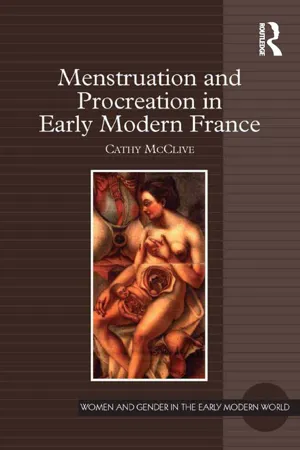
Early modern bodies, particularly menstruating and pregnant bodies, were not stable signifiers. Menstruation and Procreation in Early Modern France presents the first full-length discussion of menstruation and its uncertain connections with embodied sex, gender and reproduction in early modern France. Attitudes to menstruation are explored in three inter-linked arenas: medicine, moral theology and law across the sixteenth to the eighteenth centuries. Drawing on a wide range of diverse sources, including court records and private documents, the author uses case studies to explore the relationship between the exceptional corporeality of individuals and attempts to construct menstrual norms, reflecting on how early modern individuals, lay or otherwise, grappled with the enigma of menstruation. She analyzes how early modern men and women accounted for the function, recurrence and appearance of menstruation, from its role in maintaining health to the link between other physiological and bodily processes, including those found in both male and female bodies. She questions the assumption that menstruation was exclusively associated with women by the second half of the eighteenth century, arguing that whilst sex-related, menstruation was not sex-specific even at the turn of the nineteenth. Menstruation remains a contentious topic today. This book is not, therefore, simply a study of periods in early modern France, but is also of necessity an exploration about the nature and constitution of historical evidence, particularly bodily evidence and how historians use this evidence. It raises important questions about the concept of certainty and about the value of observation, testimony, expertise, the nature of language and the construction of bodily truths - about the body as witness and the body as evidence.
Information
Chapter 1
Leviticus and the Problem of Sex during Genital Fluxes
Leviticus is one of the main written sources, along with texts by Aristotle (384–22 BCE) and Pliny the Elder (23–79 CE), credited with the origin of negative attitudes towards menstruation and menstrual fluid in the Judaeo-Christian world.1 Anxieties about sex during menstruation suggest some overlap between these traditions, although Aristotle’s and Pliny’s texts explicitly mention the negative properties of menstrual fluid, while Leviticus does not. Leviticus prohibits sex during menstruation, whereas Pliny’s Natural History (c.77–79 CE) warned of the nefarious consequences of such an act ‘for the woman’s sexual partner, and progeny’, cautioning that ‘coitus [with a menstruating woman] is fatal for men’.2 In Leviticus, however, it is a question of ritual or spiritual, rather than physical, impurity that is contracted during contact, sexual or otherwise, with a menstruant.
Taken at face value, these oft-repeated statements present a fairly negative image of menstruation. It is easy to see why the deleterious connotations of menses are so memorable, but they are also often taken out of context. For instance, most of us are more familiar with Pliny the Elder’s comments regarding the ability of menstruating women to sour wine, destroy crops, tarnish mirrors and give dogs rabies than with his less well-known assertion that menses could also cure tumours, pathological emissions, paralysis and epilepsy and that they were used to form and nourish the foetus.3 Yet when properly contextualised, Pliny’s comments can be seen to embody both negative and positive attitudes towards menses. However, the positive elements of Pliny’s account of the properties of menses are often ignored in the overarching representation of the ‘magical’ and malefic qualities of menstrual blood. For instance, the above quotation regarding the impact of sex during menstruation on the male sexual partner is partial and reveals a very different picture when read in full: ‘If the rules coincide with a lunar or solar eclipse, the ill they cause is irremediable; the same is true when they coincide with the absence of the moon, then coitus is fatal for males.’4 Sex during menstruation was not always fatal for men, then, but only if it occurred when the moon was obscured which rather limits the magical powers of the menses themselves. And yet, authors past and present, drawing on Pliny, generally only retain the part about the lethality of coitus during menstruation.5 Such decontextualisation perhaps reveals more about the reception of Pliny’s text than about the author’s aims and can be explained partly by the structure of the work itself and partly by the reputation Pliny acquired subsequently, which has led scholars to focus on the magical elements of his deliberations. Pliny’s encyclopaedic text claimed to be a compilation of over 20,000 facts presented in 37 books drawn from a wide range of textual classical scholarship as well as popular sources. Menstruation is discussed in Books 7 and 28, both of which contain positive and negative elements; however, discussion of the therapeutic qualities of menses is mainly found in Book 28. Given what we know about the production of ancient texts and the fact that individual books were often written on individual rolls allowing buyers to purchase only the sections which interested them, it is possible that not all the sections on menstruation were copied every time Pliny’s Natural History was sold, and that Book 13, which covers generation, might have been more in demand than Book 28 on medicinal remedies from human ingredients, thus facilitating the decontextualisation of Pliny’s negative remarks.6
Pliny’s sources are included in lists at the end of each chapter, but it is not always clear which bit comes from which source unless this is cited in the body of the text. In the sections on the positive qualities of menstruation in Book 28, Pliny does cite his sources directly. They include Lais the fifth-century courtesan, midwives Salpe and Sotira, physician Icetidas and a certain Bythus of Dyrrachium, suggesting that ancient medicine was positively disposed towards menstruation, as scholars such as Lesley Dean-Jones have argued. Indeed, many ancient texts did not express anxieties about menstruation at all.7
Similar points can be made about the treatment of Leviticus. Prohibitions on sex during menstruation are often picked out from Leviticus 15, 18 and 20. However, the issue of sex during menstruation is situated within a body of laws governing genital discharges, adultery, fornication and idolatry. Levitican laws regulate contact between the sacred and the profane and command comportment regarding food and hygiene, as well as sexual morality. Moreover, they are concerned with emissions from both the male and the female body, although this fact is often overlooked.
The biblical interdiction on sex during menstruation caused real anxiety in the Christian West, prompting medieval and early modern moral theologians, university-educated physicians, surgeons and more popular medical authors to address the practical ramifications of this prohibition for procreation. This, as we will see in more detail in the next chapter, was not because they were worried about the corrosive effects of menstrual blood on male sexual organs. Rather, they were concerned about optimising the conditions for healthy procreation, and balancing the tension between the dual aims of marriage: prevention of fornication and promotion of procreation.8 The ancient Levitican interdiction was not accepted unquestioningly. Rather, it was actively interrogated in theological and medical literature alike. Moral theologians queried the applicability of Levitican law in early modern Europe, and worried about how to guide penitents through the minefield of sexual morality in the context of renewed emphasis on the confessional following the Council of Trent. Medical authors, striving to understand, and to control, the mysteries of procreation, questioned the interference of religion in medical matters and deliberated the qualities of menstrual blood and its role in generation. Authors asked questions such as: Are there good reasons for sex during menstruation to be prohibited? Is conception during menstruation possible? Would it harm potential offspring?
The assumption, which many early modern historians and literary scholars have made, both implicitly and explicitly, that Leviticus was used to justify broader misogynist attitudes towards menstruating women in elite and popular theological and medical circles, is unfounded. Whilst Margaret Healy and Bethan Hindson have taken a step in the right direction by drawing attention to the existence of both negative and positive attitudes to menstruation in early modern English sources, it is time to put the misconception of ‘menstrual misogyny’ based on Leviticus to bed once and for all. Early modern medical theory was not inherently misogynistic. It did not draw on Leviticus to fuel ideas about the dangers of menstruating women. More significantly for our purpose here, the expression and diffusion of Leviticus in early modern France was gender neutral, and represents what David Biale has called ‘procreative theology’ rather than misogyny.9 In this chapter, I examine the ways in which the prohibition on sex during menstruation was promulgated in early modern France in order to refute the misconception that Leviticus was an inherently misogynist text which fuelled theologians’ and medical practitioners’ negative view of the menstruating woman. To do so, I analyse shifts in the vocabulary used to express Levitican prohibitions on sex with a menstruating woman in 35 French translations of the Bible printed between 1530 and 1789. These linguistic shifts are read alongside relevant entries in 24 dictionaries published between 1539 and 1798. This comparison illustrates the evolution in attitudes on the part of the educated male elite (theologians and lexicographers), demonstrating that any negative ideas about menstruation in circulation were not promoted by the clerical elite responsible for French biblical translations. It also demonstrates how dictionary compilers, who often saw themselves as guardians of the French language, were highly alert to the ways in which the terms used to translate biblical passages on menstruation could be misinterpreted, thereby changing their meaning entirely. Consequently, they made a point of explicitly correcting poor usage in their dictionaries. This chapter does, therefore, indicate a potential area of slippage between the spiritual impurity expressed in Leviticus and the more concrete idea of physical impurity in the popular imagination, which the lexicographers sought to correct. There is no direct evidence that such a conflation occurred, or of how widespread it was if it did, but the indirect evidence explored below suggests one way in which it may have indeed occured. This is, evidently, refracted in the dictionary compiler’s perception of popular culture and concern for his own reputation as an enlightened scholar correcting improper usage.10 It may not be possible to uncover fully wider reactions to the translations of Leviticus. However, my analysis of translation practices and dictionaries demonstrates that the male cultural elite, in control of the expression and promulgation of Leviticus, and the shaping of the French language, did not advocate, or disseminate, negative interpretations of menstruation.
The following analysis of the translations of Leviticus and dictionary entries throws up three significant, and sometimes contradictory, shifts which occurred across the period c.1530–1798. First, a change in vocabulary from immonde (unclean) to impur (impure) opened up the possibility of slippage from ritual to physical impurity in interpretations of Leviticus; this slippage was picked up and corrected by dictionary compilers. Second, a focus on contextualising Leviticus within Judaism and the ‘other’ allowed translators and dictionary compilers to emphasise the ritual, rather than physical, nature of menstrual and seminal impurity and thus to distance themselves from ideas that menses were noxious. Third, following a broader moralising movement within French Catholicism, the translations reflect a wider shift which rendered the sexual act a product of marriage, highlighting the procreative aim of the prohibition on sex during menstruation. Before we turn to this analysis, it is worth looking in more detail at the structure of Leviticus, at the problem of seminal flux, which is often overlooked as a result of the focus on menstrual flux, and at the context in which the sources selected for this chapter were produced and circulated.
The Structure and Aims of Leviticus
Leviticus 15 in particular is an enigmatic and controversial text, even today. Despite this, the majority of historians and philologists are in agreement that the principal aim of the chapter is procre...
Table of contents
- Cover Page
- Title Page
- Copyright Page
- Dedication
- Contents
- Acknowledgements
- List of Abbreviations
- Introduction: Blood, Menses and the Myth of ‘Menstrual Misogyny’
- 1 Leviticus and the Problem of Sex during Genital Fluxes
- 2 Menstruation, Conception and the Timely Use of Marriage
- 3 ‘I await my rules which do not arrive’: Menstrual Regularity and Irregular Menstruation
- 4 Detecting and Proving Pregnancy
- 5 Menstrual Time and the Moons of Pregnancy
- 6 Bleeding Hermaphrodites and Menstruating Men
- Conclusions
- Select Bibliography
- Index
Trusted by 375,005 students
Access to over 1.5 million titles for a fair monthly price.
Study more efficiently using our study tools.
Frequently asked questions
Yes, you can cancel anytime from the Subscription tab in your account settings on the Perlego website. Your subscription will stay active until the end of your current billing period. Learn how to cancel your subscription
No, books cannot be downloaded as external files, such as PDFs, for use outside of Perlego. However, you can download books within the Perlego app for offline reading on mobile or tablet. Learn how to download books offline
Perlego offers two plans: Essential and Complete
- Essential is ideal for learners and professionals who enjoy exploring a wide range of subjects. Access the Essential Library with 800,000+ trusted titles and best-sellers across business, personal growth, and the humanities. Includes unlimited reading time and Standard Read Aloud voice.
- Complete: Perfect for advanced learners and researchers needing full, unrestricted access. Unlock 1.5M+ books across hundreds of subjects, including academic and specialized titles. The Complete Plan also includes advanced features like Premium Read Aloud and Research Assistant.
We are an online textbook subscription service, where you can get access to an entire online library for less than the price of a single book per month. With over 1.5 million books across 990+ topics, we’ve got you covered! Learn about our mission
Look out for the read-aloud symbol on your next book to see if you can listen to it. The read-aloud tool reads text aloud for you, highlighting the text as it is being read. You can pause it, speed it up and slow it down. Learn more about Read Aloud
Yes! You can use the Perlego app on both iOS and Android devices to read anytime, anywhere — even offline. Perfect for commutes or when you’re on the go.
Please note we cannot support devices running on iOS 13 and Android 7 or earlier. Learn more about using the app
Please note we cannot support devices running on iOS 13 and Android 7 or earlier. Learn more about using the app
Yes, you can access Menstruation and Procreation in Early Modern France by Cathy McClive in PDF and/or ePUB format, as well as other popular books in Medicine & Early Modern History. We have over 1.5 million books available in our catalogue for you to explore.