eBook - ePub
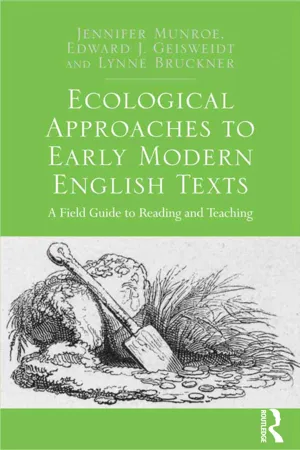
Ecological Approaches to Early Modern English Texts
A Field Guide to Reading and Teaching
- 274 pages
- English
- ePUB (mobile friendly)
- Available on iOS & Android
eBook - ePub
Ecological Approaches to Early Modern English Texts
A Field Guide to Reading and Teaching
About this book
Ecocriticism has steadily gained footing within the larger arena of early modern scholarship, and with the publication of well over a dozen monographs, essay collections, and special journal issues, literary studies looks increasingly 'green'; yet the field lacks a straightforward, easy-to-use guide to do with reading and teaching early modern texts ecocritically. Accessible yet comprehensive, the cutting-edge collection Ecological Approaches to Early Modern English Texts fills this gap. Organized around the notion of contact zones (or points of intersection, that have often been constructed asymmetrically-especially with regard to the human-nonhuman dichotomy), the volume reassesses current trends in ecocriticism and the Renaissance; introduces analyses of neglected texts and authors; brings ecocriticism into conversation with cognate fields and approaches (e.g., queer theory, feminism, post-coloniality, food studies); and offers a significant section on pedagogy, ecocriticism and early modern literature. Engaging points of tension and central interest in the field, the collection is largely situated in the 'and/or' that resides between presentism-historicism, materiality-literary, somatic-semiotic, nature-culture, and, most importantly, human-nonhuman. Ecological Approaches to Early Modern English Texts balances coverage and methodology; its primary goal is to provide useful, yet nuanced discussions of ecological approaches to reading and teaching a range of representative early modern texts. As a whole, the volume includes a diverse selection of chapters that engage the complex issues that arise when reading and teaching early modern texts from a green perspective.
Information
Reading Ecologically: Texts and Methodologies
Chapter 4
Roses in Winter: Recipe Ecologies and Shakespeare’s Sonnets
University of Colorado, Colorado Springs
Glove, pollen, rat, cap, stick. As I encountered these items, they shimmied back and forth … between … stuff to ignore, except insofar as it betokened human activity (the workman’s efforts, the litterer’s toss, the rat-poisoner’s success), and … stuff that commanded attention in its own right, as existents in excess of their association with human meanings, habits or projects.1
I have seen roses damask’d.2
Jane Bennett’s evocative descriptions of “vibrant matter” have lately attracted early modern ecocritics trying to get at the strangeness of things, but while this theoretical picture resonates, it only awkwardly applies.3 That is, the vitality, the life “in excess of … human meanings,” that Bennett perceives in her opening tableau of “stuff” caught in a storm drain—and in general through the cultural artifacts she gleans from the American Romantics forward—would have been absurd in its obviousness to individuals who were embedded in the messiness of matter on a daily basis and, more importantly, tied to the material world around them not just by aestheticized perception but by labor and the concrete knowledge that comes with it. And while the difference still lies in the quality of human perception, an appreciation of this difference is essential for successful early modern ecocritical inquiry. That is, when the human and nonhuman are so closely intertwined, so are their vulnerabilities, as well as their agentic capacities. By importing wholesale this post-Walden ecological theory and ignoring this embeddedness in the interest of articulating nonhuman agency, we lose the contours and consequences of not only early modern relationships with the environment but also our own.
For humans caught up in the work of distillation, cooking, and cultivation, we have an abundant record of close attention to the things with and through which they lived, most clearly in their recipe books. Recipe books reveal a pragmatic, rather than idealized, intimacy between early moderns and their nonhuman counterparts. Recipes record an intimacy with “stuff” that is both complicated and messy. As Michelle DiMeo and I, alongside David Goldstein, have shown, that intimacy is in no way ideal and is often cruel.4 A relationship established through material practice is not, by definition, poetically transcendent, but through it, the things involved are known more deeply than light shining off surfaces.
The vast repository of collective knowledge held in the hundreds of manuscript recipe (or “receipt”) books of the sixteenth through eighteenth centuries may be our best source for the daily interactions of a wide range of people with their environments. In the way that food, medical, and science historians such as DiMeo and Sara Pennell and Elaine Leong have done, literary historians may similarly subject these texts to close reading and contextual analysis,5 and several literary critics have begun to consider these texts in what can be perceived as ecologically motivated ways.6 In my extensive close reading of one collection alongside Shakespeare’s sonnets, I hope to further and complicate our ecological inquiry into the early modern period, revealing how, in the material necessities of daily life and of literary convention, humans objectify their environment at the same time they are subjected to it. This is not to return to an anthropocentric position, but rather to show how the anthropocentric view is not ultimately sustainable in a world in which humans and things are enmeshed. We set ecocriticism up for failure if we ignore how central objectifications are—if we place parentheses around labor as Bennett does—because inevitably the intimacy of that embeddedness leads to exposing the vulnerability of the human position. Thus the application of current theories to past moments ignores the fact that our removal from production and the resultant detachment are historically specific phenomena, and it is only in our detachment that we must come to self-critique and change our way of seeing. Again, for early moderns, the critique of anthropocentricism exists within the very intimate relationship with the environment, as we will see here fully expressed within first a recipe collection, then in Shakespeare’s sonnets.
One Recipe Collection
My methodology here is to “parse” one recipe collection through transcription of its contents and statistical analysis of its ingredients.7 I admit I began with an interest in how this collection captured the use of plant materials, but this is as specific as my ecological aims were upon first meeting this text. The manuscript belongs to the University of Pennsylvania’s rare book library. Codex 823 is notebook size with 43 leaves, and its owner is unknown.8 Devotional material at the beginning provides an historical point, 1568, after which the notebook must have been started, and the section of recipes at the end comprises 29 of the leaves. More than half of the recipes are in a Tudor hand, but later additions tell us that this volume, like many collections, passed through generations, and close analysis implies that this manuscript stayed within the same or similar local environment throughout its compilation.
Part of my contention is that the continued notable presence of roses across the collection gives evidence of a sustained household practice, a continuity of ingredients, if you will. Twenty-nine of the 146 recipes, roughly 20 percent, include roses. This was not simply an aesthetic use, but rather, roses were widely held as a cooling medicine in the Galenic schema. Certainly the rose is a regular ingredient in recipe collections in general, but the variety of forms that this ingredient takes in this manuscript is exceptional. In these recipes, roses appear in all forms: fresh blooms, and new buds (which required an “in season” processing) as well as waters, oils, dried petals, and powders (allowing for year-round use). Roses are common, yet various.
First, yes, roses are distilled. Sixteen of the twenty-nine recipes include rosewater, an ingredient discussed by both Wendy Wall and Holly Dugan in different contexts.9 The very first recipe, a medicine, requires rosewater, as do four other medicinal recipes. Another large group of recipes that include rosewater are fruit preserves (one requiring a pint), most of which are in a later hand. None gives an alternative to rosewater, as other recipes from the period do, even though, as Dugan notes, “it may take upward of five hundred pounds of roses to produce one pound of rosewater.”10
While the recipe book does not include entries for making rose water, we do know that distillation was performed in the household because of two recipes containing roses for more complicated waters. One is for a perfume, the other for a potent medicine. The first is “Damask water” (which did not necessarily include damask roses) (fol. 21r).11 The recipe calls for layering roses and lavender with a powder made from other typical perfume ingredients. These are then heated in an alembic with the only liquid in the mixture being on and of the plants. The other distillation found on the next page—pointedly made with dried rose petals and quite omnipresent throughout the sixteenth and seventeenth centuries—is “Doctor Stevens Water” (fol. 21v) and is used to alleviate numerous ailments. It includes many spices and herbs that are steeped, as is typical, in a gallon of wine, then the mixture is “stilled” in a “limbeck.” The dried rose petals point to a different function of distillation than the damask water, which requires an “in the moment” processing with fresh roses and lavender to be most fragrant.12 In contrast, another version of Dr. Stephen’s Water found at the Wellcome Library calls for fresh roses, one which ends “the tyme to make it is about Midsommer.“13
Another popular, and delicious, means of preservation is the making of syrups from fresh ingredients.14 The UPenn codex’s “To make Syrropp of Roses” (fol. 23v) begins: “Take ii pound of Roses … put them into an earthen pott … & put vppon them viii pyntes water warmed & lett them be closed viii howeres.” After that eight hours of infusion, you are to strain the water from the petals, warm the water, and then pour that same water onto as many roses again. Now the question arises: how many roses in a pound of roses? Current commercial sites only provide the equation for dried petals: 25 roses equals one ounce. If we multiply this by 32, it equals 800 in the first round, plus another 800 roses in the second. But the recipe goes on to say “thus shift them 5 times,” which suggests that the same eight pints of water will be infused by 5,600 different flowers (and about five pounds of sugar).15
The later section in a different hand gives evidence that this mega-use of roses was maintained as it expands on the number of perfumes and “fumagations,” most of which contain rose water or dry rose leaves. One, a fumagation cake (fol. 38r), even calls for the damask water found earlier. This later section also gives clear evidence that roses were a primary concern in the household gardens in “To make conserves of roses or other flowers,” which requires “the buddes of reade roses before thei be redye to spreade” (fol. 36r) and thus implies a certain access to roses as they grow.
How common it is to have so many recipes containing roses would take a database to determine, but two other randomly selected and fully transcribed collections from the same 50-year period—one (largely medicinal) has 15 percent of its recipes including roses, the other (largely culinary) has 25 percent—place Codex 823 somewhere in the middle.16 This regular appearance of roses (as well as other plant ingredients) across recipe books is part of my continued research. I do not mean, moreover, to imply that roses are extraordinary in this recurrence; other plants such as rosemary and hyssop hold starring roles as well. One rare recipe written in a looser hand and found in the middle of the manuscript, however, denotes the singularity of roses, particularly in this manuscript:17
To make Roses growe in wynter
Take Brimstone and beat yt to powder
and leye yt on the roote of the roses the
thicknes of a Strawe and then layest horse
doung thereon and cast Otes thereon
& cover yt with earth and they will grow
and Budd within eight dayes. (fol. 26r)
Seeing this recipe alongside the pints of rose water, the layers of petals in the damask water, the pounds of flowers in the syrup, the rosebuds in the conserve recipe, well, took my breath away. Suddenly, taken away from the heat of the fire, we are outdoors. It is cold.
In some ways this is not as unusual a recipe occurrence as my breathlessness implies. In giving directions essentially to “go forth and interact with the environment” and in also giving a record of that interaction, recipe books are regularly and thrillingly liminal in a dialogue between literary history and ecocritical and ecofeminist inquiry. Many recipes describe where, when, and how to harvest ingredients and in turn record the occasion in which it has been done. In integrating these dealings with the environment into the kitchen or stillroom, recipes often make explicit the movement of bodies, often female, between spaces, and show how the outside living environment becomes internalized in both senses of that word.18 These moments reveal both an embeddedness with as well as a subjugation of the environment; in that subjugation and intimacy, however, lies a precariousness and dependency, latent and soon realized.
While this was the first time I had seen this particular task, growing roses in winter, described in a manuscript collection, I had previously seen the desire articulated in works as diverse as gardening manuals and herbals, the writings of the ancient Roman stoic Seneca and the letters of the early scientist Robert Boyle. Sixteenth-century gardener John Gerard instructed his reader to “cut away” “the tops and superfluous branches” of the rose bush in “the end of their flouring,” and this would mean that the plants would “floure euen vntill October, and after” (1633, 1262). I could have come to the image any number of ways, even through Shakespeare himself, but it is significant that it occurs in the recipe book as such because within the collection it has a particular effect.
This entry may be a throwback to early books of secrets that contained many household maintenance tips, but this is the only recipe of its kind in this collection. In this recipe book, it is clearly a game of one of these things is not like the others: to be so openly in a different space makes that space suddenly apparent. We are taken out of the moment of processing. We are not distilling, or grinding, or drying, or steeping, or otherwise consuming parts of roses. We are making roses grow. In this way, we become aware of our use of them. The recipe collection as a whole thus provides a kind of ecocritical theorizing of itself: sustained engagement with the environment leads to a heightened awareness of that environment and its vicissitudes. Any denial of one’s subjection to the environment through an attempt at domination may seem as desperate as the desire to make roses bloom in winter.
This heightened awareness of our relation to the environment is certainly what ecocriticism in general seeks. With “How to make roses grow in wynter,” we can see how the demand put on the garden by the recipes (apart from aesthetic desire) precipitates the need for extended growth period, which in turn, contributes to the entry in the text. If we then translate this awareness to a deeper understanding of the relationship between more traditionally literary texts and the environment, we must reconsider the literary processes upon which our roles as close readers depend. In taking on such eco-revisionist inquiry, we must challenge the notions of convention and metaphor that define our knowledge of poetry. Therefore, I want to consider the roses of Shakespeare’s sonnets not only as poetic convention but also as environmental commonplace, as that which is seen regularly in the environment and thus known in a deeply material way, not just a surface-level and symbolic one. Through this material image, the sonnets bring their readers to a place outside the self-centered enclosure of the sonnet to a place where one is made acutely aware of one’s own subjugation. Outside of this enclosure, the illusion of control over love and nature breaks down.
The Roses of Shakespeare’s Sonnets
There are 11 sonnets in the 154 that overtly include roses. Ten contain the word “rose,” “roses,” or “rosy,” and one describes a canker in the “sweetest bud,” which describes a rose at a particular moment of growth. Seven other sonnets refer more allusively to the rose: in Sonnets 5 and 6 in the trope of distillation, “a liquid prisoner pent in walls of glass,” discussed most recently by Wall and Dugan and before them Jeffrey Masten and Richard Halpern,19 and at such moments in 65, 68, 113, 124 and 126, which equate the beloved with a flower, whom the lover-poet in 109 calls “my rose.”20 If we allow for this implicit development of the beloved as rose metaphor, there are 18 references, constituting almost 12 percent of the entire sequence.
The first sonnet (not unlike the first recipe in Codex 823) has the image that informs all others, which begins “From fairest creatures we desire increase / That thereby beauty’s rose may never die.” This opening image has been discussed with regard to distillation;21 however, only three of the 18 poems in the rose complex (and one that has nothing to do with roses) do refer to distillation. Two others refer to the conventional visual image of beauty (roses of shadow, rosy cheeks). Four refer to the canker worm, the blight of roses, successively representing the faults, vice, and shame of the beloved and ...
Table of contents
- Cover Page
- Title Page
- Copyright Page
- Contents
- List of Figures
- Notes on Contributors
- Foreword
- Introduction
- Section I Theoretical Approaches
- Section II Reading Ecologically: Texts and Methodologies
- Section III Approaches to Teaching Ecologically: Texts and Methodologies
- Afterword: Post-script
- Bibliography
- Index
Trusted by 375,005 students
Access to over 1.5 million titles for a fair monthly price.
Study more efficiently using our study tools.
Frequently asked questions
Yes, you can cancel anytime from the Subscription tab in your account settings on the Perlego website. Your subscription will stay active until the end of your current billing period. Learn how to cancel your subscription
No, books cannot be downloaded as external files, such as PDFs, for use outside of Perlego. However, you can download books within the Perlego app for offline reading on mobile or tablet. Learn how to download books offline
Perlego offers two plans: Essential and Complete
- Essential is ideal for learners and professionals who enjoy exploring a wide range of subjects. Access the Essential Library with 800,000+ trusted titles and best-sellers across business, personal growth, and the humanities. Includes unlimited reading time and Standard Read Aloud voice.
- Complete: Perfect for advanced learners and researchers needing full, unrestricted access. Unlock 1.5M+ books across hundreds of subjects, including academic and specialized titles. The Complete Plan also includes advanced features like Premium Read Aloud and Research Assistant.
We are an online textbook subscription service, where you can get access to an entire online library for less than the price of a single book per month. With over 1.5 million books across 990+ topics, we’ve got you covered! Learn about our mission
Look out for the read-aloud symbol on your next book to see if you can listen to it. The read-aloud tool reads text aloud for you, highlighting the text as it is being read. You can pause it, speed it up and slow it down. Learn more about Read Aloud
Yes! You can use the Perlego app on both iOS and Android devices to read anytime, anywhere — even offline. Perfect for commutes or when you’re on the go.
Please note we cannot support devices running on iOS 13 and Android 7 or earlier. Learn more about using the app
Please note we cannot support devices running on iOS 13 and Android 7 or earlier. Learn more about using the app
Yes, you can access Ecological Approaches to Early Modern English Texts by Jennifer Munroe,Edward J. Geisweidt in PDF and/or ePUB format, as well as other popular books in Literature & Publishing. We have over 1.5 million books available in our catalogue for you to explore.