- 192 pages
- English
- ePUB (mobile friendly)
- Available on iOS & Android
eBook - ePub
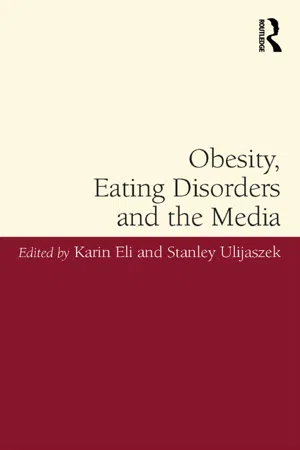
Obesity, Eating Disorders and the Media
About this book
How do the media represent obesity and eating disorders? How are these representations related to one another? And how do the news media select which scientific findings and policy decisions to report? Multi-disciplinary in approach, Obesity, Eating Disorders and the Media presents critical new perspectives on media representations of obesity and eating disorders, with analyses of print, online, and televisual media framings. Exploring abjection and alarm as the common themes linking media framings of obesity and eating disorders, Obesity, Eating Disorders and the Media shows how the media similarly position these conditions as dangerous extremes of body size and food practice. The volume then investigates how news media selectively cover and represent science and policy concerning obesity and eating disorders, with close attention to the influence of pre-existing framings alongside institutional and moral agendas. A rich, comprehensive analysis of media framings of obesity and eating disorders - as embodied conditions, complex disorders, public health concerns, and culturally significant phenomena - this volume will be of interest to scholars and students across the social sciences and all those interested in understanding cultural aspects of obesity and eating disorders.
Information
Chapter 1 Introduction: Obesity, Eating Disorders and the Media
DOI: 10.4324/9781315598666-1
This volume is premised on the idea that we can best understand the media’s representations of obesity and eating disorders by conceptualizing them as closely interlinked, rather than distinct, public health and social phenomena. It questions the tendency to position the obese and the anorexic body as separate, polar opposites – as overeating juxtaposed with self-starvation. Instead, this volume approaches obesity and eating disorders as mutually-implicating conditions that together draw attention to the material extremes of fat and emaciated bodies, overeating and self-starvation, and fatty and lean foods.
Eating disorders and obesity are not, in themselves, contrasting conditions. While obesity can be defined by metrics, such as body mass index, eating disorders are defined primarily through ideation and practice; underweight, rather than being the endpoint of eating disorders, is only one possible outcome. Far from being mutually exclusive, obesity and eating disorders, at times, co-exist, and the clinical literature has long recognized connections between the two conditions. As early as the 1970s, prominent eating disorders clinicians such as Hilde Bruch (1974) and Arthur Crisp (1980) published case study monographs that highlighted links between obesity and eating disorders, and implicated childhood obesity as a risk factor for the development of anorexia nervosa later in life. The newly published fifth edition of the Diagnostic and Statistical Manual (DSM-V) (American Psychiatric Association, 2013) recognizes binge eating disorder – which often leads to obesity – as one of the three specified eating disorders, alongside anorexia nervosa and bulimia nervosa. Moreover, boundaries between the three eating disorders (and their subclinical variants, subsumed under other specified feeding or eating disorder [OSFED]), are highly fluid. While it may appear that binge eating disorder and anorexia nervosa entail significantly different eating practices, anorexia nervosa does have a binge eating and purging subtype, and most people with eating disorders, including those diagnosed with anorexia nervosa, have binge eating experiences during the course of their disorder (Fairburn and Harrison, 2003). And rather than remaining fixed in their diagnoses, people with eating disorders, particularly those initially diagnosed with restrictive anorexia nervosa, may transition from one diagnosis to another (Eddy et al., 2002; Eddy et al., 2008). Indeed, Fairburn, Cooper and Shafran (2003) argue that a ‘transdiagnostic’ approach to understanding and treating eating disorders best reflects the cognitive realities of these disorders.
For the lay public, however, clinically-observed connections between obesity and eating disorders are not readily apparent. Popular imaginings of obesity and eating disorders tend to relegate these conditions to contrasting points on the continuum of body weight. Yet this misperception also links obesity and eating disorders through their seeming disparity. In lay framings of obesity and eating disorders, the two conditions are submerged in inescapable co-existence, not within the same person, but within the same society. Whether explicitly or implicitly, lay framings of one condition vis-à-vis its ‘other’ reveal a form of cultural ‘sense-making’ that interweaves the construction of social problems, a fascination with the body in extremes, and the zeitgeist of normative body image and consumption concerns in the twenty-first century.
Bridging the clinical and lay realms are the news media. In recent years, the news media landscape has been undergoing rapid change with the emergence of influential new media and social media platforms, enabling more local control and user involvement. Amidst these changes, the media (‘traditional’ and new) continue to be the central source of research information for the public, while also providing the main platform for lay (albeit, at times, journalistically-mediated) discussion, dissemination, and consumption of dominant popular ideas on obesity and eating disorders. The news media, importantly, broker knowledge, making visible selected scientific findings and policy decisions, while leaving many others obscured: even to the well-versed lay reader, most scientific and policy papers remain inaccessible, such that the public – beyond certain academic and government circles – must rely on news media to learn about scientific and policy work. Analyses of media framings of obesity and eating disorders, then, can unveil two central constituents of popular ‘sense-making’: how lay discourses constitute these conditions as social problems, and how scientific and policy news is transmitted to the public.
To develop a new, interlinked perspective on media representations of obesity and eating disorders, we set out to delineate the themes underlying media framings of these conditions, and elucidate the news media’s selective coverage and representation of scientific and policy reports. Reflecting these dual aims, this volume is divided into two sections: ‘Rhetorics of abjection and alarm’ and ‘Representations of science and policy’. We suggest that richer understandings emerge when media representations of obesity and media representations of eating disorders – and of the bodies attendant to each of these conditions – are read together. Such reading provides fertile ground from which to explore the discursive parallels these representations share, consider how the framing of one condition implicates the other, and examine how these framings reflect the greater socio-political space within which obesity and eating disorders, and the science and policy thereof, occur.
The book begins with Anna Lavis’ analysis of the morally-condemning media discourses surrounding pro-anorexia websites. Lavis examines the ways in which these discourses have become entangled in the (re)production of pro-anorexia (pro-ana) online, their reductionist, and indeed, judgmental framings of pro-ana redefining pro-anorexic cyber spaces as zones of (malicious) contagion. These media stories, Lavis argues, have practical bearing on the sites and people they frame, as they facilitate, even encourage, engagements that overtake and transform pro-anorexic spaces. Media tales of anorexic ‘contagion’ online facilitate and legitimize interlopers – ‘righteously indignant’ outsiders, and those seeking to be ‘infected’ – whose entry into pro-anorexic spaces then reinforces the media’s reductionist framing of pro-ana as a cause for alarm. The framing of pro-ana through an alarmist lens is, perhaps, not surprising; even predating the pro-ana era, media stories have portrayed eating disorders as ‘infectious’, preying on women’s supposedly inherent vulnerabilities (to images, texts, and other women), and being transmitted from one ‘victim’ to another through, paradoxically, the media themselves (cf. Bray, 1996; Burke, 2006). But alarmist media framings are not restricted to presumed social contagion. As Natalie C. Boero suggests in her chapter on New York Times articles, the news media frame the ‘obesity epidemic’ as an impending nation-wide public health crisis brought on by irresponsible, ill-educated, or self-indulgent eating and (non-)exercise behaviours. While media reports on obesity sound the alarm for a population much broader than the teenage girls identified in reports on pro-ana, the crisis they portray is also bound up with groups they identify as being ‘susceptible’, particularly women and ethnic minority citizens of reduced or deprived means. Borrowing the language of epidemiology, media reports dissect these groups’ socio-environmental realities into practices that equal vulnerability and risk, reducing them into variables that do not reflect people’s own lived experience. And much like media stories on pro-ana, media reports then frame these ‘at risk’ groups as posing risk to wider society.
Alarm is central in media framings of both obesity and eating disorders; yet, when media portrayals of people with eating disorders and people with obesity are considered together, suggestive differences in the styles of alarm emerge. In their comparative analysis of media stories on people with eating disorders and people with obesity, Saguy and Gruys (2010) pointed to the intersectionality of gender, race, and class in the moral framings of these stories. Eating disordered women, they argued, were framed sympathetically, their white, middle class status affording the protective labelling of disease ‘victim’, in sharp contrast to the moral condemnation levelled at the often non-white, working class or poor people with obesity portrayed in media stories as bearing responsibility for their condition. As Ferris (2003) suggested in her analysis of media stories on Carnie Wilson and Tracey Gold (US celebrity women known for their obesity and anorexia, respectively), while media stories situate both obese and anorexic people at the margins of society, they frame them at odds: the latter as afflicted and in need of re-incorporation, and the former as blame-worthy and requiring ostracism.
In this volume, however, we expand the comparative discussion beyond the realm of biomedically defined disorders, and toward an exploration of the murkier ground occupied by the ‘extreme’ bodies these disorders connote. The obese body and the emaciated body do not simply connote disorder; they are suffused with the materiality of fat, muscle, and bones, and the discourses thereof. It is this materiality that Pino Donghi and Josephine Wennerholm explore in their chapter on the moral dimensions of fat in popular media images and texts. Donghi and Wennerholm draw parallels between media framings of bodies and foods, arguing that both are imagined through similar aesthetic and moral lenses. Fat, especially, looms large. Christopher Forth (2013) argues that stereotypes of fat as morally transgressive or abject are associated, historically, with responses to the sensory properties of fat, its slipperiness and softness. In Donghi and Wennerholm’s analysis, fat emerges as a substance that, as framed by contemporary media stories, pervades both indulgent foods and indolent bodies, implicating failure to embody the self-controlled ethic of neoliberal citizenship. Lean foods and lean bodies, on the other hand, are portrayed in the media as embodying the streamlined, minimalist aesthetic of this political era.
In their material being, the emaciated body and the fat body, moreover, implicate one another. The imagining of the emaciated body in juxtaposition to, and intimate linking with, the obese body has historical roots that extend further than the biomedical and epidemiological definitions of obesity and eating disorders. The situating of fat and wasted bodies as objects for public display can be traced back through the cultural history of enfreakment and spectacle, where ‘living skeletons’, ‘fat men’, and ‘fat ladies’ were stock characters in the travelling menageries of the freak show carnival; as Thomson (1996) writes, ‘living skeletons’ and ‘fat ladies’ were often theatrically coupled, positioned on stage one next to the other to enhance their individual ‘extreme’. Yet seemingly egalitarian exaggerations of ‘extremeness’ do not carry the same implications for the bodies they contrast. In their chapter on the visceral and moral worlds of UK reality show ‘Supersize vs. Superskinny’, Karin Eli and Anna Lavis demonstrate how the show’s direct juxtaposition of fat and skinny bodies constructs the fat body as abject, dangerous, and in need of education and reform. Eli and Lavis argue that the show, which brings together obese and underweight participants who then eat each other’s meals, evokes disgust – directed at both fatty foods and fat bodies – to develop a tacit learning of abjection. In portraying fat as abject, and teaching participants to regard their chosen foods, and their own bodies, as such, the show frames abjection as a central element of public health education – as the sensation all must embody, in reaction to fat, if society is to reverse the alarmingly increasing rates of population obesity.
Abjection and alarm, however, are not confined to reality show, magazine, and newspaper feature framings of obesity and eating disorders. As the book’s second section shows, these framings also shape news media reports on science and policy concerning these conditions. We begin this section with Megan Warin, Tanya Zivkovic, Vivienne Moore and Michael Davies’ chapter on media representations of the fetal origins hypothesis as applied to obesity. As the authors argue, while the hypothesis implicates socio-environmental variables in the development of obesity, its representations cite women (particularly those living in poverty) as the causal agents shaping adverse uterine environments, and thereby transmitting obesity to the next generation. It becomes apparent, then, that while media reports on the fetal origins hypothesis may purport to explain a complex scientific concept to the public, they reproduce judgmental constructions of gender, race, and class, made ‘objective’ through the (mis)use of scientific research. Emily Martin (1991; 1994) has argued that bioscientific representations of physiological phenomena are themselves inflected with implicit social, political, and gendered constructions. Yet, as Warin et al. show in their chapter, news media framings may even distort the representation of a phenomenon in order to shape the story for a socially recognized template of alarm.
The familiar framings of abjection and alarm offer a way of simplifying the biomedical and environmental complexities associated with obesity and eating disorders. In their analysis of US newspaper coverage of eating disorder stories, O’Hara and Clegg Smith (2007) found that most articles employed simplistic, alarmist framings, reducing the medical complexity of eating disorders to support a journalistic entertainment agenda. Emily Shepherd and Clive Seale suggest in their comparative analysis of UK and US media coverage of eating disorders that the extent of reductionism and sensationalism may be dependent on the news source: the character of news media reports on eating disorders, they found, varies by nation and the intellectual standing of the media source. Yet, Shepherd and Seale argue that entertainment-centred framings – mainly focused on portrayals of (rumoured) celebrity illness– constitute the main template by which popular newspapers provide information, and even education, on eating disorders to the widest segment of the lay public. Familiar templates, however, not only affect the ways in which scientific findings are reported; they may also affect which scientific findings are reported. In their chapter on scientific reports concerning obesity, their attendant press releases, and the media coverage that followed, Abigail Saguy and Rene Almeling find that media reports employ alarmist framings to convey scientific findings. Saguy and Almeling suggest, moreover, that the news media may actively choose to report on those research findings that best fit an alarmist frame. Yet they also note that media reports make use of another facilitator of simplified reporting – the press release. Issued by the Journal of the American Medical Association, the press releases the authors studied employed alarmist framings similar to those later included in the media reports. It is possible, then, that press releases may operate symbiotically with news media reports, creating a positive feedback loop: to ensure the popular dissemination of biomedical research findings, press releases employ familiar framings, accessible to the public; journalists then deploy these framings in news media reports; and the reappearance of these framings in the popular news media further reinforces their cultural import.
The news media’s familiar templates of representation also hold sway in the reporting of policy discussions concerning obesity and eating disorders: influence which, in turn, can have consequences in practice. Examining news media c...
Table of contents
- Cover Page
- Half Title Page
- Title Page
- Copyright Page
- Table of Contents
- List of Figures, Tables and Boxes
- Notes on Contributors
- Preface
- 1 Introduction: Obesity, Eating Disorders and the Media—Karin Eli and Stanley Ulijaszek
- PART I RHETORICS OF ABJECTION AND ALARM
- PART II REPRESENTATIONS OF SCIENCE AND POLICY
- Index
Trusted by 375,005 students
Access to over 1.5 million titles for a fair monthly price.
Study more efficiently using our study tools.
Frequently asked questions
Yes, you can cancel anytime from the Subscription tab in your account settings on the Perlego website. Your subscription will stay active until the end of your current billing period. Learn how to cancel your subscription
No, books cannot be downloaded as external files, such as PDFs, for use outside of Perlego. However, you can download books within the Perlego app for offline reading on mobile or tablet. Learn how to download books offline
We are an online textbook subscription service, where you can get access to an entire online library for less than the price of a single book per month. With over 1.5 million books across 990+ topics, we’ve got you covered! Learn about our mission
Look out for the read-aloud symbol on your next book to see if you can listen to it. The read-aloud tool reads text aloud for you, highlighting the text as it is being read. You can pause it, speed it up and slow it down. Learn more about Read Aloud
Yes! You can use the Perlego app on both iOS and Android devices to read anytime, anywhere — even offline. Perfect for commutes or when you’re on the go.
Please note we cannot support devices running on iOS 13 and Android 7 or earlier. Learn more about using the app
Please note we cannot support devices running on iOS 13 and Android 7 or earlier. Learn more about using the app
Yes, you can access Obesity, Eating Disorders and the Media by Karin Eli,Stanley Ulijaszek in PDF and/or ePUB format, as well as other popular books in Social Sciences & Cultural & Social Anthropology. We have over 1.5 million books available in our catalogue for you to explore.