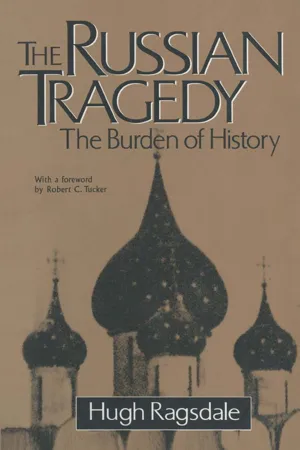
This work provides an interpretive history of Russia from earliest times to today, recounting the story of Russia's past. It discusses Russia's strengths and weaknesses as a civilization, and the challenges posed by the contemporary effort to remake Russia.
They … went overseas to the Varangian[s and] … said, “Our land is great and rich, but there is no order in it. Come to rule and reign over us.” And … three brothers, with their kinsfolk … migrated. The oldest, Riurik, located himself in Novgorod.
The Calling of the Varangians, Primary Chronicle
In framing a governmentthe great difficulty is this: you must first enable the government to control the governed; and in the next place oblige it to control itself A dependence on the people is, no doubt, the primary control on the government.
Madison, The Federalist, No. 51
The first fact in the evolution of Russia is one of the most sensitive: it was founded by aliens.
The story of Russia is above all the story of the state. The Slavs who became Russians had been where they were for generations. Their organization was tribal. They were Drevliane (Woods People), Poliane (Field People), Sloviane (People of the Word?), and a dozen or so others. According to their earliest historical record, the venerable Primary Chronicle, there was disorder in the land, and hence, they invited the Varangians to come and establish a government. This was around the year 860. This compact little formula conceals a myriad of mysteries—and of controversies. The presence of disorder is hardly unknown in the history of Russia, but issuing an invitation to foreign dominion is hardly known anywhere in world history.
The Varangians were from Scandinavia. They were Vikings, Norsemen, a dynamic and far-ranging people. They made their presence felt over a large part of the European—and perhaps even North American—world. They were raiding and plundering all over the North Sea, ravaging much of France and England. As they shed their more primordial habits, they would rule Normandy, Sicily, and England—and Russia.
The Varangians came early to Novgorod and Kiev, the “mothers of Russian cities,” and their influence in Russia suggests their motives in coming there. Their name in Russian—variagi—means traders and rowers; that is how they were perceived. They established a route, as the ancient documents have it, “from the Varangians to the Greeks,” that is, to the fabled riches of what was then the crossroads of the world, the Byzantine Empire in Constantinople. The rivers of European Russia run north into the Baltic—the Lovat, the Volkhov, and the Western Dvina—and south into the Black Sea and the Caspian—the Dnieper, the Don, and the Volga. Short overland portages provide a nearly complete “river road” over the whole route. In the year 912, when Kiev dispatched envoys to draw up a treaty with the Byzantines, the Slavic influence in the list of names is hard to find: Karl, Ingjald, Farulf, Vermund, Hrollaf, Gunnar, Harold, Kami, Frithleif, Hroarr, Angantyr, Throand, Leithulf, Fast, and Steinvith.
In this fashion did a Russian state arise amidst the Slavic tribes under the auspices of the Varangians. And this fact gave birth to the “Norman theory” of the origins of the first Russian state, Kievan Rus.
Its consequences for the self-esteem of a major modern nation are easily imagined. Analogous insults would torment the Russian psyche like an ordained atavism, not excluding the present moment. One of the more poignant examples is the story of the origins of the Norman theory itself.
Peter I (d. 1725) wished to modernize his country, make it more like Western Europe. He consulted with the celebrated philosopher Gottfried Wilhelm von Leibniz to lay plans for the founding of an Academy of Sciences. The Academy was duly opened in 1725. Since Peter had died a few months previously, it was formally founded by his widow and successor, Catherine I, apparently a barely literate German peasant woman. The staff of the Academy was imported from Germany. It was two of these German scholars, Gottlieb Siegfried Bayer and August Ludwig von Schlozer, who did the first research into the history of Russia.
The Norman theory was born—nearly stillborn—on 6 September 1749. It was presented to a meeting of the Academy of Sciences by the official imperial Russian historiographer, the German scholar Gerhard Friedrich Miiller, who relied on the research of his German colleague Bayer. As Miiller spoke, his Russian colleague N.I. Popov interrupted to protest: “You, famous author, dishonor our nation.” A tumult arose, and the meeting dispersed. The Empress Elizabeth appointed a committee to determine whether Miiller’s work was inimical to the interests of the nation. Miiller was subsequently forbidden to continue his research, and his publications were confiscated and destroyed.1 He was forced to turn to other subject matter, and he soon began the first serious work on the history of Siberia.
The Norman theory of the origins of Russia has always been controversial, and the significance of Norman influence has been much disputed. It appears that the cultural level of Kievan society was more advanced than that of contemporary Scandinavia. Kiev had a written literature, a written code of law, and the coining of money before these things appeared in Scandinavia. Ancient Russian borrowed words readily from neighboring cultures but few from Scandinavia. In the roughly 125 years between the coming of the Varangians (ca. 860) and the conversion of Russia to Christianity (988), there is no sound evidence of the influence of Scandinavian gods in Russian paganism. Strong evidence in support of Norman influence is clear in archaeological finds, however, and in the distinctly Scandinavian names of the early princes of Kiev and their retinues.
In any event, when Kiev was founded in the ninth century, there were no nations in Europe; there were only tribes. Europe had no East and West in the modern sense of those terms. When the Norman theory was formulated, nations were present, and East and West were recognized. The significance of these factors was undoubtedly projected anachronistically back onto the evolution of the first Russia. Modern Germans discovered ancient Teutons coming to the assistance of backward Russians—as the Teutons themselves were. If that attitude was a misinterpretation of what had happened in 860, by the year 1749 it had become a habit of thinking on both sides of the Russian cultural frontier. It remains so today, and it is one of the most enduring and painful problems of modern Russia. The persistence of the Norman theory undoubtedly owes much to the fact that both Westerners and Russians, however offensive it is to the latter, find in it a kind of familiar description of the cultural relations between them. The civilization of modern England—and of the United States—owes something to the Normans as well, but the nation on whose empire the sun never set and the self-anointed guardian of the new world order are less sensitive to questions of cultural derivation and dependence than modern Russians are.
Most of the experience of Kiev was far happier than the story of its origins. The first Russians were prosperous, as uniquely prosperous in the history of Russia as they were in the Europe of their time. Prosperity forsook modern Russia, and it was not present in the Western Europe of Kievan days. The fall of the Roman Empire and the ravages of the barbarians, the forays of the Norsemen, the expansion of Islam—all of this left travel and transport insecure in Western Europe. This was the age of manorialism, the natural economy, the great contraction of long-distance trade.
The Russians drew their prosperity from two sources. The first was trade. It was the search for trade that had brought the Varangians to Russia, and they were thus predisposed to the good civil order that favored it. The Russian “river road” gave northern and western Europeans a secure access to the eastern Mediterranean, otherwise obstructed by the Muslim–Christian conflict. The archaeological and numismatic records are clear: the trade between Scandinavia and Byzantium along the Russian rivers was active and abundant. The Russians enjoyed a trade like that of modern rather than medieval Europe.
The second source of Russian prosperity was an unusually rich agriculture. If modern Russia is notorious for the poverty of its agriculture, Kievan Russia was quite different. Kiev is the heart of Ukraine. Of the four conditions of a rich premodern agriculture—long growing season (southerly location), rich soil, open prairie (steppe), abundant moisture—Kiev had all but the last. The annual precipitation is only about twenty-four inches. Yet it was enough to make the area the “breadbasket of Europe.”
As rare as prosperity in the history of Russia was the striking freedom of Kiev. The institutions of government might have been designed by a constitutional convention of Aristotle, Polybius, Montesquieu, and Burke. There are three kinds of good government, says Aristotle: monarchy, aristocracy, and polity (democracy); and each has a corresponding perversion: tyranny, plutocracy, and mob rule. In order to avoid endless conflict between the many and the few, the citizenry must comprise as large a proportion as possible of a middle class of people neither so rich as to oppress nor so poor as to be oppressed. Polybius contributed to the classical tradition of political theory by recommending a mixture of Aristotle’s three good forms of government, and he illustrated the prudence of his principle in the institutions of the Roman Republic. In pursuit of the same concept, Montesquieu coined the phrases that were to characterize the American constitution: division of power, and checks and balances. Burke observed that “the nature of man is intricate; the objects of society are of the greatest possible complexity: and therefore no simple disposition or direction of power can be suitable either to man’s nature, or to the quality of his affairs.”2
Kiev did not, of course, have the benefit of this political wisdom, but its government reflected much of it nevertheless. The institutions were multiple and complex. A prince, kniaz, presided in monarchical fashion. The posadnik served as mayor in the towns. A tysiatskii was the urban military commander after the fashion of the Renaissance condottiere. Bishops exercised their influence, after the coming of Christianity, in tandem and in competition with the other institutions.
The exclusiveness of the prince’s power was most effectively blocked by three institutions. A boyar duma constituted his aristocratic council of retainers without whose advice and consent the prince could not execute policy. A veche was the dominant organ of city government. Elected by plebs and merchant oligarchs, it was a semirepublican, semidemocratic town council reminiscent of the city-states of the Hanseatic League and the Italian Renaissance.
Last was a peculiar custom of legal inheritance known as the otchina (later votchina) system. The word otchina is from the word otets, father. Hence the system is also known as the patrimonial (Latin pater) system of land tenure. It stipulated the division of a father’s property among all his sons without any conditionality of inheritance. Unlike the terms of inheritance in contemporary West European feudalism, the holder of a piece of property owed the local prince nothing for it. Therefore, if he chose to transfer his allegiance to a rival prince, even a foreign prince, the property remained irrevocably his, and his right to it and the income from it was not subject to challenge. The system obviously inhibited the centripetal aggrandizement of power.
A variation on the patrimonial system of land tenure was the rota system (Latin wheel, roller, alternation) of the distribution of princely power. It represents the application to royal succession of the patrimonial system of inheritance. The power and the patrimony of the grand prince of Kiev, like that of everyone else, was divided each generation among all of his surviving sons. They inherited their father’s royal prerogatives and shared them collectively. The eldest son was the senior partner in this arrangement. He received a larger inheritance, and when an individual brother-prince died, those junior to him evidently moved up a step in the hierarchy of the family. The effect of the rota system was to give the senior prince something like undivided sovereignty of princely power in his own subprincipality and shared sovereignty of princely power in those subprincipalities of his brothers that constituted, along with his own, the Grand Principality of Kiev.
What is most important in the political institutions of Kiev is the multiple fashion in which power in the state was shared. It was roughly consonant with the conceptions of our classical political philosophers, including Montesquieu. It did not embrace, however, the axioms of the American Declaration of Independence in which men were born free and equal and endowed by their creator with unalienable rights, that is, natural rights.
Neither was Kievan freedom like that of medieval Western Europe, where individual rights derived from the legal status of the ind...
Table of contents
Cover Page
Half Title Page
Title Page
Copyright Page
Dedication
Table of Contents
Foreword
Preface
Chronology
Part I: The Historical Ingredients
Part II: The Revolutionary Experience
Conclusion: A Cautious Prognosis
Notes
Index
Trusted by 375,005 students
Access to over 1.5 million titles for a fair monthly price.
Study more efficiently using our study tools.
Frequently asked questions
Yes, you can cancel anytime from the Subscription tab in your account settings on the Perlego website. Your subscription will stay active until the end of your current billing period. Learn how to cancel your subscription
No, books cannot be downloaded as external files, such as PDFs, for use outside of Perlego. However, you can download books within the Perlego app for offline reading on mobile or tablet. Learn how to download books offline
Perlego offers two plans: Essential and Complete
Essential is ideal for learners and professionals who enjoy exploring a wide range of subjects. Access the Essential Library with 800,000+ trusted titles and best-sellers across business, personal growth, and the humanities. Includes unlimited reading time and Standard Read Aloud voice.
Complete: Perfect for advanced learners and researchers needing full, unrestricted access. Unlock 1.5M+ books across hundreds of subjects, including academic and specialized titles. The Complete Plan also includes advanced features like Premium Read Aloud and Research Assistant.
Both plans are available with monthly, semester, or annual billing cycles.
We are an online textbook subscription service, where you can get access to an entire online library for less than the price of a single book per month. With over 1.5 million books across 990+ topics, we’ve got you covered! Learn about our mission
Look out for the read-aloud symbol on your next book to see if you can listen to it. The read-aloud tool reads text aloud for you, highlighting the text as it is being read. You can pause it, speed it up and slow it down. Learn more about Read Aloud
Yes! You can use the Perlego app on both iOS and Android devices to read anytime, anywhere — even offline. Perfect for commutes or when you’re on the go. Please note we cannot support devices running on iOS 13 and Android 7 or earlier. Learn more about using the app
Yes, you can access The Russian Tragedy: The Burden of History by Hugh Ragsdale in PDF and/or ePUB format, as well as other popular books in Politics & International Relations & Political History & Theory. We have over 1.5 million books available in our catalogue for you to explore.