- 194 pages
- English
- ePUB (mobile friendly)
- Available on iOS & Android
eBook - ePub
About this book
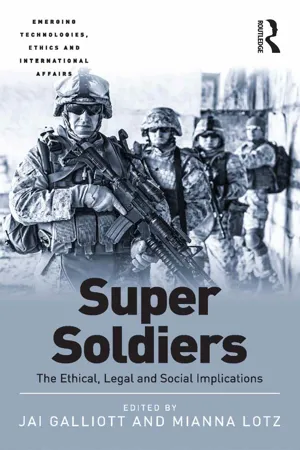
The Spartan City State produced what is probably one of the most iconic and ruthless military forces in recorded history. They believed that military training and education began at birth. Post-World War II saw a shift to army tanks, fighter jets and missiles that would go on to fight the next huge battle in Northern Europe. Today, with the advent of unmanned systems, our hopes are attached to the idea that we can fight our battles with soldiers pressing buttons in distant command centres. However, soldiers must now be highly trained, super strong and have the intelligence and mental capacity to handle the highly complex and dynamic military operating environment. It is only now as we progress into the twenty-first century that we are getting closer to realising the Spartan ideal and creating a soldier that can endure more than ever before. This book provides the first comprehensive and unifying analysis of the moral, legal and social questions concerning military human enhancement, with a view toward developing guidance and policy that may influence real-world decision making.
Information
Chapter 1
Introduction
The Spartan city-state produced what has been perhaps one of the most ruthless military forces in recorded history, second only to Hitler’s Schutzstaffel. Crucial to Sparta’s supremacy was the belief that military training and education began at birth. Those judged by state officials to have failed the first round of selection for military service, which began at an inspection in the first few days of life, were left outside the city walls to die of starvation (Lendon 2006, p. 112). In many ways, those who perished were the fortunate ones. To ‘harden’ the survivors and prepare them for battle, potential Spartan warriors were subjected to extreme temperatures, beatings, sleep deprivation and regular sexual abuse. As with the British, who later did much the same in their military academies to produce the soldiers that would eventually carve out the British Empire, the Spartan regime is renowned for its effectiveness on the battlefield. Those children who completed their military training went on to become some of the most feared warfighters in the entire ancient realm and for much of the time since, politicians and military chiefs longed for technologies that would enable them to avoid the cruelty for which the Spartan regime is now remembered, while still producing effective soldiers who will kill on command, fight without showing signs of fear or fatigue and generally behave more like machine than human beings.
In the absence of means to actualise this desire, it has long been thought that the future of warfare is all about army tanks, fighter jets and missiles. Today, with the advent of unmanned systems that operate across land, sea, air and space, our hopes are attached to the idea that we will soon be able to fight our battles with soldiers pressing buttons in distant command centres. But despite significant investment in what were supposed to be our robotic saviours, much recent warfare has turned out to be a very messy business, leading theorists to question what can be achieved without a human ‘in the loop’ (Krishnan 2009; Singer 2009; Galliott 2015). Some critics point to the fact that while active combat and reconstruction operations are technically complete, war in the Middle East drags on to this day and is still fought on a human scale in the mud and dust, not with what are typically large and impersonal killing machines (Galliott 2013). While there are most certainly unmanned systems that are useful in the battlefield, enemy forces are now accustomed to fighting in technology-saturated battlespaces and surface only when ready to attack, disappearing into fields and tunnel systems once the skirmish is over. This effectively means that military forces must have ‘boots on the ground’. Soldiers are not the cannon fodder of earlier days and must now be highly trained, super strong and have the requisite intelligence and mental capacity to handle the highly complex, dynamic, network-centric military operating environment. It is only as we progress into the twenty-first century that we get closer to realising the Spartan ideal of creating a soldier that can endure more than ever before without – it is hoped – violating human dignity.
Terminator-style weaponry may be many decades or even centuries away, but more realistic efforts to engineer a ‘super soldier’ are currently under way. We are no longer limited to so-called ‘natural’ methods of enhancement, whether it be Spartan-style conditioning or simply sending soldiers to the gym. The modern ‘military human enhancement’ effort draws on the fields of neuroscience, pharmacology, biology, genetics, nanotechnology and robotics. It is fuelled by the United States Army’s flagship science and technology initiative, which aims to develop a ‘Future Force Warrior’ that is highly independent and has superhuman strength (Webster 2012, pp. 98–112). Hundreds of millions of dollars were invested into this program, but it is now largely defunct due to budget measures aimed at ensuring America avoids its ever-looming ‘fiscal cliff’. However, it would be short-sighted and perhaps even strategically dangerous to think that military forces have abandoned efforts to upgrade service members’ minds and bodies to create the super soldiers that are necessary to match the increasing pace of modern warfare and dominate the growing militaries of the Indo-Pacific region. Slogans such as ‘be all that you can be, and a whole lot more’ still reign strong in the office of the United States Defense Advanced Research Projects Agency (DARPA) and even in these tough fiscal times, it lodged a FY2015 budget request for more than 300 million dollars of funding for biomedical and biological research under which its ‘performance optimization’ programs fall (Lin et al. 2014; Department of Defence 2014). DARPA’s current unclassified projects focus on: 1) widening physical capabilities by improving strength and mobility with nano-reinforced exoskeletons and other external devices; 2) improving cognitive abilities such as memory, attention and awareness through the use of networked body suits and pharmacological means; 3) enhancing senses such as smell, sight, taste and hearing; and 4) altering the human metabolism to allow for increased endurance, rapid healing and the digestion of otherwise indigestible materials (Lin, Mehlman and Abney 2013; Lin et al. 2014).
It must also be remembered that several emerging powers, including China, Russia, India and the European Union, all have the capacity to acquire and implement the full range of technologies that could lead to the creation of super soldiers (Silberglitt et al. 2006, p. xxiv). The Chinese military human enhancement program is particularly concerning, given that compulsory participation is likely to be mandated. Furthermore, it is reasonable to expect that if China were to develop sophisticated enhancements suitable for wide-scale operational deployment, it would quickly gain military superiority over the United States or any other nation-state, upsetting international order. For this reason, if no other, we should take the opportunity to start asking the difficult normative questions about how – and more to the point whether and on what basis – we should proceed with military human enhancement. The aim of Super Soldiers: The Ethical, Legal and Social Implications is to provide the first comprehensive and unifying analysis of the moral, legal and social questions concerning military human enhancement, with a view towards developing guidance and policy that may influence real-world decision-making. Upon close consideration, there is a plethora of questions that demand serious attention. For instance, there are general concerns about the justifications for enhancing soldiers and a range of more specific worries about fairness, the implications for society, the challenges to our traditional conception of medical ethics, risk assessment and design, responsibility, governance and the law. In general, however, it is the tough, practical and forward-looking philosophical questions that are at the core of this volume.
For ease of reference, the chapters of this volume are divided into four parts. Entitled ‘What, Why and How’, Part I considers how we might define, construct and justify the ‘super soldier’. It begins with Chapter 2 from Andrés Vaccari, who looks at the role of agency in an age of synthetic organisms, cyborgs, autonomous robots, human-machine systems and enhanced soldiers. He asks whether we can preserve the language of agency and intentionality. His answer is a hesitant ‘yes’, as he puts forward a meta-theoretical account that tends towards the post-humanist pole of the many possible perspectives on agency. In Chapter 3, Joseph Pugliese asks us to think about the blurry but important line between human and machine. When is a soldier not a soldier? To shed light on this matter, he proposes an approach that contextualises the relation between bodies and technologies, rather than simply identifying and then grasping onto something that makes us uniquely human. In Chapter 4, Barbara Gurgel and Avery Plaw show that enhancement is not always artificial, external or technological and do so via an exploration of a new frontier in military training that is of great significance in the wake of recent wars in the Middle East: cultural training. They highlight that cultural training is critical if soldiers are to function effectively in foreign environments and avoid incidents of cultural insensitivity, such as burning the Qur’an, humiliating local women and mistreating bodies of the dead. They describe the US military’s recent efforts to address these and similar challenges and review several reports from experts in these fields, drawing some preliminary conclusions about what has been and needs to be done. In Chapter 5, Ryan Tonkens takes issue with one of the more common justifications given for the employment of emerging technologies, which is essentially an appeal to military necessity. It holds that military forces and individual soldiers have an obligation to embrace enhancement efforts in order to have a legitimate chance of protecting themselves and the citizens they defend. The main thesis of Tonken’s chapter is that the use of soldier enhancements is inconsistent with the long-term goal of peace and that exclusive appeal to military necessity is insufficient to justify such enhancement efforts, even if they are in line with military proficiency.
Part II investigates ‘General Problems and Consequences’ concerning both present and future military human enhancement endeavours. In Chapter 6, Armin Krishnan explains that it will be difficult for Western democracies to make the transition from a traditional to an enhanced military and that one likely solution for dealing with this challenge is to outsource enhancement functions to private military contractors, who will train and employ small groups of permanently enhanced mercenaries. His chapter discusses the different types of enhancements that could filter through to private military contractors and outlines some of the ethical and legal implications regarding enhancement in this context. In Chapter 7, Robert Simpson discusses technological asymmetry, which poses a problem that has plagued all military technologies at one point or another, from the bow and arrow through to modern-day drones. In brief, when major technological disparities separate the opposing sides in a conflict, there is a plausible case to be made that these gaps render unjustifiable the use of lethal violence by a major military power against a small one. The standard suggestion is that in these sorts of conflicts, major powers ought to eschew warfare in favour of something resembling international policing. However, Simpson argues that a shift to a policing approach cannot be obligatory for the superpower and that any rationale for such argument is critically flawed by the advent of enhancements that alter the risk dynamics of political conflict.
In Part III, we delve into issues of ‘Military Medical Ethics’. In Chapter 8, Anke Snoek looks at the relationship between the military, soldiers and synthetic drugs, advancing three key points. The first reveals that the potential for addiction to synthetic drugs is not a mere consequence of the substance itself, and depends on personal characteristics and the context in which the substance is used. The second stipulates that military use of drugs should always be considered from within a military ethics perspective capable of separating decisions to go to war from decisions made in war and individual responsibilities from hierarchical responsibilities. The final point is that the role of the drug user should be taken more seriously in the moral analysis of military human enhancement. In Chapter 9, Steve Matthews examines the biotechnical challenges to moral autonomy and argues that for military human enhancement to be permissible, agents must have the capacity to form psychologically appropriate actions and experiences into a unified morally coherent self conception, all of which is arguably quite important to ethical conduct in war and efforts to rehabilitate soldiers upon their return home. In Chapter 10, Katrina Hutchinson and Wendy Rogers explore the ethical considerations relevant to military surgical innovation. They start by defining surgical innovation, providing a historical survey of surgical innovation in a military context, and then moving on to consider issues such as harm to soldier-patients, informed consent and conflicts of interest.
Finally, Part IV deals with matters of ‘Law, Responsibility and Governance’. In Chapter 11, Alex Leveringhaus investigates the attribution of responsibility to enhanced soldiers. He starts by detailing the general nature of responsibility and its links to just war theory, and then looks at the implications of military human enhancement for the moral agency of warfighters and any attempts to impose retrospective and prospective responsibility. In Chapter 12, Seumas Miller explores the implications of emerging technologies for the collective responsibility of humans in war. At the same time, he warns us of the perils of a future in which any system can autonomously conduct lethal operations, suggesting that it would be near impossible for autonomous systems to meet the just war principles of military necessity, discrimination and proportionality. In Chapter 13, Joseph Savirimuthu considers how the International Committee of the Red Cross (ICRC) or International Committee for Robot Arms Control (ICRAC) should respond to the legal and regulatory challenges posed by futuristic warfighters on the rapidly evolving battlefield. He argues that we must properly understand the nature of what he calls the ‘problem of disconnection’ before we can reflect on the complex interactions between law, technology and policy.
Together, these discussions offer a broad but very thorough analysis of the main ethical and philosophical questions that must be grappled with if we are to move responsibly into an era of enhanced soldiering that will profoundly change the past and current ‘landscapes’ of war. It is hoped that they will provide the guidance that will enable clear-sighted anticipation of the challenges posed by super soldiers, and thereby help us to avoid developments that violate our most deeply held ethical commitments concerning justice in war and, especially, respect for human safety and dignity.
References
Department of Defence 2014, Fiscal Year (FY) 2015 Budget Estimates, Defense Advanced Research Projects Agency, Defense Wide Justification Book, vol. 1, Research, Development, Test & Evaluation, Defense-Wide.
Galliott, J. 2013, ‘Unmanned Systems and War’s End: Prospects for Lasting Peace’, Dynamiques Internationale, 8(1): 1–24.
Galliott, J. 2015, Military Robots: Mapping the Moral Landscape. Farnham: Ashgate.
Krishnan, A. 2009, Killer Robots: Legality and Ethicality of Autonomous Weapons. Farnham: Ashgate.
Lendon, J. 2006, Soldiers & Ghosts: A History of Battle in Classical Antiquity. New Haven, CT: Yale University Press.
Lin, P., Mehlman, M. and Abney, K. 2013, Enhanced Warfighters: Risk, Ethics, and Policy. San Francisco, CA: Greenwall Foundation.
Lin, P., Mehlman, M., Abney, K. and Galliott, J. 2014, ‘Super Soldiers (Part 1): What is Military Human Enhancement’, in S. Thompson (ed.), Global Issues and Ethical Considerations in Human Enhancement Technologies. Hershey: IGI Global.
Silberglitt, R., Anton, P., Howell, D. and Wong, A. 2006, The Global Technology Revolution 2020, In-Depth Analyses. Arlington: RAND National Security Research Division.
Singer, P. 2009, Wired for War: The Robotics Revolution and Conflict in the 21st Century. New York: Penguin.
Webster, J. 2012, What Brings a Soldier to His Knees. Edinburgh: Westbow Press.
What, Why and How
Chapter 2
Abjecting Humanity: Dehumanising and Post-humanising the Military
Ethical questions concerning war are often posed around notions of the human – humanness, humaneness, humanity – and its shadows: the inhuman, dehumanised, post-human. There are two questions here, one metaphysical and one ethical. The first one is about the ontological limits of the human in a novel military context populated with new actors who straddle the categories of human and machine, biology and technology. As way of an answer, I offer a framework to consider a broad range of (real and prospective) hybrids with military applications, such as synthetic organisms, cyborgs, autonomous robots, human-machine systems and modified humans in general. My aim is to link two problems: human agency and the ontology of new hybrids. The metaphysics of agency (particularly, in relation to intentionality) has been the traditional basis on which to distinguish natural from made, human from nonhuman – and this is the central link between the two questions.
The ethical question is closely tied to this, and concerns moral agency and responsibility. Much of the philosophical literature on new military technologies is concerned with this, and particularly with the legal approaches that should be developed to deal with these novel realities. This ethical aspect comes to rest on metaphysical matters. To ask about responsibility is to pose the metaphysical problem of the author of an action – the question of agency. And agency has become increasingly hard to trace in an age in which humans predominantly carry out their activities in the midst of ‘ever more distributed and entangled socio-technical systems’ (Simon 2014, p. 2). According to the Office of the US Air Force Chief Scientist, this trend will accelerate in the next decades:
… natural human capacities are becoming increasingly mismatched to the enormous data volumes, processing capabilities, and decision speeds that technologies either offer or demand. Although humans today remain more capable than machines for many tasks, by 2030 machine capabilities will have increased to the point that humans will have become the weakest component in a wide array of systems and processes. Humans and machines will need to become far more closely coupled, through improved human-machine interfaces and by direct augmentation of human performance (Technology Horizons, 2010: ix–x).
The loss of human agency and the increasing autonomy of systems are two aspects of the same phenomenon. Can we preserve the language of responsibility, intentionality and a unique human autonomy while situating agency in this dense...
Table of contents
- Cover Page
- Title Page
- Copyright Page
- Contents
- Notes on Contributors
- Chapter 1 Introduction
- PART I What, Why and How
- PART II General Problems and Consequences
- PART III Military Medical Ethics
- PART IV Law, Responsibility and Governance
- Index
Trusted by 375,005 students
Access to over 1.5 million titles for a fair monthly price.
Study more efficiently using our study tools.
Frequently asked questions
Yes, you can cancel anytime from the Subscription tab in your account settings on the Perlego website. Your subscription will stay active until the end of your current billing period. Learn how to cancel your subscription
No, books cannot be downloaded as external files, such as PDFs, for use outside of Perlego. However, you can download books within the Perlego app for offline reading on mobile or tablet. Learn how to download books offline
Perlego offers two plans: Essential and Complete
- Essential is ideal for learners and professionals who enjoy exploring a wide range of subjects. Access the Essential Library with 800,000+ trusted titles and best-sellers across business, personal growth, and the humanities. Includes unlimited reading time and Standard Read Aloud voice.
- Complete: Perfect for advanced learners and researchers needing full, unrestricted access. Unlock 1.5M+ books across hundreds of subjects, including academic and specialized titles. The Complete Plan also includes advanced features like Premium Read Aloud and Research Assistant.
We are an online textbook subscription service, where you can get access to an entire online library for less than the price of a single book per month. With over 1.5 million books across 990+ topics, we’ve got you covered! Learn about our mission
Look out for the read-aloud symbol on your next book to see if you can listen to it. The read-aloud tool reads text aloud for you, highlighting the text as it is being read. You can pause it, speed it up and slow it down. Learn more about Read Aloud
Yes! You can use the Perlego app on both iOS and Android devices to read anytime, anywhere — even offline. Perfect for commutes or when you’re on the go.
Please note we cannot support devices running on iOS 13 and Android 7 or earlier. Learn more about using the app
Please note we cannot support devices running on iOS 13 and Android 7 or earlier. Learn more about using the app
Yes, you can access Super Soldiers by Jai Galliott,Mianna Lotz in PDF and/or ePUB format, as well as other popular books in Politics & International Relations & National Security. We have over 1.5 million books available in our catalogue for you to explore.