- 216 pages
- English
- ePUB (mobile friendly)
- Available on iOS & Android
eBook - ePub
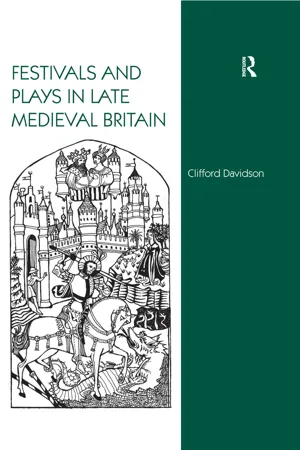
Festivals and Plays in Late Medieval Britain
About this book
Based in records and iconography, this book surveys medieval festival playing in Britain more comprehensively than any other work to date. The study presents an inclusive view of the drama in the British Isles, from Kilkenny to Great Yarmouth, from Scotland to Cornwall. It offers detailed readings of individual plays-including the York Creed Play, Pentecost and Corpus Christi plays and the little studied Bodley plays, among others - as well as a summary of what is known of their production. Clifford Davidson here extends the usual chronological range to include work typically categorized as early modern, enabling a juxtaposition of earlier plays with later plays to yield a better understanding of both. Complementing documentary evidence with iconographic detail and citation of music, he pinpoints a number of common misconceptions about medieval drama. By organizing the study around the rituals of the liturgical seasons, he clarifies the relationship between liturgical feast and dramatic celebration.
Information
Part I
The Landscape of Festival Drama and Play
Chapter One
Playing and the Ritual Year
If, before clocks were universally present in people's lives in the West, time tended to be fluid and experiences less chronologically organized throughout the individual day, there was still a consistent and rigorous marking of temporality by reference to the seasons and the calendar. Church bells, to be sure, marked the "hours," but these were often only approximations of the time of day and signaled the canonical hours that were to be devoted to prayer by the clergy, monks and nuns, and pious laypersons. The calendar was in contrast fixed, with its yearly round of regular Church festivals, including the important saints' days. Major feasts provided opportunities for ceremonies, playing games, performing plays, and engaging in various forms of entertainment. These observations naturally suggest a starting point in Charles Phythian-Adams's study "Ceremony and the Citizen: The Communal Year at Coventry 1450–1550,"1 even though his division into sacred and secular seasons is oversimplified and needs to be treated with great flexibility, as Eamon Duffy has warned.2 An empirical survey of occasions for plays seems required, starting with the beginning of the Church year four Sundays before Christmas and the slackening of playing in the course of the increasingly busy summer season.
In such a survey, one must not gloss over the fact that there was at times disappointingly little differentiation in the manner of celebration of certain of the dates and festivals, except that they were occasions for festivity, whether pious or worldly. The presence of a religious play on a particular topic (for example, a Magi drama) will not necessarily match the point in the liturgical year where it would be expected.3 Further, in dealing with dramatic records there is also much inherent ambiguity due to the fragmentary nature of the records, which were not normally written down as historical accounts designed to answer the questions we would like to ask, and in addition any description derived from such records must further be selective since there is no possibility of calling on evidence from every bit of documentation available from medieval Britain. Emphasis hence will here need to be directed toward those locations where the knowledge gained from such evidence will provide the contours of the story, though this will certainly also mean special attention to the major feasts and the neglect of minor local customs.4
To be sure, customs of playing and entertainment varied from one region to another, or even from one town or parish to another within a region. A reference to a particular play topic in one location does not necessarily translate into the same thing elsewhere. In addition to geography, much had to do with the size and affluence of the community as well as the presence of a guild structure capable of supporting theater. The royal court, for example, had far greater resources than a relatively small town such as Doncaster, which still was able to mount a Corpus Christi play, though hardly as elaborate as York's play cycle.5 Of course, the ritual year was not celebrated in the same way by towns and parishes as by university, the court, or aristocratic households. Social groups do need to be differentiated. On the other hand, there are signs enough across the spectrum of all social groups of responsiveness to the ritual year and its opportunities for drama and entertainment.
Occasions for playing might begin as early as St. Nicholas's Day, on December 6, early in the liturgical year, which begins with the first Sunday in Advent. This beginning point will provide a considerably different view of the ritual year in relation to drama and entertainment than promoted by Phythian-Adams,6 and is more consistent with the way in which festivals available for playing were perceived prior to the Reformation. But, as a penitential season leading up to the great feast of Christmas. Advent perhaps not surprisingly, gives little evidence for drama, even the liturgical music-drama more likely to have been presented at this time than entertainments or vernacular plays. Yet while evidence for St. Nicholas plays on the feast of the saint is very limited, there was an activity associated with this festival that was quite widespread. This involved the choosing, either on St. Nicholas's Day or on the vigil of this feast, of a boy to be dressed up as the saint—the "Boy Bishop"—to perform his duties either then or on Holy Innocents (December 28).7
St. Nicholas Day
The first reference to a St. Nicholas play in England appears in a homily, possibly by a Dominican preacher, in which the saint grants the desire of a good monarch: "yf ye wollet stille ben / in þis pleye ye mowen isen."8 The Boy Bishop and a Clerks' play of St. Nicholas both appear in records from Gloucester in 1283, when the boy and the players were rewarded with 26s 8d by the king.9 The play treated the miracles of the saint, and the clerical involvement in the production suggests that this was a liturgical music drama, perhaps like the work of Hilarius, whose connection with England has been asserted by some scholars.
Hilarius' Iconia, for which unfortunately no music survives, concerns a character named Barbaras who comes to venerate and trust an image of St. Nicholas, to which he entrusts his wealth as he sets forth on his travels.10 He does not even lock the door to his house. Robbers enter and take away his goods. Upon his return, as Karl Young indicates in his summary.
he first laments the loss of the property, and then denounces and beats the image. Meanwhile St Nicholas, in his own person, visits the robbers, and, with threats of disclosing their crime, charges them to return the plunder. When the robbers have carried out this command, Barbarus joyfully and penitently gives thanks to the image. St Nicholas himself now appears, bidding Barbarus transfer his gratitude to the Almighty. Accordingly the penitent renounces his past errors, and declares his belief in Christ, the Son of the one God.11
Barbaras is a pagan, not a Jew as is the case in the Fleury Playbook version, which nevertheless, because its music is preserved, provides indication of how a saint play of this kind would have sounded when staged. The three further St. Nicholas dramas in the Fleury Playbook also indicate other possibilities of plot formation that might have been used at Gloucester and elsewhere. These involve stories of the Three Clerks, the Three Daughters, and the Son of Getron.12
The Boy Bishop could be seen as less dramatic in spite of the complexity of his involvement in the liturgy, but because of the ample records pertaining to him he clearly deserves careful attention. He was a character who maintained the role of an actual bishop, except of course for consecrating the elements of bread and wine at Mass, and was as we would expect dressed investments like a prelate. The practice was recorded at Salisbury Cathedral as early as 1222,13 and in the seventeenth century a thirteenth-century image purported to be that of a Boy Bishop, holding a crozier and with right hand raised in blessing, was discovered there. This "Monument in stone" to a Boy Bishop who was believed to have died while in "office" was illustrated and described by John Gregory, bishop of Winchester, in his posthumously published Episcopus Puerum, in die Innocentium.14 In this illustration, the Boy Bishop is dressed in full episcopal vestments, including a cope and miter, and is standing on a dragon, obviously meant to designate a demon, perhaps Lilith destroyer of children, according to Bishop Gregory's speculations.15 Unfortunately, in spite of the fact that the image does give a suggestion of how a Boy Bishop would have appeared, Gregory's views otherwise would seem to involve pure fantasy. Sarah Brown reports what seems to be the current view of archaeologists: instead of a boy bishop, the diminutive image might have been a monument to William de la Corner, who died in 1291.16
The Boy Bishop was recorded at other locations than cathedrals. Documents from various places, including records from the parish churches of London, indicate the presence of this custom and in some cases confirm the practice of having the Boy Bishop attended by a chaplain and his canons or other attendants.17 At Lincoln College, Oxford, the attendants were called "saynt nycolas clarkes."18 At Bristol, in preparation for the Boy Bishop, his "suffrygann" along with the clerk of the Church of St. Nicholas were "to Dresse vppe the Bysshopes Sete [that is, his throne] A-yeniste Seynte Nicholas Daye."19 According to Robert Ricart's The Maire of Bristowe is Kalendar (1478–1479), this Boy Bishop also had a "Chapell," a children's choir that would sing evensong on the vigil of St. Nicholas Day at the Church of St. Nicholas, and the next day he would preside over the services, including Mass, and preach a sermon. Afterward, he was to bless those in attendance.20 In London, the church of St. Michael-le-Quern had not only four "olde copes for children of bawdkyn" but also a "vestment for the bysshopp on Saynte Nicholas Daye,"21 suggesting activities on this feast rather than (or along with) Holy Innocents.
The statutes of King's College, Cambridge, dating from 1442–1443 ind...
Table of contents
- Cover
- Half Title
- Dedication
- Title
- Copyright
- Contents
- List of Figures
- Preface
- Acknowledgments
- Abbreviations
- PART I: THE LANDSCAPE OF FESTIVAL DRAMA AND PLAY
- PART II: SOME ASPECTS OF TWO GENRES OF FESTIVAL DRAMA
- Select Bibliography
- Index
Trusted by 375,005 students
Access to over 1.5 million titles for a fair monthly price.
Study more efficiently using our study tools.
Frequently asked questions
Yes, you can cancel anytime from the Subscription tab in your account settings on the Perlego website. Your subscription will stay active until the end of your current billing period. Learn how to cancel your subscription
No, books cannot be downloaded as external files, such as PDFs, for use outside of Perlego. However, you can download books within the Perlego app for offline reading on mobile or tablet. Learn how to download books offline
Perlego offers two plans: Essential and Complete
- Essential is ideal for learners and professionals who enjoy exploring a wide range of subjects. Access the Essential Library with 800,000+ trusted titles and best-sellers across business, personal growth, and the humanities. Includes unlimited reading time and Standard Read Aloud voice.
- Complete: Perfect for advanced learners and researchers needing full, unrestricted access. Unlock 1.5M+ books across hundreds of subjects, including academic and specialized titles. The Complete Plan also includes advanced features like Premium Read Aloud and Research Assistant.
We are an online textbook subscription service, where you can get access to an entire online library for less than the price of a single book per month. With over 1.5 million books across 990+ topics, we’ve got you covered! Learn about our mission
Look out for the read-aloud symbol on your next book to see if you can listen to it. The read-aloud tool reads text aloud for you, highlighting the text as it is being read. You can pause it, speed it up and slow it down. Learn more about Read Aloud
Yes! You can use the Perlego app on both iOS and Android devices to read anytime, anywhere — even offline. Perfect for commutes or when you’re on the go.
Please note we cannot support devices running on iOS 13 and Android 7 or earlier. Learn more about using the app
Please note we cannot support devices running on iOS 13 and Android 7 or earlier. Learn more about using the app
Yes, you can access Festivals and Plays in Late Medieval Britain by Clifford Davidson in PDF and/or ePUB format, as well as other popular books in Literature & Literary Criticism. We have over 1.5 million books available in our catalogue for you to explore.