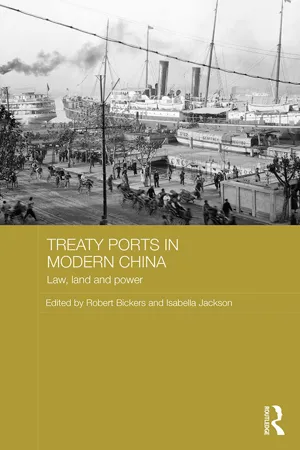
This book presents a wide range of new research on the Chinese treaty ports – the key strategic places on China's coast where in the late nineteenth and twentieth centuries various foreign powers controlled, through "unequal treaties", whole cities or parts of cities, outside the jurisdiction of the Chinese authorities. Topics covered include land and how it was acquired, the flow of people, good and information, specific individuals and families who typify life in the treaty ports, and technical advances, exploration, and innovation in government.
eBook - ePub
Treaty Ports in Modern China
Law, Land and Power
- 266 pages
- English
- ePUB (mobile friendly)
- Available on iOS & Android
eBook - ePub
Treaty Ports in Modern China
Law, Land and Power
About this book
Information
1 Extraterritoriality in China
What we know and what we don’t know
Pär Cassel
The prominent historian of Japan Carol Gluck once pointed out that ‘[m]odernity is not optional in history, in that societies could not simply “choose” another regime of historicity for themselves, for such is the tyranny of modern times’.1 In some polities, the government simply proclaimed the modern era per decree, whereas in other cases, the arrival of gunboats ushered in modernity by military means. China decidedly belongs to the latter kind, as the beginning of the modern period was inaugurated by a series of commercial treaties, which were concluded at gunpoint from the 1840s through the 1860s. Yet with the exception of some imperial enclaves, such as the British crown colony of Hong Kong and the Portuguese settlement in Macau, the Western imperial powers never embarked on direct colonial rule in China.2 Instead they contented themselves with carving out legal spaces for their subjects in the form of extraterritorial privileges and establishing foreign settlements and concessions that were increasingly beyond the reach of Qing laws and jurisdiction.
Over time, the extraterritorial legal order intruded into almost any aspect of everyday life in treaty port China and anything a foreigner touched could obtain an extraterritorial aspect, giving him or her what Eileen Scully has dubbed the ‘Midas Touch’ of extraterritoriality.3 Consequently, any historian who aims to research topics as diverse as publishing, shipping, postal services, religion, public sanitation, Christianity, taxation, trade, and the legal profession in late nineteenth century China, will have to grapple with the thorny problem of extraterritoriality in one form or another.4 Indeed, extraterritoriality and modernity are so intertwined in the narrative of nineteenth- and twentieth-century history that it is next to impossible to talk about one without talking about the other.
But extraterritoriality was not just an interface of modernity in East Asia; it was also a vestige of an earlier inter-state order in Europe and the Mediterranean, which antedated the supposedly absolute claims of territorial jurisdiction of the Westphalian nation-state.5 None of the European states that sponsored the perpetuation of consular jurisdiction in China and the rest of East Asia accepted extraterritorial jurisdiction within their own territories, save for diplomatic personnel and heads of state. In due course, extraterritoriality worked to conserve the political and legal system in China, as the different treaty powers saw the Qing state as a guarantor of the extraterritorial legal order and abstained from toppling the regime even when they had the chance to do so in 1860 and again in 1900.6 It should come as no surprise then, that the abolition of extraterritoriality became a priority of the first order to the Qing government and its Republican successor regimes when they embarked on massive programs of state-building in the early twentieth century, which generated a tremendous literature from the 1900s through the 1940s.7 Yet despite the well-established presence of extraterritoriality in the field of late Qing and early Republican Chinese history, many aspects of the practice remain rather neglected topics and relatively few monographs on extraterritoriality have appeared in the past few decades. This is rather curious, given recent advances in the fields of legal history and ‘new Qing studies’.8 This essay is an attempt to summarize the state of the field in what we could tentatively call ‘extraterritorial studies’ in Chinese and East Asian history.
Genealogies of extraterritoriality: where did it come from?
In contrast to the form of extraterritoriality that was in force in the Ottoman Empire under the ‘Capitulations’ since the seventeenth century, the origins of extraterritoriality in East Asia remain a relatively under-researched topic.9 When Western Europeans set out to demand legal privileges in East Asia, they evidently had clear precedents in mind that dated from the Roman Empire, medieval Europe, and contemporary practices in the Ottoman Empire. Yet it is equally clear that there were important antecedents to extraterritoriality, and its corollary personal jurisdiction, in the Qing Empire.
Having inherited a nominally centralized bureaucracy that harkened back several centuries, the Qing state was territorially organized, but Qing officials primarily enforced the legal code over people, not territories.10 The penal system was organized around the ‘five mourning degrees’ (wufu 五服), according to which offenders were punished in correspondence to the degree they violated the norms of the Confucian family system.11 For instance, when it came to violent crimes, the closer the defendant was related to the victim, the heavier the punishment. This principle was reversed for property crimes such as theft, where the offender was punished more leniently the closer he or she was related to the injured party.12 Furthermore, different ethnic groups were supposed to remain within their designated territories in order to limit their interaction with other ethnic groups, and whenever these territorial lines were transgressed, the suspected offender was supposed to be handed back to the original jurisdiction. When two different jurisdictions were involved in a legal suit in this pluralistic legal order, the officials holding jurisdiction usually held a joint conference (huishen 會審) to determine the outcome.13 More importantly, being subject to the norms of the Qing Code was regarded as a sign of civilization, and the minimalist Qing state preferred to avoid rather than to claim jurisdiction. While the Qing state preserved its monopoly on punishing rebellion, homicide, and other severe infractions against the political and social order, it also encouraged local officials to cede jurisdiction to lineages, guilds, and native place associations in minor criminal cases, as well as in disputes of a civil nature.14 There were at least two major motives behind this policy. The most obvious reason was the need to reduce the case load of civil officials, who became increasingly overburdened during the Qing dynasty, as the state was reluctant to create new jurisdictions to keep pace with the growth of the population; by the mid-nineteenth century, a county magistrate could exercise jurisdiction over hundreds of thousands of people.15
A more ideological motive was the traditional Confucian disdain for litigation and criminal sanctions, which were seen as signs of a moral failure on the part of the state and local elites. This was clearly spelled out in several of the sixteen maxims that made up the Sacred Edict (Shengxun 聖訓), which were first promulgated under the reign of the Kangxi Emperor and later expounded upon by his son the Yongzheng Emperor and several other commentators.16 Apart from enjoining his imperial subjects to respect the virtues of filial piety, neighbourly harmony, and benevolence, the emperor also impressed on his subjects the importance of abstaining from frivolous lawsuits and to hand in fugitive bannermen to the military authorities.17 The Sacred Edict was also an important source of legal knowledge for the commoners of Qing China and a number of commentaries to the edict paired the positive moral injunctions of the Sacred Edict with negative penal sanctions from the Qing Code, in order to teach the common people what would happen should they fail to live up to the norms laid down in the Edict. 18 In this context, law enforcement was not an end in itself or even the primary task of the state, but a means to perpetuate Confucian ideals. As the ultimate arbiter possessing the sovereign power over life and death, many emperors took great personal interest in cases and often intervened to ensure that Confucian norms were respected, sometimes against the letter of the law.19
In this socio-political and legal order, there was little space for foreigners – or ‘barbarians’ – who by definition did not subscribe to the Confucian ideal of the family as a microcosm of the state, and the punishment of whom could hardly fit into the neatly arranged hierarchies of the five mourning degrees. While the Qing Code did establish that ‘people outside of the pale of civilization’ were subject to the stipulations of the Code, it was unclear to what extent this applied to Western sojourners in the southern coastal port of Guangzhou. Could, for instance, a foreigner be punished for lack of filial piety? Having left their families behind in Europe or North America to pursue the selfish occupation of trade, foreigners were presumably beyond the pale of Confucian civilization and not necessarily subject to the strict application of the Code.
When Western merchants started to carry out trade on the southern maritime frontier of China, the first response of the Qing state was to impose severe restrictions on the mobility of foreigners, in order to limit their interaction with the local population and to reduce the likelihood of criminal suits.20 These policies of exclusion also had a gendered dimension, as the authorities strictly prohibited the immigration of foreign women into the port of Guangzhou, so as to forestall the emergence of a permanent foreign community.21 The local authorities usually left foreigners to resolve disputes on their own and only insisted on meting out punishment in cases where foreigners were accused of killing Chinese. In 1743, the Qianlong Emperor established the rule that local authorities would only claim jurisdiction over foreigners when they were accused of having killed Chinese.22 Consequently, foreign demands for separate treatment and the segregating logic of the Qing legal order mutually reinforced each other to the effect that the Qing state abstained from claiming the type of full territorial jurisdiction that any modern nation-state would regard as its exclusive prerogative. It is noteworthy that the antebellum policies of the Qing Empire thus went beyond the legal concessions of the Ottoman Empire, which claimed jurisdiction over all criminal cases where Ottoman subjects were involved.23
However, this relatively lenient legal regime did not satisfy British merchants in Guangzhou, who resented Chinese penal practices, such as torture and collective punishment, as well as what they saw as the failure of the Qing legal system to distinguish between manslaughter and intentional homicide.24 This tendency to paint the Qing legal order in the bleakest terms possible also served as a convenient foil to debates on criminal justice reform in many Western European countries, where supplice chinoise often served as a trope for the barbarities of the non-Christian world.25 In November 1784, British and Qing concepts of justice clashed head-on, when a British gunner on the country ship Lady Hughes accidentally killed two Chinese officials as he fired a salute to greet another ship. The Qing authorities demanded that the gunner be delivered to local courts in order to prosecute the case, but George Smith, the British supercargo of the ship, tried to resist an extradition and only delivered the gunner to the governor of Guangdong after the local authorities had apprehended him in person and blockaded all foreign trade in the port. As many scholars have pointed out, English penal laws in the late eighteenth century were in many respects just as harsh as contemporary Qing Law, so had the gunner been tried according to English law, he may very well have been executed, notwithstanding the claims that the gunner had not intended to kill the...
Table of contents
- Cover
- Half Title
- Title Page
- Copyright Page
- Table of Contents
- List of illustrations
- List of contributors
- Acknowledgments
- Introduction: law, land and power: treaty ports and concessions in modern China
- 1. Extraterritoriality in China: what we know and what we don’t know
- 2. Who ran the treaty ports? A study of the Shanghai Municipal Council
- 3. The land system of the Shanghai International Settlement: the rise and fall of the Hardoon family, 1874–1956
- 4. Problems of circulation in the treaty port system
- 5. Treaty ports as shipping infrastructure
- 6. River conservancy and state building in treaty port China
- 7. Interport printing enterprise: Macanese printing networks in Chinese treaty ports
- 8. The global entanglements of a marginal man in treaty port Xiamen
- 9. ‘Throwing light on natural laws’: meteorology on the China coast, 1869–1912
- 10. From Terra incognita to Garden of Eden: unveiling the prehistoric life of China and Central Asia, 1900–30
- 11. The French Concession in Hankou 1938–43: the life and death of a solitary enclave in an occupied city
- 12. The Communists and the Kailuan mines: eliminating the legacies of the treaty ports
- Index
Trusted by 375,005 students
Access to over 1.5 million titles for a fair monthly price.
Study more efficiently using our study tools.
Frequently asked questions
Yes, you can cancel anytime from the Subscription tab in your account settings on the Perlego website. Your subscription will stay active until the end of your current billing period. Learn how to cancel your subscription
No, books cannot be downloaded as external files, such as PDFs, for use outside of Perlego. However, you can download books within the Perlego app for offline reading on mobile or tablet. Learn how to download books offline
Perlego offers two plans: Essential and Complete
- Essential is ideal for learners and professionals who enjoy exploring a wide range of subjects. Access the Essential Library with 800,000+ trusted titles and best-sellers across business, personal growth, and the humanities. Includes unlimited reading time and Standard Read Aloud voice.
- Complete: Perfect for advanced learners and researchers needing full, unrestricted access. Unlock 1.5M+ books across hundreds of subjects, including academic and specialized titles. The Complete Plan also includes advanced features like Premium Read Aloud and Research Assistant.
We are an online textbook subscription service, where you can get access to an entire online library for less than the price of a single book per month. With over 1.5 million books across 990+ topics, we’ve got you covered! Learn about our mission
Look out for the read-aloud symbol on your next book to see if you can listen to it. The read-aloud tool reads text aloud for you, highlighting the text as it is being read. You can pause it, speed it up and slow it down. Learn more about Read Aloud
Yes! You can use the Perlego app on both iOS and Android devices to read anytime, anywhere — even offline. Perfect for commutes or when you’re on the go.
Please note we cannot support devices running on iOS 13 and Android 7 or earlier. Learn more about using the app
Please note we cannot support devices running on iOS 13 and Android 7 or earlier. Learn more about using the app
Yes, you can access Treaty Ports in Modern China by Robert Bickers, Isabella Jackson, Robert Bickers,Isabella Jackson in PDF and/or ePUB format, as well as other popular books in Scienze sociali & Studi sull'etnia. We have over 1.5 million books available in our catalogue for you to explore.