eBook - ePub
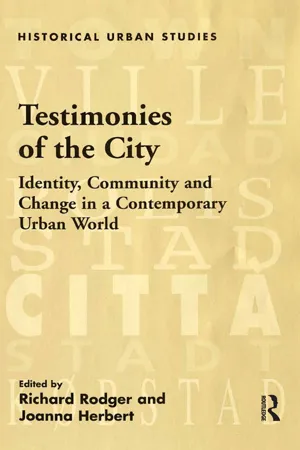
Testimonies of the City
Identity, Community and Change in a Contemporary Urban World
- 296 pages
- English
- ePUB (mobile friendly)
- Available on iOS & Android
eBook - ePub
Testimonies of the City
Identity, Community and Change in a Contemporary Urban World
About this book
Oral testimony is one of the most valuable but challenging sources for the study of modern history, providing access to knowledge and experience unavailable to historians of earlier periods. In this groundbreaking collection, oral testimonies are used to explore themes relating to the construction of urban memories in European cities during the twentieth century. From the daily experiences of city life, to personal and communal responses to urban change and regeneration, to migration and the construction of ethnic identities, oral history is employed to enrich our understanding of urban history. It offers insights and perspectives that both enhance existing approaches and forces us to re-examine official histories based on more traditional sources of documentation. Moreover, it enables the historian to understand something of the nature of memory itself, and how people construct their own versions of the urban experience to try to make sense of the past. By using the full range of opportunities offered by oral history, as well as fully considering the related methodological issues of interpretation, this volume provides a fascinating insight into one of the least explored areas of urban history. As well as adding to our understanding of the European urban experience, it highlights the potential of this intersection of oral and urban history.
CHAPTER ONE
Frameworks: testimony, representation and interpretation
Academic interest in oral testimonies has grown significantly in the last twenty years, as is evident by the expansion in the study of oral history internationally and the biographical and narrative turn in the social sciences.1 Accordingly, oral testimonies have attracted interest from a range of disciplines. Indeed, oral history itself has been influenced by a diverse number of fields, including anthropology, ethnology and folklore, sociology, cultural studies, psychology and linguistics and has developed by fusing ideas, concepts and methodological issues from these fields to provide fresh insights and sophisticated tools for analysis and interpretation. The collection of chapters presented here reflects this multi-disciplinary approach and includes authors from a diversity of disciplinary backgrounds, whose research focuses on a broad range of international cities. The breadth of oral testimonies is also evident and the volume incorporates spoken recollections of contemporary events recorded in an interview and then transcribed, otherwise known as oral history, but also includes a chapter that draws on personal accounts published in newspapers and another that explores the representation of oral materials in public urban spaces.
Despite this growing popularity of oral sources within and across various disciplines, there remains some resistance among historians to oral testimonies as a viable research method. This resistance is not new. In the second half of the twentieth century, the importance of oral testimonies as a valuable resource gradually gained recognition; yet in late 1970s and early 1980s, criticisms came to the fore that these sources were essentially unreliable, consisting merely of ‘old men drooling about their past.’2 The inaccuracy of people’s opinions due to nostalgia, forgetfulness, or unconscious and conscious attempts to present false information were seen as major failings. These criticisms sparked intense and critical debates.3 Initially, oral historians attempted to defend these attacks by rectifying this bias and it was not until the 1980s that the subjectivity of oral testimonies, once at the root of such criticisms, was hailed as an advantage. Those who used oral testimonies in their research argued that oral history was a specific type of historical evidence that did not necessarily produce factually accurate details but offered a lens to view the narrators’ world view, their emotions and feelings, and their visions and desires. It enabled an exploration of the psychological impact of events and meanings that individuals themselves attributed to episodes in their lives as they attempted to assess and make sense of their past in the context of the present day. To reiterate the words of Portelli, ‘the diversity of oral history consists in the fact that “untrue” statements are still psychologically “true” and that these previous “errors” sometimes reveal more than factually accurate accounts.’4 From this perspective, the notion of an inaccurate or untrue oral source was immaterial. In short, oral testimonies offered a unique perspective on aspects of history that conventional sources not only ignored, but could not capture. The role of the interviewer was also revised and was no longer seen as detached and omniscient but was implicated in the process and crucial to its construction. The spoken testimony came to be viewed as the result of a collaborative experience. A greater understanding of these issues, of both the potential of oral testimonies and their complex and problematic nature, underscored the vital need for consistent critical analysis and reflexivity on behalf of the researcher.
While the collection of first hand accounts has had a marked impact on the practice of history, oral history still tends to be viewed as marginal and secondary within mainstream academic history.5 Possible explanations for this have included the notion that historians prefer the written source to engaging with living people, perhaps based on the presumption that the written source is more objective and, therefore, superior. Other explanations blamed historical topics heavily weighted towards studies of previous centuries and on training that traditionally focused on empirical and quantitative methods.6 The latter may explain why reservations concerning oral testimonies continue to stem from issues relating to reliability, validity and representativeness despite the debates and developments in the 1980s.
Key concepts
Within this context, this book attempts to illuminate the insights that oral testimonies can offer to the urban historian. As the following chapters will show, oral accounts can open up new ways of thinking about and understanding the city. Firstly, oral sources can aid a deeper and richer understanding of the experience of urban life. They can provide detailed descriptions of particular social settings, which help to reconstruct a picture of daily life in the city from the respondents’ perspective. While earlier oral history studies conducted in the 1960s and 1970s have since been criticized for their naïve idealism in aiming to recover the raw and authentic experience, the focus on the realm of experiences remains important, particularly in the context of traditional social history that has typically centred on legislative and administrative aspects or the pursuit of aggregate data.7 It also reminds us that the city is not simply lived as a spectacle, a site of aesthetic pleasure as featured in post-modern writings of the city, but is an embodied experience that is often mundane and repetitive. These aspects are key features of Varlet’s chapter, which shows how daily life for Parisians during the interwar period was remembered as a series of rhythms and rituals that structured everyday life. The intimate details of the organization and performance of laundry tasks, bathing rituals and the provision and preparation of food creates a vivid impression of the arduous and habitual nature of daily life, a cluster of routines and schedules from which Sunday, a day of pleasure, offered brief respite. Yet this ‘essence of the city’ was also evoked through memories of the senses, such as the warmth and condensation associated with laundry work, the anticipation of cherries at the beginning of the summer, or the pot-au-feu left to stew for hours on laundry day. Thus, while a dominant theme was how urban life for Parisians during the interwar period was experienced as highly routinized, difficult and subject to constraints, oral testimonies also reveal the many layers of the urban experience.
Oral testimonies also allow an insight into human agency. Advocates of oral testimonies often claim that oral accounts, particularly life story approaches that aim to encapsulate the whole life story, restore some of the agency to the narrator. That is, the interview allows the narrators the central stage to construct their own story so that they are not positioned as objects of the research but are fully engaged in the interview process of interpreting and evaluating their lives.8 In the context of urban history, oral testimonies also show how people’s experience of the city is not a passive one; rather, they are active agents that attribute meanings to and invest in the urban landscape. This theme underpins many of the chapters presented here yet it is also at the crux of Zrnić’s chapter, which reveals how the individual’s relationship to the city is a dynamic and creative process. This is illustrated by an exploration of how inhabitants of housing communities built in the second half of the twentieth century in the new city of New Zagreb participated in creating their own sense of community and belonging by, for example, forging networks with neighbours and participating in local organizations. These actions fostered a particular culture and consciousness on each estate. Official discourses stigmatized the housing estates as dreary and nameless, but the local inhabitants did not share this perception and attributed positive meanings to the area. This focus on the subjective perceptions of particular areas, particularly the discrepancy between official views and the opinions of the actual inhabitants has been an enduring theme of oral histories of urban working class life.9 It highlights a further value of oral testimony to elucidate how and in what ways spaces have different meanings for different social groups.
Oral testimony can reveal how groups create mental maps of the city and in essence create spaces for themselves that are typically distinct from dominant cultures.10 This insight is most important considering the recent spatial turn in the humanities and social sciences. That is, developments in new cultural geography have reasserted space and place into critical theory.11 Influenced by theorists such as Lefebvre12 there has been a critical rethinking and privileging of space and a consequent appreciation that human life does not simply have a temporal and social dimension, but is also spatial.13 This, of course, was a key element in the early development of urban history in Britain14 in the 1960s and 1970s, which has drawn further strength from cultural geographers, leading to a renewed focus on the importance and role of space, particularly the spatial context of identities.15 In Johnston’s and McIvor’s paper, the masculine spaces of the pub, the football ground and the bookmakers featured heavily in the narratives of working class men in Glasgow and helped to create and reinforce a masculine identity.16 In Horváth’s chapter, which focuses on the micro street level, a group of hippies in Budapest in the 1960s and 1970s transformed a space by a particular tree into a key meeting place where they could freely express their utopian identity. This illustrates how seemingly mundane and taken-for-granted landscapes are saturated with meanings. When the hippy gang walked along the streets and casually decided to visit the American Embassy to pay tribute to a musician, this was interpreted by the police as ‘agitating the state’. The oral testimonies show how groups have their own geographies, and the importance of understanding mental maps of the city. They highlight how identities were constructed in particular spaces and how these spaces were highly contested.
Yet Horváth’s chapter also offers a unique insight into the values, perceptions and motivations of the youths that were reported by the police as threatening and criminal. This highlights how oral narratives enable us to shift focus and attention away from dominant groups in society to explore and understand the perspectives of the marginalized, stigmatized or excluded.17 This focus on uncovering the histories of ‘hidden’ groups has been a longstanding feature of oral histories. Since the 1960s, academics have endeavoured to ‘give a voice’ to marginalized groups, such as women and the working classes and while these proclamations of ‘giving a voice’ are now deemed as patronizing, oral testimonies are still crucial to accessing the experiences of groups who are simply not available through conventional written sources. For instance, recent developments have included the growing use of oral testimonies to explore the experiences of lesbians and gay men, as few relevant written sources exist.18 As Thompson predicted, oral histories have proved invaluable for those researching migrant groups, particularly migrants who may not be well educated, do not speak (or may not be proficient in) the dominant language of the host society and who are depicted in the files of the local record office simply as a problem.19
The importance of oral testimonies to those interested in migrant groups is reiterated by Fischer who highlights that it is most significant for those groups that may not be formally organized, are invisible in the public sphere, and who have consequently been ignored from mainstream historiography.20 As Tóth shows, oral testimonies are also invaluable for research on migrant women, particularly as academics continue to claim that, despite increasing attention in recent years, the paucity of gender as a fundamental organizing principle within migration studies still remains.21 Alongside providing access to otherwise neglected groups, oral testimonies also enable an exploration of previously uncharted and contentious topics of social history, such as the detrimental effect of working in heavy industries on employees’ health.22
Oral testimonies not only offer an alternative perspective or fill in the gaps in our knowledge left by traditional histories; they can go beyond this and have the potential to actually challenge the categories and assumptions of official history. This is a distinct strength of oral accounts and is a theme interwoven in many of the chapters presented here. For instance, oral histories of migrant women have served as an important counterpoint to the presumption that female migrants were disempowered victims who simply followed the pioneering men as dependant wives and mothers. Tóth’s chapter in this volume contributes to this growing body of literature by showing how the women in her interviews portrayed themselves as independent and self sufficient.23 Meanwhile, Popa’s paper challenges the conventional notion that equated the reconstruction of Bucharest in the 1980s with the actions of a dictator by highlighting how the transformation of the Romanian city was influenced by a multitude of factors.
In challenging traditional histories, oral testimonies draw our attention to the complexity of urban life. They remind us that there was no single static determinant, but a host of dynamic factors at work. Popa’s interviews elucidate the processes behind the urban reconstruction, which involved continuous negotiation between different social groups. This insight into processes and negotiation also features in Wallach’s chapter on the use of oral histories as public art. Wallach shows that while the art served to fix history in a public setting, behind this was a complex process whereby the artists negotiated both the views of the community leaders and the contested histories within the immigrant communities, which included generational fissures. This emphasis on the complexity of urban processes and relationships within communities is a unique feature of oral testimonies and is a dimension that simply cannot be gleaned from quantative methods.
Method, analysis and representation
The...
Table of contents
- Cover
- Half Title
- Frontispiece: Some of the contributors
- Title Page
- Copyright Page
- Table of Contents
- General Editors’ Preface
- Illustrations and Table
- Notes on Contributors
- Acknowledgements
- Dedication
- 1 Frameworks: testimony, representation and interpretation
- PART 1: SOCIAL IDENTITIES
- PART 2: COMMUNITY, NEIGHBOURHOOD AND DAILY LIFE
- PART 3: RESPONSES TO URBAN CHANGE
- PART 4: MIGRATION AND METHODS
- Index
Trusted by 375,005 students
Access to over 1.5 million titles for a fair monthly price.
Study more efficiently using our study tools.
Frequently asked questions
Yes, you can cancel anytime from the Subscription tab in your account settings on the Perlego website. Your subscription will stay active until the end of your current billing period. Learn how to cancel your subscription
No, books cannot be downloaded as external files, such as PDFs, for use outside of Perlego. However, you can download books within the Perlego app for offline reading on mobile or tablet. Learn how to download books offline
Perlego offers two plans: Essential and Complete
- Essential is ideal for learners and professionals who enjoy exploring a wide range of subjects. Access the Essential Library with 800,000+ trusted titles and best-sellers across business, personal growth, and the humanities. Includes unlimited reading time and Standard Read Aloud voice.
- Complete: Perfect for advanced learners and researchers needing full, unrestricted access. Unlock 1.5M+ books across hundreds of subjects, including academic and specialized titles. The Complete Plan also includes advanced features like Premium Read Aloud and Research Assistant.
We are an online textbook subscription service, where you can get access to an entire online library for less than the price of a single book per month. With over 1.5 million books across 990+ topics, we’ve got you covered! Learn about our mission
Look out for the read-aloud symbol on your next book to see if you can listen to it. The read-aloud tool reads text aloud for you, highlighting the text as it is being read. You can pause it, speed it up and slow it down. Learn more about Read Aloud
Yes! You can use the Perlego app on both iOS and Android devices to read anytime, anywhere — even offline. Perfect for commutes or when you’re on the go.
Please note we cannot support devices running on iOS 13 and Android 7 or earlier. Learn more about using the app
Please note we cannot support devices running on iOS 13 and Android 7 or earlier. Learn more about using the app
Yes, you can access Testimonies of the City by Joanna Herbert, Richard Rodger,Joanna Herbert in PDF and/or ePUB format, as well as other popular books in History & World History. We have over 1.5 million books available in our catalogue for you to explore.