- 200 pages
- English
- ePUB (mobile friendly)
- Available on iOS & Android
eBook - ePub
About this book
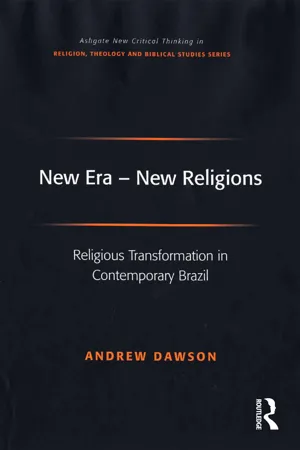
New Era - New Religions examines new forms of religion in Brazil. The largest and most vibrant country in Latin America, Brazil is home to some of the world's fastest growing religious movements and has enthusiastically greeted home-grown new religions and imported spiritual movements and new age organizations. In Brazil and beyond, these novel religious phenomena are reshaping contemporary understandings of religion and what it means to be religious. To better understand the changing face of twenty-first-century religion, New Era - New Religions situates the rise of new era religiosity within the broader context of late-modern society and its ongoing transformation.
Information
Chapter 1
Mapping the Religious Landscape
If census categories alone are anything to go by, the last three decades have witnessed the rapid and widespread pluralization of the religious landscape of Brazil. Excluding both non-declarations and those self-designating as ‘without religion’ (sem religião), the eight categories of the 1980 census relating to religion rose to 45 in 1990 before considerably expanding to the 141 categories employed by the census of 2000. As one would expect given the recent history of religious change in Brazil, the largest expansion of census categories relates to Protestant (Evangélico) Christianity, with the two categories of the 1980 census increasing to 23 in 1991 then rising to 74 in 2000. Across the board, however, the sub-categories of existing designations have multiplied and new categories have been added (Jacob et al., 2003: 221–4). On the one hand, the multiplication of census categories concerned with religion has something to do with the ongoing development of social scientific concepts and methodological approaches. As the analytical lens refines its focus what is seen increases both in detail and intensity. On the other hand, and in parallel with the aforementioned growth of academic interest in religion in general, the multiplication of census categories is a direct response to changes happening on the ground. And whilst census categories inevitably lag behind the actuality they seek to quantify, dramatic changes such as those evidenced in respect of religion nevertheless indicate that something interesting is afoot. Ultimately, then, the exponential increase in census categories is, above all, an indication of the rapid and far-reaching pluralization to which the Brazilian religious landscape has been subjected over the course of the last thirty years.
The very nature of novelty comprises not only the introduction of what was formerly absent, but also the appearance of previously unseen phenomena which result both from the combination of once disparate elements already in place or the mixture of existing ingredients with those of a more contemporary provenance. As Clarke reminds us, new religious phenomena ‘are not … exclusively modern, but juxtapose both modern and traditional forms of religion’ (2006b: 355). For many academics and interested parties, this is what makes the study of new religions so stimulating. With new religious phenomena one gets to study not only the appearance and consolidation of the dramatically new but also what emerges and takes shape when the old is transformed into something recognizably different than what it once was. As with all things new, novelty comes in a variety of shapes and sizes. With these things in mind, this chapter provides an overview of the religious landscape of Brazil which is both historical and contemporary in nature. What follows sets the broader backdrop against which the rise and spread of new era religiosity can be understood. It also highlights the most relevant historical and contemporary ingredients which have, in one way or another, found their way into the discourse and practice of new era repertoires. Inevitably, then, both Catholic and Protestant Christianity receive attention, as does Afro-Brazilian religiosity in the forms of Candomblé and Umbanda. However, as we are concerned with non-mainstream and non-established religiosity the space given over to these religions is limited to the basic (in terms of broader context) and the necessary (in terms of particular detail). In contrast the religious repertoires of Spiritism and Japanese new religions receive greater attention. Although English-language treatments are available, the subject matter of this book lends itself to including at least an overview of the establishment and principal features of Japanese new religions in Brazil. Less readily accessible to the non-Portuguese speaking world than Brazil’s other established (i.e. Christian and Afro-Brazilian) religions, Spiritism is no less important to the rise of new era religiosity in both setting the historical backdrop and furnishing particular ingredients. Furthermore, such is the correspondence between certain motifs central to both Spiritist and new era repertoires that a basic understanding of Spiritism stands the reader in good stead for the detailed treatments which follow this chapter.
Colonial Beginnings
Catholic Christianity
An integral part of the Portuguese imperial enterprise from 1500, the Lusitanian brand of Catholic Christianity brought by its southern European settlers remained the only legal religion of Brazil for the first three hundred years of its colonial existence. Indirectly through European-borne pestilence and directly through persecution and enforced conversion, Catholic Christianity displaced indigenous forms of religious-cultural expression in all but the most inaccessible parts of the country (Hoornaert, 1992: 21–152). ‘Two basic forms of Catholicism are present in the religious history of Brazil: traditional Catholicism and renewed Catholicism’ (Azzi, 1978: 9). Known also as ‘romanized Catholicism’, renewed Catholicism established itself in Brazil from the late nineteenth century onwards as Catholic Christianity assumed an increasingly ecclesiastical tenor. This institution-centred ethos was established through the centralization of clerical authority and sacramental distribution which were mediated through strengthened parish and other formal organizational structures (Oliveira, 1985). Alternatively termed ‘popular’ and ‘folk’, Oliveira defines traditional Catholicism as ‘the body of religious practices and representations developed by the popular imaginary starting from the religious symbols introduced to Brazil by Portuguese missionaries and colonists, to which certain indigenous and African religious symbols have been added’ (Oliveira, 1985: 122). Although ‘Roman’ Catholicism is very much the official face of Catholic Christianity in Brazil today, by no means has it been as influential in shaping the contours of contemporary Brazilian religious culture as its ‘traditional’ counterpart. ‘Tied profoundly’, Azzi maintains, ‘to the culture of the Brazilian people’ (1978: 9), traditional Catholicism comprised, among other things, three formative characteristics that conspired to shape successive forms of popular Catholic Christianity from colonial times, through independence and the establishment of the Republic, to contemporary urban-industrial Brazil. In no particular order of priority, the foundational characteristics of popular Catholicism most relevant here are its pragmatic supernaturalism, semi-autonomous existence from formal ecclesiastical structures, and highly eclectic nature.
The form of Catholic Christianity established in Brazil was, according to Mello e Souza, an admixture of late-medieval and early-modern religiosity ‘imbued with paganism’ and accustomed ‘to a magical universe’ in which ‘people could barely distinguish between the natural and the supernatural, the visible and the invisible, part and whole, the image and what it represented’ (2003: 48). Inhabiting a universe populated by magical forces and spiritual entities, both malign and beneficent, Brazilian colonists managed their supernaturalized world through recourse to a vast array of superstitions, beliefs, and practices articulated by popular Catholicism and geared towards meeting the needs provoked by the everyday challenges and hardships of life. The utilitarian nature of popular Catholicism is exemplified in practices such as the promessa, novena, and pilgrimage. These practices underwrite a form of reciprocally binding, though generally temporary, arrangement through which favours and benefits are gained by the supplicant in exchange for some form of ritualized offering to the supernatural powers that be (Greenfield, 2001: 59–61; Oliveira, 1985: 117). Structured principally around the ritualized interaction of supplicant and saint, colonial popular Catholicism embodied an unabashedly pragmatic religiosity in which saintly patronage combined with thaumaturgy (i.e. use of charms, spells, offerings, amulets, and curses) and assorted means of supernatural manipulation thought most likely to engender sought after results. The more formal beliefs and practices of popular Catholicism’s pragmatic supernaturalism were ordered through a range of sanctioned organizations and semi-official structures likewise inherited from Lusitanian religiosity (Azzi, 1978: 155). Owing to the organizational structure of the Catholic mission in Brazil, its prioritization of the elite classes, and relative lack of well-trained and pastorally committed clergy, popular Catholicism enjoyed a relative independence from ecclesiastical structures already weakened through political compromise and geographical remoteness (Azzi, 1977: 160–200). Orientated around domestic shrines, local chapels, and strictly segregated associations (e.g. irmandades and confrarias) popular Catholicism drew upon a range of lay functionaries (e.g. benzedores, rezadores, and festeiros) whose semi-autonomous and socially-stratified nature further enhanced the development of a para-ecclesiastical religious worldview (Oliveira: 1985: 130–33; Pessar, 2004: 20). Attuned more to the social rhythms and hardships of everyday life than the theological intricacies of official Church teaching, the pragmatic supernaturalism and semi-autonomous nature of popular Catholicism inclined it as much toward heterodoxy as perceived orthodoxy. Exploiting the room for manoeuvre furnished by its semi-autonomous nature, popular Catholicism’s pragmatic ethos engendered an eclecticism that judged beliefs and practices relative to their practical efficacy for the hardships of everyday life rather than their correlation with official Church teaching (where, indeed, it was propagated).1 Add to this popular Catholicism’s well-developed supernaturalism, and one can appreciate the relative ease with which elements of indigenous animistic worldviews and spiritist cosmologies of imported African slaves were drawn upon and incorporated within the discursive and practical repertoires initially provided by colonial Catholic Christianity.
Emerging Pluralization
Protestantism
Except for ill-fated invasions by French Huguenots (Rio de Janeiro, 1555–67) and Dutch Calvinists (Bahia and Olinda, 1624, 1630–54), Catholicism continued to enjoy official religious hegemony until the British-assisted arrival of the Portuguese royal court in 1808 (Mendonça, 2004: 50). Keen to establish trading relationships with the nascent imperial power of Great Britain and desirous of attracting immigrant farmers from Protestant northern Europe, the Brazilian aristocracy oversaw a raft of legal reforms to help realize these aspirations. Whilst maintaining Catholicism as the official ‘imperial’ religion, for example, the Constitution of 1824 granted limited liberties to Anglican/Protestant modes of religious expression, such as permission to hold religious services as long as they were restricted to a domestic context and foreign language (Mariano, 2002).2
Reflecting the advance of secularist philosophies among the nation’s ruling elites, and seeking to increase Brazil’s appeal to European immigrants (thereby lessening latifúndio reliance upon slave labour), religious liberties were further extended in the early 1860s; but again in such a way as to protect Brazilian Catholics from the advances of Protestant missionary activity (Fragoso, 1980: 237–48).3 Indicative of the progressive realignment of Brazil’s international relations from the mid-1850s onward, it was the more zealously proselytising forms of North American Protestantism that most readily exploited this new-found political-legal space. Excluding the Igreja Evangélica Fluminense (1858), whose roots lay in Scottish Congregationalism, the legally sanctioned establishment of non-Catholic churches in the second half of the nineteenth century (e.g. Methodist Church, Rio de Janeiro, 1878; Presbyterian Church, Rio de Janeiro, 1862; Baptist Church, Salvador, 1882; Episcopalian Church, Rio Grande do Sul, 1890) reflected the now hegemonic status of North American denominations within Brazilian Protestantism (Mendonça, 2004: 53–5). Although constituting only 1 per cent (142,235) of the population in the 1890 census, the establishment of Brazil as a republic in the same year did much to consolidate the social-cultural position of Protestantism as a legitimate marker of Brazilian identity (Mariano, 2002). Modelled on the secular liberal State exemplified by the French and U.S. Constitutions, Brazil’s new political order oversaw the removal of the Roman Catholic ecclesiastical institution as a quasi-official body of government (Burns, 1980: 288). Along with the secularization of official procedures relating to birth, education, marriage, and death, the granting of full civil and political rights to members of selected non-Catholic religions created an environment in which nascent Protestant denominations could thrive well enough by the early decades of the twentieth century to begin to act autonomously from their North American parent organizations. Never numerically significant enough to reshape Brazil’s religious-cultural landscape in any dramatic way, a number of traditional Protestant denominations nevertheless remain well represented within influential sectors of the nation’s contemporary urban-industrial elite.4
In many ways, the establishment in Brazil of Christian-spawned movements such as the Seventh Day Adventists, Jehovah’s Witnesses, and Church of the Latter Day Saints (Mormons) mirrors that of many traditional Protestant denominations. The Seventh Day Adventists are recorded by the census of 2000 as the largest of these denominations, with 1.2 million members. The Jehovah’s Witnesses come a close second with 1.1 million members, whilst the Church of the Latter-day Saints registers 199,641; although it claims to have more than 600,000 members (<www.lds.org.br>). Each of these movements has a similar demographic profile to traditional Protestantism in Brazil (Jacob et al., 2003: 73, 103). Although, like its two counterparts, Seventh Day Adventism emerged in the United States, it first made its way to Brazil as part of the late nineteenth-century arrival of German immigrants who had been converted through the organization’s missionary activity in 1870’s Germany. Confined for the first decades of its existence to the German speaking immigrant community in the south, Adventism’s first real missionary successes in Brazil occurred subsequent to its adoption of the Portuguese language in the early decades of the twentieth century. The Adventist presence in Brazil was complemented by the arrival of Mormonism and the Jehovah’s Witnesses in the 1920s (Schunemann, 2003: 27–40).
The massive demographic shifts unleashed by Brazil’s rapid urban-industrial expansion in the 1950s and 1960s provided fertile ground for the progressive spread of Protestant Pentecostalism that had begun to establish itself in Brazil some fifty years earlier. Along with ‘first wave’ Pentecostal churches such as the Christian Congregation (1910) and Assemblies of God (1911), ‘second wave’ denominations such as the Foursquare Gospel (1951), Brazil for Christ (1955), New Life (1960), and God is Love (1962) rapidly augmented the Pentecostal presence in Brazil by their expansion among the recently displaced and increasingly urbanized rural masses (Read, 1965: 159–79; Willems, 1967: 12–13, 54–8). Typified by the subsequent emergence of, for example, the Universal Church of the Kingdom of God (1977), the International Church of the Grace of God (1980), and the Reborn in Christ Apostolic Church (1986), the radicalization of Pentecostal discourse and practice in the late-1970s and early-1980s led to the term ‘neo-Pentecostal’ being coined (Freston, 1994: 131). In addition to exploring the factors behind the urban spread of neo-Pentecostalism (Mariano, 2002; Ruuth: 2002), recent treatments have engaged, among other things, neo-Pentecostalism’s move into the formal political arena (Oro, 2003: 53–69), its acrimonious relations with Afro-Brazilian and Spiritist religions (Mariz, 1997: 251–64), the movement’s transnationalization through the establishment of neo-Pentecostal churches in other parts of the world (Aubrée, 2002: 12–21), and its use of mass-media communications, corporate institutional practices, and state of the art marketing techniques (Chesnut, 2003: 50–62; Cunha, 2004: 53–80; Dolghie, 2004: 201–220). Of most relevance here, however, is the manner in which neo-Pentecostal organizations are adapting to Brazil’s increasingly pluralized religious field by appropriating (e.g. exorcism, unction, correntes, and novenas) and adapting to (e.g. religious transit) themes and practices central to the repertoire of Brazilian popular religiosity (Mariano, 1999: 109–146; Freston, 1994: 138–9, 142). By tapping into the foundational aspects of popular Catholic, Afro-Brazilian, and Spiritist discourse and practice, neo-Pentecostalism broadens its appeal among the poorer sectors of Brazilian society whilst unwittingly providing qualified legitimacy to beliefs and practices at the heart of popular religious expression in Brazil. Among the fastest growing religious organizations in the world today, neo-Pentecostalism grew from 3.9 million in 1980, through 8.8 million in 1991, to 18 million in 2000. Predominantly a religion of the urban poor, neo-Pentecostal denominations represented 10.6 per cent of the population recorded in Brazil’s census of 2000 (Jacob et al., 2003: 39).5
Candomblé
If the desire for European immigration played a part in reshaping Brazilian political-legal attitudes in respect of certain non-Catholic religions, the legacies of slave-related immigration have redrawn sections of Brazil’s religious map in their entirety. Estimates range between three to five million African slaves forcibly transported to Brazil between the years 1530–1851, with approximately 266,000 arriving in the last seven years (Burns, 1980: 183; Brown, 1994: 27). With the dynamic of the Brazilian slave trade having moved by this time from servicing a rural to an urbanising context, this fresh infusion of African cultures was provided with a social-economic space conducive to the maintenance and survival of themes and practices central to their religious worldview. Inevitably, trade-related upheavals of transportation and distribution did much to undermine and confuse the linguistic, cultural, regional, and cultic allegiances established in Africa (Johnson, 2002: 37). Although geographical clustering of slaves allowed for a degree of regional variation in Afro-Brazilian religious expression, there nevertheless remains a great deal of substantive overlap between central motifs, rituals, and their respective interpretations (Gaspar, 2002).6 Certainly, by the time the first recorded Candomblé terreiros (places of worship) appeared in Bahia in the early part of the nineteenth century, earlier processes of fusion and selection had produced from its various constituents a more streamlined and systematized cosmology (Voeks, 1997: 51).
Candomblé is divided into ‘nations’ (nações) which function as ostensible historical links to the diverse African cultural-linguistic strands comprising this particular Afro-Brazilian religious worldview (Bastide, 2001: 29). The most influential of these nations, the ‘Ketu’, is centred upon the worship of orixás, with most terreiros acknowledging the existence of more than twenty orixás, but usually concentrating upon actually honouring no more than twelve.7 Candomblé cultic practice revolves around a mutually advantageous exchange between orixá and adherent facilitated by the ritually trained medium (mãe or pai de santo and filhas or filhos de santo). Candomblé cosmology has the physical terrain of the earth (aiê) surrounded by a spiritual realm (orun) comprising nine semi-permeable concentric spheres. The outermost spheres are populated by the remote god Olórun and other foundational deities (the Irumalé). The souls of the dead (eguns) are dispersed throughout orun, their cosmological position in the supernatural hierarchy determined relative to their spiritual development when alive on earth. The spiritual spheres nearest the earth share a similar level of cosmic energy (axé) with it, thereby allowing the orixás most central to Candomblé practice to pass easily between orun and aiê and possess their designated mediums. Acting ostensibly as representatives of the higher...
Table of contents
- Cover Page
- Title Page
- Copyright Page
- Dedication
- Contents
- Acknowledgements
- Introduction
- 1 Mapping the Religious Landscape
- 2 Neo-Esoteric Religiosity
- 3 Ayahuasca Religions of Brazil
- 4 New Era Discourse
- 5 New Era Religiosity in Late-Modern Perspective
- Conclusion
- Bibliography
- Index
Trusted by 375,005 students
Access to over 1.5 million titles for a fair monthly price.
Study more efficiently using our study tools.
Frequently asked questions
Yes, you can cancel anytime from the Subscription tab in your account settings on the Perlego website. Your subscription will stay active until the end of your current billing period. Learn how to cancel your subscription
No, books cannot be downloaded as external files, such as PDFs, for use outside of Perlego. However, you can download books within the Perlego app for offline reading on mobile or tablet. Learn how to download books offline
Perlego offers two plans: Essential and Complete
- Essential is ideal for learners and professionals who enjoy exploring a wide range of subjects. Access the Essential Library with 800,000+ trusted titles and best-sellers across business, personal growth, and the humanities. Includes unlimited reading time and Standard Read Aloud voice.
- Complete: Perfect for advanced learners and researchers needing full, unrestricted access. Unlock 1.5M+ books across hundreds of subjects, including academic and specialized titles. The Complete Plan also includes advanced features like Premium Read Aloud and Research Assistant.
We are an online textbook subscription service, where you can get access to an entire online library for less than the price of a single book per month. With over 1.5 million books across 990+ topics, we’ve got you covered! Learn about our mission
Look out for the read-aloud symbol on your next book to see if you can listen to it. The read-aloud tool reads text aloud for you, highlighting the text as it is being read. You can pause it, speed it up and slow it down. Learn more about Read Aloud
Yes! You can use the Perlego app on both iOS and Android devices to read anytime, anywhere — even offline. Perfect for commutes or when you’re on the go.
Please note we cannot support devices running on iOS 13 and Android 7 or earlier. Learn more about using the app
Please note we cannot support devices running on iOS 13 and Android 7 or earlier. Learn more about using the app
Yes, you can access New Era - New Religions by Andrew Dawson in PDF and/or ePUB format, as well as other popular books in Theology & Religion & Religion. We have over 1.5 million books available in our catalogue for you to explore.