- 350 pages
- English
- ePUB (mobile friendly)
- Available on iOS & Android
eBook - ePub
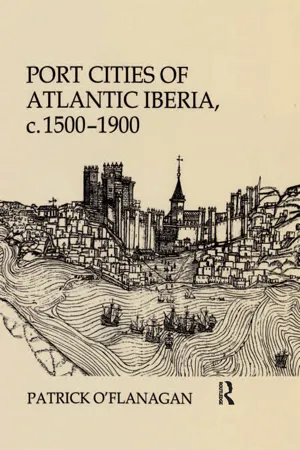
Port Cities of Atlantic Iberia, c. 1500–1900
About this book
Charting the evolution of the port cities of Atlantic Spain and Portugal over four centuries, this book examines the often dynamic interaction between the large privileged ports of Lisbon, Seville and Cadiz (the Metropoles) and the smaller ports of, among others, Oporto, Corunna and Santander (the Second Tier). The book particularly focuses on the implications of state-sponsored commercial policies for the main ports of Atlantic Iberia during the monopoly period extending from 1503 to c.1778, and briefly considers the implications of the suppression of monopoly for these centres over the remainder of the nineteenth century. Patrick O'Flanagan employs a wealth of source material to provide a multi-faceted survey of the growth of these port cities, moving deftly from local concerns to regional developments and global relationships. Beyond Spain and Portugal, the book also considers the important role played by the Atlantic archipelagoes of the Canaries, the Azores and Madeira. This formidable study is an essential addition to the library of those studying Atlantic Iberia, historical geography, and transatlantic economic relationships of this period.
Ports and the Atlantic
Introduction
Sailors, ships, docks, harbours, slaves, exotic and routine products, warehouses, distinctive smells, fish, merchant princes and prostitutes, ethnic diversity and cosmopolitanism are among the characteristics which have made port cities and towns what they are and were, and which have caught the attention of many authors (Hugill, 1967; Rudolf, 1980; Mollat du Jourdan, 1993; Runyan, 1997; Walvin, 1997). Port settlements from early times were an urban type found on every continent (Villiers and Dutiel, 1997). A port’s activities propel the emergence of a specific type of urban community and, in addition, may also reshape, reorder and transform its hinterland and configure its foreland (Wrigley, 1990).
Outside Europe, after the so-called ‘Discoveries’, the political economies in vogue endowed the elites of these ports with enormous economic and political influence, which extended to the cover vast areas of their forelands and hinterlands (Briost, 1997). Many visitors to ports in the past were not impressed by what they saw. Arthur Young writing about Bordeaux noted: ‘the way of its merchants here is extremely lavish’. He described the harbour at Bordeaux as: ‘one dirty slippery muddy bank with unpaved areas covered in detritus ... it was without the order, the arrangement and the opulence of a quay’.
There are problems that require attention in any quest to define what constitutes a port city. Some settlements may only become port cities after a former existence during which the port was of little consequence, as in the case of Santander. Others are like Seville, whose port’s all embracing functions were overshadowed by the emergence of new functions and have since withered. Whatever the case, port cities represent a recognisable settlement type. It is argued here that several different types of port cities emerged within Europe, and especially Atlantic Iberia, largely as a consequence of the implementation of a particular brand of political economy:
The concept of the port city in historical studies ... has scarcely advanced beyond the stage of definition. That is a curious state of affairs for an urban type that has dominated urban civilisation from antiquity until the twentieth century. (Konvitz, 1978, p.115)
Such a statement may today appear unduly harsh; it does, however, have more than a ring of truth about it, as far as the study by geographers of historic European port cities is concerned. Although geographic concepts have been brought to bear on these kinds of cities in multi-cultural contexts (Broeze, 1989), perhaps one of the factors which has deterred scholars from grappling with this urban type is their incredible complexity and their capacity for abrupt change. Their problematic and discontinuous documentary records are a central issue. For instance, unravelling synchronisation of movement of goods from port hinterlands to ports and then simultaneously linking them with shipping activity and physical growth in the past is notoriously difficult to divine: take the case of wool intake to Bilbao and its dispatch by sea (Phillips and Phillips, 1997).
The notion of the port city as a generic settlement type has also been obfuscated by the general failure to grapple with these settlements in their entirety (Lee, 1998). Some studies that address ports are oblivious to their urban locales (Caselli and Lemaine, 1991). Others have examined the cities while relegating the port to an auxiliary position and the consequences of this are severe:
... we either have studies of ports with no reference to the cities which they relate to; or we have studies which discuss port cities as if there were no maritime functions that could influence the spatial and social evolution of the city. (Reeves et al., 1989, p. 29).
Whatever about the problems of definition, there is a vague scholarly consensus that port settlements represent a distinctive urban category (Price, 1974; Hohenberg and Lees, 1985; Barioch et al., 1988). Settlements so defined often have more in common with each other than with the states or the regions where they were/are located. Port cities have also had a global incidence and they represent some of the earliest known urban settlements (Lawton and Lee, 2002). Here one can invoke the example of the Phoenicians and their port network extending from Beirut via Syracuse to Gadir (Cádiz).
Even in antiquity, some of the great ports were planned and some enjoyed immediate spectacular success, as was the case with Alexandria. Europe’s most populous city, Istanbul, strangely not always posted in urban league tables, must rank as one of the world’s most complex, remarkable and longstanding port cities (Mantran, 1996; Mansel, 1997). Port cities were centres of diffusion on both sides of the Atlantic and, in the New World, they unleashed prodigious environmental changes as settlers fanned out and established their capitalist monocultures with all of the attendant implications for indigenous societies, their landscapes and nature (Cronon, 1990). Port cities were not simply passive agents in this endeavour; through them returned a host of plants (Schiebinger, 2004). This has transformed our back and front gardens and our botanical gardens (Hoyles, 1991). They augmented Europe’s bio-diversity to an unprecedented extent (Hoyles, 1991; Miller and Reill, 1996; Walvin, 1997).
Gold, silver, spices, precious timber, dyes, highly valued medicines and drugs passed through them as did thousands and thousands of slaves (Blackburn, 1997). For some time, it made the Atlantic less white and more ‘black’ (Gilroy, 1993; Northrup, 1994). Ports linked Africa and Africans to a transoceanic system (Eltis, 2000; Thornton, 1998). The European thirst for new beverages and their accompaniments, from chocolate to gin, fundamentally changed the way Europeans lived and these new tastes were facilitated in the form of new social locales such as coffee houses and gin palaces. Nevertheless, port cities were agents of the world of colonialism and imperialism and they thrived in these contexts (Brotton, 1997). Alphabets, languages and religions were carried in and out of many ports (Cabantous, 1970). Mapmakers constructed new worlds in ports such as Amsterdam and Seville (Buisseret, 1993).
On the ground, port cities configured social structures with distinctive characteristics, not least in the attraction of foreign merchants who played catalytic roles in all aspects of the careers of these settlements. In this way, the study of port cities is intimately connected to our growing understanding of the complexity of urbanism (Jansen, 1996). Their study must also contribute to our knowledge of globalisation and the historical geography of modernity (Butel, 1997)
This study examines, within an Atlantic Iberian context, the evolution of metropole port settlements, the relationships between their forms, their changing functions and their shifting social configurations. In addition, their roles as trading breakpoints mean that the connections and movements between their forelands and hinterlands must also be explored. In Portugal and Spain, state-inspired political economies embodied in sophisticated monopoly policies had profound influences on the articulation of trade passing through ports with exclusive rights. They can be termed metropoles and it was these policies that made and undid them. Another kind of monopoly drove a wool trade to the ports of Bilbao and Santander. Inertia after the suspension of the monopoly allowed the monopoly ports to thrive for some time afterwards; the consequences of American independence and civil unrest unleashed by Napoleon had very different outcomes.
Three centres, namely Seville, Cádiz and Lisbon were endowed with consummate mercantile privileges. Effectively, many other peninsular port settlements were simply embargoed from trading with the colonies, and the consequences of exclusion for four key ports are also examined. This study then focuses on the implications of state-sponsored commercial policies for the main ports of Atlantic Iberia during the monopoly period extending from 1503 to c.1778. It also briefly considers the implications of the suppression of monopoly for these centres over the remainder of the nineteenth century.
Can, for example, the demographic, functional and physical expansion of ports be linked to particular trading conjunctures? At centre-stage in the inquiry is an analysis of the changing urban fabric, functions, population, nature and volumes of trading, foreland–hinterland relationships, merchant ideologies and commercial networks under the auspices of the monopoly and its immediate legacies. The relationship between political economy, trade and port development during and in the aftermath of the monopoly form the core of the analysis. The book is concerned with the connections between policy, trade, urban growth and decline. It deals, in so far as is possible, with the institutions established to implement exclusionist policies at port level and omits consideration of the roles of municipal bodies and the church to urban growth. It is about ports, their changing fabrics, their evolution and exegesis and how monopoly policies influenced the kind of societies that emerged within them. After all, the arrival of such copious amounts of colonial goods at a number of specific ports recalibrated the peninsula’s port hierarchy and facilitated the appearance of a distinctive urban social composition. The study seeks to pinpoint how and when they grew, but does not purport to examine either their social histories or the contributions of civic administrations to their careers.
The book is organised as follows. It begins with a consideration of the historiography of port settlements and this is followed by a discussion of their leading attributes and an assessment of the types of port settlements recognised in the literature. The context of these settlements is explored specifically on the Iberian Peninsula. As a counterpoint to urban evolution, there is a chapter that addresses the evolution of political economic structures, their reflection in colonial trading patterns and the emergence of different Atlantic worlds and their ‘histories’. Linked to this is a section which deals with some of the key instruments that were devised to manage the Portuguese and Spanish Atlantic empires and how merchants organised commerce within these confines.
The remaining parts of the work discuss the relationships between the patterns and contents of trade and port settlement evolution in a series of discrete areas. To begin with, metropoles of Atlantic Andalusia, namely Seville and those of the Bahia of Cádiz, are scrutinised. Then Lisbon’s role as an imperial metropole, capital city and premier port city are considered. As outports or anteports of the peninsula, the roles of some of the islands of the Atlantic archipelagos are evaluated. Castile’s functions as a source of raw materials is then explored as are its links with the ever-expanding inner Atlantic world.
The fortunes of the remaining second tier of port settlements are then addressed. Their activities and functions were constricted by the political economies of their respective states over extended periods. Of them all, Oporto’s mercantile career was least affected by these obstacles. The development of its hinterland as a prosperous viticultural zone consolidated its career as an Atlantic port. Corunna, Bilbao and Santander had all successfully participated in inner Atlantic commerce during the sixteenth century, but all of them had to wait until the late eighteenth century, or even the nineteenth century to emerge as significant Atlantic port settlements. In conclusion, an attempt is made to categorise these port settlements as a distinctive urban class in their historiographic setting.
Ports in literature
To date, port cities have been the subject of limited serious enquiry both implicitly as groups of interacting cities or even as encyclopaedic case studies as the works of Broeze (1989), Gilchrist (1967); Knight and Liss (1991) and CEHOPU (1994) illustrate. The sheer volume of individual analysis conducted and published in various languages in Europe may be responsible for the fact that few regional studies have appeared, nor has anyone yet attempted a continental synthesis. There have been some brilliant case studies such as those of Chaunu for Seville (1955–60), García Baquero González (1988) for Cádiz, Roncayolo for Marseilles (1990), or Clarke’s pertinent study of La Rochelle (1981), as well as Devine and Jackson’s work on Glasgow (1995), Loose (1984) on Hamburg, and Suykens and Aesert’s (1986) study of Antwerp.
The only attempt to derive a broader perspective from Europe has been the Clark and Wood edited thematic volume (1994) which focuses upon port cities in ‘The Transatlantic World in the Age of Expansion’. Its eclectic remit extends to a pungent cultural flavour addressing, for instance, slaves, white labour and American influences on Antwerp’s material culture. The contents page serves as a compelling but daunting desideratum of what remains to be completed.
Konvitz (1993) has made an excellent and path-breaking study of the planning of early modern port cities with particular reference to France. By drawing on a rich variety of maps, etchings, plans, memoirs, paintings and state papers, this creative work demonstrates that state interventions in planning port settlement happened perhaps earlier than many would have supposed. Broeze has also made several useful contributions, not least in a trenchant review essay (1989). The sea (Steinberg, 2003; Lambert et al., 2006) and the Atlantic world (Gabaccia, 2004) have more recently engaged the attention of a wider community of scholars to judge by the appearance of editions of the Journal of Historical Geography (2006), Social and Cultural Geography (2005) and the foundation of the review Atlantic Studies (2004).
English geographers have been productively active chiefly in addressing the ramifications of modern port transformation and also have imbued some of this work with a deep historical flavour (Bird, 1980; Lawton and Lee, 2002). The contextualisation of ports in seaport systems has also yielded valuable insights into change (Hoyle and Hilling, 1984). Work on Africa and modern seaport change been the focus of a more recent work (Hoyle and Pinder, 1992). To date, little serious research has been accomplished by Europeans on urban cultural transfers to the New World (Thomas, 2004). This is especially the case in relation to Spanish urban transmission (Calderón Quijano, 1984; Cámara Muñoz, 1998). The Portuguese, not unexpectedly, have been more active on this front. Research has been completed covering how Portuguese urbanism in India was influenced by Renaissance idealism (Rossa, 1997). An attempt has been conducted to identify the principal features of Portuguese-built colonial Atlantic towns of the fifteenth and sixteenth centuries and their locational characteristics have been studied. Reverse cultural transfers via Portuguese port cities remain less well understood (Rodrigues, 2000). Anyone who has examined the hybrid civic architecture at Faro cannot fail to observe Indian influence.
Some of the earliest port cities undoubtedly emerged fringing the Pacific (Tindall, 1982). Many settlements there have been subject to detailed and pioneering scrutiny (Murphey, 1979). Indeed, recent research has confirmed that the European contribution to their expansion has been generally overestimated and often exaggerated (Broeze, 1989). The European Discoveries encountered a series of complex port settlement systems in fine fettle in China, Moghul India, Persia, Thailand, the rivers of south-east Asia and the archipelagos and peninsulas occupied by the Malays (Basu, 1979). The presence of well-established trading networks focused on ports such as these are attested to in the movements and observations of Arab, Central Asian, Chinese, Maghrebi and Persian travellers as exemplified in the journeys of Ibn Battuta (Gibb, 1994). State involvement in building, or promotion, of port cities was often quite limited and de novo centres were very much the exception. In Asia, given the longstanding nature of coastal urban development, many settlements acted as imperial and/or colonial ports (Broeze et al., 1986).
In the New World, many excellent studies are available in relation to the evolution of seaport cities but, as yet, no synthesis had been accomplished for any macro-region. As background research on the emergence of the Portuguese and Spanish seaborne empires, the works of Boxer (1969) and Parry (1966) are most seminal. More has yet to be written on European endeavours overseas (Chaunu, 1964). An early collection of essays has set a kind of benchmark (Gilchrist, 1967). A limited number of works have appeared dealing with European state relationships with the overseas colonies in which ports figure prominently (Mauro, 1960; McNeill, 1985; Pearson, 1990; Kagan, 1986). The publication of an edited series offers a statement on the recent state of the debate and it illustrates the diversity of issues now being addressed under the banner of port cities (Knight and Liss, 1991).
The records of the authorities implicated in the administration of ports and trade is copious and sometimes overwhelming. Their survival has permitted the publication of some riveting research such as that of Chaunu (1955–60) of Mauro (1960) and Morineau (1985). Key ports were highly sensitive locales, many receiving enormous defensive investments, as at Cádiz, for instance (Calderón Quijano et al., 1978; Buisseret, 1998; Cámara Muñoz, 1998). Some monarchs were desperate to be able to view their ports. Painters and engravers such as Braun, Hogenberg and Van den Wjngaerde helped fill such voids during the reign of Philip II (Popham, 1936; Kagan, 1986). Indeed, the peninsular painting itinerary of the latter is significant in what it excluded and included: it covered two visits to northern Castile, one to Aragón, Cataluña-Valencia, Madrid and Andalusia (Kagan, 1986, p. 10). This monarch had an insatiable desire for place-informatics so he commissioned various statistical trawls (Martínez Taboada, 2000). He also persistently patronised the collection of urban informatics (Sanz Herminda, 2000). Later on, Carlos III of Spain ordered a series of models to be made of his major peninsular ports. In 1777, Alfonso Jiménez completed the only one for Cádiz. Others commissioned artists to represent their major ports and the output of Joseph Vernet for France represents a prodigious achievement (Boulaire, 2001). All of these portrayals of ports, domestic residences and public buildings illustrate their basic anatomies representing their ethos and constitute another series of unexplored texts. In Atlantic Iberia, these texts largely remain to be deconstructed.
What approaches have been employed to engage with these settlement types? Individual case studies reveal, as one would expect, an eclectic range of approximations. Many are focused on a restricted range of themes guided by the disciplinary tropes in vogue. Collections of essays concerned with these ports manifest what, to some, might seem a lack of control over the approaches to the topic and the themes selected for scrutiny. To be fair, however, the scale and range of issues relating to the study of port cities is almost hopelessly extensive and many different disciplines consider them part of their remit. This makes the task of theorising about the nature of their urban forms as difficult as that of achieving any consensual approaches to their study.
Several attempts have been made to classify ports by type in terms of their origins exemplified by Broeze et al. (1986), while others have tried to sort them out in terms of their range, scale and specialism(s) of their port functions (Jackson, 1996). Efforts have been made to allocate phases of growth to existing urban evolutionary typologies, although others have argued that recognisable stages in their growth can be fastened onto well-known eras of development as propounded by economic historians. Obviously, this task needs to be conducted within a broad perspective of urban definition (Jansen, 1996)
The work of Vance is important here, as it attempts to link trade cycles with urban change with especial reference to Anglo-America (Vance, 1970, 1990). Briefly, this geographer asserts that five stages in the process of change can be identified. To begin with, accelerating prosperity in Europe promotes the voyages of exploration. This phase is replaced by essentially east-to-west traffic in basic raw materials such as fish, furs, tobacco and timber. With the consolidation of permanent settlement in North America, more regular two-way traffic increases; however, most of the interactions remain animated by Europe’s increasingly voracious appetite. Transportation links remain pivoted on coastal hubs. The emergence of self-sustaining manufacturing characterises the fourth stage in which the legacies of earlier stages remain evident. The dominance of internal trade marks the consolidation of the last stage. Other models such as that of Rimmer (1977) clearly have been inspired by the works of Vance and of Brookfield (1975). In further examples, phases in the evolution of ships have been suggested as a means of understanding port city progression (Broeze, 1996).
Transportation spe...
Table of contents
- Cover
- Half Title
- Dedication
- Title Page
- Copyright Page
- Table of Contents
- List of Figures
- List of Plates
- List of Tables
- Preface
- Acknowledgements
- PART I PORTS AND THE ATLANTIC
- PART II THE MONOPOLY: SEVILLE, CÁDIZ AND THE ANDALUSI PORT COMPLEX
- PART III A SECOND TIER OF PORTS
- Conclusions
- Select Bibliography
- Index
Trusted by 375,005 students
Access to over 1.5 million titles for a fair monthly price.
Study more efficiently using our study tools.
Frequently asked questions
Yes, you can cancel anytime from the Subscription tab in your account settings on the Perlego website. Your subscription will stay active until the end of your current billing period. Learn how to cancel your subscription
No, books cannot be downloaded as external files, such as PDFs, for use outside of Perlego. However, you can download books within the Perlego app for offline reading on mobile or tablet. Learn how to download books offline
Perlego offers two plans: Essential and Complete
- Essential is ideal for learners and professionals who enjoy exploring a wide range of subjects. Access the Essential Library with 800,000+ trusted titles and best-sellers across business, personal growth, and the humanities. Includes unlimited reading time and Standard Read Aloud voice.
- Complete: Perfect for advanced learners and researchers needing full, unrestricted access. Unlock 1.5M+ books across hundreds of subjects, including academic and specialized titles. The Complete Plan also includes advanced features like Premium Read Aloud and Research Assistant.
We are an online textbook subscription service, where you can get access to an entire online library for less than the price of a single book per month. With over 1.5 million books across 990+ topics, we’ve got you covered! Learn about our mission
Look out for the read-aloud symbol on your next book to see if you can listen to it. The read-aloud tool reads text aloud for you, highlighting the text as it is being read. You can pause it, speed it up and slow it down. Learn more about Read Aloud
Yes! You can use the Perlego app on both iOS and Android devices to read anytime, anywhere — even offline. Perfect for commutes or when you’re on the go.
Please note we cannot support devices running on iOS 13 and Android 7 or earlier. Learn more about using the app
Please note we cannot support devices running on iOS 13 and Android 7 or earlier. Learn more about using the app
Yes, you can access Port Cities of Atlantic Iberia, c. 1500–1900 by Patrick O'Flanagan in PDF and/or ePUB format, as well as other popular books in History & World History. We have over 1.5 million books available in our catalogue for you to explore.