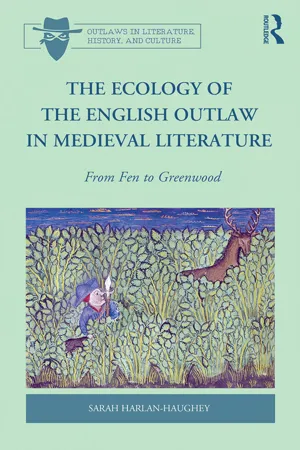
Arguing that outlaw narratives become particularly popular and poignant at moments of national ecological and political crisis, Sarah Harlan-Haughey examines the figure of the outlaw in Anglo-Saxon poetry and Old English exile lyrics such as Beowulf, works dealing with the life and actions of Hereward, the Anglo-Norman romance of Fulk Fitz Waryn, the Robin Hood ballads, and the Tale of Gamelyn. Although the outlaw's wilderness shelter changed dramatically from the menacing fens and forests of Anglo-Saxon England to the bright, known, and mapped greenwood of the late outlaw romances and ballads, Harlan-Haughey observes that the outlaw remained strongly animalistic, other, and liminal. His brutality points to a deep literary ambivalence towards wilderness and the animal, at the same time that figures such as the Anglo-Saxon resistance fighter Hereward, the brutal yet courtly Gamelyn, and Robin Hood often represent a lost England imagined as pristine and forested. In analyzing outlaw literature as a form of nature writing, Harlan-Haughey suggests that it often reveals more about medieval anxieties respecting humanity's place in nature than it does about the political realities of the period.
eBook - ePub
The Ecology of the English Outlaw in Medieval Literature
From Fen to Greenwood
- 220 pages
- English
- ePUB (mobile friendly)
- Available on iOS & Android
eBook - ePub
About this book
Information
1 The wolf and the fen
Outlawry and exile in Anglo-Saxon England
Exile is an important and common theme of Anglo-Saxon poetry, which is saturated with images of wilderness, inhumanity, and madness. Poets dwell on the exile’s relationship with his landscape and the creatures that inhabit it. There exist in the fabric of metaphor and allusion a number of hints that the idea of bestial outlawry was common. Famous outlaws like Cain, Lucifer, and even Grendel suffused poetry and prose. And humans suffered exile, too—and composed poems and stories about that experience. Though many critics have studied the elegies and other poems upon which this study touches, this chapter will show how bestial exile in a watery or wooded wasteland forms a unified theme throughout the Anglo-Saxon corpus—not only in the elegies, but also in the biblical poems, epic poems, and homilies; it is a central poetic question for the Anglo-Saxon author. This chapter identifies many exiles or outlaws in Anglo-Saxon poetic and prose texts, each of which portrays some aspect of the complex cluster of ideas and motifs dealing with exile, animality, and wilderness.
Before analyzing specific texts, I will outline the ecological and cultural currents of this tradition in the Anglo-Saxon period, focusing in particular on Anglo-Saxon attitudes toward fenland and wild animals. After these introductory sections, I will discuss many different figures of outlawry in turn, drawing upon a wide range of Anglo-Saxon poetic and prose material to demonstrate that the bestial outlaw was a prominent figure in the literary cosmology of the time. These narratives will be explored within the context of the landscapes of exile: the woods and fens. I will trace the topography of Anglo-Saxon exile by following each manifestation to its particular ground and placing different narratives in their own imaginary landscape of exile.
Outlaw narratives are responses to place, and in the Anglo-Saxon period, we see emotive and ecological connections repeatedly established between exile and wilderness, and especially fenland. This chapter will show how the Anglo-Saxon sense of place as embodied in narratives of exile will come to influence profoundly the ecology and sensibility of outlaw narrative.1
Outlaws, wolves, and wilderness
The historical outlaw in the Anglo-Saxon period is at the same time a prominent and murky figure. I cite in full Karen Swanson’s description of outlawry, since she does an admirable job of presenting the basic aspects of the practice, noting “the fictive tendency of the technique of execution, the tendency to let the criminal die without direct intervention on the part of his executioners at the decisive moment.” She argues that:
A sentence of complete outlawry, in spite of the long evasions of such outlaws as Grettir, must often have meant death. The laws of Alfred, from the end of the ninth century, indicate that it may have been almost impossible for an outlaw to find himself a new lord and community elsewhere… . In the Old English Genesis, Cain is a banished individual condemned to wandering far from his kin, an exile that represents his spiritual separation from his Lord. The outlaw, besides being spiritually or symbolically dead to his community, could well become literally dead as … [the] ‘wineleas haele,’ one suspects, would not long live.2
The outlaw must live outside human life—thus the “out” element (fors, ut-, ex)—but also simply outside, as in outside human meaning, out of doors.3 People who commit heinous crimes like rape, murder, sorcery, and treason lose their rights to the status of “human”; humanity is not a biological, but a spiritual state of being.4 In this way, the wolf’s head is not some sort of “legal poetry,” as has been previously argued, a “magico-legal transformation of the medieval criminal into a wolf, or rather werewolf,” but rather a sort of verbal reality, pointing to the fact that these outlaws are no longer human in a fundamental way.5 The outlaw was outside communal, kingly, and heavenly law—no distinction seems to be made between these separate legal categories.6 Perhaps this was because all civilization was no longer available to him.7
The connection between outlaws and wolves was arguably a formal one.8 That this is an old equation is supported by the existence of other Germanic outlaw words such as vargr or wearg, which lexically equate the outlawed human specifically with wolves. The logical connections between outlaws and wolves are inherent in many different ways. First, outlaws were forced to flee to uninhabited spaces, which were often also the abodes of wild animals; since wolves are the most dangerous of wild beasts in the region, they become associated with the space they inhabit. Therefore, the dangerous human who shares his home in the wilderness becomes, in some way, wolflike. If he wasn’t bestial by nature, his new habitat makes him so. Second, outlaws, like wolves, can be hunted and decapitated by anyone who chooses to undertake the task—the relative simplicity of ending an outlaw’s life underlines his basic loss of humanity. Finally, the outlaw’s need to find food for himself may perhaps have led to his preying upon settled areas, stealing livestock or foodstuffs in a way quite similar to the activities of wolves.
A human outlaw is an uncanny outcast; bereft of his humanity, he wears a symbolic “wulfsheafod” that allows him to be hunted down and killed as if he were a wolf or other uncomfortably eerie animal. When he dies, he can expect to be buried in some liminal no-man’s-land like a crossroads or a beach—if his body is ever found. His final resting place is outdoors, unmourned, unnoticed, inhuman, rolled around in earth’s diurnal course. What it means to be hunted like a beast is a question this monograph will explore in detail, but the specific question here is: What did it mean to be hunted like a wolf in Anglo-Saxon England? The Anglo-Saxons had an uneasy relationship with wolves and bears—and by extension, with nature itself. Records show that these animals posed a serious emotional and physical threat to Anglo-Saxon communities. The woods of Great Britain were haunted by wild beasts and, in the imagination of the Anglo-Saxons, the ghosts of the previous inhabitants. One of the most common lupine collocations, after the beasts of battle topoi, are wood words with wolf words. See, for example, Maxims II: “Wulf sceal in wudu,” Elene: “holtes gehleða,” and Brunanburh: “wulf on wealde,” among many other examples.9 Anglo-Saxons appear to have associated wolves with wooded areas. This could, of course be simply a poetic convention inspired by the convenient alliteration of the w-words wudu, weald, wulf, and wod. But whatever the case, the association existed, and it was powerful; mad (wod) wolves inhabit the woods, and anyone who lives in their habitat must take their company into account—and he must beware the maddening effects of their proximity. Aleksander Pluskowski writes: “What is relatively clear is that medieval [Old] English and Scandinavian literature is not explicitly recording the distribution of wolves in the landscape, but points to a recurring conceptual link between the wolf and the woods that is ultimately ousted by a romance forest typically free of wolves.”10 In subsequent chapters, I will argue that the romance forest, in England at least, was not as free of imagined wolves as Pluskowski suggests, but his assertion of a conceptual link between wolves and woods in Old English and Old Norse literature is sound and thought-provoking. The reality of lupine habitat in Anglo-Saxon England is a little more complex; wolves tended to avoid densely occupied areas, but they did not seem to prefer woodland, to, say, moorland.11 Their relationship with the wilderness would play an important part in the way they were approached by human settlers, who found it imperative to conquer that wild space symbolized by those wild predators.
Anglo-Saxons came to a landscape that had been inhabited for millennia, and they knew it. John Howe argues that the Anglo-Saxons knew that they had inherited the British Isles. By “inherit,” he explains that “one is not the first in a primordial or virgin world; it means that landscape always comes with history attached to it, or if that seems too strong a claim, that landscape comes with signs of prior occupation that can and often must be interpreted historically.”12 Howe notes that:
the Anglo-Saxon accounts of place in Bede or the Chronicle have none of the innocence that marks Geoffrey of Monmouth’s account of the island… . [Bede] tells us only that the island was more fertile and clement than were their homelands in northwestern Europe and thus they stole it away from the Celtic Christians.
Unlike the American myth of pristine land, Anglo-Saxons “did not know the luxury of an island without prior inhabitants; their story of place had always to deal with the intertwined acts of possession and dispossession, both as a historical fact and as future possibility.” Therefore, he concludes, they had to invent new meaning for the landscape: “to order the natural terrain, or to impose organizing divisions on it, so that it becomes a human creation.”13 The invaders needed to treat the land in such a way that it became more comfortably theirs. In his work Monster of God, David Quammen observes that:
The extermination of alpha predators is fundamental to the colonial enterprise, wherever that enterprise occurs. It’s a crucial part of the process whereby an invading people, with their alien forms of weaponry and organized power, their estrangement from both the homeland they’ve left and the place where they’ve fetched up, their detachment and ignorance and fear and (in compensation for those sources of anxiety) their sense of cultural superiority, seize hold of an already occupied landscape and presume to make it their own.14
Understanding this colonial conquest of nature is fundamental to an understanding of the Anglo-Saxons’ uncomfortable relationship with alpha predators as part of “a campaign by which the interlopers, the stealers of a landscape, try to make themselves comfortable, safe, and supreme in unfamiliar surroundings.”15
The Anglo-Saxon rhetoric about wolves and bears arguably intensifies during the worst years of the Viking invasion, probably a reassertion of that initial colonial enterprise in the face of the insecurity of continuing to hold a previously occupied British landscape.16 I quote Quammen’s analysis of this colonial process in America as a war against grizzly bears in full because I believe it clarifies a great deal of what is happening a millennium earlier in England. He notes the “murderous loathing that many ranchers (of European extraction) in Montana, Wyoming, and Idaho continue to harbor for the grizzly bear.” He argues that to the white ranchers and farmers:
At some subliminal level, the grizzly bear is perceived as a guerrilla warrior, fighting the final noisome skirmishes in a war of territorial seizure that began with Lewis and Clark, continued with the great cattle drives up the Bozeman Trail, and reached its provisional culmination with the surrender of Chief Joseph and his harried remnant of Nez Perce in the Bearpaw Mountains. The war won’t be over, not quite, until the last individuals of the animal once known as Ursus arctos horribilis have been eradicated from the northern Rockies and the forests (on public land as well as private) are safe for the white people and their cows.17
To the student of early medieval Europe, this whole passage h...
Table of contents
- Cover
- Title
- Copyright
- Dedication
- Contents
- Acknowledgments
- Introduction: a field guide to the outlaw’s life cycle and habitat
- 1 The wolf and the fen: outlawry and exile in Anglo-Saxon England
- 2 Hereward: a sense of place
- 3 Frontier Fauvism in Fouke le Fitz Waryn
- 4 The menace in the Greenwood: Gamelyn, Gisborne, and Little John
- 5 Chasing the green hart
- References
- Index
Trusted by 375,005 students
Access to over 1.5 million titles for a fair monthly price.
Study more efficiently using our study tools.
Frequently asked questions
Yes, you can cancel anytime from the Subscription tab in your account settings on the Perlego website. Your subscription will stay active until the end of your current billing period. Learn how to cancel your subscription
No, books cannot be downloaded as external files, such as PDFs, for use outside of Perlego. However, you can download books within the Perlego app for offline reading on mobile or tablet. Learn how to download books offline
Perlego offers two plans: Essential and Complete
- Essential is ideal for learners and professionals who enjoy exploring a wide range of subjects. Access the Essential Library with 800,000+ trusted titles and best-sellers across business, personal growth, and the humanities. Includes unlimited reading time and Standard Read Aloud voice.
- Complete: Perfect for advanced learners and researchers needing full, unrestricted access. Unlock 1.5M+ books across hundreds of subjects, including academic and specialized titles. The Complete Plan also includes advanced features like Premium Read Aloud and Research Assistant.
We are an online textbook subscription service, where you can get access to an entire online library for less than the price of a single book per month. With over 1.5 million books across 990+ topics, we’ve got you covered! Learn about our mission
Look out for the read-aloud symbol on your next book to see if you can listen to it. The read-aloud tool reads text aloud for you, highlighting the text as it is being read. You can pause it, speed it up and slow it down. Learn more about Read Aloud
Yes! You can use the Perlego app on both iOS and Android devices to read anytime, anywhere — even offline. Perfect for commutes or when you’re on the go.
Please note we cannot support devices running on iOS 13 and Android 7 or earlier. Learn more about using the app
Please note we cannot support devices running on iOS 13 and Android 7 or earlier. Learn more about using the app
Yes, you can access The Ecology of the English Outlaw in Medieval Literature by Sarah Harlan-Haughey in PDF and/or ePUB format, as well as other popular books in Literature & Literary Criticism. We have over 1.5 million books available in our catalogue for you to explore.