eBook - ePub
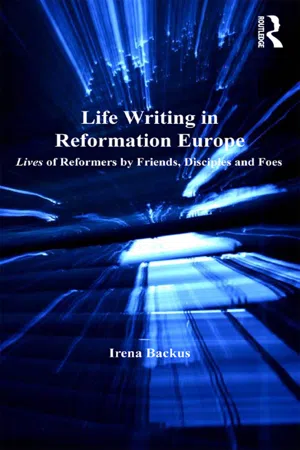
Life Writing in Reformation Europe
Lives of Reformers by Friends, Disciples and Foes
- 302 pages
- English
- ePUB (mobile friendly)
- Available on iOS & Android
eBook - ePub
About this book
The Reformation period witnessed an explosion in the number of biographies of contemporary religious figures being published. Whether lives of reformers worthy of emulation, or heretics deserving condemnation, the genre of biography became a key element in the confessional rivalries that raged across Europe in the sixteenth and seventeenth centuries. Offering more than a general survey of Life writing, this volume examines key issues and questions about how this trend developed among different confessions and how it helped shape lasting images of reformers, particularly Luther and Calvin up to the modern period. This is the first-ever full length study of the subject showing that Lives of the reformers constitute an integral part of the intellectual and cultural history of the period, serving as an important source of information about the different Reformations. Depending on their origin, they provide a lesson in theology but also in civic values and ideals of education of the period. Genevan Lives in particular also point up the delicate issue of 'Reformed hagiography' which their authors try to avoid with a varying degree of success. Having consistently been at the forefront of the study of the intellectual history of the Reformation Irena Backus is perfectly placed to highlight the importance of Life writing. This is a path-breaking study that will open up a new way of viewing the confessional conflicts of the period and their historiography.
Information
Chapter 1 Luther: Instrument of God or Satan's Brood. Main Developments in Luther Biography, 1546–81
DOI: 10.4324/9781315592381-2
Unlike the Lives of Calvin and Genevan reformers or the Zurich Lives, early attempts at writing a biography of the Wittenberg reformer, whether partisan or hostile, have been the object of a considerable amount of interest, especially among German church historians of the 1930s and 1940s. Among those, Herte's studies of Cochlaeus’ Commentaria deserve a special mention.1 To these we might add Volz's work on Mathesius.2 Over the past decade, a resurgence of interest in the questions of reception and memory as an important factor of history writing in the Reformation has prompted further publications on Luther's Lives, some of which have yet to appear.3 Of these more recently published works, Eike Wolgast's article on the early Lutheran biographies of Luther as attempts to establish the reformer's authority, Robert Kolb's study of Luther's image in the later phases of the Reformation, and Hans-Peter Hasse's article on Selnecker's Life of Luther deserve special mention, while bearing in mind that none of these deals with the Catholic side of Luther biography.4 We should also single out the first modern English translation with commentary of Melanchthon's Life of Luther and of Cochlaeus’ Commentaria on the Wittenberg reformer.5
My aim in this chapter is not to repeat what Herte, Volz, Hasse and others have said, but to review the orientation and diffusion of the better-known biographies of Luther so as to offer a point of comparison for the orientation and diffusion of the Genevan and Zurich Lives. This is particularly important as Luther's Lives, partisan or hostile, stayed firmly within national boundaries although they did tend to cross those more easily, if they happened to be either written in Latin or translated into Latin from the vernacular. The upshot of this was that while the Catholic image of Luther was the direct outcome of Franco-German collaboration and became, so to speak, fixed on the European level fairly early on and for many years to come, his Protestant image tended to be diverse, regional and not fixed at all, ranging from that of a saint to the symbol of the Augsburg Confession and the unifying factor of post-Lutheran Lutheranism. It was also, as we shall see, close to the medieval ideal of sainthood. While it would have been inconceivable for Beza or Colladon to preach sermons or even to give lectures on the life of Calvin, this mode of recounting Luther's life and struggles was extremely common among the Wittenberg reformer's Protestant biographers. Another striking feature of Luther's Lives as written by his fellow Lutherans was their tendency not to view Luther as an individual, but as an instrument of God or embodiment of a set of doctrines incarnating the Reformation. Thus while there is no doubt that Wolgast is correct in seeing the early Lutheran biographies of Luther as attempts at establishing his authority, it is also important to stress that they all see this authority as first and foremost God-given.6
Melanchthon: Luther as an Instrument of God
Compared to the Lives of Zwingli or Oecolampadius, which we shall examine further on, Melanchthon's portrait of Luther was less well defined. The reason for this is that Melanchthon broke to some extent with the antique models and with the model of Lives of the saints by making his hero an integral part of history. Judging by the speech that Melanchthon pronounced to his students on receiving news of Luther's death, the reformer was not seen by him as an ordinary man. Even allowing for the constraints of rhetoric, there is no question of describing Luther as a pious Christian, a hero or of having his death accompanied by miraculous portents, a concept which Melanchthon was otherwise not adverse to.7 The speech is taken up mainly with a graphic description of Luther's last illness, ‘an oppression of the humours in the stomach cavity’, and his final prayer, in which he commends himself entirely to God. Melanchthon's concluding words make it clear that, in contrast with the perfectly human complaint which killed him, Luther was not of the mortal realm, for ‘his doctrine of the remission of sins and faith in the Son of God was not the product of human intelligence but he was raised by God.’8 With its very conscious effort to insert Luther not just into history but into sacred history or eschatology, Melanchthon's Life follows loosely the Suetonian format and is divided into the following commonplaces: Luther's lineage, birth, early years and schooling; his life as professor; his first attempts at reforming theology; his controversy with Tetzel; his relationship with Elector Frederick; the progress of Luther's Reformation; his dislike of change and innovation; his liking of moderation. There follows an excursus on the four main developments of the Christian doctrine after the time of the Apostles, and another one on the necessity of Luther's Reformation. Of the two final sections, one is on Luther's writings and the other is a pia conclusio.
In short, Melanchthon uses the format to present not so much a portrait of Luther – the character as such possesses fewer personal traits than Fagius, Zwingli, Oecolampadius, or for that matter Calvin – as to show him to have been an instrument of God. Why in that case is it necessary to do a Suetonian-type biography at all? Would it not have been enough to write up Luther's providential workings without going into his lineage, his studies, and so on? Apparently not. It is therefore legitimate to conclude that Melanchthon wanted to show his students and other readers not just Luther's instrumentality, but also something of his human characteristics; in other words, he wanted to demonstrate what sort of man God chose to restore the church. This imposed enormous constraints on any personal portrait, reducing it to the necessary minimum. Thus Melanchthon begins by regretting that Luther died before he could put into operation his plan of writing up his own Life. His biographer finds this regrettable not because of the providential aspect of Luther's life, but because (apart from refuting calumnies) ‘a well-written account of his private life would have been useful, for it was full of examples which would have reaffirmed piety in good souls and a catalogue of many events which would have kept his memory alive for posterity.’9 Melanchthon thus announces what his biography is not: a biography in the sense of a chronological account of an individual's life. It is an account of Luther as instrument of divine providence, which also praises a selection of his extraordinary human qualities.
In other words, Luther, the exemplary human, is depicted by Melanchthon as possessing only those features of character which are of relevance to his divine mission. These happen to be his thirst for learning, and more particularly humanist learning. Melanchthon stresses his interest in rhetoric and the role of bonae litterae in his propaedeutic studies. Although Luther was condemned to study the ‘thorny dialectic of the time’ in Erfurt and although he found he had a gift for it, his mind, according to Melanchthon, ‘required much more and better.’ Therefore, he read authors such as Cicero, Virgil, Livy and others ‘not as a child would, just picking out words, but for instruction and as a mirror of human life’ seeking to apply their precepts. He thus became the object of admiration at Erfurt.10 This suggests that, in Melanchthon's view, the human God chose to implement His design should be extremely intelligent and imbued with classical learning and its moral values. The message here is the standard Christian humanist message: only classical learning can lead to the right understanding of the Bible, the implicit conclusion being that God could not have chosen a scholastic as his instrument.11 Indeed, Luther's biographer is very keen to stress that his hero entered the Augustinian order not to profit from scholastic learning and its methods, but for reasons of piety. This meant that he could treat scholastic learning as a parergon, or incidental, especially as he found it very easy. His principal concern was to ‘read avidly by himself the sources of celestial doctrine, in other words, the writings of the Prophets and the Apostles, so as to instruct his mind in God's will and to nourish fear and love by firm testimonies.’12 Thus Luther the man possessed humanist learning and was pious. What other human qualities did God require of his instrument? Very few. Although Melanchthon never denies his subject's personal merits and virtues, that is not what is important. Indeed, having made clear to his readers that Luther followed the humanist course of studies, there was nothing much (in Melanchthon's view) about Luther the man that he, Melanchthon, needed to write about. As he puts it himself,
Table of contents
- Cover Page
- Half-title Page
- Title Page
- Copyright Page
- Table Of Contents
- Introduction Biography and Religious Biography: Pagan and Christian Models, and What Happened to Them in the Reformation Period
- 1 Luther: Instrument of God or Satan’s Brood. Main Developments in Luther Biography, 1546–81
- 2 Lives of Chief Swiss Reformers: Hagiographies, Historical Accounts and Exempla
- 3 Zurich Lives in the Latter Part of the Sixteenth Century
- 4 Early Lives of Calvin and Beza by Friends and Foes
- 5 Post-Masson Views of Calvin: Catholic and Protestant Images of Calvin in the Seventeenth Century, or the Birth of ‘Calvinography’
- Concluding Remarks
- Bibliography
- Index
Trusted by 375,005 students
Access to over 1.5 million titles for a fair monthly price.
Study more efficiently using our study tools.
Frequently asked questions
Yes, you can cancel anytime from the Subscription tab in your account settings on the Perlego website. Your subscription will stay active until the end of your current billing period. Learn how to cancel your subscription
No, books cannot be downloaded as external files, such as PDFs, for use outside of Perlego. However, you can download books within the Perlego app for offline reading on mobile or tablet. Learn how to download books offline
Perlego offers two plans: Essential and Complete
- Essential is ideal for learners and professionals who enjoy exploring a wide range of subjects. Access the Essential Library with 800,000+ trusted titles and best-sellers across business, personal growth, and the humanities. Includes unlimited reading time and Standard Read Aloud voice.
- Complete: Perfect for advanced learners and researchers needing full, unrestricted access. Unlock 1.5M+ books across hundreds of subjects, including academic and specialized titles. The Complete Plan also includes advanced features like Premium Read Aloud and Research Assistant.
We are an online textbook subscription service, where you can get access to an entire online library for less than the price of a single book per month. With over 1.5 million books across 990+ topics, we’ve got you covered! Learn about our mission
Look out for the read-aloud symbol on your next book to see if you can listen to it. The read-aloud tool reads text aloud for you, highlighting the text as it is being read. You can pause it, speed it up and slow it down. Learn more about Read Aloud
Yes! You can use the Perlego app on both iOS and Android devices to read anytime, anywhere — even offline. Perfect for commutes or when you’re on the go.
Please note we cannot support devices running on iOS 13 and Android 7 or earlier. Learn more about using the app
Please note we cannot support devices running on iOS 13 and Android 7 or earlier. Learn more about using the app
Yes, you can access Life Writing in Reformation Europe by Irena Backus in PDF and/or ePUB format, as well as other popular books in Histoire & Histoire du monde. We have over 1.5 million books available in our catalogue for you to explore.