eBook - ePub
Identities and Allegiances in the Eastern Mediterranean after 1204
- 366 pages
- English
- ePUB (mobile friendly)
- Available on iOS & Android
eBook - ePub
Identities and Allegiances in the Eastern Mediterranean after 1204
About this book
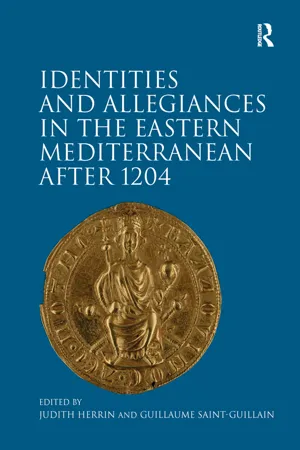
This volume of studies explores a particularly complex period in Byzantine history, the thirteenth century, from the Fourth Crusade to the recapture of Constantinople by exiled leaders from Nicaea. During this time there was no Greek state based on Constantinople and so no Byzantine Empire by traditional definition. Instead, a Venetian/Frankish alliance ruled from the capital, while many smaller states also claimed the mantle of Byzantium. Even after 1261 when the Latin Empire of Constantinople was replaced by a restored Greek state, political fragmentation persisted. This fragmentation makes the study of individuals more difficult but also more valuable than ever before, and this volume demonstrates the very considerable advances in historical understanding that may be gained from prosopographical approaches. Specialist historians of the Byzantine successor states of the period, and of their most important neighbours, here examine the self-projection and interactions of these states, combining military history and diplomacy, commercial and theological contacts, and the experiences and self-description of individuals. This wide-ranging series of articles uses a great diversity of sources - Arabic, Armenian, Bulgarian, Greek, Latin, Persian and Serbian - to exploit the potential of the novel methodology employed and of prosopography as an additional historical tool of analysis.
Chapter 1
Introduction
Defining Identities and Allegiances in the Eastern Mediterranean after 1204
This volume of studies is in many senses interdisciplinary. It marks the confluence of developments in medieval history, in the uses of prosopography, and in digital humanities. Each area has been influencing processes in the others, often barely perceptibly. This is an excellent moment to take stock of the situation, to assess the achievements of the past and sketch out proposals for the future.
The Backgrounds: Prosopography
In August 2006 the International Association for Byzantine studies held its 21st International congress in London, hosted by the society for the Promotion of Byzantine studies. This event brought about a thousand Byzantinists to London from all corners of the globe. On 24 august, at an evening reception at King’s college London, the local research team launched a major new resource in Byzantine Studies – the online Prosopography of the Byzantine World, covering the eleventh and twelfth centuries.
This project, sponsored by the British Academy, had a long history. The original inspiration was the heroic undertaking by Theodor Mommsen, to produce the Prosopographia Imperii Romani.1
That project was principally source-driven – that is, it was developed in response to the accumulation of a very large number of Latin career inscriptions in Mommsen’s major project, the Corpus Inscriptionum Latinarum. The evidence came from a definable political and geographic entity, the Roman Empire; the nature of the sources suggested limitation of the work to office-holders and members of the ruling class. These limitations made good sense within the historiography of the time, and made it feasible to publish the material in book form, although this has presented increasing problems for updating as archaeological activity has expanded, producing a regular flow of new inscriptions.
Mommsen had himself envisaged a further project, to cover the Later Roman Empire (from 284), which was undertaken by the French and British Academies after the second World War. Already the source materials were more varied, and accommodating the information was a greater problem. It was agreed that coverage should still be limited to the ruling classes; but the existence of very different categories of sources made it sensible to separate secular and ecclesiastical officials – the secular became the responsibility of the British Academy, while ecclesiastical officials were assigned to the CNRS in Paris. The Prosopography of the Later Roman Empire, 250–641, covering the secular officials, was published in book form, between 1972 and 1991. Several volumes covering ecclesiastical officials of various regions have also been published.2
By the late 1980s, when discussion of the next period began, it was clear that the future was electronic. It was also clear that electronic publication would allow far fuller coverage than in any earlier study. At the same time, historiography had evolved to be far more inclusive; the limitation to the study of a ruling elite might have been justified on purely practical grounds, but once the constraints of paper publication were removed, it no longer appeared acceptable. Work on the Prosopography of the Byzantine Empire, 641–867, began in the early 1990s at King’s College London. It collected information on all identifiable individuals within the Byzantine Empire in an exceptionally difficult historical period, during which the empire, and the medieval world of the Mediterranean area, were in a state of dramatic transformation. PBE was published in 2001 on a CD, but readable through a web-browser. While the project team had to deal with sources of every kind, what made the undertaking feasible was their relative scarcity.
The prosopography of the period 867–1025 was undertaken by the Berlin Academy and proceeds on paper.3 But the British Academy was responsible for the period 1025–1204, and was confronted with further developments, technological and intellectual. By the early twenty-first century it had become clear that electronic resources could not only be read using a web-browser, but could be published directly on the web. This further eliminated considerations of space; it again made possible (and so required) the inclusion of all identifiable individuals. The larger challenge was intellectual. A historiographical undertaking that had its origins in the conventional career descriptions of Roman imperial office-holders had had to accommodate a new hierarchy, in the church, and then a new approach, in recording individuals at every level. But at least until 867 it was possible to focus on ‘the Byzantine Empire’. For the eleventh-century material a new problem arose, as foreign individuals, who could not be described in any official relationship to the Byzantine Empire, came to play an increasing role in its history. For that reason it was agreed to rename the project, as the Prosopography of the Byzantine World.
Like all the preceding enterprises, this one also is determined by its sources. The list provided by the web publication makes it clear which ones have so far been analysed. In December 2002 the British Academy hosted a workshop specifically to examine the non-Greek sources for PBW in this period; the proceedings were published as Byzantines and Crusaders in Non-Greek Sources, 1025–1204,4 which is now available online.5 A further venture, funded by the Leverhulme Trust, studied several relevant Arabic sources, and the material from these, and from some Armenian materials, is being added to the web publication by experts in the fields. The nature of web publication also means that materials can continue to be added. PBW is therefore an analysis of a particular group of sources; it is envisaged that material will continue to be added from other sources from time to time, thereby resolving the problem of accommodating new analyses and new materials.
The Thirteenth Century
By 2006, therefore, the entire project had evolved into something very different from Mommsen’s original publication. Moreover, it was clear that the future would be even more different. While materials are still being added to the online resource, future planning has to be for perhaps the most complex undertaking of all: the provision of a prosopographical analysis of the period 1204 to 1261, when there was no Greek state based on Constantinople. Thus, by many definitions, there was no Byzantine Empire. Yet in 1204 the imperial role was claimed by the rulers of the Fourth Crusade, while many of the defeated Byzantines moved elsewhere to keep Byzantine organisms alive for rebirth, resulting in the creation of three (for a time four) Greek successor states. In 1261 the Byzantine Empire of Constantinople was re-established by the exiled leaders from Nicaea. The prosopography of that empire, from 1261 to 1453, has been covered by the Austrian Academy.6 What is far less clear is what had happened to Byzantium in the interim; where was Byzantium between 1204 and 1261? Who are the Byzantines of the thirteenth century that a Prosopography of the Byzantine World should study?
A further problem arises because the period as a whole is seriously understudied, even if parts have been the subject of scrupulous analysis. The fragmentation of the old Byzantine world is such that it is extremely difficult to find general questions that may be asked over the whole area: in Latin Constantinople, in Greek Nicaea, Epiros and Trebizond, on the Slavic and Turkish borders, in the Venetian colonies, in the Morea and Cyprus, where recent research has found signs of territorial protonationality, and on an Aegean island, perhaps ruled by a proto-capitalist Genoese trader and pirate. This fragmentation makes the careful study of individuals both more difficult and more valuable than ever before, as we follow their negotiations in such variety. Moreover, relationship to the Byzantine centres of power can prove a useful standpoint from which to open up the period to research, raising questions of legitimacy and legitimization, empire and other power structures, allegiances of all kinds, and religious, linguistic and cultural identities.
From the foundation of its capital in 330, the Byzantine identity was itself a complex one, based on political allegiance to an ill-defined Rome and a definite religious commitment to Orthodox Christianity, with an omnipresent Greek element, rooted in language, that was intensified among intellectuals educated in the ancient Attic Greek classics. Even the word, Byzantium, is problematic, never being used at the time as an imperial name, but only as a local way of referring to the city of constantinople. But its anachronistic status can be an advantage, as it holds together a portmanteau of associations that other names may oversimplify or distort. Byzantium was quintessentially an empire with a strong claim to universality and eternity and a centre in the New Rome of the city of constantine. after 1204, many of these elements were removed or profoundly redefined, temporarily or for ever, in the Latin Empire and other states with imperial ambitions. What was the character of the Byzantium that remained, and survived till 1261?
The Colloquium
Faced with this complex material, the project team decided to hold a colloquium, The Eastern Mediterranean in the Thirteenth Century: Building a Prosopographical Methodology of Identities and Allegiances. With the generous support of the British Academy this took place in March 2007. The aim was to bring together experts on the Byzantine world of the period (including the doubtfully Byzantine states inserted at and near its heart) together with its most important neighbours. They were asked to address the self-projection of the states/entities concerned, and their interactions, which are themselves to be found in the experiences and self-description of individuals.
crucial elements included many of the determinants of statehood at any period: control of territory, adoption and ceremonial use of symbols, names (self-projected and given by others), coins, the language of international diplomacy and legitimization by popular acceptance, both within the boundaries of the state under discussion and outside them. The last issue was of particular importance here, as in many areas the existence of a loyal Byzantine population has been hypothesized in areas of non-Greek rule, which have often preserved only restricted signs of them in the historical record. But in each case the nature of the sources will have a determining role, which must be regularly restated.
While the colloquium included contributions devoted to Islamic and papal sources, Jo van Steenbergen discovered that there was insufficient evidence to justify a publication of the Arabic material, and Christoph Egger decided not to publish his most interesting contribution on the papal documents of the period. Ruth Macrides, who had presented the sources from the empire of Nicaea at the colloquium, invited Vincent Puech to take her place in this volume, and Guillaume saint-Guillain, who agreed to act as co-editor, also contributed a new analysis of some of the copious Venetian material. cécile Morrisson, who had offered some fascinating observations about the coinage of the Latin emperors of constantinople in her concluding remarks, most generously agreed to expand them into a paper on metallic identities. In other respects the volume presents most of the material from the colloquium of March 2007.
One outcome of this event and the material published here, therefore, is a better understanding of how to study individuals, institutions and states in this complex period, where the death-throes of direct inheritance from Ancient Rome meet the first colonialist stirrings of European nationalism and capital in the West, and the formation and reformation of new and older states in the east. But we also see this discussion as having a more general application. The issues that it raises, of transitional and fluid ‘identities’, are not unique to this period, but simply far more obvious. In the past such fluidities have often been obscured by the format imposed by print publication, with its need to impose limits on any intellectual investigation. The era of electronic publication changes the situation; while any one enterprise must still operate within limits, those limits can offer an interface with other such enterprises. since the colloquium we have been involved in wide-ranging discussions as to how we can create structures and protocols to facilitate collaborative research along such boundaries. This volume demonstrates how enormously enriching it can be to cross over into ‘alien’ territory: we very much hope to encourage and facilitate such transgressions.
________________
Notes
1 See Werner Eck, ‘The Prosopographia Imperii Romani and Prosopographical Method’, in Averil M. Cameron (ed.), Fifty Years of Prosopography: The Later Roman Empire, Byzantium and Beyond (Oxford, 2003), pp. 11–22.
2 See John R. Martindale, ‘The Prosopography of the Later Roman Empire, Volume l: The Era of A.H.M. Jones’, in Cameron (ed.), Prosopography, pp. 3–10.
3 Ralph-Johannes Lilie et alii, Prosopographie der mittelbyzantinischen Zeit. Abteilung I: 641–867 (Berlin-New York, 1998–2002); in preparation: Prosopographie der mittelbyzantinischen Zeit. Abteilung II: 867–1025 (Berlin–New York: W. de Gruyter).
4 Mary Whitby (ed.), Byzantines and Crusaders in Non-Greek Sources, 1025–1204, Proceedings of the British Academy, 132 (Oxford, 2007; repr. 2008).
5 See http://www.britac.ac.uk/pubs/cat/pba.cfm, accessed 13 September 2010.
6 See Erich Trapp et alii, Prosopographisches Lexikon derPalaiologenzeit, vols 1–12 and two supplements (Vienna, 1976–90).
PART I
The Aftermath of the Fourth Crusade
Chapter 2
The Lost Generation ...
Table of contents
- Cover
- Half Title
- Title Page
- Copyright Page
- Table of Contents
- List of Contributors
- List of Maps
- List of Figures
- List of Tables
- 1 Introduction: Defining Identities and Allegiances in the Eastern Mediterranean after 1204
- Part I: The Aftermath of the Fourth Crusade
- Part II: On the Peripheries of Byzantium
- Part III: Western Interests
- Part IV: Conclusions
- Index
Trusted by 375,005 students
Access to over 1.5 million titles for a fair monthly price.
Study more efficiently using our study tools.
Frequently asked questions
Yes, you can cancel anytime from the Subscription tab in your account settings on the Perlego website. Your subscription will stay active until the end of your current billing period. Learn how to cancel your subscription
No, books cannot be downloaded as external files, such as PDFs, for use outside of Perlego. However, you can download books within the Perlego app for offline reading on mobile or tablet. Learn how to download books offline
We are an online textbook subscription service, where you can get access to an entire online library for less than the price of a single book per month. With over 1.5 million books across 990+ topics, we’ve got you covered! Learn about our mission
Look out for the read-aloud symbol on your next book to see if you can listen to it. The read-aloud tool reads text aloud for you, highlighting the text as it is being read. You can pause it, speed it up and slow it down. Learn more about Read Aloud
Yes! You can use the Perlego app on both iOS and Android devices to read anytime, anywhere — even offline. Perfect for commutes or when you’re on the go.
Please note we cannot support devices running on iOS 13 and Android 7 or earlier. Learn more about using the app
Please note we cannot support devices running on iOS 13 and Android 7 or earlier. Learn more about using the app
Yes, you can access Identities and Allegiances in the Eastern Mediterranean after 1204 by Guillaume Saint-Guillain, Judith Herrin,Guillaume Saint-Guillain, Judith Herrin, Guillaume Saint-Guillain in PDF and/or ePUB format, as well as other popular books in History & European Medieval History. We have over 1.5 million books available in our catalogue for you to explore.