- 286 pages
- English
- ePUB (mobile friendly)
- Available on iOS & Android
eBook - ePub
About this book
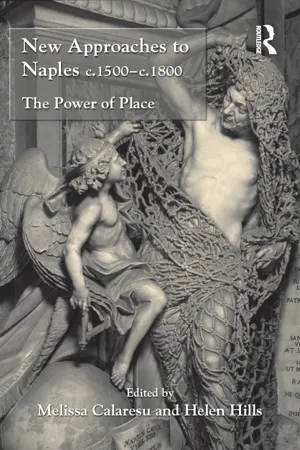
Early modern Naples has been characterized as a marginal, wild and exotic place on the fringes of the European world, and as such an appropriate target of attempts, by Catholic missionaries and others, to 'civilize' the city. Historiographically bypassed in favour of Venice, Florence and Rome, Naples is frequently seen as emblematic of the cultural and political decline in the Italian peninsula and as epitomizing the problems of southern Italy. Yet, as this volume makes plain, such views blind us to some of its most extraordinary qualities, and limit our understanding, not only of one of the world's great capital cities, but also of the wider social, cultural and political dynamics of early modern Europe. As the centre of Spanish colonial power within Europe during the vicerealty, and with a population second only to Paris in early modern Europe, Naples is a city that deserves serious study. Further, as a Habsburg dominion, it offers vital points of comparison with non-European sites which were subject to European colonialism. While European colonization outside Europe has received intense scholarly attention, its cultural impact and representation within Europe remain under-explored. Too much has been taken for granted. Too few questions have been posed. In the sphere of the visual arts, investigation reveals that Neapolitan urbanism, architecture, painting and sculpture were of the highest quality during this period, while differing significantly from those of other Italian cities. For long ignored or treated as the subaltern sister of Rome, this urban treasure house is only now receiving the attention from scholars that it has so long deserved. This volume addresses the central paradoxes operating in early modern Italian scholarship. It seeks to illuminate both the historiographical pressures that have marginalized Naples and to showcase important new developments in Neapolitan cultural history and art history. Those developments showcased here include bot
Disaster and Decline
Chapter 1
Myths of Modernity and the Myth of the City: When the Historiography of Pre-modern Italy goes South
John A. Marino
When Petrarch went to Naples to be examined by Robert the Wise (r.1309–43) before his coronation as poet-laureate in 1341 and when Boccaccio set the plot of The Decameron Day II, tale 5 ‘Andreuccio da Perugia’ after the Sicilian Vespers of 1282 in homage to his thirteen formative years in Naples (1327–41), these twin pillars of the Florentine Renaissance were acknowledging the moral and intellectual leadership in Italy of the Angevin king of Naples. Angevin Naples had been a papal investiture in 1265, which was created to replace the Hohenstaufen Holy Roman emperors in southern Italy after the contested succession following the death of Frederick II’s heir Conrad IV in 1254. This French cadet monarchy became a bulwark of the pro-papal, pro-French Guelph alliance against the centralized monarchical policy of the German imperialist Ghibelline party. With the defeat of Frederick II’s natural son Manfred at Benevento in 1266 and his grandson Conradin at Tagliacozzo in 1268, Guelph politics opened Angevin Naples to French Gothic forms of art with importation of French masters and craftsmen and commissions to Tuscan artists such as Giotto, Donatello and Michelozzo.1 A late medieval confluence of piety and aesthetics influenced both art and architecture (as attested by church construction in Naples from the beginning of Angevin rule – S. Lorenzo Maggiore, S. Domenico Maggiore, S. Chiara, S. Eligio, S. Maria Donnaregina and the Duomo), as well as literature and learning in the Neapolitan court.2
San Domenico Maggiore in Naples, a great Gothic structure built under Angevin patronage from 1283 to 1324, was the cornerstone of the Dominican monastic complex in the kingdom’s capital and also served as the seat of the University of Naples. San Domenico stands in the heart of the old city at the top of a large piazza around the corner from the seat of the noble city district of Nido, and was the neighbourhood church of such Nido noble families as the Carafa, d’Avalos, Brancaccio, Pignatelli, Spinelli and Orsini. It became the preferred church of the Neapolitan nobility in the Renaissance; in the second half of the fifteenth century, the Aragonese court made it their royal chapel. From 1494 Aragonese coffins were collected and stored there, where they remained neglected until the 1590s. High atop the armoires where the walls meet the vaulted ceiling in its sacristy, forty-five caskets of Aragonese royals and high noble retainers were restored, systematized and rededicated in 1594 under the patronage of Philip II (r. in Naples, 1554–98) as a royal pantheon for four generations of the Neapolitan Aragonese.3 These abandoned Aragonese sarcophagi held the remains of the heirs of Alfonso V, who in 1442 had taken the Neapolitan mainland from the Angevins. Now a century and a half later, asserting the unified Spanish monarchy’s continuity with and legitimacy of his Aragonese inheritance, Philip II reclaimed the deceased Aragonese conquerors as direct ancestors and founders of his Spanish imperial domains in the Mediterranean.
The Aragonese conqueror Alfonso had made the city of Naples the capital of a Mediterranean empire fuelled by trade led by Catalan merchants and bound by Aragón, Sardinia, Southern Italy and Sicily with title to Athens and Jerusalem. After a century of internal conflict and warfare following the death of Robert the Wise in 1343, Alfonso ruled the two Sicilies, the southern Italian mainland and the island of Sicily (Regnum Siciliae Citra et Ultra Farum), as separate kingdoms. Alfonso’s Neapolitan kingdom, however, was later split off from Aragón at his death in 1458 with his illegitimate son, Ferrante I (r.1458–94), succeeding him in Naples and his brother, John II (r.1458–79), father of Ferdinand the Catholic (r.1479–1516), in Sicily and the Aragonese possessions. But an independent Aragonese dynasty in Naples was to be short-lived; for, barely fifty years after Alfonso’s conquest, the French invasions of 1494 brought his Angevin rivals in the person of the king of France, Charles VIII (r.1483–98), back into Italy to conquer Naples. In Guicciardini’s ironic parody, Charles conquered even before he came and saw.4 The southern Italian Kingdom of Naples became the great prize tempting both France’s Louis XII (r.1498–1515) and the unified Spanish monarchy of Castile and Aragón under Ferdinand the Catholic and Isabella of Castile to return in 1499 and carve up the kingdom between themselves in the Treaty of Granada in 1500. Soon thereafter the Spanish expelled the French and established a 200-year viceroyalty beginning with their victory at Garigliano on 29 December 1503 and ending with the occupation of Naples by the Austrian Habsburgs in 1707 during the War of the Spanish Succession (1701–14).
I have evoked the haunting images of contested crowns, caskets and conquests in this well-known chronology in order to highlight the complex exchange and interaction between the Italian north and south, and between the Italian states and their neighbouring states in Spain, France and Germany. In order to integrate these actions and events into a unified history, we must reject viewing them from the vantage point of a single state or a single national tradition. We might best begin by asking a series of questions about two simple, but often misunderstood problems concerning the relationship between politics and culture in the period between the fourteenth- and seventeenth-century crises that bracketed the Renaissance in Italy. First, with regard to the origins of the conflicts, how and why were successor states in the Italian south conquered? Why did Angevin Naples collapse, the Aragonese successfully conquer Naples, the Italian Wars of 1494 bring an end to the Neapolitan Aragonese dynasty, the Spanish conquer Naples and, after almost a century of a pax hispanica, the Spanish in turn lose Naples? In other words, some may have won their battles, but who won the wars? Can the history of Naples move beyond its stereotype as an unstable kingdom in constant decline, its chronicle of conquests and revolutions, and its long-standing division into dynastic periods? Second, how does the oscillation between dynastic victory and defeat for the Kingdom of Naples relate to the idea of modernity, an interpretive concept associated with the Renaissance in Italy ever since 1860 when Burckhardt found the modern state and modern individualism personified in Frederick II?5 Or, to put it another way, why are politics so central to our understanding of Italian Renaissance culture? With all its wars, was there no Renaissance in Naples and the south? To answer these questions we must re-examine the contingency of events and understand how states were maintained or lost.
Recent scholarship has been de-centring the story of the Renaissance in Italy from a ‘tale of two [or sometimes three] cities’ – Florence, Venice and sometimes Rome – to a pan-Italian story grounded in three common registers: the control of property, production and labour; the exchange of people, goods and ideas; and local varieties of the evolving inheritance of Latin language, Roman law and the Latin Church.6 I propose here that this period, with all its brilliance and baggage, cannot be understood without emphasizing the ways in which northern and southern Italy were intimately related, not in terms of the dualism of the ‘two Italies’, but as integrated parts of economic, social, political and cultural systems based on similar rules and rituals constantly appropriating and assimilating products and peoples peninsula-wide, and how that equilibrium dramatically diverged at the end of the Renaissance during the seventeenth-century crisis. The history of northern Italy cannot be understood without the south, and southern Italy without the north. The role of the papacy is central to the story in its political conflicts with the German Holy Roman emperor and the French monarchy, while regional lords and internal factions sided with one or another of the contending parties – popes or anti-popes, emperors or kings – in their attempts to gain ascendancy over their rivals. For the Italian south, then, history is not a series of dynasties and conquests with one thing after another; rather, these bonds of exchange and conflict – the forming and breaking of solidarities – suggest the possibility of writing a unified history above the surface squabbles of the vying internal and external actors.
To ask, then, the first question, who conquered and controlled Naples, would be to return to the point of departure for Machiavelli in The Prince: how to gain and maintain a new state. Not by chance, writing in 1513 almost two decades into the Italian Wars following the French Invasion of 1494, Machiavelli frames his central argument around two examples presented at the beginning in Chapter 1 and repeated near the end in Chapter 24: Naples conquered by Alfonso V of Aragón in 1442 and Milan conquered by Francesco Sforza in 1450. In his characteristic binary logic, Machiavelli argues that the calamities of Italy derived primarily from the failure of Italian armies (for him, only citizen militias could restore Italian rule); or, if a state had strong armies, because the people and/or the nobility opposed their ruler. In Chapter 24, the first of his three concluding chapters, Machiavelli lays blame on the lack of virtù among Italy’s leaders:
Thus, these princes of ours, who have been in their principate for many years and subsequently lose it, should not blame fortune, but rather their own sloth, because they never thought during quiet times that things could change. (This is a common failing of men; they never take account of their affairs in the eye of a storm.) … The only good, certain, and durable defenses are those that depend on you yourself from your own virtù.7
Again Machiavelli repeats his key metaphor of imprinting form onto matter in the middle of Chapter 26, which I read to be addressing the Medici princes – the initial dedicatee, Giuliano (duke of Nemours), and after his death in 1516, the revised dedicatee, Lorenzo (duke of Urbino), but above all the unnamed head of the family, Giovanni (the newly elected Pope Leo X [r.1513–21]) – whom Machiavelli is exhorting to unite Italy and to whom he is ingratiating himself for employment:
And in Italy matter is not lacking on which to impress forms of every sort. There is great virtù in the limbs if only it were not lacking in the heads. You may see that in duels and combats between small numbers, the Italians have been much superior in force, skill, and inventiveness. But when it is a matter of armies, Italians cannot be compared with foreigners. All this comes from the weakness of the heads, because those who know are not obeyed, and with everyone seeming to know, there has not been up to the present time anyone who has known how to raise himself so high through both virtù and fortune that the others would yield to him.8
Machiavelli argues that the problem is not individual Italian arms, but Italian armies; armies have failed because of the lack of vigorous leadership, the absence in Italy not of men of virtù, but of the one man of virtù whom the others are willing to obey and accept as their leader.
Guicciardini similarly castigates the ‘ill-advised measures of rulers’ whose ‘foolish errors’ and ‘short-sighted greed’ led them to mistake ‘the frequent shifts of fortune’, abuse their power and ‘become the cause of new perturbations either through lack of prudence or excess of ambition’ that shattered his idealized portrait of a tranquil paradise before 1494.9 For Guicciardini, while our problems may be determined by the stars, their cause lies in ourselves, especially in those powerful rulers among us who have subverted the common good for their own advantage. David Abulafia has shown, however, that Guicciardini’s history is not always an accurate one. The portrait of the weak and imbecilic Charles VIII is a gross mischaracterization, as are those flattering reveries of Lorenzo de’ Medici and distortions of Ferrante I of Naples.10 Later, after a description of French misrule upon their conquest of Naples in 1495, the caprice of the Neapolitan nobility whom the French disadvantaged and the recall of the Aragone...
Table of contents
- Cover Page
- Dedication
- Title Page
- Copyright Page
- Contents
- Illustrations
- Colour Plates
- Notes on Contributors
- Acknowledgements
- Introduction: Between Exoticism and Marginalization: New Approaches to Naples
- PART I DISASTER AND DECLINE
- PART II TOPOGRAPHIES
- PART III EXCEPTIONALITY
- Select Bibliography
- Index
Trusted by 375,005 students
Access to over 1.5 million titles for a fair monthly price.
Study more efficiently using our study tools.
Frequently asked questions
Yes, you can cancel anytime from the Subscription tab in your account settings on the Perlego website. Your subscription will stay active until the end of your current billing period. Learn how to cancel your subscription
No, books cannot be downloaded as external files, such as PDFs, for use outside of Perlego. However, you can download books within the Perlego app for offline reading on mobile or tablet. Learn how to download books offline
Perlego offers two plans: Essential and Complete
- Essential is ideal for learners and professionals who enjoy exploring a wide range of subjects. Access the Essential Library with 800,000+ trusted titles and best-sellers across business, personal growth, and the humanities. Includes unlimited reading time and Standard Read Aloud voice.
- Complete: Perfect for advanced learners and researchers needing full, unrestricted access. Unlock 1.5M+ books across hundreds of subjects, including academic and specialized titles. The Complete Plan also includes advanced features like Premium Read Aloud and Research Assistant.
We are an online textbook subscription service, where you can get access to an entire online library for less than the price of a single book per month. With over 1.5 million books across 990+ topics, we’ve got you covered! Learn about our mission
Look out for the read-aloud symbol on your next book to see if you can listen to it. The read-aloud tool reads text aloud for you, highlighting the text as it is being read. You can pause it, speed it up and slow it down. Learn more about Read Aloud
Yes! You can use the Perlego app on both iOS and Android devices to read anytime, anywhere — even offline. Perfect for commutes or when you’re on the go.
Please note we cannot support devices running on iOS 13 and Android 7 or earlier. Learn more about using the app
Please note we cannot support devices running on iOS 13 and Android 7 or earlier. Learn more about using the app
Yes, you can access New Approaches to Naples c.1500-c.1800 by Helen Hills, Melissa Calaresu in PDF and/or ePUB format, as well as other popular books in History & Early Modern History. We have over 1.5 million books available in our catalogue for you to explore.